
Published
2026-07-04
2026-07-04 intelligence examines articles connected by the same Published, giving readers a fuller path through public reporting, evidence quality, market context, and infrastructure consequence. The page links the subject to relevant organisations, people, regions, signal types, governance exposure, operating dependencies, service-continuity pressure, customer risk, and capital or regulatory implications rather than presenting a short list of matching articles. It explains what the classification covers, why the pattern matters, which public sources support the recurring signal, and how readers should compare developments as the evidence base changes. Operators, investors, customers, analysts, and policy readers can use the page to understand where a theme is concentrated, which actors may be exposed, and which follow-up questions deserve closer review before treating the signal as durable.

Europe and Middle East National Telecom
Vodafone España and the price of making a Spanish mobile-and-fibre asset work
For Zegona, Vodafone España is not a rescued trophy brand. It is a live test of whether a mature telecom operator can rebuild cash generation in one of Europe's most price-sensitive converged markets while renting, sharing and refinancing more of the network estate beneath the…

Latin America and Caribbean National Telecom
WOM and the cost of keeping Chile's challenger network credible
WOM forced Chile's mobile market to price more aggressively, but the post-restructuring test is harder than the launch story: after debt repair, 5G obligations, tower sale-leasebacks and fibre substitution, the company has to prove that a lower-cost challenger can still be…
North America Regional ISP
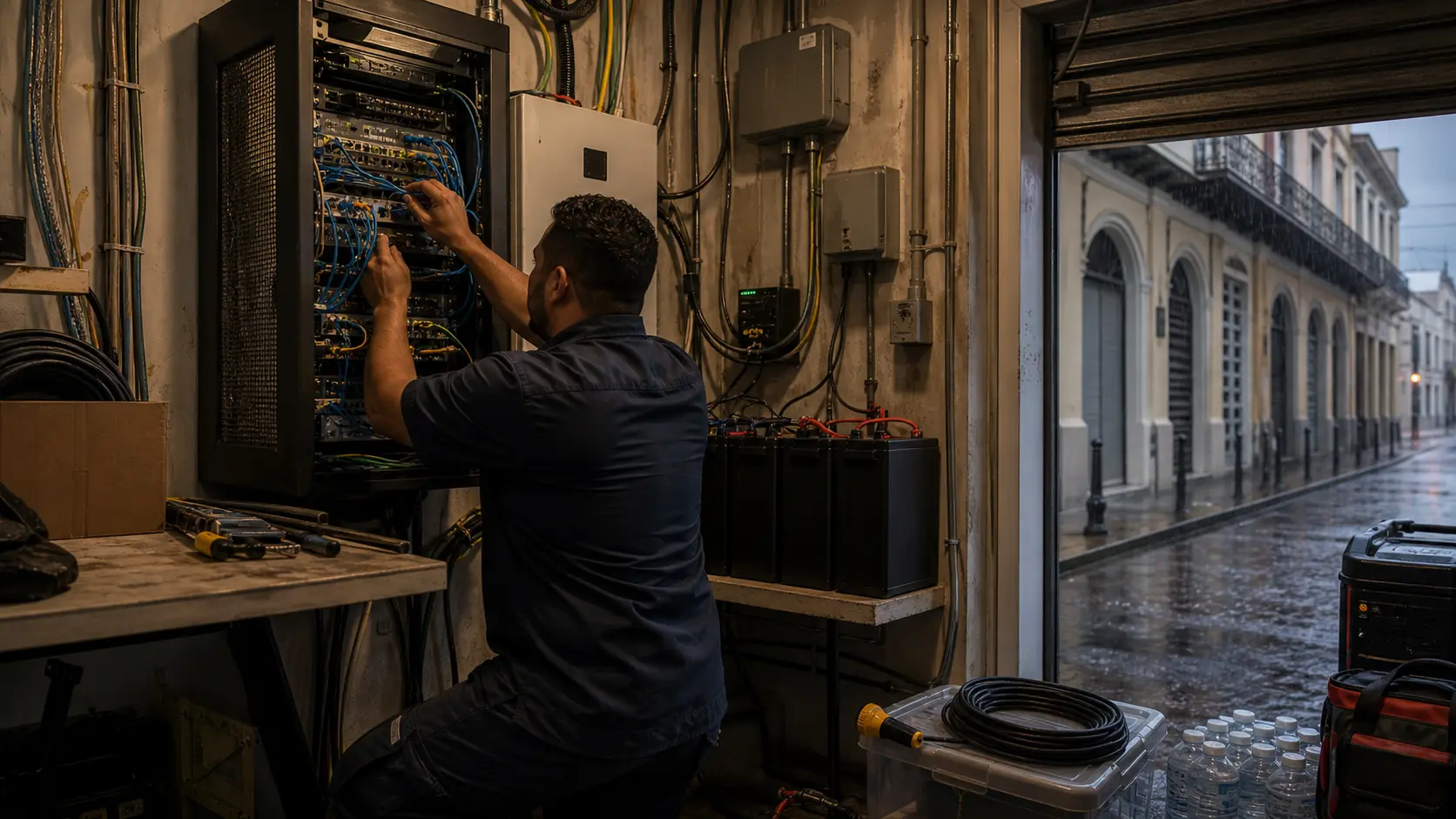
WorldNetPR and the Premium for Staying Open When Puerto Rico Goes Dark
For Puerto Rico businesses, WorldNetPR is not just another broadband option in a price table. Its economic role is clearest before hurricane season, when a buyer weighs the cheap line that works on a calm day against the more expensive circuit, support desk, route diversity and…

Africa Regional ISP
Wan4u and the repair bill behind ordinary broadband trust
Wan4u looks small beside South Africa's national fibre and mobile brands, but its economics show why regional broadband trust is expensive to maintain. The company has to turn line-of-sight wireless, open-access fibre resale, backup power, field repair, upstream capacity and…

Asia-Pacific Regional ISP
Wistel Teknologi Solusi and the local trust premium in Indonesian business internet
Wistel Teknologi Solusi is small enough for local trust to matter and network-visible enough for its economics to be tested in public routing data. Its wager is that Indonesian SMEs, campuses and local institutions will pay for managed connectivity when the provider can answer…

North America Cloud Services
Wowrack and the Margin Left After Hyperscale Becomes the Default
Wowrack is a Seattle-born hosting and managed-infrastructure company whose remaining advantage is not that private cloud beats public cloud in the abstract. It is that certain buyers still pay for physical proximity, support labor, compliance comfort, network control and…

Asia-Pacific National Telecom
XLSmart and the cost of making Indonesia's merged radio network pay
XLSmart was created to turn Indonesia's mobile market from a crowded price fight into a three-operator scale contest. The hard question is whether the combined XL Axiata-Smartfren radio estate can produce enough ARPU repair, tower savings, spectrum efficiency and…

North America Cloud Services
Whatbox SG and the price of a specialist box when cheap cloud is everywhere
Whatbox SG shows a small but revealing corner of the hosting economy: customers can rent cheap compute, cheap object storage and cheap virtual servers almost anywhere, yet some still pay a specialist to run a storage-heavy, streaming-ready, abuse-managed box with predictable…

Asia-Pacific Regional ISP
WheroNet and the rural price of staying connected
WheroNet shows why rural broadband economics are not only about speed. In north Waikato and South Auckland edge communities, the monthly bill buys terrain work, field maintenance, backhaul discipline and local support as much as it buys Mbps.

Europe and Middle East Regional ISP
The EUR 16 access line and the basement visit: WicitY's local ISP arithmetic
In Italy, fibre can be bought wholesale by the line and sold retail by the bundle. WicitY's problem is everything between those two numbers: the apartment riser, the FWA roof path, the shop router, the support call and the local memory that national offers do not price…

Latin America and Caribbean Regional ISP
Wanhouse Soluções em Tecnologia and the support cost hidden inside cheap neighbourhood fibre
In Brazil's crowded broadband market, the cheapest fibre plan is not only a price. For a regional operator such as Wanhouse Soluções em Tecnologia, it is a promise that every apartment riser, street pole route, WhatsApp message, backhaul hop and second technician visit can be…

Africa National Telecom
Angola Cables and the hard price of a South Atlantic shortcut
Angola Cables owns one of the most interesting routing bets in the Atlantic: a path that can make Africa-to-Brazil traffic feel local, but only if wholesale buyers believe the cable, data-centre and interconnection stack is worth paying for despite Angolan currency, power…

Asia-Pacific National Telecom
Bangladesh Submarine Cables PLC IX and the Price of Keeping National Internet Growth Offshore
A Bangladeshi operator buying evening-peak international capacity is not only choosing a supplier. It is deciding how much of the country's digital growth should depend on state cable capex, regulated wholesale prices, terrestrial routes through India, local exchange density and…

Asia-Pacific Datacenter
QTS Hong Kong and the Scarcity Price Behind a Gateway Data-Centre City
A financial platform choosing between Hong Kong, Singapore and Tokyo is not buying a generic rack. It is buying milliseconds, legal comfort, cloud reach, China adjacency and proof that a constrained city can keep power, land and operating discipline available when everyone else…

Europe and Middle East Datacenter
NorthC Germany and the Local Premium in European Data Centres
A German manufacturer, hospital group or municipal IT buyer no longer asks whether cloud is available. It asks whether nearby colocation still earns a premium over hyperscale capacity, low-cost German cloud and cheap virtual machines. NorthC Germany is a useful test case because…

Africa Datacenter
iColo and the East African Colocation Spread
iColo's useful question is not whether Kenya needs data centers. It is whether Nairobi demand, Mombasa cable gravity and Digital Realty capital can make East African carrier-neutral colocation cheaper and more reliable than sending too much regional traffic, enterprise risk and…

Latin America and Caribbean Datacenter
Equinix Managed Services Brazil and the price of being local in Sao Paulo's cloud economy
Equinix Managed Services Brazil is not interesting because it is a small cloud hidden inside a large data-centre company. It is interesting because Brazil's payments, SaaS and enterprise buyers increasingly need three things at once: Brazilian locality, private access to global…

Asia-Pacific Datacenter
Lightstorm and the fibre bargain behind India's AI racks
An Indian enterprise AI workload does not become real when a server is ordered. It becomes real when powered racks, metro fibre, cloud on-ramps, data-centre interconnect and a renewal-safe network contract all line up at the same time.

Europe and Middle East Datacenter
DATA4 Luxembourg and the Price of Sovereign Locality
A Luxembourg rack premium is not paid for romance about small countries. It is paid when a regulated buyer can turn locality, legal certainty, power, connectivity and exit control into lower operational risk than the larger data-centre markets around it.

Asia-Pacific Datacenter
Micron21 and the Australian control premium
An Australian SaaS or security buyer comparing Micron21 with hyperscale cloud is not just comparing compute prices. The real choice is whether audited local colocation, hands-on Melbourne support, DDoS protection and infrastructure control are worth a premium when public cloud…