
Asia-Pacific Institutional Trends
Asia-Pacific Institutional Trends
Institutional trend intelligence tracks institutional market trends, regulatory pressure, standards activity, public-sector digital policy, governance reform, and infrastructure funding in Asia-Pacific, giving readers a fuller view of the demand shifts, capacity constraints, platform strategies, capital timing, regulatory pressure, and operating assumptions behind the market.

Latest Coverage
Latest from Asia-Pacific Institutional Trends
223 articles

Asia-Pacific Institutional Trends
AER Opens a Ten-Business-Day Test of Australia’s Four-Year Return Formula
A new AER consultation asks how to weigh evidence behind two draft inputs for regulated energy networks. An independent panel questioned the reasoning, not the proposed values, and the regulator’s own analysis shows why one falling model estimate is easy to misread.

Asia-Pacific Institutional Trends
APRA Floats a 20–30% Ceiling for Concentrated Super Investments
Australia’s prudential regulator wants superannuation trustees to decide which investment options create a concentration risk and to limit how much an individual member can put into them. The proposed ceiling is still a consultation position; members would continue to carry…

Asia-Pacific Institutional Trends
NSW’s Lobbying Reforms Put Two Regulator Models in Play
A government package would keep the NSW Electoral Commission at the centre of oversight, while a private member bill proposes a new Lobbying and Integrity Commission. Their different scopes make institutional design—not the shared promise of stronger scrutiny—the decisive…

Asia-Pacific Institutional Trends
Tasmania’s New Child Commission Keeps Regulator Powers in a Separate Legal Role
The 8 October launch brought children’s-rights advocacy and safety oversight under one agency, while statutes preserve the Regulator’s independent decision-making and leave a possible combined office uncommenced.

Asia-Pacific Institutional Trends
Australia’s proposed power-contract mechanism needs a credible exit test
Australia’s draft Electricity Services Entry Mechanism would turn long-range reliability and emissions goals into contracts whose costs flow through the National Electricity Market. The design question is not only how to finance new supply, but what evidence would let the…

Asia-Pacific Institutional Trends
What a 115% Ratio in Australia’s Telco Data Really Measures
A regulator’s comparison of TIO referrals with provider complaints can exceed 100 per cent. That does not mean more than every customer escalated; it means the two published complaint counts are not a matched customer cohort.

Asia-Pacific Institutional Trends
Australia's Telco Code Is Moving Toward a Regulator-Written Standard
ACMA has opened consultation on a draft that would replace the industry-developed 2019 consumer code with a directly enforceable standard. The proposal would move rulemaking closer to the regulator and put named executives, records and sales incentives inside the compliance…

Asia-Pacific Institutional Trends
AEMO’s draft separates seeing flexible demand from dispatching it
AEMO’s consultation proposes graduated ways to observe price-responsive resources, with more formal participation only if evidence shows that visibility alone is not enough. The distinction matters because forecasting a response can itself alter the price signal that prompts it.

Asia-Pacific Institutional Trends
Singapore sees enough AI compute now, but not a forecast
Two parliamentary replies separate today's market signal from tomorrow's infrastructure plan: industry feedback points to adequate supply now, while future compute demand remains difficult to project.

Asia-Pacific Institutional Trends
ASEAN’s Cable-Repair Clock Still Runs Through National Gates
The enhanced ASEAN submarine-cable guidelines give governments and operators a clearer regional playbook. Their familiar seven-to-ten-working-day permit target, however, was already in the 2019 version—and the 2026 text still qualifies it as a goal “where possible,” subject to…

Asia-Pacific Institutional Trends
Singapore’s Passed Infrastructure Bill Sets Three Different Licensing Tests
Parliament passed Singapore’s Digital Infrastructure Bill on 7 October. Its three numerical tests measure different things: data-centre capacity, the reach of a facility service, and cloud revenue tied to Singapore users.

Asia-Pacific Institutional Trends
Z.AI raises $5bn through shares and bonds
Z.AI raised $5bn through shares and zero-coupon convertible bonds due in September 2027 to fund model development and expansion.

Asia-Pacific Institutional Trends
China Merchants Bank logs 13.88m AI-equivalent hours
China Merchants Bank says token throughput rose more than 78% as it measures AI use against the work delivered.

Asia-Pacific Institutional Trends
ASML gains broader backing for High NA tools
ASML's High NA tools are gaining customers, but their economics will be decided on the production line rather than by the machine price alone.
Asia-Pacific Institutional Trends
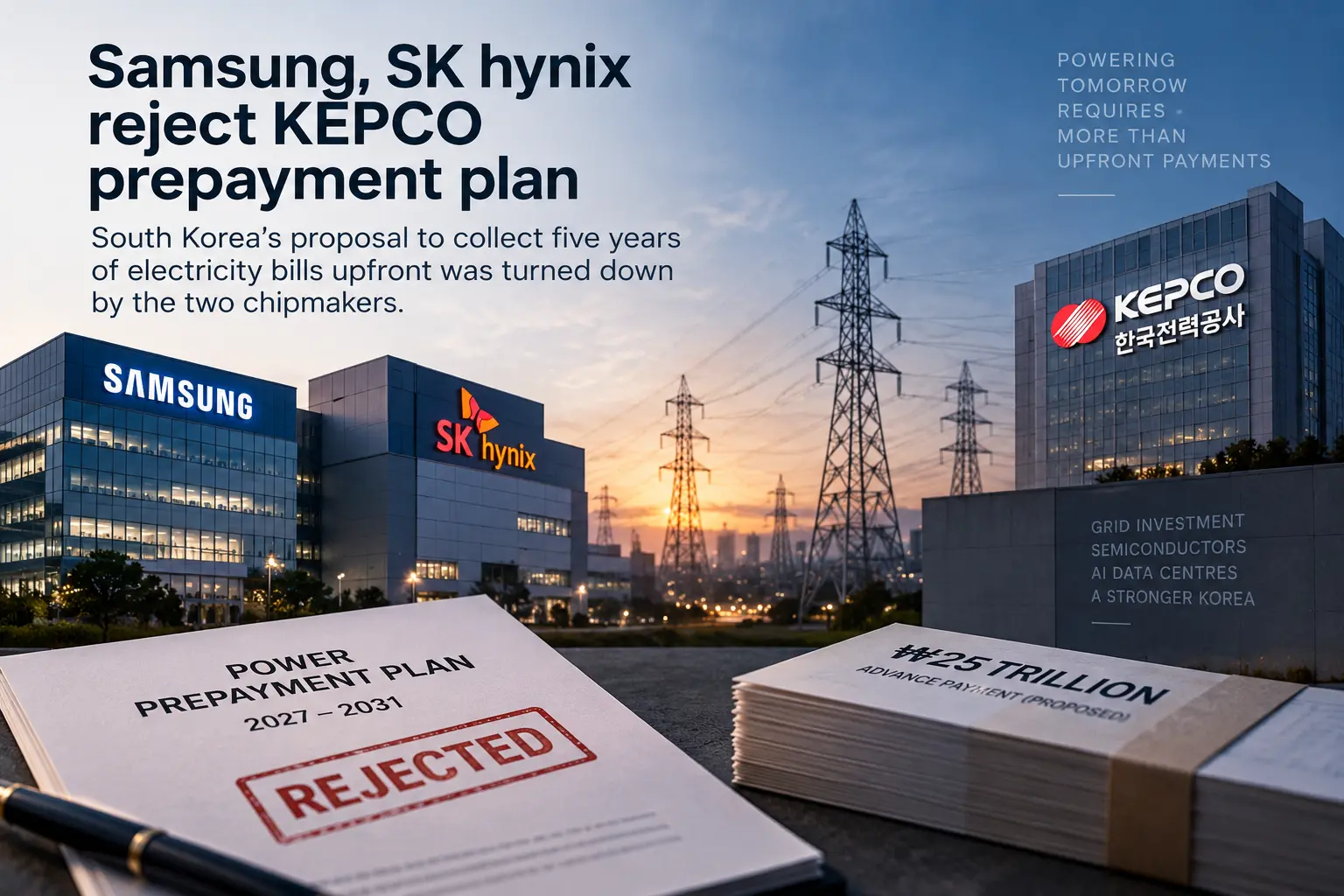
Samsung and SK hynix reject KEPCO power prepayment plan
KEPCO wanted future electricity bills to help fund grid construction now, but Samsung and SK hynix rejected a proposed 25 trillion won advance.

Asia-Pacific Institutional Trends
Samsung backs ASML High NA for 2028 DRAM
Samsung plans to use ASML's High NA lithography in volume DRAM production from 2028, while a separate larger-mask programme remains years away.

Asia-Pacific Institutional
NICT reports incorrect timestamps from public time servers
NICT says part of its public time service sent incorrect timestamps for 11 minutes, putting the focus on whether connected systems accepted the wrong time.

Asia-Pacific Institutional Trends
South Korea chip exports jump 270% in early September
South Korea’s chip exports surged 270% in early September, lifting semiconductors to nearly half of total export value.

Asia-Pacific Institutional Trends
Micron offers Taiwan staff rewards as union talks continue
Micron announced new Taiwan staff rewards while union talks remained unresolved, with no confirmed production or delivery disruption.

Asia-Pacific Institutional Trends
ARC–Firstborn’s $1 Billion Price Is a Floating Share Count
Firstborn Top Capital’s sellers cannot know their final ARC share count from the transaction announcement, and they may not know it at closing. The contract first adjusts a US$1 billion base for debt, working capital and unpaid deal compensation, then divides the result by the…