
Summary
- What it says: In Italy, fibre can be bought wholesale by the line and sold retail by the bundle.
- Main topic: Regional ISP economics; Network-resource evidence; Wholesale access economics
- Context: market / company research report / Italy; Salento; Puglia; national Italian wholesale access market
A EUR 26.90 promise in a EUR 16 input market
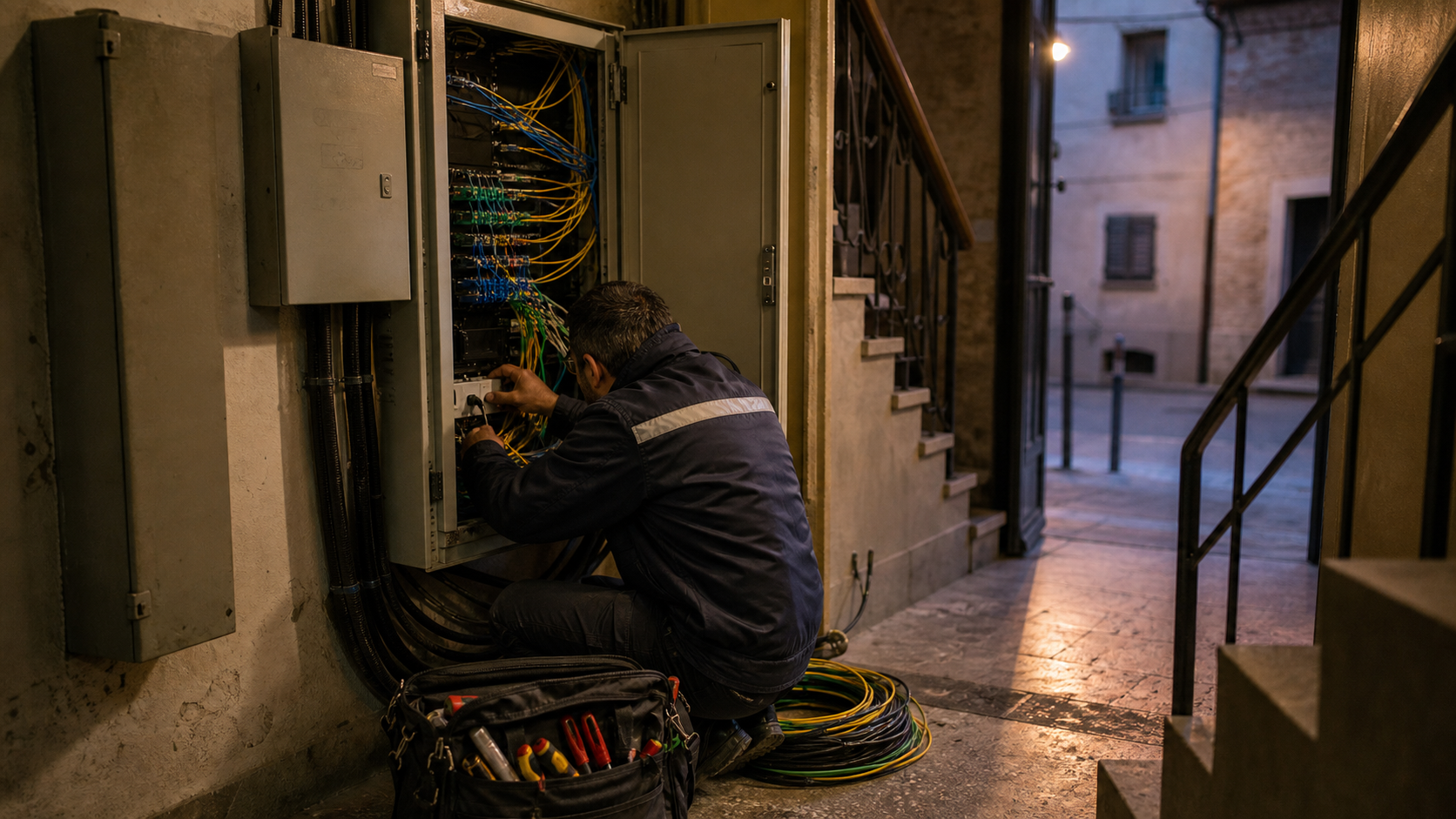
In a Lecce apartment block, the broadband decision does not begin with a technology-neutral map. It begins in the basement, beside the fibre cabinet, with a landlord asking whether another cable can pass through a cramped riser, a neighbour asking whether the technician actually came, a family comparing a national fibre-and-mobile bundle on a phone screen, and the accountant on the ground floor asking whether the line will be stable before payroll day. The national operator has the advantage of scale: it can sell fibre, mobile, modem, streaming add-ons and discount mechanics as one retail story.
The local provider has to answer the less glamorous question. Who knows this building, this cabinet, this router, this antenna path and this support history when the connection fails?
That is the right place to start WicitY. The company identifies itself as WicitY s.r.l., based at Via San Nicola 68, Vernole, in the province of Lecce, with VAT number 03991990759, REA 259927 and share capital of EUR 21,000 (https://www.wicity.it/trasparenza-tecnica/). Its own "Chi Siamo" page says the ISP was born in Salento in 2006, later expanded nationally, and provides ultra-broadband connectivity over Fttx, xDSL and dedicated fibre, with symmetric and guaranteed bandwidth up to 10 Gbps (https://www.wicity.it/chi-siamo/). Public company-data pages add a useful scale marker: one registry-style source reports 2024 revenue of EUR 1,300,709, profit of EUR 79,746 and 9 employees in 2026, while warning that users should go to official company-register extracts for fully current commercial information (https://www.ufficiocamerale.it/2220/wicity-srl). This is not the balance sheet of a national incumbent. It is the scale of a small operator trying to make local trust pay inside a market where the access line itself is being commoditised.
The hard price reference is visible on WicitY's own site. Its homepage advertises FTTH from EUR 26.90 per month up to 2.5 Gbps, FTTCab from EUR 26.90 up to 200 Mbps, FWA from EUR 18.90 up to 100 Mbps, a private-home entry point from EUR 26.90 and business internet from EUR 29.90 (https://www.wicity.it/). The uncomfortable fact is that those prices do not sit far above the national retail floor. Iliad's tariff-transparency page shows fibre entries around EUR 25.99, or EUR 21.99 with a mobile advantage, for named 2026 offers (https://www.iliad.it/trasparenza-tariffaria-fibra.html). Vodafone's public fibre page shows the converged-bundle pressure even more directly: a fixed line can be presented at EUR 23.95 per month when paired with a mobile SIM, while other home offers sit at higher price points (https://privati.vodafone.it/casa/fibra). TIM's home-fibre page puts the reference price in the same broad band, with the subscription moving to EUR 31.90 per month under one stated condition after an online promotion period (https://www.tim.it/fisso-e-mobile/fibra-e-adsl/fibra-internet-casa).
The input side is just as revealing. Open Fiber's white-area wholesale list shows OpenStream FTTH access at EUR 16 per month across 100 Mbps, 1 Gbps and 2.5 Gbps profiles, with activation or migration at EUR 43.78, disactivation at EUR 33.01, first-connection charges split between a EUR 110 one-time item and EUR 1.70 monthly charge, and OpenStream FWA access at EUR 13.70 or EUR 14.90 per month with activation at EUR 118.68 (https://openfiber.it/app/uploads/2025/12/Aree-Bianche-Listino-Servizi-C-e-D_250630.pdf). That is not WicitY's private contract and it is not a clean gross-margin calculation because product scope, VAT treatment and area context differ. It still gives the right public arithmetic. Between a visible EUR 26.90 retail FTTH offer and a EUR 16 wholesale FTTH benchmark sits a nominal EUR 10.90 before the provider has paid for backhaul, routing, router handling, support, billing, failed visits, churn and the time needed to make the customer feel connected.
AGCOM's market data explains why the pressure is rising. Its September 2025 monitor reports 8.52 million FTTC accesses, 6.74 million FTTH accesses and 2.56 million FWA accesses; year on year, FTTC fell 8.4 percent, FTTH rose 22.0 percent and FWA rose 11.5 percent (https://www.agcom.it/sites/default/files/media/allegato/2026/AGCOM_Osservatorio%20n4-2025_EN.pdf). The market is not simply waiting for fibre. It is actively moving from copper to fibre while wireless access also grows as a substitute in places where fixed deployment remains inconvenient or late. WicitY is therefore selling into a market where the customer has more credible alternatives every year: national FTTH where the building is easy, national FWA or mobile fallback where the line is not, and local rivals where the buyer wants a nearby support desk.
The pressure is local, not only national. Open Fiber said its Italy 1 Giga work in Spongano, in the province of Lecce, would cable more than 2,900 civic numbers corresponding to more than 3,000 property units (https://openfiber.it/media/comunicati-stampa/fibra-ottica-spongano/). Rai's Puglia service later reported Open Fiber work across Brindisi, Lecce and Taranto provinces, with more than 213,000 civic numbers connected across 116 municipalities (https://www.rainews.it/tgr/puglia/articoli/2026/04/open-fiber-banda-ultralarga-completata-in-116-comuni-del-salento-6b6409f2-94f5-4257-a6f2-e9208ed43376.html). Those figures are not WicitY coverage data. They show the overbuild environment into which a Salento operator must sell local memory. Every newly lit street narrows the room for vague locality claims.
The economic mechanism is the spread between the public access number and everything that happens in the building. Wholesale reach may make national coverage possible, but a local ISP still carries acquisition cost, order handling, router logistics, support calls, field visits, landlord friction, failed appointments, customer education, churn, payment risk and the cost of being remembered when something breaks. In a dense Italian city, the household can switch for a lower bundle.
In a Salento town, rural lane or SME site, the buyer may value a provider that remembers the cabinet, the antenna path, the old copper problem, the local power issue, the router model and the person who will answer. WicitY's commercial question is whether that memory can be monetised before national fibre, mobile substitution and wholesale overbuild turn it into a free expectation.
The apartment-block scene is therefore not just colour. It is the unit economics. A national operator may have automated ordering power, large call-centre capacity and a brand that reassures tenants. A local operator may know which addresses are awkward, which rooftops have workable FWA paths, which basements hide the fibre distribution point and which SME cannot tolerate a week of unresolved packet loss. But that knowledge is costly because it sits in people, not software alone. It is earned through visits, tickets and informal memory.
If WicitY's EUR 26.90 residential FTTH or EUR 29.90 business access becomes indistinguishable from a national bundle, the local economics degrade. If customers believe local response, IP know-how, dedicated fibre options and FWA fallback make the difference between broadband as a commodity and broadband as a working service, the local provider still has a margin to defend.
Salento roots, national reach, limited scale
WicitY's identity is strongest when treated as a Salento-rooted ISP with a national access promise, not as a mini-incumbent. The company page is explicit about that mix. It says WicitY was born in Salento and later extended its operations at national level, while preserving direct relationships with productive districts and local customers (https://www.wicity.it/chi-siamo/). Its public contact page reinforces the operating surface: commercial information at 800.036.424, technical and administrative assistance at 0832.183.0632, working hours from Monday to Friday, and role-specific email contacts for support, sales, resellers and jobs (https://www.wicity.it/contatti/). This is not a faceless national-retail posture. It is a small-provider posture that asks customers to believe the organisation can be found.
The company also gives a clear regulatory and network self-description. Its "Chi Siamo" page lists general authorisation for electronic communications networks, ministerial authorisation number 3874 for telecom services, R.O.C. registration number 23450, OLO licence number 173, Autonomous System AS59766, Namex Rome and Bari membership, RIPE NCC membership, MANRS membership and partnerships with TIM Wholesale, Open Fiber and Fastweb (https://www.wicity.it/chi-siamo/). Those claims need to be read carefully. They do not mean WicitY owns a national fibre network comparable to a wholesale access giant. They mean WicitY presents itself as a licensed Italian operator with enough access relationships, numbering, routing and interconnection evidence to be more than a simple comparison-site reseller.
The company's LinkedIn profile adds a useful historical clue, though it should be treated as a company-controlled channel rather than independent proof. It says WicitY was the first wireless ISP in Salento to provide data, voice and internet transport using wireless technologies; it describes the original goal as countering digital divide conditions in areas where broadband access was weak; and it says the company invested in a proprietary BWA network based mainly on wireless and fibre (https://it.linkedin.com/company/wicity-srl). That matters because the current economic problem is not only FTTH. WicitY comes out of a market where the customer problem was often "no decent line reaches me", not "which national gigabit bundle is cheapest this month." The shift from scarcity to overbuild changes the value proposition.
The service mix shows the same transition. WicitY's internet page says it operates throughout Italy through investments and agreements with major international carriers, providing Fttx, xDSL and "pregiata" optical fibre with symmetric and guaranteed speed up to 10 Gbps (https://www.wicity.it/internet/). Its FAQ says the company offers FTTH up to 2.5 Gbps, FTTC and Himax FWA, and also designs dedicated fibre circuits with diversified paths and automated backup systems in underserved areas (https://www.wicity.it/faq/). The commercial identity is therefore hybrid: mass-market access for homes, small-business broadband, FWA for gaps in fixed-network coverage, VoIP, PBX, Wi-Fi coverage, security and dedicated fibre for customers whose revenue depends more directly on uptime.
That hybrid identity can be an advantage, but only if customers understand what they are paying for. A household may only see a monthly price and a headline speed. An SME may see a broader operating contract: internet, voice, router, public IP, troubleshooting, backup and someone responsible for the handoff. WicitY's dedicated-fibre page tries to make that distinction. It describes point-to-point optical circuits from the nearest WicitY exchange to the customer site, preliminary feasibility studies, symmetric dedicated service up to 10 Gbps, high guaranteed bandwidth, low latency, public static IP and specialised internal support (https://www.wicity.it/fibra-dedicata/). It also describes optional diversified routes, backup lines with automatic failover and 24/7 proactive monitoring. That is where the local provider can escape pure household-price comparison.
Scale remains the constraint. A small revenue base means every van roll, radio site, customer-premises problem, routing issue, billing dispute and router replacement matters. It also means a few business customers may be disproportionately important even when the residential brand is visible. If public revenue is around EUR 1.3 million, as reported by one business-data site, WicitY does not need millions of customers to be viable; it needs a defensible customer base whose monthly payments cover upstream, wholesale, staff, equipment, access charges, tax, bad debt, replacement hardware and local support labour.
The risk is that national competitors can price below that full local cost because the marginal customer is only one part of a converged portfolio.
The product is not the line; it is the avoided return visit
WicitY's retail catalogue looks simple until the costs underneath are separated. On the residential side, it sells FTTH, FTTC and FWA. Its homepage shows FTTH from EUR 26.90 per month up to 2.5 Gbps, FTTCab from EUR 26.90 up to 200 Mbps and FWA from EUR 18.90 up to 100 Mbps (https://www.wicity.it/). The FAQ explains the intended segmentation: FTTH for maximum speed, FTTC where fibre-to-the-home is not available, and Himax FWA for rural or fixed-network gaps where traditional cable access fails (https://www.wicity.it/faq/). These are familiar labels, but they have different cost shapes.
FTTH sold over wholesale networks gives a small ISP addressable scale, but the product is highly comparable. The customer can ask why one 2.5 Gbps offer costs more than another. If the line is installed smoothly and never fails, the local provider's added value is hard to perceive. FTTC is a transitional product: still useful where full fibre is missing, but less attractive as national and publicly supported FTTH moves deeper into Italian towns. FWA is different. It retains some scarcity value in locations where ducts, civil works, distance or coverage gaps make fixed fibre messy. WicitY's Himax page says its base stations are spread over a broad area, connected to the network by dedicated fibre circuits and distributing internet by radio bridge; it advertises up to 100 Mbps download and 10 Mbps upload, unlimited traffic and low-latency improvements from ongoing network modernisation (https://www.wicity.it/offerte/himax-privati/). That reads like a legacy strength that still has value in rural and edge cases.
The business offer is where the model becomes more layered. WicitY's home page says business internet starts from EUR 29.90, but the dedicated-fibre page makes clear that serious business connectivity is quote-like rather than shelf-priced. It offers dedicated and symmetric fibre up to 10 Gbps, high guaranteed minimum bandwidth, public static IP address, specialised internal support, 24/7 proactive monitoring, diversified route options, backup lines and a cloud PBX option (https://www.wicity.it/fibra-dedicata/). This is the part of the business where the provider is not just selling access. It is selling risk reduction to customers whose own operations stop when the line fails.
That difference matters for margins. A residential customer may call three times in a year and leave at the first discount from a national operator. A business customer with a PBX, VPN, video-surveillance, Wi-Fi or payment dependency may pay more, stay longer and value continuity. WicitY's public menu includes VoIP, PBX, fax-to-mail, TLC networks, Wi-Fi coverage, IoT, security, hotspot, firewall and VPN, and video surveillance (https://www.wicity.it/). Those adjacent services are not side decorations. They are the natural way a small ISP tries to make the broadband line part of a broader operational relationship.
The strongest economic version of WicitY is therefore an attach model. The base access line brings the customer in. The margin improves when the customer also needs voice, static IP, managed router, Wi-Fi coverage, firewall, backup, PBX or a dedicated circuit. The risk is that attach requires trust and labour. A local ISP cannot simply claim to be consultative; it must answer the phone, send a technician, remember the configuration and own the issue when the wholesale input is not the part that failed. That creates a higher support burden than a pure low-cost access model. It also creates churn resistance if done well.
The support signal is visible but not conclusive. WicitY's own site emphasises internal technical assistance and customer satisfaction. Trustpilot shows 44 reviews and a 4.5 score, with a profile claimed since July 2017; it also says the company has no history of asking for reviews and has not replied to negative reviews (https://www.trustpilot.com/review/www.wicity.it). That should not be treated as a statistically robust service-quality fact. It is a public sentiment signal. The useful reading is narrower: the brand has enough retail visibility to have a review trail, positive customer comments do mention availability and competence, and a non-trivial minority of one-star reviews reminds us that local-service reputation can break quickly when expectations are not met.
The service model therefore has a precise economic thesis. WicitY must keep enough commodity access customers to maintain route scale and brand visibility, but it likely earns its defensible margin from customers who need local support, non-standard access, dedicated circuits, managed voice, static addressing, backup or site-specific design. The more Italy's retail market teaches households that fibre costs around EUR 20-30 per month, the more WicitY must keep shifting the conversation from "what is the headline download speed?" to "who owns the installation, the route, the router, the support call and the failure?"
AS59766 is real, but the access chain is borrowed
The network evidence supports WicitY as a real public internet operator, but not one that controls every layer of its access destiny. PeeringDB lists WicitY under AS59766, classifies the network as Cable/DSL/ISP, records traffic in the 5-10 Gbps band, shows an open peering policy, and lists public exchange points at Namex Bari and Namex Rome, each as an operational 10,000 Mbps connection (https://www.peeringdb.com/asn/59766). PeeringDB's API record also shows the network entry was updated on 2026-03-25 and gives six IPv4 prefixes as the operator-provided prefix count (https://www.peeringdb.com/api/net?asn=59766). For a Salento-rooted provider, the Bari point is especially relevant because it places the company inside southern Italy's exchange fabric rather than only in a distant northern hub.
BGP.tools adds another layer of evidence. It identifies AS59766 as WicitY srl, registered on 13 October 2014, active and allocated under RIPE, with three visible originated IPv4 prefixes, 12 peers, two upstreams and two downstreams at the time observed (https://bgp.tools/as/59766). RIPEstat is the harder registry-facing snapshot. Its AS overview identifies the holder as "ASWICITY WicitY srl", marks the ASN as announced, and places it in a RIPE NCC-assigned 16-bit AS block at the 2026-07-03 query time (https://stat.ripe.net/data/as-overview/data.json?resource=AS59766). RIPEstat's routing-status endpoint reports three announced IPv4 prefixes, 19,456 IPv4 addresses, visibility from 324 of 324 RIS peers, 13 observed neighbours and no visible IPv6 prefixes at that snapshot (https://stat.ripe.net/data/routing-status/data.json?resource=AS59766). Its announced-prefixes endpoint names the three visible IPv4 blocks: 89.148.128.0/18, 185.51.168.0/22 and 62.69.128.0/21 (https://stat.ripe.net/data/announced-prefixes/data.json?resource=AS59766). IPinfo classifies AS59766's network type as Consumer ISP, geography Italy, with a day/night activity rhythm and peak hour in the Italian afternoon (https://ipinfo.io/AS59766). None of these sources reveals private customer contracts. Together they confirm that WicitY is not merely a brand on someone else's billing platform; it has a public routing identity.
The Namex evidence matters because local traffic economics are not only about buying transit. A small ISP that peers locally can reduce latency, improve customer experience and avoid sending domestic traffic through unnecessarily long paths. WicitY's dedicated-fibre page claims its data centre is interconnected to Namex Rome and Bari, enabling direct traffic exchange with major national and international providers and reducing latency and jitter for its access services (https://www.wicity.it/fibra-dedicata/). PeeringDB independently supports the Rome and Bari exchange presence, while the PeeringDB netixlan API shows WicitY's IPv4 addresses as 193.201.28.73 at Namex Rome and 185.1.218.9 at Namex Bari, both operational at 10,000 Mbps (https://www.peeringdb.com/api/netixlan?asn=59766). A public IX-F style export URL is also referenced in the directory evidence for the company, showing Namex's member-export endpoint as a public infrastructure source (https://my.namex.it/api/v4/member-export/ixf/0.7). The exact commercial impact is not visible, but the operational logic is clear: peering helps a small ISP look larger to customers because popular traffic can be reached more directly.
Namex Bari itself is economically relevant. Namex describes Bari as a connecting point that improves internet access quality in the region and links Bari to national networks and to countries facing the Adriatic, the Mediterranean, the Middle East and Asia (https://www.namex.it/namex-bari/). That does not make WicitY a Mediterranean carrier. It does make Bari a more credible local interconnection site than it would have been a decade ago. The Milan Internet Exchange is the national benchmark: MIX Milano calls itself the main IXP for internet networks in Italy, shows 424 ASNs, peak traffic of 3,065 Gbps, current traffic of 2,128 Gbps and 20.00 Tbps of capacity, with a 10GE public-peering port at EUR 600 per month for a 10 Gb rate limit (https://www.mix-it.net/en/exchange/milano/). Public PeeringDB evidence does not put WicitY at MIX; it puts WicitY at Namex Rome and Bari. That distinction matters. The public footprint is southern and Rome-facing, not a claim to Milan-scale interconnection.
The upstream dependence is still unavoidable. Peering does not replace transit, wholesale access or physical last-mile relationships. WicitY says it works through agreements with major international carriers (https://www.wicity.it/internet/), and its own authorisation list names partnerships with TIM Wholesale, Open Fiber and Fastweb (https://www.wicity.it/chi-siamo/). These are not incidental relationships. They are the input market. WicitY can build radio coverage, manage customers, operate an autonomous system, peer at exchanges and sell dedicated circuits, but much of the national FTTH and FTTC reach depends on large access platforms.
That dependence cuts both ways. Wholesale access allows a small ISP to sell service beyond its own ducts and towers. It also exposes the small ISP to wholesale lead times, fault boundaries, provisioning rules, access tariffs, address eligibility, migration rules and other operators' construction quality. When a customer says "my line is down", the customer usually does not care whether the fault sits in the customer router, the in-building wiring, the wholesale access network, a backhaul path, an upstream route or a DNS setting. A local provider earns trust by translating that complexity into one accountable support experience.
But if too many faults sit outside its direct control, the support cost rises while the brand absorbs the blame.
This is the hidden cost of the small-ISP model. WicitY's public routing identity can improve performance and credibility, especially for business customers that need static IP, low latency or better troubleshooting. Yet the company still operates inside a layered Italian access market. It has to be good at orchestrating other people's networks as well as its own. A national incumbent can internalise more of that chain; a pure virtual retailer can disclaim more of it; a local ISP is trapped in the middle. It sells accountability even when the physical dependency is shared.
The public network record therefore strengthens the case for tracking WicitY as infrastructure-relevant, but it also defines the risk. AS59766, RIPE/LIR status, Namex Rome and Bari presence, public prefixes and peering are real signals. They support the company as an operator with technical control over routing and interconnection. They do not prove subscriber count, access-network ownership, tower count, wholesale contract terms, traffic volume, financial durability or fault performance.
The investment view should stay in that evidence boundary: WicitY is a real Italian ISP with visible network surface, but its value depends on how much operational control and customer stickiness it can hold above wholesale inputs.
The wholesale spread is where the labour bill hides
That shift pushes small ISPs toward a paradox. Fibre gives them a better product to sell, but the more widely fibre is available, the less special the product feels. The European Commission's Italy connectivity page says the Italy 1 Giga plan has a planned allocation of EUR 3.8 billion to provide 1 Gbps download and 200 Mbps upload in grey and market-failure areas, with Italy's recovery plan allocating EUR 5.3 billion to connectivity measures including fibre and 5G (https://digital-strategy.ec.europa.eu/en/policies/digital-connectivity-italy). Open Fiber's own Italy 1 Giga page says the plan promotes ultra-broadband network investment and includes Puglia among the eight regional lots (https://openfiber.it/piano-di-copertura/bandi-di-gara/piano-italia-a-1-giga/). When public and wholesale networks reach more addresses, a local ISP can enter more buildings, but so can its rivals.
That spread is the whole business. If a line retails at EUR 26.90 and the access input is around the mid-teens in a relevant wholesale scenario, there is not much room for repeated human labour. One failed installation appointment can consume months of margin. One returned router, disputed bill or hard-to-reach apartment can do the same. The same Open Fiber list gives names to this hidden cost: a delivery intervention can fail when the end customer is unreachable or refuses the technician's work, and an assurance intervention can reveal that the wholesale network is functioning while the fault is induced by the customer or operator equipment rather than the access network (https://openfiber.it/app/uploads/2025/12/Aree-Bianche-Listino-Servizi-C-e-D_250630.pdf). The document is written as a wholesale list, but it captures the small-ISP reality. Somebody still has to coordinate the appointment, explain the result and absorb the customer's frustration.
A small provider that answers locally is therefore not just being friendly; it is spending scarce margin. The provider must segment customers by support burden and value. A stable household on autopay is profitable. A high-touch household that churns after a promotion is not. A business customer that pays for dedicated access, backup and managed voice can support human service. A customer who expects business-grade response at household bundle prices destroys economics.
Building entry is a special version of this problem. Wholesale lists and national coverage maps count addresses, units, profiles and access charges. The apartment block counts keys, risers, landlords, power sockets, old conduits, missing labels, suspicious neighbours and appointments missed because someone had to leave for work. Every Italian ISP knows this gap between availability and installation reality. WicitY's opening challenge is not whether it can advertise fibre. It is whether the building experience is smooth enough for the customer to remember service rather than hassle.
The same logic applies to FWA. WicitY's Himax product has a low headline price from EUR 18.90 and solves real coverage gaps, but radio access is operationally hands-on. It requires site feasibility, line-of-sight judgement, customer-premises equipment, mast or mounting decisions, weather resilience, interference management, backhaul quality and truck rolls. The Open Fiber list's FWA activation cost illustrates why wireless is not simply cheaper: getting the customer on air can be more expensive upfront than the monthly access fee suggests.
WicitY may have local know-how in this category, but know-how still requires technicians and time.
For WicitY, the result is a market in which the input side becomes more available but the output side becomes more price-sensitive. Wholesale fibre lets a Salento company sell beyond its own historic wireless footprint. It also lets national brands and other local ISPs sell the same building. The winner is not necessarily the cheapest provider. It is the provider that can keep the customer once the first promotion fades and the first fault arrives. WicitY's margin depends on turning local reliability into a billable difference before wholesale abundance turns every line into a commodity.
The rivals are national bundles and the shop next door
WicitY competes in three markets at once. The first is the national fixed-broadband market, where TIM, Vodafone, Fastweb, Wind Tre, Iliad, Sky, PostePay and others train consumers to shop by monthly price, headline speed and bundle convenience. AGCOM's March 2025 report showed the fixed broadband and ultrabroadband market distributed across major operators, with TIM, Fastweb+Vodafone, Wind Tre, Sky Italia, Tiscali, Eolo, Iliad and "Others" all visible in the share charts (https://www.agcom.it/sites/default/files/media/allegato/2025/AGCOM_Osservatorio%20n2-2025_EN%20-%2008%2008%202025_1.pdf). WicitY lives in the "Others" world, where share can be locally meaningful but nationally tiny.
The second market is FWA and fixed-wireless substitution. TIM advertises 5G FWA with modem and unlimited calls from EUR 24.90 per month in its 2026 public offer (https://www.tim.it/fisso-e-mobile/fibra-e-adsl/internet-fwa). EOLO advertises FWA plans from EUR 24.90 per month up to 100 Mbps, EUR 29.90 up to 200 Mbps and EUR 34.90 up to 300 Mbps, with installation and Wi-Fi 7 router included in its public offer (https://www.eolo.it/offerte-fwa/). WicitY's Himax offer is cheaper at entry level, but Eolo and TIM show the nationalisation of what used to be the local wireless niche. When FWA was mainly a local-divide workaround, a local wireless operator could be the only credible answer. When national brands sell FWA as part of a broad portfolio, local operators must prove why their radio planning, local support or bundled services are better.
The third market is local and regional competition. The most obvious signal is not a single rival but the density of alternatives around Salento and southern Italy. Fibra Salento advertises FTTH up to 2.5 Gbps, home offers from EUR 24.90 per month and business offers from EUR 34.90, with local customer care and coverage in Salento towns (https://fibrasalento.it/). Its Vernole page specifically advertises ultra-fast fibre up to 2.5 Gbps in WicitY's home municipality (https://fibrasalento.it/comuni/vernole). Navigabene advertises FTTH up to 10 Gbps over Open Fiber, FiberCop and its own network, with optimised latency, locked price and persistent assistance (https://www.navigabene.it/). Trustpilot's WicitY page also shows suggested comparison companies such as Fibra Salento, Interfibra and Navigabene (https://www.trustpilot.com/review/www.wicity.it). These are market signals, not proof of direct loss. They show that "local support" is no longer a unique phrase.
This local crowd matters because it attacks WicitY's softest asset: the claim that a smaller provider is closer. If every local rival promises customer care, the buyer has to decide whose proximity is real. A household may ask a neighbour. A shop owner may ask the bar down the street. An SME may ask who fixed the POS line fastest during the last outage. The company's historical service memory helps, but only if recent customers can still feel it. Local churn is often social. A national discount wins quietly; a local failure travels through WhatsApp groups and apartment conversations.
Mobile substitution is the broader threat behind all fixed offers. Italy's mobile market gives households and SMEs another way to avoid fixed-line friction, especially when 4G/5G coverage is strong enough for ordinary use. AGCOM's mobile data in the March 2025 report shows postpaid growth and a large human-SIM market, while mobile data traffic keeps rising across its quarterly monitors (https://www.agcom.it/sites/default/files/media/allegato/2025/AGCOM_Osservatorio%20n2-2025_EN%20-%2008%2008%202025_1.pdf). The relevant point is not that mobile replaces fibre for every use. It is that mobile changes bargaining power. A household that can survive on mobile hotspot for a week has less tolerance for a difficult installation. A small business with a 5G backup has more leverage over a local fixed provider.
National bundles amplify that substitution. Vodafone's fixed-plus-mobile presentation explicitly discounts the fixed line when a SIM is attached (https://privati.vodafone.it/casa/fibra). Iliad's fibre advantage similarly links lower fibre pricing to mobile subscription status (https://www.iliad.it/trasparenza-tariffaria-fibra.html). WicitY can sell VoIP and business services, but it does not have the same national mobile base to subsidise fixed broadband or increase lock-in. That is a structural disadvantage. It must compensate through local service, business attach, FWA reach, dedicated circuits or better support.
What would strengthen WicitY's position is not merely more coverage. More coverage without differentiation increases support burden and price comparison. The stronger path is proving that the company can combine wholesale reach with operational accountability: faster diagnosis, fewer missed visits, better router management, real backup design, cleaner business voice, visible local technicians and enough network control through AS59766 and Namex peering to improve user experience. That is hard to measure publicly, but it is the difference between a local ISP and a thin retailer.
When local memory becomes operational risk
A local ISP's customer dependence is often hidden in plain sight. WicitY's public site speaks to homes, businesses, public administrations and resellers. It advertises business internet, dedicated fibre, VoIP, PBX, Wi-Fi coverage, security, VPN, hotspot and video surveillance (https://www.wicity.it/). These categories imply customers whose own operations depend on connectivity: shops taking payments, professional offices using cloud software, hospitality sites serving guests, municipalities or public offices needing Wi-Fi, small factories using remote systems, and households whose workday is now home-based. The company does not disclose customer concentration, but the service mix points toward a classic small-operator dependency: a limited number of demanding business accounts may matter more than a large number of low-margin households.
That can be good. Business customers are more likely to buy continuity, static addressing, voice, Wi-Fi, firewall and backup. They are also more likely to punish failure. WicitY's dedicated-fibre page uses language aimed at exactly that buyer: guaranteed bandwidth, public static IP, high reliability, dedicated number, internal technical assistance, proactive monitoring and optional diversified routes (https://www.wicity.it/fibra-dedicata/). The customer who buys that service is not just buying a lower price. It is buying a lower chance of operational interruption.
The operational risk starts with the same promise. If a provider sells "we know your problem", every problem becomes personal. Local customer memory is valuable, but it can become a liability when support staff are stretched. Public sources do not disclose WicitY's ticket volumes, field-force capacity, tower maintenance costs, router return rates, access-provider fault ratios or outage history. One company-data page reports nine employees in 2026 (https://www.ufficiocamerale.it/2220/wicity-srl). Even if that figure is approximate, it suggests the organisation must be careful about service complexity. A small team can be technically strong, but it has less redundancy when several faults, installs and business escalations land on the same day.
The network side has its own risk. BGP.tools shows two upstreams and public peering/peers for AS59766 (https://bgp.tools/as/59766). PeeringDB shows 10G connections at Namex Rome and Bari (https://www.peeringdb.com/asn/59766). That is meaningful resilience for a small operator, but it is not the same as hyperscale redundancy. The company must maintain routing hygiene, upstream diversity, exchange connectivity, monitoring, address management and customer-premises troubleshooting while relying on wholesale access providers for many physical-line events. A route issue, exchange failure, upstream dispute or poorly isolated customer prefix problem can harm reputation faster than an ordinary billing issue.
FWA adds field risk. WicitY's Himax page says base stations are distributed over a broad territory and connected through dedicated fibre circuits (https://www.wicity.it/offerte/himax-privati/). That implies active infrastructure that must be powered, backhauled, aligned, upgraded and maintained. Wireless networks are attractive because they can reach places where fixed access is weak. They are costly because every radio site has weather, power, interference, capacity and equipment risk. If FTTH overbuild reaches the same customers, the FWA asset can shift from growth engine to retention problem unless it serves addresses fibre still cannot serve well.
Regulation is not an abstract backdrop. WicitY's service charter page references Italian communications-service obligations and points to AGCOM's ConciliaWeb dispute-resolution system in its footer (https://www.wicity.it/carta-dei-servizi/). The company's authorisation list on its "Chi Siamo" page places it inside the official Italian electronic-communications framework (https://www.wicity.it/chi-siamo/). For the economics, the important point is not formal status alone. It is that small operators must carry consumer transparency, quality, portability, dispute and service-documentation burdens while competing on prices set by much larger players. Administrative load is a fixed cost. Fixed costs weigh more heavily on small revenue bases.
The informal market signals are mixed but useful. Trustpilot is generally positive, yet review platforms are self-selecting and can overrepresent both pleased and angry customers (https://www.trustpilot.com/review/www.wicity.it). Local competitors advertise similar support language and lower or comparable fibre prices (https://fibrasalento.it/). IPinfo sees AS59766 as a consumer ISP with traffic rhythms consistent with residential or eyeball use (https://ipinfo.io/AS59766). Those signals point to a provider with real end-user exposure, not just wholesale routing, but they do not prove customer satisfaction, churn or profitability. They should be treated as market colour.
The evidence that would move the price of trust
The central view is that WicitY's value lies in operational memory above commodity access. It is not a story about owning Italy's next national fibre grid. It is a story about whether a Salento-rooted ISP can turn local support, FWA reach, business attach, dedicated fibre and peering into enough margin to survive wholesale overbuild and national bundle pressure.
The facts already visible support that view: WicitY's EUR 26.90 and EUR 18.90 retail entry prices, its dedicated-fibre and FWA claims, AS59766, Namex Rome and Bari, RIPE/LIR evidence, AGCOM's FTTH and FWA growth, Open Fiber wholesale access prices, and the crowded retail comparison set.
The view would change most with seven missing facts: subscriber count by product, gross margin by access input, support-performance data, FWA site durability, business attach, route resilience and local win/loss evidence. A small ISP can be healthier than its public revenue suggests if customers are sticky and business-heavy; it can be weaker than it looks if most revenue is low-margin household access that churns with each promotion. WicitY's public pages name TIM Wholesale, Open Fiber and Fastweb partnerships (https://www.wicity.it/chi-siamo/), but they do not disclose private terms, access volumes or fault allocation. The Open Fiber list gives a public benchmark, not WicitY's actual economics.
Support quality is the most important unknown because a local ISP's intangible value disappears if customers experience national-call-centre frustration with a smaller balance sheet. Evidence that WicitY resolves faults quickly, keeps installation appointments, manages FWA sites well, attaches voice/security/Wi-Fi services, maintains route headroom and wins local customers because of field support would materially strengthen the view. Rising unresolved complaints, FTTH overbuild across the FWA base, weak business attach or evidence that customers treat every provider as interchangeable would weaken it.
The final view is deliberately modest. WicitY matters because small ISPs are where national broadband policy becomes lived infrastructure. Italy can subsidise gigabit reach, wholesale operators can publish access lists, national brands can bundle fibre with mobile, and regulators can measure FTTH growth. But in the basement, the shop, the farm road and the SME rack, the service still becomes local. WicitY's economic problem is to be paid for that locality. If it succeeds, the company is not merely selling 2.5 Gbps or 100 Mbps.
It is selling the chance that someone understands the building, the route, the radio path, the router and the business consequence of failure. If it fails, it becomes another retail layer squeezed between a EUR 16 wholesale access line and a EUR 23-30 national bundle.
That is why the company deserves attention despite its small scale. The Italian broadband market's next phase will not only decide which wholesale networks pass more homes. It will decide whether local ISPs can still make dependability a product when the access line itself has been commoditised. WicitY's Salento roots, AS59766, Namex presence, FWA history, dedicated-fibre offer and public support posture give it a credible answer. The open question is whether enough customers will pay for that answer before cheaper bundles teach them to forget the local technician.