
Summary
- What it says: For Puerto Rico businesses, WorldNetPR is not just another broadband option in a price table.
- Main topic: Regional ISP economics; SME service continuity; Network-resource evidence; Peering and transit
- Context: Regional ISP
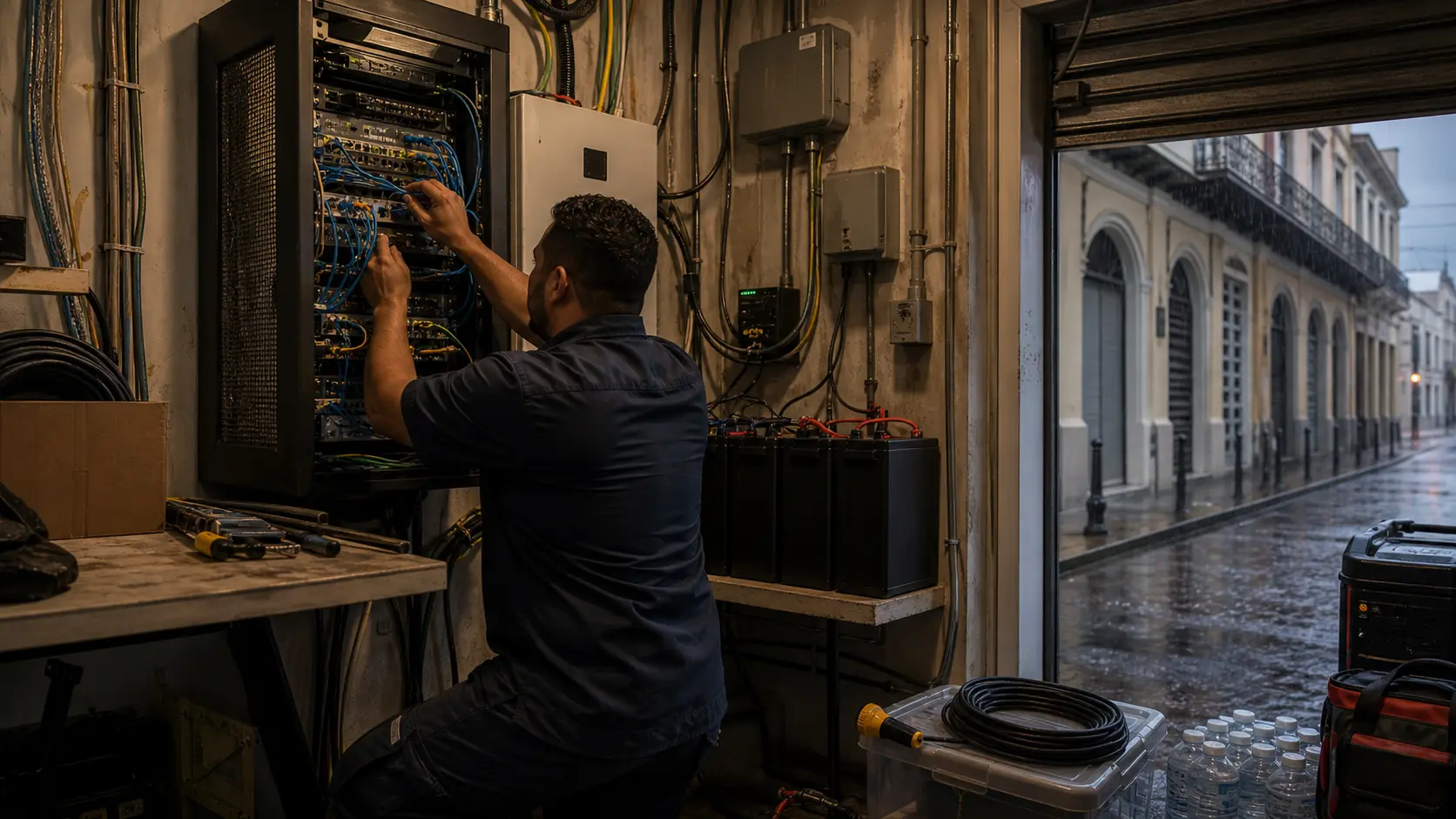
In late May, before the first serious storm cone appears on television, a San Juan business owner stands in the back room of a cafe, pharmacy, law office or logistics counter and looks at the small network closet that now carries more of the business than the storefront sign. The modem is not just internet access. It is the card terminal, inventory system, delivery app, accounting login, WhatsApp line, cloud phone, building cameras and the customer's proof that the business is still alive. A cheaper broadband line may be enough for ordinary browsing.
The decision before hurricane season is whether ordinary browsing is the right benchmark for an island economy that remembers what happens when the grid, poles, mobile sites and off-island paths all fail in overlapping ways.
WorldNet Telecommunications, LLC, publicly branded as WorldNetPR or WorldNet, is a Puerto Rico telecommunications provider based in Guaynabo. Its own business page says it has operated since 1996 and sells voice, data, internet and cloud services, with fiber optic, wireless and satellite infrastructure across the island: https://www.worldnetpr.com/en/business/. The identity matters because WorldNet's strongest strategic claim is local business continuity rather than raw consumer scale. It does not ask an enterprise buyer to think only about a monthly access charge. It asks the buyer to treat connectivity as an operating reserve, like fuel, insurance, refrigeration backup or a second supplier.
The hard number that changes the economics is not a price. It is the Federal Communications Commission's Hurricane Maria communications finding that, at the worst point, 95.6 percent of Puerto Rico cell sites were out of service, with a charted 95.2 percent outage level and 48 of 78 municipios having 100 percent of cell sites out of service: https://docs.fcc.gov/public/attachments/doc-353805a1.pdf. That number turns telecom procurement from a commodity exercise into a survivability question. If almost the entire wireless layer can disappear and restoration can take months, a buyer who chooses only on nominal megabits is ignoring the island's lived balance sheet. The relevant cost is not the difference between two advertised monthly plans. It is lost revenue, spoiled inventory, idle staff, cancelled bookings, missed medical or legal appointments, security blind spots and the reputational penalty of being unreachable when customers are looking for someone who can still serve them.
That memory did not end with Maria. The U.S. Energy Information Administration reported that, even without major hurricane events, Puerto Rico customers experienced an average of about 27 hours of power interruptions per year from 2021 through 2024, compared with about two hours for mainland U.S. customers; in 2024, major events pushed the average outage time above 73 hours: https://www.eia.gov/todayinenergy/detail.php?id=65925. For a small firm, those numbers explain why the internet bill is no longer just an overhead line. It is part of the business continuity budget.
The public sector and WorldNet's own price labels make the same point at different scales. USAC says the FCC put up to $950 million behind Puerto Rico and U.S. Virgin Islands network rebuilding and hardening: https://www.usac.org/high-cost/funds/bringing-puerto-rico-together-uniendo-a-puerto-rico-fund-and-the-connect-usvi-fund/. WorldNet's broadband-facts CSV lists Business Fiber Fit plans from $69.95 per month for 200/50 Mbps to $149.95 per month for 1000/200 Mbps, with a $5 access charge and a 36-month business contract: https://ebill.worldnetpr.com/ESP-WLDESP/WLD/facts/BroadbandFactPlans.csv. The buyer is not just buying megabits. The buyer is deciding how much outage risk to leave on the balance sheet.
The central mechanism is simple: in Puerto Rico, business connectivity is priced around the option value of remaining operational when substitute networks are degraded at the same time. The buyer pays for a higher probability that the circuit, support response, voice layer, cloud failover, route selection and provider accountability will work together under stress. WorldNet's advantage, if it sustains one, is not that every customer will see a unique speed test on a sunny Wednesday.
It is that a locally focused provider with enterprise services can sell a preparedness premium into an island market where power instability, storm exposure, limited backhaul geography and customer impatience make downtime unusually expensive.
The owner's calculation becomes sharper when the cheaper line is translated into business hours. A small San Juan shop may not use the language of redundancy engineering, but it knows the practical difference between a line that is fine until everyone calls support at once and a provider that can discuss circuit path, voice rerouting, wireless contingency, static addresses, payment terminals and after-hours escalation before the storm arrives. The premium is an option contract written in operational terms: pay more during quiet months so the business has fewer unknowns during the week when customers, staff and suppliers are also stressed.
That is why WorldNetPR is best understood through island resilience economics. The company is not immune to the same storms, power failures and backhaul constraints that affect everyone else. Its commercial opportunity is to organize those constraints into a service package a business owner can buy. The value is not perfection. It is fewer single points of failure, clearer accountability and a higher chance that a customer can still make a call, process a card, pull a record or dispatch a truck when a cheaper substitute has become a dead monthly saving.
The company is local, but the product is resilience
WorldNet's public materials place the company in the middle of Puerto Rico's business connectivity market rather than at the edge of it. Its about page says the company was founded in 1996, has invested more than $40 million in proprietary Voice over IP and fiber optic infrastructure, acquired an additional fiber optic route throughout the island in 2021, and describes itself as the largest locally owned telecommunications provider in Puerto Rico: https://www.worldnetpr.com/en/aboutus/. A December 2024 advertorial in News is My Business says WorldNet had continued expanding fiber infrastructure into the northwestern region, reaching from Bayamon to Aguadilla as well as San Juan, Caguas, Guaynabo, Mayaguez and Ponce: https://newsismybusiness.com/worldnet-powering-businesses-with-northern-fiber-optic-technology/.
Those claims need to be read with discipline. They support a picture of a local enterprise provider with fiber ambitions and business continuity messaging. They do not prove that WorldNet has the lowest unit cost, the broadest household footprint or the deepest capital base in Puerto Rico. The article's real economic question is narrower: whether WorldNet sits in a profitable niche where Puerto Rico firms will pay more for managed continuity than for plain access.
The answer begins with the customer. A Puerto Rico business buyer is not only comparing WorldNet with Liberty, Claro, AeroNet, Optico, satellite and fixed wireless alternatives. The buyer is comparing possible futures. In one future, the line is cheap and the month is quiet. In another, a tropical storm takes power down, a fiber path rides on damaged poles, mobile backup is congested, upstream routes shift, staff cannot reach a call center and every hour of confusion leaks money. WorldNet sells into the second future. Its business page explicitly talks about contingency plans, document protection, business continuity, disaster recovery and internet connectivity "regardless of the situation at hand": https://www.worldnetpr.com/en/business/.
The business model follows from that posture. WorldNet can sell connectivity, voice, hosted PBX, cloud services, virtual servers, support and managed security as a bundle. Its Cloud Direct page lists business continuity, hosted Exchange, web hosting, virtual servers and hosted PBX: https://www.worldnetpr.com/en/clouddirect/. Its voice page emphasizes commercial lines, digital telephone lines, SIP trunking, hosted PBX style functionality and what it calls a 100 percent digital VoIP network in Puerto Rico: https://www.worldnetpr.com/en/voice-service/. These are not just product categories. They are ways to deepen account control. The more services a customer places with WorldNet, the less the provider is selling a replaceable pipe and the more it is selling an operational layer.
That bundling also changes the sales conversation. A buyer that purchases only internet access can churn when another provider advertises a lower monthly fee. A buyer that uses the same provider for access, voice continuity, hosted PBX, cloud mail, managed support and emergency planning must compare the cost of switching against operational disruption. The provider gains more account knowledge, and the customer gains one accountable party for several failure points. In a normal mainland market this can be ordinary managed-services logic. In Puerto Rico it becomes sharper because the failure points are not theoretical.
Power, poles, access roads, off-island capacity and mobile congestion can interact in the same week.
That matters in a market where small and midsize businesses often lack the staff to design redundancy from scratch. The U.S. Small Business Administration's Puerto Rico profile recorded 45,451 business establishments and 680,586 employees in 2020, with retail trade, health care, accommodation and food services, professional services, manufacturing and finance all visible in the establishment base: https://advocacy.sba.gov/wp-content/uploads/2022/08/Small-Business-Economic-Profile-Puerto-Rico.pdf. A pharmacy, restaurant group, accounting practice, clinic, shipper or municipal contractor can understand uptime risk, but many cannot run a carrier engineering process. WorldNet's opportunity is to turn that gap into managed service revenue.
The network evidence shows a real operator, not just a reseller
WorldNet's network footprint is visible outside its marketing pages. BGP.tools lists AS11367, WorldNet Telecommunications, LLC, as an active ARIN network registered on July 27, 1998, with 19 IPv4 prefixes, one IPv6 prefix, 86 /24s of originated IPv4 space, 65,536 /48s of IPv6 space, three upstreams, 11 peers and seven downstreams visible in the public routing view: https://bgp.tools/as/11367. Hurricane Electric's BGP service also lists AS11367 in Puerto Rico, with one internet exchange entry at the Puerto Rico Internet Exchange in San Juan and originated prefixes including IPv4 and IPv6 routes: https://bgp.he.net/AS11367. PeeringDB identifies WORLDNETPR as AS11367 under WorldNet Telecommunications, LLC, with the company website listed as http://www.worldnetpr.com: https://www.peeringdb.com/net/32179.
For an enterprise buyer, the practical meaning is not that public BGP pages can guarantee service quality at a single address. They cannot. The meaning is that WorldNet is visible as a routed network with its own autonomous system and public interconnection identity. That gives it more strategic substance than a pure storefront that resells another operator's access under a brand. The BGP picture also clarifies dependence.
Public route collectors show upstream names such as Telxius and DATACOM CARIBE, along with WorldNet-related AS62627, which means the company's off-island and regional reach is still tied to larger carrier and transport relationships. Local ownership does not mean self-sufficiency.
Puerto Rico's interconnection environment reinforces the point. The Puerto Rico Internet Exchange says its mission is to improve interconnection quality and reduce cost between networks in Puerto Rico, advertising access speeds up to 100 Gbps, low latency and a local ecosystem that includes WorldNet AS11367 among listed participants: https://puertoricoix.net/. For Puerto Rico, local exchange participation can be more than a network engineer's badge. It can reduce tromboning of local traffic, improve latency to local content or partners, and give operators additional options when island routes or mainland backhaul are under pressure.
Still, the island's backhaul reality is stubborn. Puerto Rico depends on subsea systems and landing points for much of its external data reach. Telxius describes BRUSA as a 160 Tbps, 11,000 km subsea cable linking Rio de Janeiro, Fortaleza, San Juan and Virginia Beach, with a design intended to reduce service disruption risk from natural disasters: https://telxius.com/en/brusa-2/. Telxius and partners also announced CELIA, a planned Caribbean cable connecting Aruba, Martinique, Antigua, Puerto Rico and Boca Raton, with more than 170 Tbps estimated initial capacity and a target service date in the third quarter of 2027: https://telxius.com/en/celia-submarine-cable-connecting-the-caribbean-to-the-united-states/. These projects matter because the price of a Puerto Rico enterprise circuit is partly a price for reaching beyond Puerto Rico.
The government has made the same diagnosis. Puerto Rico's broadband program lists a PR Submarine Cable Resilience Program whose objective is to build three cable landing stations in the West, South and East and add subsea fiber connections because having all submarine cable stations in metropolitan areas represents a single point of failure: https://www.smartisland.pr.gov/en-us/projectos-programas/programa-de-resiliencia-de-cables-submarinos-de-pr. That public statement is unusually important for WorldNet's thesis. It confirms that backhaul concentration is not an imaginary risk invented by a provider's sales team. It is a recognized infrastructure weakness around which business customers must price continuity.
Revenue logic: the premium is paid for avoided loss
WorldNet's revenue logic is strongest where the buyer can calculate avoided loss. A consumer can tolerate a cheaper plan that slows streaming for a few hours. A business cannot easily tolerate a dead card terminal during lunch service, a disconnected clinic appointment system, an unreachable insurance office after a flood, or a warehouse that cannot print labels while goods are moving through the port economy. The premium is not emotional. It is a rational response to asymmetric downside.
The wider economy supports that interpretation. The Bureau of Economic Analysis reported that Puerto Rico's real GDP increased 3.0 percent in 2023 after decreasing 2.1 percent in 2022, with growth reflecting exports and increases in personal consumption, government spending and private fixed investment: https://www.bea.gov/data/gdp/gdp-puerto-rico. GAO's 2025 update put Puerto Rico's fiscal year 2024 GDP at $125.8 billion and GNP at $85.6 billion, while also noting that electric utility status and other risks remain significant: https://files.gao.gov/reports/GAO-25-107560/index.html. In a slow-growth, risk-heavy island economy, a business line that reduces disruption can be treated as a productivity asset, not only a telecom expense.
The economics of downtime make the premium easier to understand. The SBA tells businesses to prepare for emergencies and says statistics indicate 25 percent of businesses will not open again after a disaster: https://www.sba.gov/business-guide/manage-your-business/prepare-emergencies. ITIC's 2024 downtime survey says the average cost of a single hour of downtime now exceeds $300,000 for more than 90 percent of mid-size and large enterprises, with the caveat that its sample is global and skewed toward organizations larger than a Puerto Rico corner shop: https://itic-corp.com/itic-2024-hourly-cost-of-downtime-report/. The exact dollar figure will vary by company, but the direction is clear. The more digitized a business becomes, the more a communications outage looks like a revenue shock rather than an inconvenience.
This is why WorldNet can sell more than internet access. A basic access line has one obvious metric: price per advertised megabit. A continuity bundle has many: how fast support answers, whether voice survives a local equipment failure, whether a second medium can be provisioned, whether hosted PBX calls can be rerouted, whether cloud mail remains reachable, whether the provider understands municipal road access after a storm, and whether the customer can talk to someone who knows Puerto Rico rather than a distant queue.
Those attributes are harder to compare on a shopping page, which is exactly why they can sustain margins if the provider delivers.
WorldNet's published business price labels put a floor under this revenue logic. The Fiber Fit schedule lists 200/50 Mbps at $69.95, 300/50 Mbps at $79.95, 400/50 Mbps at $99.95, 500/100 Mbps at $119.95, 800/100 Mbps at $129.95 and 1000/200 Mbps at $149.95, each with unlimited data and a $5 access charge: https://ebill.worldnetpr.com/ESP-WLDESP/WLD/facts/BroadbandFactPlans.csv. These are not custom enterprise circuits with publicly visible four-figure monthly prices. They are small-business broadband offers that can become the entry point for a larger continuity relationship. The margin opportunity comes when the buyer adds voice, managed security, network monitoring, business satellite backup, cloud services or support.
WorldNet's Lifeline page shows it also participates in affordability-oriented residential voice and internet programs, with residential internet described from $20.70 per month for eligible users and plans from 25 megabytes to 1 gigabyte subject to availability: https://www.worldnetpr.com/en/lifeline-program/. Its business satellite page describes WorldNet Sky Internet as an emergency contingency service "when all else fails," separated from traditional ground-based infrastructure, with priority connection, persistent IP address and installation in three to five business days: https://www.worldnetpr.com/en/business-satellite-internet/. That satellite offer is strategically important even if it is not the default line. It shows WorldNet selling resilience as a portfolio of substitutes rather than only as fiber access.
The buyer's math is about substituting cost before the outage
The most important pricing comparison is not between WorldNet and a rival's headline plan. It is between planned expense and unplanned loss. A cheap line saves money every month until the hour it does not work. A designed continuity package costs more every month and may look wasteful if nothing happens. That asymmetry is why resilience purchases are hard for small firms and attractive for providers that can explain them honestly. The buyer must approve visible recurring cost to avoid an invisible future loss.
Puerto Rico makes that decision less abstract than most markets. A restaurant can estimate how many lunch tickets disappear if payment terminals cannot authorize. A medical office can estimate the cost of rescheduling appointments and calling patients from mobile phones during an outage. A professional firm can estimate the penalty of missing a filing window or losing a day of staff time. A wholesaler can estimate the value of shipments delayed because labels, invoices and dispatch systems are inaccessible. None of those calculations requires a global downtime survey.
They require a business owner to ask what one storm-season day of operational silence would cost.
WorldNet's role, if it is selling well, is to move that discussion from fear to architecture. Which applications must survive first? Which employees need voice or messaging if the office is closed? Does the business have backup power for the router, switch and Wi-Fi, or only for lights and refrigeration? Is there a second access medium? Are cloud voice calls able to forward to mobile devices? Can a backup circuit be tested before hurricane season rather than discovered during it? Does the customer know which number to call, and does the provider know the customer's priority services?
This buyer model supports premium pricing but also disciplines it. A provider cannot simply say "resilience" and charge more. It must translate each premium element into a failure mode the customer understands. Fiber route diversity matters if one route can be cut by pole damage or construction. Wireless backup matters if it is not dependent on the same local power and congestion bottleneck. Hosted PBX matters if call routing can move away from the office. Cloud services matter if the business has a practical way to reach them from another location.
Support matters if the provider can triage real dependencies rather than repeat generic outage language.
The same model explains why some buyers will not pay. A small firm with low daily revenue, cash constraints and tolerant customers may rationally choose cheaper access plus a mobile hotspot. A business with high transaction density, regulated records, perishable goods, public safety obligations or logistics deadlines has a different loss curve. WorldNet's addressable market is therefore defined less by employee count than by intolerance for interruption. A ten-person clinic may be a stronger prospect than a larger office whose work can wait.
This is also where Puerto Rico's business culture matters. Many firms have personal memories of Maria, Fiona, island-wide power failures and smaller neighborhood outages. The buying committee may include someone who slept beside a generator, lost refrigerated stock, drove to find mobile signal, or watched customers line up at the one business whose payment system still worked. Those experiences convert resilience from a technical feature into a boardroom and family-business conversation. WorldNet's premium survives only if it attaches to that real memory without exaggerating what any network can guarantee.
Cost base: Puerto Rico raises the floor under every serious network
The same conditions that let WorldNet charge for resilience also raise its cost base. A provider that promises continuity on an island has to spend money before the storm. It needs fiber routes, access electronics, standby power, batteries, generators, fuel arrangements, spares, field crews, network monitoring, upstream diversity, customer support, insurance and relationships with contractors who can move after roads are blocked. Some of those costs are visible in WorldNet's own claim of more than $40 million invested in proprietary VoIP and fiber optic infrastructure: https://www.worldnetpr.com/en/aboutus/.
Puerto Rico's disaster history increases those costs because telecom assets are physically coupled to other fragile systems. GAO's telecommunications review after Hurricane Maria noted that damaged poles affected telecommunications services because fiber cables were hung on those poles in both Puerto Rico and the U.S. Virgin Islands, and that personnel, equipment and key resources had to be shipped or flown from the mainland because the islands are about 1,000 nautical miles from the U.S. mainland: https://www.gao.gov/assets/gao-21-297.pdf. That fact is central to WorldNet's economics. A mainland metro fiber provider can often restore service from regional warehouses and truck rolls over connected highways. A Puerto Rico provider faces port, airlift, fuel, road and power constraints at the same time.
The electric grid adds another layer. GAO described Hurricanes Irma and Maria as causing the longest blackout in U.S. history and said it took roughly 11 months for power to be restored to all customers with structures deemed safe for restoration: https://www.gao.gov/products/gao-20-141. EIA's later 27-hour annual interruption measure shows that the problem is not limited to the 2017 catastrophe. A telecom provider must either absorb some backup-power cost itself or pass it into enterprise pricing. A business that complains about a premium circuit may still be implicitly asking the provider to maintain a private resilience stack around a public grid that remains unstable.
Capital intensity is therefore not a footnote. It is the barrier that protects the niche and the burden that can squeeze it. Fiber route diversity, backup power and local support are expensive. A provider that underprices them will win customers and then disappoint them when the next storm exposes the gap. A provider that prices them honestly risks losing the ordinary buyer to cheaper broadband. The business challenge for WorldNet is to segment the market carefully: sell commodity access where the buyer wants commodity access, but protect the margin and service design for customers who truly need continuity.
Public funding can both help and pressure the cost base. The Puerto Rico Broadband Program lists major available funds, including a $400 million Puerto Rico Broadband Infrastructure Fund, approximately $329.6 million in BEAD implementation funding, about $158 million from the Treasury Capital Projects Fund and about $70 million in CDBG-MIT mitigation funding: https://www.smartisland.pr.gov/en-us. USAC's summary of the FCC's Puerto Rico and U.S. Virgin Islands support says Stage 2 allocated up to $950 million to rebuild, expand and harden fixed and mobile networks, including $504.7 million for Puerto Rico fixed networks over 10 years and $254.4 million for Puerto Rico mobile networks over three years: https://www.usac.org/high-cost/funds/bringing-puerto-rico-together-uniendo-a-puerto-rico-fund-and-the-connect-usvi-fund/. Subsidized hardening raises the market's baseline. If public money lifts competitors' resiliency, WorldNet must keep proving why its own continuity premium is worth paying.
Supplier and upstream dependence: local control meets off-island reality
WorldNet's local identity is strategically valuable, but no Puerto Rico carrier escapes supplier dependence. The island's business internet experience is shaped by access loops inside Puerto Rico, aggregation across the island, peering and transit choices, subsea capacity, mainland data-center routes and cloud application endpoints. A local provider can own customer relationships and parts of the access network. It still needs equipment vendors, fiber contractors, data-center partners, power equipment, upstream carriers, public rights of way and access to subsea or regional transport.
The public routing evidence makes that dependence visible. BGP.tools lists Telxius, DATACOM CARIBE and WorldNet-related AS62627 among AS11367 upstreams: https://bgp.tools/as/11367. Hurricane Electric's view shows related peer and exchange data, including the Puerto Rico Internet Exchange in San Juan: https://bgp.he.net/AS11367. Those names do not tell us the commercial terms of WorldNet's upstream contracts. They do show that WorldNet is part of a carrier ecosystem in which external path diversity is bought, negotiated and engineered rather than conjured from local ownership alone.
This is not a weakness unique to WorldNet. It is the structure of island telecommunications. The question is whether WorldNet can turn dependence into designed redundancy. A business customer does not need its provider to be independent of every supplier. It needs the provider to know which supplier failure modes matter and to build around them. In Puerto Rico, that means not only having a second upstream on paper but understanding physical diversity, landing-station geography, power at local nodes, last-mile pole exposure, wireless backup limitations and the operational reality of field repair after storms.
The strongest public signal in WorldNet's favor is its 2021 additional fiber route claim. The company's about page says the additional route broadened its presence throughout Puerto Rico: https://www.worldnetpr.com/en/aboutus/. The 2024 News is My Business piece adds that the company expanded fiber into the northwestern region from Bayamon to Aguadilla and lists several other urban areas: https://newsismybusiness.com/worldnet-powering-businesses-with-northern-fiber-optic-technology/. If those routes are physically diverse and operationally supported, they improve the economic case. If they are mostly marketing descriptions of incremental coverage, the value is smaller. The facts that would matter are route maps, restoration records, service-level outcomes and customer-specific failover designs.
Subsea additions also change the supplier picture. BRUSA gives San Juan a large route to Virginia Beach, and CELIA is expected to add a new Caribbean to Florida path in 2027. But more capacity does not automatically eliminate local concentration risk. Puerto Rico's own submarine resilience project says metropolitan-area landing concentration is a single point of failure: https://www.smartisland.pr.gov/en-us/projectos-programas/programa-de-resiliencia-de-cables-submarinos-de-pr. WorldNet's strategic room is therefore between local access and global backhaul: help customers make pragmatic continuity choices while the island's public and private infrastructure catches up.
Customer dependence: the best accounts are operationally intolerant of silence
WorldNet's likely best customers are not the most bandwidth-hungry customers in the abstract. They are the customers for whom silence is costly. Health care offices need appointment systems, insurance verification and voice. Logistics firms need dispatch, scanning, customs documentation and shipper communications. Retailers need point-of-sale authorization and inventory visibility. Professional services firms need cloud documents, filing deadlines and client communications. Local government and public safety customers need coordination. Tourism and hospitality businesses need bookings, guest communications and payment systems.
WorldNet's own public testimonials point in that direction. Its business page quotes the Puerto Rico Fire Department and Crowley Puerto Rico on communications and operational transformation, showing the kinds of organizations it wants future buyers to associate with reliability and support: https://www.worldnetpr.com/en/business/. These testimonials are promotional, but they are still useful market evidence. They show WorldNet positioning itself around institutional and business workflows rather than only household browsing.
The buyer's dependence on connectivity has deepened since Maria. The Census Bureau's Puerto Rico business formation story notes that events such as Hurricanes Irma and Maria and the COVID-19 pandemic had significant economic impacts on business creation, with seasonally adjusted applications rising from 487 in October 2017 to 1,591 in October 2018 and from 944 in April 2020 to 2,327 in April 2021: https://www.census.gov/library/stories/2024/09/bfs-puerto-rico.html. Those spikes do not prove telecom demand by themselves. But they show an economy where shocks reshape the business base and where new firms are born into a more digital operating environment than their predecessors.
The customer dependence risk for WorldNet is concentration by geography and use case. A local provider can be very strong in accounts that value hands-on support, but it may have less leverage with national chains that negotiate regionally, enterprises that buy global carriers, or price-sensitive small firms that will accept lower resilience for lower monthly cost. If Puerto Rico's macro conditions weaken, some buyers may downgrade. If public subsidy expands last-mile competition, others may get acceptable alternatives.
WorldNet's revenue quality therefore depends on how many accounts see connectivity as mission-critical enough to pay for design, support and failover.
The strongest version of the WorldNet thesis is not "everyone should buy premium service." It is "enough Puerto Rico businesses have learned that cheap connectivity is not cheap when the island is stressed." That is a different and more durable claim. It allows WorldNet to win where buyers remember outages as operating losses rather than anecdotes.
Competition is broad, but not all substitutes solve the same problem
Puerto Rico is not an empty market. BusinessInternet.com lists 55 providers offering specialized business services in Puerto Rico, including seven fiber providers, 17 cable/DSL/copper providers and 30 fixed wireless providers, and identifies Claro Internet and Liberty Business as large overlapping competitors: https://businessinternet.com/puerto-rico. The same listing puts Worldnet much lower by broad state coverage than the largest providers, which is a useful reminder that WorldNet's opportunity is not mass-market ubiquity.
Liberty Business competes aggressively on both price and continuity. Its site advertises a 1000 megas business triple-pack at $79.49 per month and lists managed services, cybersecurity, dedicated fiber, data center, cloud and business continuity categories: https://www.libertybusinesspr.com/. News is My Business reported in November 2024 that Liberty relaunched its OnGoing redundancy service, a wireless device that switches a fixed internet customer to Liberty's mobile network if the fixed connection fails, for $20 per month on top of fixed internet plans: https://newsismybusiness.com/liberty-business-relaunches-ongoing-internet-redundancy-service/. That is direct evidence that Puerto Rico business continuity has become a competitive product, not just a WorldNet talking point.
AeroNet is another relevant substitute. Its site markets business connectivity "built for Puerto Rico's businesses," speeds up to 10 Gbps, dedicated bandwidth, and Dual Network Access that combines fiber optic and microwave routes so that one takes over if the other fails: https://www.aeronetpr.com/. Its business pricing page lists broadband plans from $99 per month for 200/50 Mbps to $199 per month for 1000/200 Mbps, plus installation pricing and a list of municipalities where the offers apply: https://www.aeronetpr.com/business. This is a serious competitive signal. AeroNet is selling the same broad idea of physical diversity and uptime, with a different engineering mix and brand posture.
Claro, Liberty, AeroNet, Optico, Neptuno, fixed wireless providers, satellite options and smaller local ISPs all create substitution pressure. But substitution is not binary. A low-cost Liberty bundle may be a good fit for a small office that wants price and acceptable backup. A fixed wireless provider may be a good fit where fiber buildout is weak or where path diversity matters. Satellite may be useful as an emergency tertiary option but can bring latency, weather and capacity tradeoffs.
WorldNet's job is to make its specific combination of local support, fiber routes, voice, cloud and continuity worth more than each substitute for the target account.
The competitive risk is that resilience becomes standardized. If every provider can credibly sell dual access, backup power, cloud voice and 24/7 support, the premium compresses. But standardization is harder in Puerto Rico than in a mainland suburb because the physical problem is harder. A backup that depends on the same pole line, the same local power failure, the same congested mobile layer or the same metro landing concentration is not full substitution. Buyers that understand the difference will ask harder questions than "what is the speed and monthly price?"
WorldNet's defensible position depends on consultative selling and proof. It must show how a particular customer would stay reachable if the first access path fails, if mobile backup is congested, if the customer's building loses power, if a nearby pole line goes down, or if the issue sits upstream rather than in the last mile. In resilience economics, the sales process is an engineering explanation.
Regulation, public funding and geopolitics shape the upside
WorldNet operates in a U.S. jurisdiction with federal universal service rules, Puerto Rico public policy, broadband grant programs, public safety concerns, disaster recovery politics and Caribbean backhaul geopolitics all layered into the market. The immediate upside is that public money and policy attention continue to flow toward hardened communications. The risk is that the same money can favor larger competitors, distort deployment economics or raise customer expectations faster than a smaller provider can invest.
The FCC and USAC recovery programs demonstrate the scale of public involvement. USAC says the FCC made up to $76.9 million in immediate High Cost Universal Service funding after Irma and Maria, then established the Puerto Rico and U.S. Virgin Islands funds to restore, expand and upgrade networks, with Stage 2 allocating up to $950 million for rebuilding and hardening: https://www.usac.org/high-cost/funds/bringing-puerto-rico-together-uniendo-a-puerto-rico-fund-and-the-connect-usvi-fund/. Puerto Rico's Smart Island broadband program lists hardening projects, public Wi-Fi, workforce development, community technology centers and other initiatives: https://www.smartisland.pr.gov/en-us.
For a provider like WorldNet, this creates a two-sided effect. On one side, public hardening projects can improve the island's baseline infrastructure, create opportunities for service providers, and validate the business case for resilience. On the other, subsidized competitors can improve their networks without bearing the full private cost, and public procurement can concentrate benefits among operators with the scale, compliance staff and balance sheet to navigate awards.
Geopolitics enters through geography. Puerto Rico is a U.S. territory in the Caribbean, connected to mainland economic, regulatory and cloud systems but physically exposed to Atlantic storms and dependent on maritime and air logistics when disaster hits. GAO's telecommunications review stressed the challenge of moving personnel, equipment and resources from the mainland after Maria: https://www.gao.gov/assets/gao-21-297.pdf. In an era when cloud services, payment systems, health records and government operations all depend on continuous IP reachability, Puerto Rico's telecom infrastructure is part of economic resilience and national continuity, not just a consumer utility.
Subsea cable investment also has geopolitical meaning. BRUSA, CELIA and the planned Puerto Rico submarine resilience program all point toward an island trying to reduce chokepoints and improve route diversity. A provider's local economics can improve if wholesale capacity becomes cheaper and more diverse. But the upside is not automatic. More cables can lower backhaul cost and improve options, but they can also invite more competition and reduce the scarcity premium that smaller operators may have earned from difficult access conditions.
Regulation can also shape pricing transparency. Broadband facts labels, universal service obligations, Lifeline participation and public grant reporting all make parts of the market more visible. WorldNet's Lifeline page gives specific affordability numbers and program details, including subsidies and internet plans subject to availability: https://www.worldnetpr.com/en/lifeline-program/. For enterprise resilience, however, the most important attributes remain less standardized: route diversity, response time, field capability, failover design and actual performance during island-wide stress.
Unofficial signals show the market is buying confidence
Unofficial market signals in Puerto Rico telecom tend to cluster around reliability, neighborhood-level variance, support responsiveness, generator readiness, fiber availability and distrust of one-size-fits-all claims. Forums, local conversations and social media comments often praise one provider in one municipality and criticize the same provider in another. That is exactly what a resilience market sounds like. Buyers are not merely ranking brands; they are trying to map failure probability at the level of a street, building, pole line, tower sector and support queue.
The recurring signal is that Puerto Rico customers do not evaluate connectivity only by advertised speed. They ask who is good in a specific neighborhood, whether fiber is truly available at the address, whether fixed wireless holds up in rain or congestion, whether a provider answers after an outage, and whether backup power exists at the premises and network node. That maps directly onto WorldNet's resilience thesis. The buyer is not searching for the theoretically best ISP on the island.
The buyer is searching for the provider whose particular physical path and support model can keep a particular business operating on the worst week of the year.
The strongest informal signal is the willingness to mix providers. A business may buy one fiber provider, keep a cable line as backup, add LTE or 5G failover, and consider satellite for emergency use. That can either help or hurt WorldNet. It helps if WorldNet becomes the orchestrator of continuity, selling the main service and managing the design. It hurts if WorldNet becomes only one of several replaceable inputs in a customer-built redundancy stack. The difference is account control: the provider that explains the whole continuity map gets the higher-value relationship.
There is also a cultural advantage to local credibility. When a storm hits, buyers may value a provider that speaks the island's operating language, knows local geography, understands municipal access, and has a local reputation at stake. That is not sentimental. It can affect repair prioritization, communication quality and trust during uncertainty. WorldNet leans into that local identity in public materials. The market will decide whether that identity is supported by enough proof during outages.
The unofficial signal to watch is whether business owners talk about WorldNet as "expensive but worth it," "the one that answers," or simply "another provider." The first two phrases support pricing power. The last phrase means the premium is vulnerable. In a Puerto Rico resilience market, reputation is a form of working capital: it is accumulated in quiet months and spent during outages.
What would change the judgment
Several facts would materially change the assessment of WorldNet's resilience economics. The first is route-level proof. If WorldNet can demonstrate physically diverse fiber paths for key business districts, backup-power arrangements at critical nodes, upstream diversity that avoids shared failure points, and documented restoration performance during recent outages, the premium case strengthens. If route diversity is thin, if backup depends heavily on the same vulnerable infrastructure, or if support capacity is weak, the case weakens.
The second is customer mix. WorldNet's public materials point toward business, government, logistics and institutional customers, but private revenue distribution is not public. A customer base with many multi-location businesses, clinics, public safety accounts, professional services firms and logistics operations would support higher average revenue and lower churn. A customer base weighted toward price-sensitive residential and small office access would make the resilience story less financially powerful.
The third is competitive response. Liberty's $20 OnGoing add-on and AeroNet's fiber-plus-microwave Dual Network Access show that rivals are already selling continuity. If larger rivals bundle credible failover into low-cost packages and improve support, WorldNet may need to differentiate through local engineering and account service rather than broad claims. If competitors' backup products prove superficial during major events, WorldNet can win by showing deeper design.
The fourth is public infrastructure progress. If Puerto Rico's submarine cable resilience program delivers new landing stations in the West, South and East, if CELIA goes live on schedule, and if public funds harden ISP infrastructure across the island, the baseline risk declines. That could reduce some fear-driven premium. It could also expand the market by making digital operations more dependable and encouraging businesses to buy more cloud, voice and managed services. The net effect depends on whether WorldNet captures more service wallet as infrastructure improves.
The fifth is power. EIA's reported 27 hours of annual non-major-event interruption and more than 73 hours in 2024 including major events are not just energy statistics: https://www.eia.gov/todayinenergy/detail.php?id=65925. They are telecom economics. If Puerto Rico's power reliability improves materially, some emergency connectivity spending may normalize. If power instability persists, the continuity premium remains rational.
Finally, the judgment would change if WorldNet's public claims stopped matching observable network and customer evidence. A resilience provider must be unusually careful with overstatement. The market can forgive a consumer ISP for a bad afternoon. It is less forgiving when a company sells continuity and then fails silently during the moment it is needed.
The bottom line
WorldNetPR sits in a market where memory has economic value. Hurricane Maria's communications failure, persistent power interruptions, concentrated backhaul geography and the digitization of everyday business have made Puerto Rico connectivity more than a monthly utility purchase. For the right customer, the question is not whether a cheaper broadband line is enough on an ordinary day. It is whether the business can afford to discover, during a storm, that the cheap line was the only operational plan.
WorldNet's public identity as a locally owned provider with business voice, data, internet, cloud, fiber, wireless, satellite, continuity and support services gives it a credible position in that market. Public routing records show it is a real network operator. Its own materials and local coverage show fiber investment and route-expansion claims. Government and independent sources confirm that Puerto Rico's power, pole, backhaul and disaster-recovery environment makes resilience valuable.
The investment case is not risk-free. WorldNet faces larger competitors, subsidized hardening, supplier dependence, high operating costs and the possibility that resilience products become commoditized. Its advantage must be proven account by account through route design, support quality, restoration performance and honest continuity engineering.
But the economic spine is strong. On an island where a business owner's network closet may decide whether payroll runs, shelves stay stocked and customers can pay, the premium for keeping circuits alive is not a luxury. It is the price of staying open when the rest of the system is under stress.