
Asia-Pacific Companies
Asia-Pacific Companies
Asia-Pacific company intelligence maps internet infrastructure operators, cloud service providers, telecom networks, data centre companies, registries, alliances, standards bodies, and institutional market actors across Asia-Pacific internet infrastructure markets.

Latest Coverage
Latest from Asia-Pacific Companies
1,441 articles
Asia-Pacific Regional ISP
Eleven prefixes, one mirror's total, and no registry that prints the sum
Carrier licence 126 has read *Current* against Ergon Energy Telecommunications Pty Ltd since 14 November 2003, and the company's 2024-25 industry levy was assessed at $216,515.30. The one number in this record that nobody publishes is how many IPv4 addresses the company actually…

Asia-Pacific Institutional
Nepal's .np registry keeps three lists of itself and starts a clock
Mercantile Communications has managed Nepal's country-code top-level domain since IANA recorded .np's creation on 25 January 1995. In the twelve documents I read on 24 November 2026, the operator's own portal lists nine second-level suffixes, its FAQ lists twelve, and the policy…

Asia-Pacific Institutional
MMIX prints 54 members on one page and 65+ on another
Myanmar's exchange publishes traffic graphs, three member tables, four port speeds and a registry identity, and not one page that states what the word "member" counts. The numbers are not missing. The definition is.
Asia-Pacific Datacenter
True IDC prints eight capacities and still owes the market one number
In Thailand the binding constraint on data-centre capacity is electricity, and the operator that calls itself the largest in the country has published eight capacity figures without ever publishing the one a customer, a lender or a regulator needs: how much it operates today, in…

Asia-Pacific Institutional
APNIC Stopped Pricing by the Band. The Band Still Votes.
APNIC still publishes seven membership tiers, and a reader could be forgiven for assuming seven prices. Since 2010 the annual fee has been a formula: a Base Fee multiplied by a Bit Factor raised to the number of address bits a member holds. The tier names have been doing…

Asia-Pacific Institutional
The Ombudsman prints the rate, or the names, never both
Indonesia's ombudsman can tell you what share of its recommendations were obeyed, or it can tell you which governments refused. It has never printed a page that does both, and the document that would settle the difference is one its own statute requires somebody else to write.
Asia-Pacific Institutional
PNIX is still registered, still "Active", and gone from its own operator's list
PNIX is still registered, still "Active", and gone from its own operator's list intelligence summary explains the development, the public evidence available to readers, the organisations involved, the regional context, market exposure, and the infrastructure consequences that may…
Asia-Pacific National Telecom
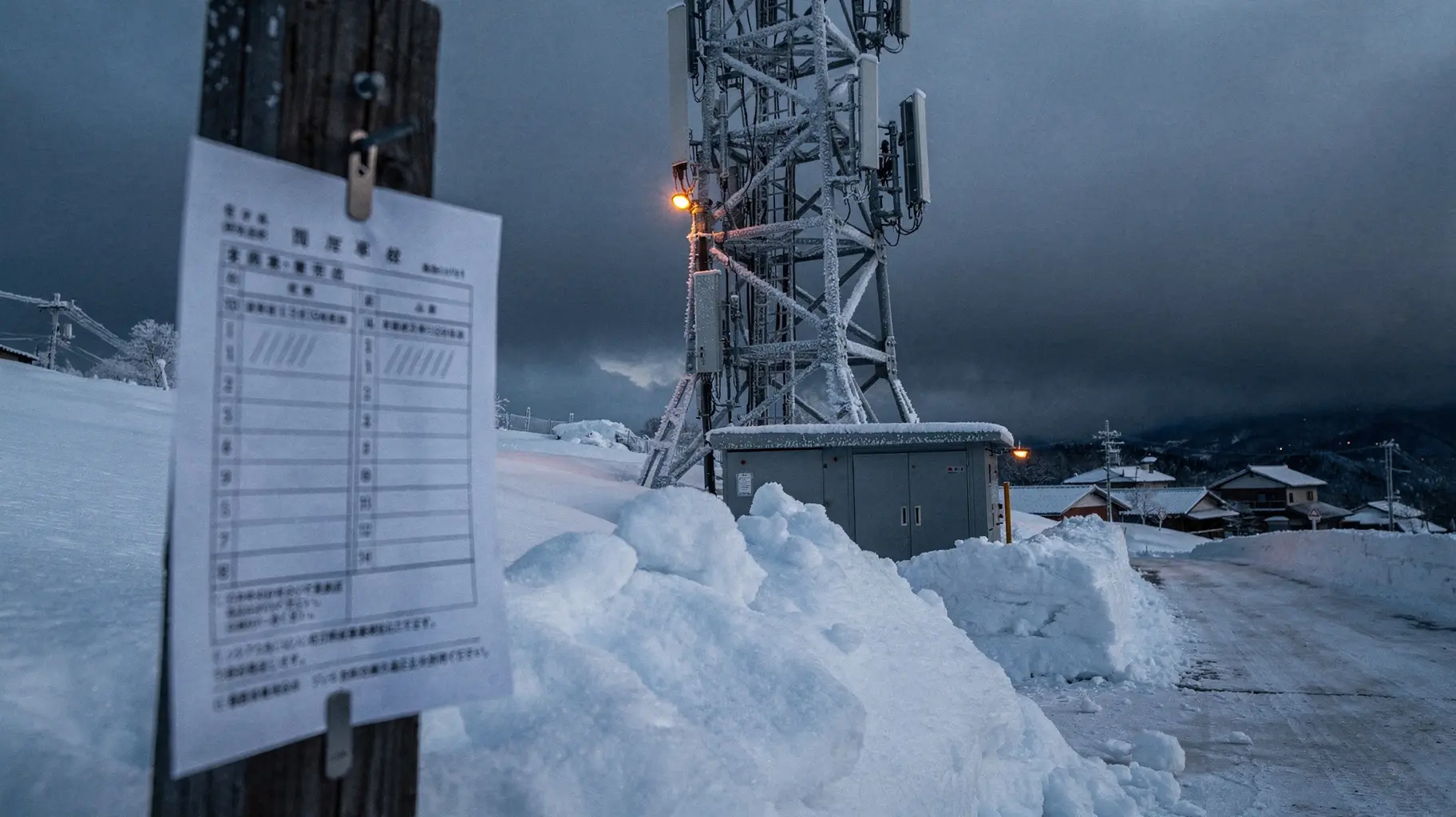
Japan's accident rule wants two numbers. KDDI's snow notice gave none.
KDDI's 22 November update names four towns, four brands, the cause and a 300 kbps roaming fallback. It does not name either figure that decides whether an outage becomes a reportable telecom accident — and 42 hours of elapsed time already clears every duration minimum the…
Asia-Pacific Institutional
A Bible society, one AS number and 512 addresses: the registry proves the holding, not the purpose
A Bible society, one AS number and 512 addresses: the registry proves the holding, not the purpose intelligence summary explains the development, the public evidence available to readers, the organisations involved, the regional context, market exposure, and the infrastructure…
Asia-Pacific Institutional
Singapore Can Time a Breach to the Hour. It Still Won't Tell You the Clock Ran.
The republic now measures incident response in hours and calendar days. Every instrument written since the SingHealth breach is more exact than the silence it replaced. Precision is not a receipt.

Asia-Pacific Institutional
Indonesia's Ombudsman publishes the number, not the counting rule
A number becomes an accountability instrument only when a stranger can rebuild it. Indonesia's national ombudsman prints the total every year, prints components beneath the total, and leaves the one sentence that would let anyone add them up somewhere off the page.
Asia-Pacific National Telecom
Indosat prints 0.36x. Its own nine-month figures print 0.49x.
Indosat Ooredoo Hutchison closed the nine months to September with Rp21,049.6 billion of EBITDA, Rp10,281.9 billion of net debt and a leverage ratio of 0.36x. The statements filed the same day carry Rp51,747,334 million of lease liabilities outside that net debt, and no line in…

Asia-Pacific National Telecom
Globe Telecom's 2025 Profit Arrives in Three Numbers: ₱23,262m, ₱20,888m, ₱20,800m
Globe Telecom, Inc. closed 2025 with one audited bottom line and two management bottoms printed beside it. The audited consolidated statements put net income at ₱23,262,060 thousand for the year. The results release for the same year puts core net income at ₱20,888 million and…
Asia-Pacific Institutional
Thirteen Promises, One Blank Column
Thirteen numbered cyber recommendations went to the Australian Parliament on 19 March 2021, each with the audited body's answer written underneath it. The audit office that produced them has since built an instrument for testing whether an answer becomes action. For these…

Asia-Pacific National Telecom
SISCC prints five capacities and leaves the perimeter to a stranger
The Coral Sea Cable System has carried Solomon Islands traffic since February 2020, and its owner states its size as up to 20 Terabits/s for each country. That figure closes only when the reader supplies a fibre-pair perimeter no reviewed page prints. Across the same fibre pairs…

Asia-Pacific Institutional
InternetNZ prints 100% for four years and never the denominator
Four annual-report pages and one audited statement, signed on 16 July 2026, print .nz DNS, EPP and WHOIS availability against targets. The footnotes define the acronyms. Nothing in that page set says what was counted, over which window, or by whom — and the year that printed 100%…

Asia-Pacific National Telecom
Airtel's Rs 271 Per User Rests on a Divisor the Pack Never Prints
Bharti Airtel Limited prints an India mobile ARPU of Rs 271 beside a customer count of 377,224 thousand. Divide the quarter's printed mobile revenue by that count and the quotient lands Rs 2.43 above the printed figure — because the count in the table is a date, and the count…

Asia-Pacific National Telecom
China Tower prints two tenancy ratios. Only one divides by a number it prints
China Tower counted 2.149 million tower sites and 3.856 million tenants at the end of 2025, and sells the pair as a single number: 1.79 tenants per site. The same table prints a second ratio, for the telecom operators alone. One of the two rebuilds from the integers printed…

Asia-Pacific National Telecom
NBN Co stopped printing the number that explained the other two
Two footnotes on the same page define both of its premises counts, and the column arithmetic closes exactly. What the October 2026 report no longer carries is the count of premises inside a declared ready-for-service area that still cannot order a service — printed at 60,000 in…

Asia-Pacific Institutional
NZIX publishes its whole rulebook and leaves the one date that counts to a sentence
The society that runs New Zealand's national internet exchange prints its legal name, its society number, its NZBN, its incorporation date and a registered office on its own website: five of the eight fields the incorporated societies register itself names. The three it leaves to…