
Summary
- What it says: Angola Cables owns one of the most interesting routing bets in the Atlantic: a path that can make Africa-to-Brazil traffic feel local, but only if wholesale buyers believe the cable, data-centre and interconnection stack is worth paying for despite Angolan currency, power, govern
- Main topic: Currency mismatch in infrastructure; Network-resource evidence; Peering and transit; Wholesale access economics
- Context: National Telecom
The buyer at the Atlantic fork
Imagine the buyer is not a tourist trying to stream a match from Luanda, but a bank, a content platform, a cloud reseller, a gaming distributor or a wholesale carrier with paying customers on both sides of the South Atlantic. The engineer can buy ordinary international transit and let packets follow the old habit of passing through Europe or North America. That route is familiar, liquid and easy to price.
Or the engineer can pay for a path that uses Angola Cables' Atlantic infrastructure: Angola to Brazil over SACS, onward to Brazil's interconnection market and the United States through MONET, and back toward Europe or Africa through WACS and other partnerships. The second choice may lower latency and diversify failure risk. It also asks the buyer to trust a more unusual combination of Angolan landing control, Brazilian data-centre execution, dollar-linked equipment costs, local power resilience and political economy.
That is the economic problem Angola Cables creates. The company is often described as an African connectivity champion, but the useful question is narrower. Can it turn a geographically rare route into a toll road that buyers will use even when they have cheaper or more liquid alternatives? The answer depends less on slogans about bridging continents than on three operating facts. First, SACS is a real and scarce physical shortcut: NEC and Angola Cables announced in October 2018 that the South Atlantic Cable System was complete and ready for commercial service, directly linking Angola and Brazil across the South Atlantic (https://www.nec.com/en/press/201810/global_20181001_02.html). Second, the cable is part of a broader route chain: public cable databases and vendor releases place Angola Cables in SACS, MONET and WACS, with Fortaleza, Luanda, Boca Raton, Sao Paulo, London and West African landing points forming the practical map (https://www.submarinecablemap.com/submarine-cable/south-atlantic-cable-system-sacs, https://www.submarinecablemap.com/submarine-cable/monet, https://www.submarinecablemap.com/submarine-cable/west-africa-cable-system-wacs). Third, the route becomes commercially useful only if it is wrapped in data-centre space, peering, route management, cloud access and credible repair economics.
The hard number that makes the first section concrete is 6,165 km. Angola Cables and its contractors have repeatedly described SACS as a 40 Tbps, four-fibre-pair system connecting Angola and Brazil over a 6,165 km route (https://www.newswire.ca/news-releases/angola-cables-cable-system-connecting-africa-and-the-americas-reaches-a-major-milestones-to-create-a-new-route-for-internet-traffic-619956023.html, https://www.lacnic.net/innovaportal/file/3209/1/sacs_lightning_talk_lacnic30.pdf). That is not merely a capacity statistic. It is a claim on a path. For a bank moving data between Lusophone Africa and Brazilian partners, for a content platform caching video closer to Angolan users, or for a wholesale carrier selling Africa-to-Latin-America diversity, the route's value is the avoided detour.
But a route is not a monopoly if customers can live with the detour. Angola Cables has to persuade buyers that the shortcut is worth a premium, or at least worth enough committed volume to pay for subsea capital, landing-station operations, optical upgrades, data-centre expansion, power redundancy, security, sales labour, repair exposure and route engineering. That is why this article treats Angola Cables as an infrastructure toll-road operator rather than as a generic telecom company. It sells the option to make South Atlantic traffic behave differently.
The question is whether the toll is enforceable in a market where hyperscale cables, terrestrial fibre, European hubs, South African data centres, Brazilian exchanges and cloud-network overlays all compete for the same traffic budgets.
What Angola Cables actually controls
The company identity is unusually important because public references can blur between Angola Cables S.A., TelCables subsidiaries, AngoNAP facilities, Angonix and cable systems whose ownership is shared through consortia. The RIPE NCC member page lists Angola Cables S.A. with an address in Talatona, Luanda, and areas serviced that include Angola, Brazil, Cape Verde, Germany, Spain, France, the United Kingdom, Ghana and Nigeria (https://www.ripe.net/membership/member-support/list-of-members/ao/angola/). Angola Cables' own public about page says Angola Cables S.A. is an Angolan-law company with registered office in Luanda (https://www.angolacables.co.ao/sobre). Those records do not prove every commercial claim made in sales material, but they anchor the subject as an Angolan company operating an international footprint.
Ownership is a second anchor. Public trade and official-market sources have long described Angola Cables as formed by major Angolan telecom operators, with Angola Telecom holding 51%, Unitel 31%, MSTelcom 9%, Movicel 6% and Startel or Mundo Startel 3% (https://www.trade.gov/market-intelligence/angola-information-and-communications-technology, https://www.theworldfolio.com/news/angola-telecoms-movi/3465/, https://www.nec.com/en/press/201411/global_20141104_04.html). The percentages are dated and should be refreshed against current company filings before any transaction analysis, but they explain the original political economy. Angola Cables was not a pure venture-backed carrier. It was a national infrastructure vehicle tied to incumbent and mobile operators in a market where the state and state-linked groups have historically had large telecom roles.
That ownership context cuts both ways. It can make the company strategically important to Angola, especially when international gateways, cable landings and wholesale capacity shape national digital dependence. Freedom House's 2024 Angola internet report notes that Angola Telecom owns 51% of Angola Cables and says two of the four undersea cables connecting Angola to the internet are managed by Angola Cables, while one is owned by Angola Telecom (https://freedomhouse.org/country/angola/freedom-net/2024). That makes Angola Cables more than a private reseller. At the same time, state-linked ownership can raise buyer questions about decision speed, political intervention, capital allocation and foreign-exchange access. A global content platform does not buy ideology; it buys reliability, price, repair rights, latency and contractual clarity.
The service stack is broad enough to matter. Angola Cables' connectivity page describes IP transit, remote peering, dedicated internet, private circuit and Angonix-related connectivity products (https://www.angolacables.co.ao/conectividade). Ciena describes the company as a multinational ICT provider serving wholesale and corporate segments, with SACS, MONET and WACS directly connecting the Americas, Africa and Europe, and with AngoNAP Fortaleza, AngoNAP Luanda, PIX in Brazil and Angonix in Angola as related facilities or platforms (https://www.ciena.com/about/newsroom/press-releases/angola-cables-boosts-capacity-on-monet-submarine-cable-network-with-ciena.html). A buyer should read that as a bundle: the company is trying to sell not only wet capacity, but a way to reach cloud, content, internet exchange and data-centre ecosystems around the South Atlantic.
The visible internet layer backs up the claim that this is not merely a brochure network. PeeringDB lists Angola Cables as AS37468 and shows interconnection facilities including AngoNAP Fortaleza, AngoNAP Luanda, Ascenty facilities in Fortaleza and Sao Paulo, and other exchange or facility presences (https://www.peeringdb.com/net/4894). BGP.tools describes AS37468 as an old, active network with many peerings and upstreams, including large exchange presences such as IX.br Sao Paulo, GigaPIX, Equinix Miami, DE-CIX Frankfurt, NAPAfrica Cape Town, IXPN Lagos, LINX London, Angonix and AMS-IX (https://bgp.tools/as/37468). CAIDA's AS Rank page places AS37468 among the larger global networks by customer-cone and AS-degree metrics, though those rankings are routing measurements rather than revenue rankings (https://asrank.caida.org/asns/37468).
The useful interpretation is not that Angola Cables is a hyperscaler. It is not. The useful interpretation is that it owns and operates a rare regional control surface: cable rights, landing relationships, data-centre nodes, exchange participation and BGP reach. That combination is exactly what a toll-road operator needs. A road with no ramps is not a business. Angola Cables' ramps are Fortaleza, Luanda, Sao Paulo, Miami, Lisbon, London, Lagos, Accra, Johannesburg and other points where traffic can meet customers, peers, clouds and transit providers.
The cable route is the product
SACS gives Angola Cables its distinctive economic problem. When NEC announced SACS ready for commercial service in 2018, it called the project the first submarine cable system across the South Atlantic and said it directly linked Africa to Latin America (https://www.nec.com/en/press/201810/global_20181001_02.html). Submarine Cable Map lists the system as 6,165 km, owned by Angola Cables, supplied by NEC and landing in Sangano, Angola and Fortaleza, Brazil (https://www.submarinecablemap.com/submarine-cable/south-atlantic-cable-system-sacs). The company's own public presentation at LACNIC 30 described SACS as a 40 Tbps, four-fibre-pair system and listed Fortaleza-to-Luanda round-trip time dropping from 350 ms before SACS to 63 ms after SACS in the measurement set shown (https://www.lacnic.net/innovaportal/file/3209/1/sacs_lightning_talk_lacnic30.pdf).
Those latency numbers are central to the thesis because they turn cable geography into customer economics. A game publisher, video platform, financial-services firm or enterprise application provider does not buy route length as a moral good. It buys lower delay, more predictable performance, fewer middlemen and route diversity. The LACNIC and IX Forum SACS presentations showed large latency improvements between Brazilian cities and Luanda after SACS, including Sao Paulo to Luanda falling from roughly 380 ms to just over 100 ms in those tests (https://forum.ix.br/files/apresentacao/arquivo/422/23%20-%20SACS_Lightning_Talk_IX%20F%C3%B3rum%2012_alterado11.12.pdf). That is the buyer's reason to answer the sales call.
The caveat is that internet routing does not always reward physical shortcuts cleanly. CAIDA researchers studied SACS after deployment and found predictable improvements for Africa-to-Brazil and South-America-to-Angola paths, but also unexpected degradations for some Europe-to-Angola and other paths when routing became suboptimal (https://blog.caida.org/best_available_data/2020/12/15/unintended-consequences-of-submarine-cable-deployment-on-internet-routing/). This matters commercially. A cable can be excellent physics and still be mediocre product if route policy, traffic engineering, peering, commercial incentives or customer default settings send packets the wrong way. Angola Cables therefore has to sell engineering competence as much as kilometres.
MONET is the second leg. Ciena's 2017 MONET release described a 10,556 km route providing more than 25 Tb/s of traffic on Angola Cables' network between the United States and Sao Paulo, and it described the system as an open cable where consortium members could select terminal equipment for their fibre pairs (https://www.ciena.com/about/newsroom/press-releases/Angola-Cables-Selects-Ciena-for-MONET-Subsea-Cable-System.html). Submarine Cable Map lists MONET at 10,556 km, with owners including Algar, Angola Cables, Antel and Google, and landing points in Fortaleza, Praia Grande and Boca Raton (https://www.submarinecablemap.com/submarine-cable/monet). For Angola Cables, MONET is what makes SACS more than an Angola-to-Brazil story. It extends the shortcut toward the U.S. internet economy.
WACS is the third leg and the older west-coast artery. Submarine Cable Map lists WACS at 14,530 km, with owners including Altice Portugal, Angola Cables, Bayobab, Broadband Infraco and other consortium members, running from South Africa up the west coast of Africa to Europe (https://www.submarinecablemap.com/submarine-cable/west-africa-cable-system-wacs). The 2017 SACS milestone release said Angola Cables was one of the 12 WACS consortium members and one of its largest shareholders, and described WACS as serving operators in Angola and Sub-Saharan Africa across 11 countries (https://www.newswire.ca/news-releases/angola-cables-cable-system-connecting-africa-and-the-americas-reaches-a-major-milestones-to-create-a-new-route-for-internet-traffic-619956023.html). This matters because a customer buying a South Atlantic path still needs redundancy toward Europe and Africa.
The cable product is therefore a triangle: WACS toward Europe and West Africa, SACS across the South Atlantic, and MONET toward Brazil and the United States. The triangle is valuable because it offers route diversity. It is expensive because every side has capital, maintenance and upgrade needs. SACS alone reportedly required large investment; NEC's 2014 release put total SACS investment at approximately USD 160 million (https://www.nec.com/en/press/201411/global_20141104_04.html). The broader chain involves consortium economics, optical terminal equipment, spectrum management, repeaters, landing stations, cable ships, marine maintenance, insurance, spare-parts logistics, network operations and customer-facing service-level commitments. The toll road must collect enough from capacity, IP transit, remote peering, colocation and cloud connectivity to justify the road.
Fortaleza turns wet capacity into sellable capacity
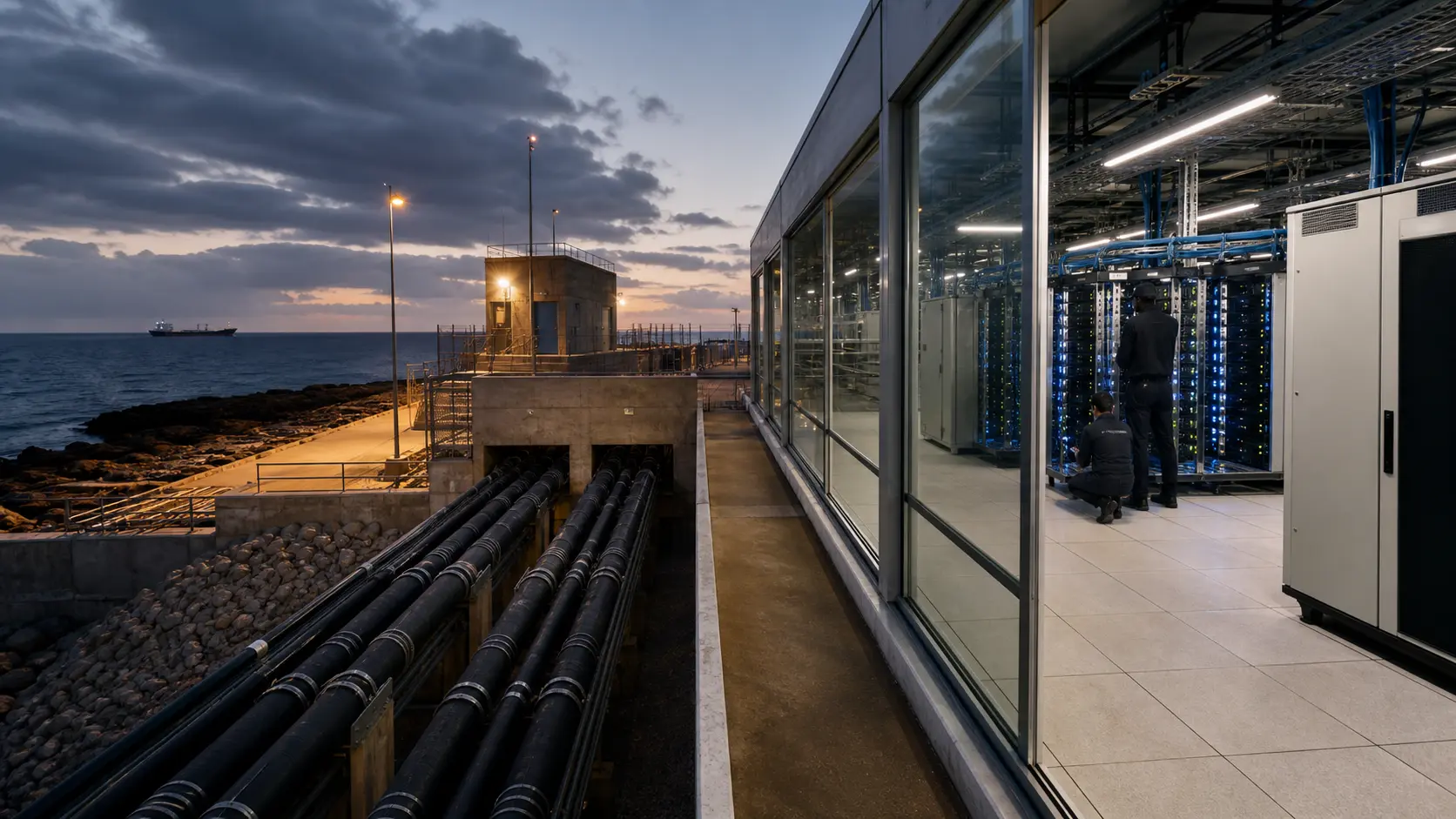
The most revealing Angola Cables asset may not be under the ocean. It is AngoNAP Fortaleza, because that is where the cable route becomes inventory a customer can actually use. Developing Telecoms reported in 2019 that Angola Cables opened its carrier-neutral AngoNAP data centre in Fortaleza, and that the facility would host SACS, MONET, other international submarine systems, backhaul providers, content providers, CDNs and research and academic exchange points in Latin America (https://developingtelecoms.com/telecom-technology/data-centres-networks/8464-angola-cables-opens-data-centre-in-brazil.html). This is the right architecture for a toll road. A cable landing without a local ecosystem is a highway exit into a field. A cable landing with carriers, peers, CDNs and cloud links can become a market.
Fortaleza is also where the company's strategy looks most capital hungry. Data Center Dynamics reported in 2022 that Angola Cables planned to invest at least USD 40 million in the first expansion phase of AngoNAP Fortaleza, tripling storage capacity to about 500 racks and taking installed power capacity to 5 MW, while the first phase covered about 2,100 square metres and the site had room for future expansion (https://www.datacenterdynamics.com/en/news/angola-cables-planning-expansion-of-angonap-data-center-in-fortaleza/). In 2024, DCD reported plans for a second Fortaleza data centre next to the existing site, spanning about 960 square metres, with investment up to 400 million reais, about USD 80 million at the quoted conversion (https://www.datacenterdynamics.com/en/news/angola-cables-to-build-second-data-center-in-fortaleza-brazil/). These are not trivial follow-on expenses for an Angolan-rooted carrier.
The economic logic is clear. Data-centre space captures value that raw capacity alone may not. A wholesale buyer that lands traffic in Fortaleza may also need racks, power, cross-connects, remote hands, security, peering, cloud onramps and local Brazilian routes. A content company may want caches near a cable landing. A bank may want a controlled facility that links Angola, Brazil and Europe without relying entirely on remote third-party handoffs. A cloud reseller may want to sell African customers access to a Brazil-U.S. route with a service wrapper.
In each case, Angola Cables' margin improves if it sells a managed route and facility stack rather than commodity megabits.
The cost logic is equally clear. Data centres do not forgive weak power planning. A 5 MW installed-power claim means capital tied up in electrical rooms, generators, UPS systems, switchgear, cooling, maintenance contracts, fire suppression, physical security, specialised labour and compliance. It also exposes the company to Brazil's data-centre competition. Fortaleza is attractive because subsea cables land there and IX.br Fortaleza has become a large exchange hub, but that same attractiveness brings rivals and substitutes.
If buyers can colocate with another carrier-neutral facility, connect through Ascenty, Equinix, local IX.br participants or cloud-network overlays, Angola Cables has to prove why AngoNAP's combination of SACS, MONET and African reach is worth the relationship.
The company appears to understand this, because its recent partnership story is less about one cable and more about interconnection. Megaport-related coverage said Angola Cables and Megaport would give African customers access to hundreds of data centres and hundreds of cloud nodes through a virtual network arrangement, with key interconnects in places such as New York, Miami and London (https://satelliteprome.com/news/angola-cables-and-megaport-to-expand-global-digital-connectivity/, https://www.intelligentcio.com/africa/2025/04/04/angola-cables-and-megaport-to-interconnect-in-new-york-miami-london/). MEO Wholesale Solutions and TelCables Europa by Angola Cables announced a 2025 strategic partnership to strengthen international data-centre connectivity between Portugal and Angola Cables' AngoNAP Fortaleza hub using the South Atlantic cable ring (https://en.institutional.meo.pt/media/press/2025/june/parceria-estrategica-entre-meo-e-telcables-europa-by-angola-cables-reforca-ligacao-internacional-entre-data-centers). Uniti Wholesale partnership coverage in 2026 pointed to U.S. terrestrial reach across more than 300 metro markets and 386,000 km of fibre route infrastructure (https://www.intelligentcio.com/north-america/2026/05/21/angola-cables-expands-transatlantic-and-regional-reach-through-uniti-wholesale-partnership/).
These partnerships are market signals, not proof of utilisation. They show the sales problem Angola Cables is trying to solve. The company has a rare route, but rare routes need distribution. Megaport can make cloud access easier. MEO can strengthen the Portugal side. Uniti can extend reach inside the United States. Ciena can add optical capacity and improve monitoring. The better the partner web, the less Angola Cables looks like a single-country cable owner asking buyers to accept unusual risk.
The worse the partner execution, the more the route becomes a specialist path used only when customers have a very specific Africa-Brazil requirement.
The dollar-cost problem
Submarine cables are built in dollars, upgraded with imported optical equipment and maintained through specialised global supply chains. Angola Cables earns some revenue in foreign-currency-linked wholesale markets, especially where customers are international carriers, content providers or cloud-related buyers. But its Angolan base exposes it to macro conditions that do not match the currency of much of the cost base. The IMF's 2025 Angola Article IV statement said the kwanza depreciated by over 10% against the U.S. dollar in 2024, with high external debt service and market expectations weighing on the exchange rate (https://www.imf.org/en/news/articles/2025/02/24/pr-2541-angola-imf-executive-board-concludes-2024-article-iv-consultation). In 2026, the IMF said Angola's 2025 growth held up at 3.1%, inflation eased to 12.4% by March 2026, but lower oil production weakened fiscal and external positions and the current-account balance fell to a preliminary 0.4% of GDP (https://www.imf.org/en/news/articles/2026/05/01/pr26135imf-executive-board-concludes-2026-article-iv-consultation-with-angola).
That macro setting changes the economics of a cable operator. If a supplier invoice is in dollars and a meaningful portion of domestic receipts, wages, taxes or local services are in kwanza, currency volatility becomes part of network cost. If the state or state-linked shareholders affect capital allocation, oil revenue and public-sector liquidity can indirectly affect infrastructure timing. If Angola's import and foreign-exchange market is tight, equipment spares, generator parts, fuel, batteries, optical modules and vendor support become less predictable.
The company can hedge some of this by earning dollar-linked wholesale revenue and by placing a major operating node in Brazil, but the risk does not disappear.
Power is the second cost problem. World Bank data show Angola's electricity access at 51.1% of the population in 2023 (https://data.worldbank.org/indicator/EG.ELC.ACCS.ZS?locations=AO). World Bank Enterprise Surveys' 2024 Angola country profile said reliable electricity is necessary for efficient private-sector operation and that inadequate electricity can raise costs, disrupt production and reduce profitability; the API for the same World Bank indicator shows 61.4% of surveyed Angolan firms experiencing electrical outages in 2024 (https://www.enterprisesurveys.org/content/dam/enterprisesurveys/documents/country/Angola-2024.pdf, https://data.worldbank.org/indicator/IC.ELC.OUTG.ZS?locations=AO). For an ordinary shop, that means lost sales. For a landing station or data centre, it means duplicated power systems, fuel logistics, maintenance discipline and higher total cost of reliability.
AngoNAP Fortaleza lowers part of that Angola power exposure because Brazil is a different grid and regulatory environment. But the Angola side still matters. SACS lands in Angola, AngoNAP Luanda is part of the company's facility story, and Angonix is in Luanda. PeeringDB lists AngoNAP Luanda among Angola Cables' interconnection facilities (https://www.peeringdb.com/net/4894). The official Angonix site describes the platform as an internet exchange in Angola, shows a traffic peak above 46 Gbps, more than 23 ISPs and a 99.99% availability claim (https://www.angonix.net/). Packet Clearing House lists ANGONIX in Luanda, established in March 2015, with facilities that include Angola Cable Datacenter / AngoNAP (https://www.pch.net/ixp/details/1848). These local facilities create value only if Angola-side power and operations are credible.
The capex burden is also optical. Ciena said in 2021 that Angola Cables added 2.2 Tbps of capacity to MONET segments connecting Miami, Fortaleza and Sao Paulo, using GeoMesh technology, and that the upgrade reduced power, space and operational complexity by optically bypassing cable landing stations between Sao Paulo and Miami (https://www.ciena.com/about/newsroom/press-releases/angola-cables-boosts-capacity-on-monet-submarine-cable-network-with-ciena.html). That is valuable, but it also shows how the toll road must keep upgrading. Capacity that was strategic in 2018 becomes table stakes in 2026 as video, cloud, enterprise backup, gaming and machine-generated traffic grow. A cable owner cannot simply harvest the route after construction. It has to keep turning capital into lit, saleable, supportable capacity.
The unit economics are therefore not "build cable, collect rent." They are closer to "build cable, light capacity, fill racks, sell routes, manage peers, add partners, pay power bills, repair faults, refresh optics, absorb currency shocks and keep enough utilisation to cover fixed costs." The economics can be attractive because incremental capacity on a lit system may be sold at high contribution once the fixed platform exists. They can also be punishing because the fixed platform is large and demand may arrive unevenly. A content customer can shift traffic. A cloud partner can route through another market.
A bank can decide compliance risk outweighs latency. A wholesale carrier can negotiate hard if capacity is underfilled.
Who pays for the route
Angola Cables' most important customers are not ordinary households. The buyer set is wholesale carriers, mobile and fixed operators, ISPs, cloud and content platforms, CDNs, enterprise networks, financial institutions, gaming and media companies, oil and gas firms, government-linked bodies and resellers that need cross-Atlantic connectivity. Ciena's company description points to wholesale and corporate segments, access to IXPs, Tier 1 operators and global content providers (https://www.ciena.com/about/newsroom/press-releases/angola-cables-boosts-capacity-on-monet-submarine-cable-network-with-ciena.html). Developing Telecoms said AngoNAP would accommodate backhaul providers, content providers and CDNs in Latin America (https://developingtelecoms.com/telecom-technology/data-centres-networks/8464-angola-cables-opens-data-centre-in-brazil.html).
That customer mix shapes pricing. Wholesale buyers are sophisticated. They know the difference between protected and unprotected capacity, between latency average and latency jitter, between route diversity and route marketing, between a peering claim and a committed service, between list pricing and utilisation-driven discounts. They also compare Angola Cables against substitutes. A large platform may already have global backbone capacity. A Brazilian ISP may reach Europe or the United States through other cable systems. An African operator may buy from regional carriers with better terrestrial reach.
A bank may prioritise compliance and support over latency. Angola Cables' route has to solve a real pain point for each buyer.
For content and cloud customers, the pain point is often performance at the edge. Angola's digital adoption is still developing. DataReportal's 2025 Angola report estimated 17.2 million internet users at the start of 2025, or 44.8% penetration, and 28.7 million cellular mobile connections, equivalent to 74.6% of the population (https://datareportal.com/reports/digital-2025-angola). World Bank data put individuals using the internet at 40.7% of the population in 2024 (https://fred.stlouisfed.org/series/ITNETUSERP2AGO). The gap between mobile connections and active internet use means latent demand is large, but monetisation is not automatic. The route buyer wants to know whether better international paths will produce enough user engagement, paid usage, enterprise adoption or cloud spend to justify capacity commitments.
For Angolan ISPs and enterprises, Angola Cables can lower dependence on one direction of travel. Old routing through Europe or the United States made Africa-to-Brazil traffic absurdly long. SACS changes that. But an ISP or bank will not rely on one route only. The Internet Society's 2024 West Africa cable outage report showed how multiple cables off Cote d'Ivoire went offline in March 2024 and affected 13 countries, while countries with cable diversity and cross-border routes maintained more uptime (https://www.internetsociety.org/resources/doc/2024/2024-west-africa-submarine-cable-outage-report/). AfPIF's 2020 cable-cut event summary described WACS and SAT-3 cuts that caused degradation or outages in parts of West and Southern Africa, with rerouting through other networks and repair processes that could take a month or two depending on conditions (https://www.afpif.org/virtual-peering-series-africa/impact-of-submarine-cable-cuts-in-africa/event-summary/). These events make route diversity valuable, but they also remind buyers to diversify away from any single operator.
For global carriers, Angola Cables is both a supplier and a competitor. Its routing policy PDF lists communities for upstream routes in Angola, South Africa, Nigeria, Ghana, Europe, Portugal, France, the Netherlands, the United Kingdom, Brazil, the United States and Singapore; it also lists IXP and partner communities for Angonix, NAPAfrica, IXPN, GigaPIX, France-IX, AMS-IX, LINX, IX.br locations, Equinix, Google, Facebook, Akamai, Cloudflare, Netflix, Amazon, Globo, CDN77 and other names or locations (https://angolacables.co.ao/routes-table/IP-Network-Routing-Policy-v2024.pdf). A buyer should not treat every community label as a current commercial contract of equal depth. It is, however, strong evidence that Angola Cables manages a complex routing environment and wants wholesale customers to steer traffic deliberately.
For financial institutions and public-sector customers, the value proposition is control. Angola has banks, public services, oil and gas operations, telecom operators and government bodies whose data dependence is growing but whose tolerance for delay, outage and jurisdictional uncertainty differs from a consumer app. Angola Cables can pitch a route that stays closer to Lusophone and South Atlantic corridors rather than defaulting through Northern Hemisphere hubs. The buyer's question is whether that control is operationally and legally bankable. Does the contract specify restoration? Is the path genuinely diverse?
Are the facilities audited? Are cross-connects timely? Are support engineers reachable? Does the route stay stable during cable incidents? Those are the questions that turn national infrastructure into revenue.
Competition is not only another cable
The obvious competitor is another submarine cable, but the real competition is the buyer's ability to assemble a good-enough path elsewhere. Google-backed Equiano, Meta-led 2Africa, MainOne, SAT-3, ACE, WACS, EASSy, Seacom, terrestrial routes through South Africa, North African and European hubs, Brazilian domestic backbones, cloud backbones and carrier-neutral data centres all weaken any single route's pricing power. The Internet Society outage report notes that Equiano helped maintain uptime for several affected countries during the March 2024 West Africa outage because it did not terminate at the same Cote d'Ivoire failure point (https://www.internetsociety.org/resources/doc/2024/2024-west-africa-submarine-cable-outage-report/). That is exactly the kind of evidence buyers use when they demand diversity.
Angola Cables' defense is that SACS is a specific geography, not just another wet segment. The South Atlantic shortcut is hard to replicate casually. A new cable can be announced, but marine survey, permitting, financing, manufacture, landing rights, consortium alignment, construction and lighting take years. The SACS route has been operating since 2018. The company also has a Brazilian data-centre and interconnection strategy rather than a bare landing. Those are real barriers. The question is whether they are enough to sustain pricing once hyperscale cables and cloud backbones reshape global traffic.
A hyperscaler does not need to pay a specialist toll if it owns or controls enough alternative path and can optimise traffic internally.
Brazilian interconnection is also competitive. Fortaleza is not a private company town. IX.br, Ascenty, carrier-neutral facilities, domestic fibre providers and cloud-network partners give buyers multiple ways to reach Brazil's internet ecosystem. PeeringDB shows Angola Cables present at AngoNAP Fortaleza and other Brazilian facilities, but a presence does not guarantee dominance (https://www.peeringdb.com/net/4894). BGP.tools shows AS37468 at IX.br Sao Paulo, IX.br Fortaleza-related locations, GigaPIX, Equinix Miami, DE-CIX Frankfurt and other exchanges, but it also lists many upstream and peering relationships that prove traffic can choose paths rather than remain captive (https://bgp.tools/as/37468). The more liquid the exchange environment, the harder it is to charge a monopoly rent.
On the Angola side, competition includes national operators and alternative access technologies. DataReportal's mobile and internet adoption numbers suggest growth room, but the domestic ability to pay for premium connectivity remains limited by income, devices, electricity, enterprise digitisation and currency conditions (https://datareportal.com/reports/digital-2025-angola). Satellite systems and new terrestrial projects can fill some remote demand. Government programmes can extend connectivity but may route procurement through political or budget cycles. Angola Cables therefore cannot rely only on domestic retail growth to fill international capacity. It needs cross-border traffic, wholesale resale and enterprise/cloud demand.
There is also a trust competition. A buyer can choose a global carrier with a larger balance sheet, a hyperscaler with integrated cloud reach, a regional African carrier with terrestrial relationships, or a Brazilian data-centre operator with local sales depth. Angola Cables has to turn its unusual route into a trust premium rather than a perceived risk discount. The company can do that if it proves uptime, route transparency, strong peering, fast cross-connects, credible support and transparent pricing. It cannot do it merely by saying it connects continents.
Market signals from routing, exchanges and chatter
The strongest non-financial market signal is public routing data. ASRank's snapshot of AS37468 shows a large customer cone and high global connectivity metrics (https://asrank.caida.org/asns/37468). BGP.tools shows many public exchange points and upstreams, including 100 Gbps-facing presences at some major exchanges and many lower-capacity sessions elsewhere (https://bgp.tools/as/37468). PeeringDB shows open interconnection facilities and public peering exchange points (https://www.peeringdb.com/net/4894). Cloudflare Radar maintains a routing page for AS37468 that tracks announced space and routing statistics over time (https://radar.cloudflare.com/routing/as37468). None of these sources proves revenue, margin or customer satisfaction. Together, they show that Angola Cables is visible in the public internet's operational fabric.
The second signal is Angonix. The official Angonix website shows a traffic peak above 46 Gbps, more than 23 ISPs, seventh position in Africa and 99.99% availability as public-facing claims (https://www.angonix.net/). PCH lists ANGONIX as active in Luanda, established in March 2015 (https://www.pch.net/ixp/details/1848). The market interpretation is mixed but useful. A local exchange helps keep local traffic local and can make caches, content providers and domestic operators more efficient. Yet 46 Gbps is small compared with the biggest global IXPs and even compared with major African exchange hubs. Angonix is valuable as an Angolan control point; it is not by itself evidence that Angola has become a huge content market.
The third signal is the way cable incidents reshape buyer thinking. The 2024 West Africa outage made diversity more than a sales phrase. Internet Society said multiple cables were offline and 13 countries saw degraded or near-total outages, and it explicitly argued for more submarine and terrestrial diversity, locally hosted content and IXPs (https://www.internetsociety.org/resources/doc/2024/2024-west-africa-submarine-cable-outage-report/). AfPIF's earlier event summary noted that cable cuts can cost operators USD 2 million or more to repair and can take a month or two, depending on weather and conditions (https://www.afpif.org/virtual-peering-series-africa/impact-of-submarine-cable-cuts-in-africa/event-summary/). For Angola Cables, this is a sales opportunity and a warning. Buyers will pay for diversity, but they will also ask whether Angola Cables' own routes create new single points of failure.
The fourth signal is partnership volume. MEO, Megaport, Ciena and Uniti are not proof of traffic fill, but they indicate that Angola Cables is trying to connect the South Atlantic route into larger commercial ecosystems (https://en.institutional.meo.pt/media/press/2025/june/parceria-estrategica-entre-meo-e-telcables-europa-by-angola-cables-reforca-ligacao-internacional-entre-data-centers, https://satelliteprome.com/news/angola-cables-and-megaport-to-expand-global-digital-connectivity/, https://www.ciena.com/about/newsroom/press-releases/angola-cables-boosts-capacity-on-monet-submarine-cable-network-with-ciena.html, https://www.intelligentcio.com/north-america/2026/05/21/angola-cables-expands-transatlantic-and-regional-reach-through-uniti-wholesale-partnership/). The market signal to watch is whether those partnerships become repeatable revenue, not whether they produce announcements. If enterprise and carrier customers start treating Angola Cables as a default South Atlantic route supplier, the toll road gains pricing power. If the partnerships remain episodic, the company remains a specialist path with a high fixed-cost base.
The fifth signal is the absence of conventional consumer chatter. Angola Cables is not a mass retail mobile brand, so the usual complaint forums are less informative. The more useful informal evidence comes from network operators' public peering pages, exchange presence, outage reports, conference presentations and trade reporting. That evidence suggests a company with real infrastructure and a distinctive route, but it does not settle utilisation, profitability, churn, contract duration, debt service, power cost or repair reserves. The article's judgment therefore rests on mechanism rather than on an assumed financial result.
Regulation and geopolitics are part of the margin
Angola Cables' strategic value is inseparable from Angola's national telecom policy. INACOM describes itself as the Angolan body created to regulate, supervise and oversee electronic communications and postal services (https://inacom.gov.ao/). The state has repeatedly presented Angola as seeking a stronger regional telecom role, and public INACOM-linked news in 2025 referred to the ambition to transform Angola into a regional telecommunications hub (https://inacom.gov.ao/2025/10/23/transformar-angola-num-hub-regional-de-telecomunicacoes/). A South Atlantic cable platform fits that ambition. It gives Angola an infrastructure claim beyond its domestic market size.
The geopolitical upside is that Angola Cables can position the country as a route between continents rather than a peripheral end market. That matters for banks, cloud access, research networks, content distribution and state digital services. It also matters for Brazil, Portugal and Lusophone commercial links. A buyer whose risk team understands Angola's politics may still find the route attractive if the alternative is worse latency, less diversity or dependence on congested Northern Hemisphere paths.
The geopolitical downside is that national infrastructure often carries national constraints. State-linked shareholders may have policy goals as well as commercial goals. Oil revenue swings affect Angola's public economy. Foreign-exchange liquidity affects imported equipment. Public procurement and telecom regulation can move slowly. FATF and governance concerns can affect financial counterparties. The IMF's 2026 statement called for stronger governance, improved business regulation, deeper financial intermediation and measures to reduce banking-sector vulnerabilities (https://www.imf.org/en/news/articles/2026/05/01/pr26135imf-executive-board-concludes-2026-article-iv-consultation-with-angola). Those are not Angola Cables-specific defects, but they are part of the country-risk discount that sophisticated buyers price.
Brazil adds another jurisdiction. AngoNAP Fortaleza and MONET make Brazil central to Angola Cables' Americas strategy. That helps because Brazil has a large internet market, major exchanges, data-centre demand and cloud growth. It complicates operations because Angola Cables has to maintain Brazilian regulatory, labour, energy, tax and competitive execution while preserving the Angolan route advantage. The company's 2023 rebrand of Brazilian operations as TelCables Brasil, described in submarine-network coverage, indicates an effort to localise the Brazil-facing business (https://www.submarinenetworks.com/en/systems/brazil-africa/sacs). That is sensible. A Brazilian buyer is more likely to trust a locally serious operator than a distant cable owner.
The U.S. extension through MONET and Uniti-style partnerships adds a third jurisdiction. That is commercially necessary because U.S. cloud, content and enterprise ecosystems are too important to ignore. It also exposes Angola Cables to the bargaining power of U.S. carriers, cloud providers and data-centre ecosystems. The company's route can enter Miami or Boca Raton, but it then competes inside a dense market with many alternatives. The South Atlantic route is distinctive until it lands in a liquid hub; after that, the route must keep proving why it is more than one option among many.
The judgment
Angola Cables is valuable because it owns a route that can change the shape of traffic, not because it is large in the way a global carrier is large. Its strongest asset is the SACS-MONET-WACS triangle, reinforced by AngoNAP Fortaleza, AngoNAP Luanda, Angonix and public exchange presence. Its strongest business case is not generic African connectivity. It is a specific promise: if a buyer needs reliable, lower-latency, more diverse traffic between Africa, Brazil, the United States and Europe, Angola Cables can make the South Atlantic path operational rather than exotic.
The company's weakness is that the same specificity narrows the addressable premium. Not every buyer needs South Atlantic optimisation. Many can accept detours if the price is lower or if global carriers bundle the route into broader contracts. Hyperscalers and large CDNs can internalise traffic decisions. Brazilian data-centre operators and exchange participants can capture some of the value near Fortaleza. Angola's domestic market has growth potential, but internet penetration, power reliability and income levels limit immediate monetisation. Currency and power risk raise the cost of doing the work.
Submarine repair risk makes route diversity sellable but also forces Angola Cables to fund its own resilience.
The most likely successful version of Angola Cables is therefore a disciplined specialist, not a broad telecom empire. It should win where the buyer needs South Atlantic performance, Angola-Brazil-Lusophone reach, African edge access, Fortaleza interconnection, managed remote peering or route diversity after West African cable incidents. It should avoid pretending that all traffic will pay a premium for geography. The toll road earns money when it connects scarce origin-destination pairs and when the ramps are easy to use.
It loses money if it overbuilds data-centre capacity before demand, if dollar-linked upgrades outrun customer commitments, or if routing quality fails to convert physical distance into user experience.
The facts that would change this judgment are concrete. First, audited or lender-grade financials showing high utilisation, stable EBITDA, low leverage and foreign-currency revenue cover would reduce the macro-risk discount. Second, public utilisation data for SACS, MONET and AngoNAP, including committed wholesale contracts and rack occupancy, would show whether the toll road is filling. Third, independent uptime, repair and route-performance data across cable incidents would prove whether buyers are getting resilience rather than just a different path.
Fourth, evidence that Angonix and AngoNAP Luanda are attracting more high-value local caches, banks, clouds and enterprise networks would show that Angola-side demand is becoming real. Fifth, a weaker exchange-rate, power or shareholder-governance environment would do the opposite, turning route scarcity into a risk premium that customers demand Angola Cables absorb.
For now, the buyer at the Atlantic fork should treat Angola Cables as a serious infrastructure counterparty with a rare asset and a hard cost base. The route is real. The latency case is real. The data-centre and peering strategy is coherent. The risk is also real: a South Atlantic shortcut has to be paid for in the same dollars, electricity, repairs, optics, engineering labour and trust as any other global network. Angola Cables' economics will be decided by whether enough buyers find that shortcut essential rather than merely interesting.
Evidence register
The company identity and directory link are anchored by RIPE NCC's Angola member page, Angola Cables' own company page and its connectivity service page: https://www.ripe.net/membership/member-support/list-of-members/ao/angola/, https://www.angolacables.co.ao/sobre, https://www.angolacables.co.ao/conectividade. Ownership and national-infrastructure context are supported by the U.S. International Trade Administration, The Worldfolio, Freedom House and NEC's 2014 SACS investment release: https://www.trade.gov/market-intelligence/angola-information-and-communications-technology, https://www.theworldfolio.com/news/angola-telecoms-movi/3465/, https://freedomhouse.org/country/angola/freedom-net/2024, https://www.nec.com/en/press/201411/global_20141104_04.html.
The SACS argument rests on NEC's 2018 ready-for-service announcement, the 2017 milestone release, Submarine Cable Map, Angola Cables' LACNIC and IX Forum latency presentations, and CAIDA's independent routing-effects study: https://www.nec.com/en/press/201810/global_20181001_02.html, https://www.newswire.ca/news-releases/angola-cables-cable-system-connecting-africa-and-the-americas-reaches-a-major-milestones-to-create-a-new-route-for-internet-traffic-619956023.html, https://www.submarinecablemap.com/submarine-cable/south-atlantic-cable-system-sacs, https://www.lacnic.net/innovaportal/file/3209/1/sacs_lightning_talk_lacnic30.pdf, https://forum.ix.br/files/apresentacao/arquivo/422/23%20-%20SACS_Lightning_Talk_IX%20F%C3%B3rum%2012_alterado11.12.pdf, https://blog.caida.org/best_available_data/2020/12/15/unintended-consequences-of-submarine-cable-deployment-on-internet-routing/.
The MONET, WACS, Fortaleza and upgrade analysis uses Ciena, Submarine Cable Map, Developing Telecoms and Data Center Dynamics: https://www.ciena.com/about/newsroom/press-releases/Angola-Cables-Selects-Ciena-for-MONET-Subsea-Cable-System.html, https://www.submarinecablemap.com/submarine-cable/monet, https://www.submarinecablemap.com/submarine-cable/west-africa-cable-system-wacs, https://www.ciena.com/about/newsroom/press-releases/angola-cables-boosts-capacity-on-monet-submarine-cable-network-with-ciena.html, https://developingtelecoms.com/telecom-technology/data-centres-networks/8464-angola-cables-opens-data-centre-in-brazil.html, https://www.datacenterdynamics.com/en/news/angola-cables-planning-expansion-of-angonap-data-center-in-fortaleza/, https://www.datacenterdynamics.com/en/news/angola-cables-to-build-second-data-center-in-fortaleza-brazil/.
The partnership, routing and exchange signals come from Megaport-related trade coverage, MEO, Uniti, PeeringDB, BGP.tools, CAIDA AS Rank, Cloudflare Radar, Angola Cables' routing policy, Angonix and PCH: https://satelliteprome.com/news/angola-cables-and-megaport-to-expand-global-digital-connectivity/, https://www.intelligentcio.com/africa/2025/04/04/angola-cables-and-megaport-to-interconnect-in-new-york-miami-london/, https://en.institutional.meo.pt/media/press/2025/june/parceria-estrategica-entre-meo-e-telcables-europa-by-angola-cables-reforca-ligacao-internacional-entre-data-centers, https://www.intelligentcio.com/north-america/2026/05/21/angola-cables-expands-transatlantic-and-regional-reach-through-uniti-wholesale-partnership/, https://www.peeringdb.com/net/4894, https://bgp.tools/as/37468, https://asrank.caida.org/asns/37468, https://radar.cloudflare.com/routing/as37468, https://angolacables.co.ao/routes-table/IP-Network-Routing-Policy-v2024.pdf, https://www.angonix.net/, https://www.pch.net/ixp/details/1848.
The Angola market, macro, power, resilience and regulatory context is supported by DataReportal, World Bank/FRED internet-use data, World Bank electricity and outage indicators, the Enterprise Surveys profile, IMF Article IV statements, Internet Society, AfPIF and INACOM: https://datareportal.com/reports/digital-2025-angola, https://fred.stlouisfed.org/series/ITNETUSERP2AGO, https://data.worldbank.org/indicator/EG.ELC.ACCS.ZS?locations=AO, https://data.worldbank.org/indicator/IC.ELC.OUTG.ZS?locations=AO, https://www.enterprisesurveys.org/content/dam/enterprisesurveys/documents/country/Angola-2024.pdf, https://www.imf.org/en/news/articles/2025/02/24/pr-2541-angola-imf-executive-board-concludes-2024-article-iv-consultation, https://www.imf.org/en/news/articles/2026/05/01/pr26135imf-executive-board-concludes-2026-article-iv-consultation-with-angola, https://www.internetsociety.org/resources/doc/2024/2024-west-africa-submarine-cable-outage-report/, https://www.afpif.org/virtual-peering-series-africa/impact-of-submarine-cable-cuts-in-africa/event-summary/, https://inacom.gov.ao/, https://inacom.gov.ao/2025/10/23/transformar-angola-num-hub-regional-de-telecomunicacoes/.