
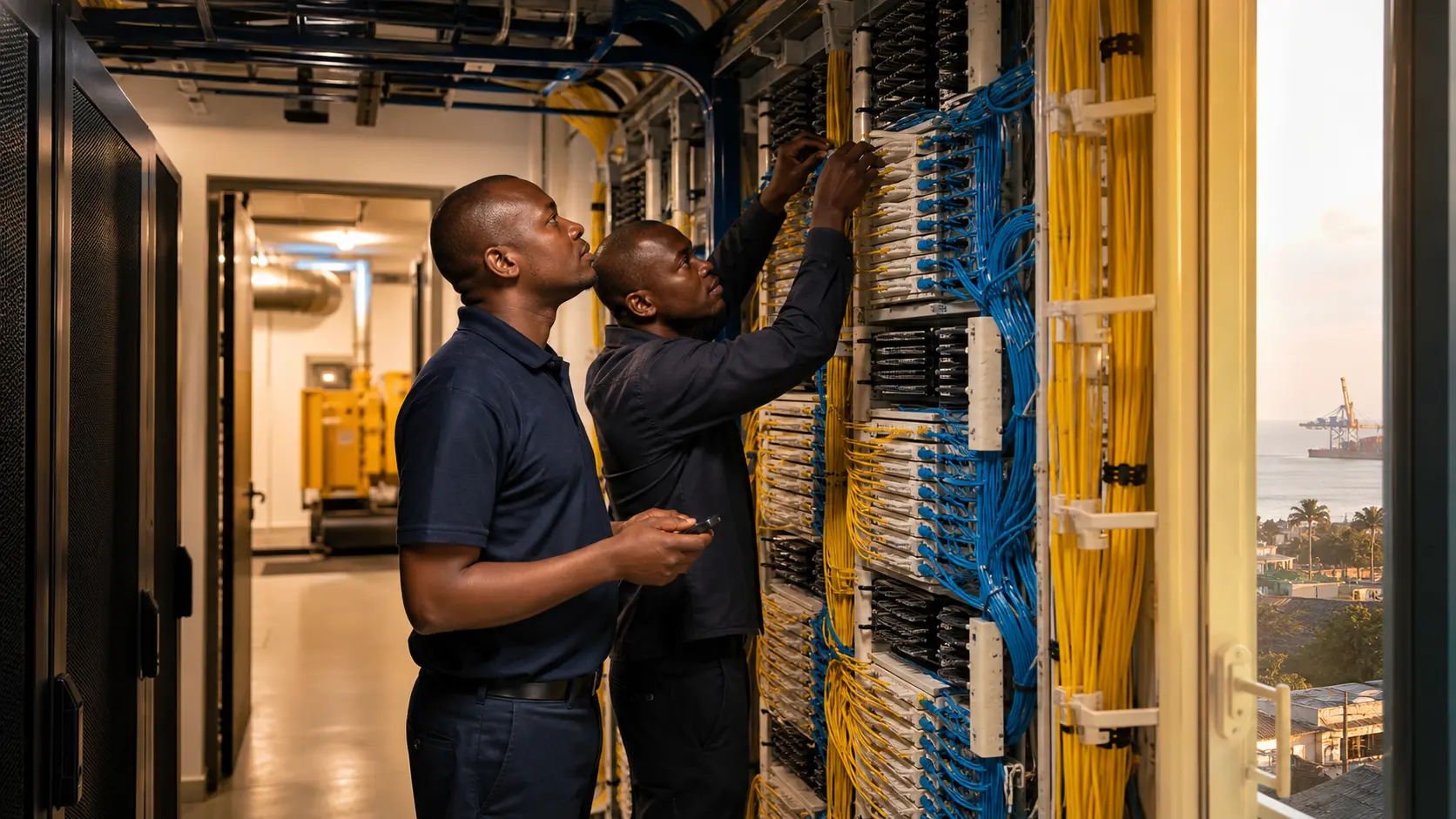
Summary
- What it says: iColo's useful question is not whether Kenya needs data centers. It is whether Nairobi demand, Mombasa cable gravity and Digital Realty capital can make East African carrier-neutral colocation cheaper and more reliable than sending too much regional traffic, enterprise risk and c
- Main topic: Hosting economics; Cloud service dependency; Data centre investment
- Context: market / company research report / Kenya / East Africa
The buyer has three maps, and none of them agrees
The buyer is a regional content platform with paying users in Kenya, Uganda, Tanzania and Rwanda. The finance team wants a simple answer: put the core origin and cache infrastructure where the monthly bill is most predictable. The network team wants the opposite: keep traffic close to the cables, the local exchanges and the mobile operators, even if the facility bill is not the lowest number on paper. The legal team asks whether East African user data can sit in South Africa without adding regulatory friction.
The product team asks why a customer in Mombasa should wait for a round trip through Johannesburg when the landing stations are down the road. The board asks the harder question: if Nairobi demand is real and Mombasa is the cable gateway, why does so much African cloud gravity still point south?
That is the economic room in which iColo matters. The company presents itself at https://www.icolo.io/ as a carrier-neutral data-center operator with campuses from Mombasa to Nairobi and Maputo. Its official location pages list Mombasa One, Mombasa Two, Nairobi One and Maputo One, with Mombasa and Nairobi doing the main work for this East African choice. Digital Realty's Nairobi page at https://www.digitalrealty.com/data-centers/emea/nairobi says the metro offers 31.8k square feet of total colocation space, 5.4k square metres, more than 60 cloud and network service providers and more than 70 customers. Digital Realty's Mombasa page at https://www.digitalrealty.com/data-centers/emea/mombasa says the metro offers 35k square feet of colocation space, 7k square metres, more than 50 cloud and network service providers and more than 55 customers; the same page says its Mombasa data centers connect into 74 networks, two internet exchanges and seven subsea cables.
For the buyer, those numbers are not decoration. They decide whether a Kenyan deployment can be more than a symbolic edge node. If the buyer colocates in Nairobi, it is near banks, public-sector buyers, enterprise headquarters, regional cloud teams, local carriers and the country's deepest demand pool. If it colocates in Mombasa, it is closer to the beach manholes, submarine-cable operators and coastal interconnection logic that decide where international traffic enters East Africa.
If it goes to South Africa, it gains the continent's most mature cloud and colocation ecosystem, including AWS Africa (Cape Town), Azure regions in Johannesburg and Cape Town, Google Cloud's Johannesburg region and Teraco's large interconnection platform. But it also accepts distance, route dependency and the political awkwardness of telling East African customers that local digital services still need a southern detour.
iColo's proposition is therefore a spread trade. It sells the difference between regional proximity and southern scale. The company is valuable when the latency saved, transit avoided, resilience gained, regulatory comfort created and customer trust earned are worth more than the higher friction of building in a smaller, power-sensitive, still-developing data-center market. It is weaker if South African cloud regions, carrier density and price competition can serve East African customers well enough at lower risk.
The judgement turns on facilities, power, cable routes, cross-connect density, cloud demand and what Digital Realty ownership actually changes.
The company is a set of switching points, not only a landlord
iColo's public identity is unusually legible for an East African private infrastructure company. The current brand is "iColo: A Digital Realty Company." The official service page at https://www.icolo.io/news/services/data-center/ describes iColo as designing, building and operating carrier-neutral data centers in Kenya and Mozambique for telecom carriers, internet service providers, peering points, IT and cloud providers, content providers, enterprises and financial services customers. The website is not selling a single building; it is selling a place where independent networks, cloud buyers and enterprise workloads can meet without giving one telecom operator control over the room.
The ownership trail matters because colocation buyers underwrite both the building and the sponsor. Interxion announced on 19 December 2019 that it had entered into an agreement to acquire a controlling interest in Icolo and form a strategic partnership with Pembani Remgro Infrastructure Fund: https://www.nasdaq.com/press-release/interxion-enters-into-agreement-for-controlling-interest-in-icolo-and-establishes. The announcement said Icolo had two operating Kenyan data centers, strong demand from cloud and content platforms and enterprise customers, and land acquisitions in Mombasa and Nairobi that could take Kenya capacity toward roughly 20MW. Digital Realty then completed its combination with Interxion in 2020, and iColo now sits under the Digital Realty brand. Digital Realty's later Africa expansion announcement at https://www.prnewswire.com/news-releases/digital-realty-expands-coverage-and-capacity-of-platformdigital-across-africa-301407687.html also describes the wider Africa strategy with Pembani Remgro.
This matters for two reasons. First, Digital Realty gives iColo a different capital and credibility profile from a local property owner with a server-room lease. The buyer can believe that technical design, compliance language, global-account sales and future expansion have institutional backing. Second, the ownership does not erase local execution risk.
The facility still depends on Kenyan power, Mombasa route economics, Nairobi enterprise adoption, local engineering labour, exchange participation and customer willingness to sign colocation contracts in a market where many workloads have historically gone to telco rooms, on-premises closets, South African regions or European hosts.
The current footprint makes the point. iColo's homepage lists Maputo One with 0.2MW of IT power and 5,000 square metres of total area; Mombasa One with 0.9MW and 4,000 square metres; and Mombasa Two with 1.75MW and 4,000 square metres: https://www.icolo.io/. The older official solar note at https://www.icolo.io/news/contributing-positively-to-kenyas-renewable-energy-grid-with-solar/ says NBO1 and MBA1 could deliver 825kW and 675kW of customer power respectively. The newer iColo solar expansion note at https://www.icolo.io/news/icolo-a-digital-realty-company-expands-renewable-energy-footprint-with-installation-of-solar-panels-in-kenya/ says NBO2 has a 6.5MW IT load and was expected to come online in Q3 2025; it also says iColo's Kenyan master plan includes three data centers, a captive substation and more than 20MW of expected full-capacity consumption. Digital Realty's NBO2 page at https://www.digitalrealty.com/data-centers/emea/nairobi/nbo2 now markets the Nairobi NBO2 facility, listing 11,811 square feet, 3,600 square metres, 2N UPS redundancy and N+2 cooling.
The public numbers are not perfectly uniform because facility pages use different measures: IT load, IT power, total campus area, building size, white space and customer space. That is common in data-center marketing, but it changes how investors should read the story. The tightest public claim is that iColo has small but strategically located live facilities in Nairobi and Mombasa, with Mombasa Two adding a larger coastal room, NBO2 adding a more serious Nairobi growth block, and the broader Kenyan plan aspiring to a much larger power draw. The company is not yet Teraco-scale.
It is an East African interconnection wedge with expansion optionality.
Mombasa is a cable gateway only when networks meet there
Mombasa gives iColo the most distinctive geography in the portfolio. The city is Kenya's large seaport and the country's East African cable gateway. Digital Realty's MBA1 page at https://www.digitalrealty.com/data-centers/emea/mombasa/mba1 describes Mombasa MBA1 as near the subsea cables connecting EMEA to the rest of the world, with 17,000 square feet, 1,579 square metres, 2N UPS redundancy, N+1 cooling, PCI-DSS and ISO 27001 references, onsite security, CCTV backup and biometric or photo-badge access. Digital Realty's MBA2 page at https://www.digitalrealty.com/data-centers/emea/mombasa/mba2 describes MBA2 on Kongoni Road, off Beach Road, with 18,000 square feet, 5,486 square metres, 2N UPS, N+2 cooling and similar security and compliance features.
iColo's own facility pages add the network-market detail. Mombasa One at https://www.icolo.io/location/mba1/ says MBA1 has been operational since 2017 and that the Miritini campus can expand over time to three data centers occupying 18,000 square metres, with 13MW total IT load and 1,800 racks. It lists 250 racks, more than 80 connectivity providers, three internet exchanges and 580 square metres of customer space. Mombasa Two at https://www.icolo.io/location/mba2/ says MBA2 launched in 2022, hosts up to 600 customer racks, is near subsea cable landing points, has 4,000 square metres of campus area, 1,200 square metres of IT space, two data halls and is two kilometres from the nearest beach manhole. Those are the details a content platform cares about: how many networks are in the room, how close the facility is to the cable edge, how much space remains and whether cross-connect demand can compound.
But Mombasa's cable advantage is not automatic rent. A cable landing creates potential; an exchange fabric converts some of that potential into recurring value. The iColo announcement at https://www.icolo.io/news/icolos-mombasa-peering-expands-as-kenya-internet-exchange-point-kixp-launches-new-point-of-presence-in-mba2-data-center/ says KIXP entered MBA2 in August 2025, that iColo's Mombasa campuses are supported by seven subsea cable systems including 2Africa, and that more than 100 networks were already connected at the Mombasa campus. LINX Mombasa's public page at https://www.linx.net/network/linx-mombasa/ says LINX Mombasa runs at iColo's MBA1 and MBA2 facilities, has more than 50 member networks, a 203Gbps peak traffic figure, two data-centre locations, 100GE readiness and a first cross-connect from the iColo sites offered free of charge.
That is the economic mechanism. A coastal data center earns when networks choose to exchange and cache traffic at the coast rather than hauling everything inland or out of region. The savings are partly latency, partly transit cost, partly resilience and partly operational simplicity. If a Kenyan ISP, Ugandan network, Rwandan enterprise platform or Tanzanian content provider can reach a cache, cloud on-ramp, security provider or wholesale peer at MBA1 or MBA2, Mombasa stops being only a place where cables touch land and becomes a place where networks buy optionality.
The public peer lists show why this is plausible. The MBA1 page lists networks such as Akamai, BICS, China Mobile International, CTGNet, Hurricane Electric, Meta, MTN South Africa, Orange, PCCW Global, PCH, Safaricom, SEACOM, WIOCC and many regional ISPs. The MBA2 page lists Meta, MTN Global Connect Kenya, Safaricom, Telcoptics, WIOCC and others. PeeringDB's KIXP-Mombasa page at https://www.peeringdb.com/ix/2362 places KIXP-Mombasa at iColo Mombasa One and iColo Mombasa Two. BGP.tools' AS328162 page at https://bgp.tools/as/328162 also shows iColo present at KIXP-Mombasa, KIXP Nairobi, LINX Nairobi and Asteroid Mombasa. Cables are evidence, but cross-connect density is the business.
Nairobi sells demand; Mombasa sells route control
Nairobi has a different job. It is not the coastal gateway; it is the demand concentration. Digital Realty's Nairobi page at https://www.digitalrealty.com/data-centers/emea/nairobi frames Nairobi as Kenya's financial hub and regional headquarters location for many international companies, near backbone fibre operators, Jomo Kenyatta International Airport and the central business district. The same page says the Nairobi metro has two data centers, NBO1 and NBO2, with 31.8k square feet of total colocation space and more than 60 cloud and network providers. iColo's NBO1 page at https://www.icolo.io/location/nbo1/ says NBO1 launched in September 2019 as the first truly carrier-neutral data center in Nairobi, is located in Karen, has fibre redundancy, 280 racks, more than 60 connectivity providers, four internet exchanges and 624 square metres of total customer space.
The business case is not simply "Nairobi is a big city." It is that Kenyan demand has enough local digital intensity to justify the data-center spend. The Communications Authority of Kenya's Q2 FY 2025/2026 sector statistics report at https://www.ca.go.ke/sites/default/files/2026-04/Sector%20Statistics%20Report%20Q2%202025-2026.pdf says mobile SIM subscriptions reached 78.4 million by 31 December 2025, while mobile data subscriptions reached 61.9 million and mobile broadband represented 83.2% of mobile data subscriptions. The same report says mobile broadband consumption grew 12.0% in the quarter to 755,095.1TB, with average mobile broadband consumption per broadband subscription rising to 14.6GB and 5G users averaging 46.4GB. These figures do not tell us iColo's revenue. They explain why content, fintech, payments, public services and enterprise platforms increasingly want local infrastructure rather than only international transit.
The East Africa data-center market brief at https://cms.d4dhub.eu/assets/East-Africa-Data-Center-Markets-Brief.pdf gives a wider frame. It estimates that East Africa had nearly 30MW of live critical IT load at the end of 2024, behind Southern Africa but already the second-largest capacity block in sub-Saharan Africa. It says Nairobi, Mombasa and Addis Ababa accounted for 80% of East Africa's available data-center capacity, and that Kenya accounted for nearly half of East Africa's live critical IT load. It also argues that East Africa may need roughly 100MW of fresh capacity by 2030, with nearly three-quarters of that build in Kenya. If those estimates are directionally right, iColo's current footprint is not a finished estate; it is an option on a market that has to absorb much more cloud, content and enterprise workload over the next few years.
The buyer choosing between Nairobi and Mombasa is really choosing where each part of the stack belongs. User-facing caches, payment systems, enterprise applications, security appliances and domestic interconnection may belong in Nairobi because the customer base, regulators, auditors and corporate teams are there. International handoff, coastal resilience, subsea redundancy and regional wholesale exchange may belong in Mombasa because the cables and landing-station logic are there.
South Africa remains the large cloud and interconnection default for workloads that need mature region depth, large-scale cloud services or easier procurement. iColo's margin is strongest when it can sell a two-city Kenyan architecture: Mombasa for cable and exchange gravity; Nairobi for enterprise and financial demand; Digital Realty for confidence that both are part of a wider African platform.
Power discipline is the margin, not a sustainability footnote
Data-center economics in Kenya are power economics before they are real-estate economics. iColo's public pages advertise redundancy, but the real question is how much the customer pays for assurance in a grid that is renewable-rich yet interruption-prone. The official NBO1 page says the teleport offer has 99.999% availability on power. Digital Realty's NBO1 and NBO2 pages list 2N UPS redundancy and N+2 cooling in Nairobi. MBA1 and MBA2 pages list 2N UPS, with N+1 cooling at MBA1 and N+2 cooling at MBA2.
These are marketing and design claims, but they tell buyers what the company is trying to monetize: a reliable powered envelope in a market where grid outages remain a board-level concern.
Kenya has an unusually attractive generation story by African standards. The IEA's Kenya 2024 executive summary at https://www.iea.org/reports/kenya-2024/executive-summary says Kenya has nearly 90% of generation from renewable sources, including geothermal, hydro, wind and solar. iColo's own 2024 solar announcement says Kenya's energy generation mix was 82% renewable according to EPRA statistics and that iColo added more than 650kW of solar across Nairobi and Mombasa: more than 450kW within the NBO campus and nearly 200kW at Miritini in Mombasa. The same note says iColo wants 25% of facility power needs met by solar over time and discusses further solar space at greenfields, car parks and rooftops: https://www.icolo.io/news/icolo-a-digital-realty-company-expands-renewable-energy-footprint-with-installation-of-solar-panels-in-kenya/.
The cleaner power mix is valuable for buyers with carbon targets, but it is not the same as uninterrupted power. Kenya has seen major outages. AP reported that an August 2023 nationwide power outage left many Kenyans, including in Nairobi, without electricity for many hours and disrupted the main international airport: https://apnews.com/article/a681463711c756d415619c2e8743fd14. AfricanFinancials' Kenya Power 2025 annual-report summary at https://africanfinancials.com/document/ke-kplc-2025-ar-00/ says SAIDI improved from 120.6 hours to 113 hours and SAIFI from 47.00 to 44.07, indicating improvement but still a heavy interruption burden for ordinary customers. A data center does not use the grid like an ordinary customer, but its value proposition exists because ordinary grid experience is not enough for mission-critical infrastructure.
This is where iColo's solar additions should be read economically rather than romantically. A 650kW solar build does not power an entire multi-megawatt data-center portfolio twenty-four hours a day. Its value is in reducing grid draw during daylight, supporting renewable claims, lowering exposure to future tariff movements and signalling that power procurement is being actively managed. At a facility level, the real product remains the full reliability chain: utility feed, substation access, UPS, generator capacity, fuel planning, cooling design, maintenance discipline and response labour.
Customers pay for that chain because an outage at a payment gateway, content cache or enterprise system turns a cheap rack into an expensive failure.
NBO2 is the key test. A 6.5MW IT-load facility is a different power commitment from a few hundred racks. It moves iColo from a proof-of-market and interconnection position toward a more serious campus economics position. The company's note that its Kenyan plan includes a captive substation and more than 20MW of full-capacity consumption is the right ambition, but it also raises the underwriting bar. Large loads need grid coordination, land discipline, project execution, power pricing, cooling efficiency and sufficient customer demand to fill phases without stranding capital.
The margin is not in announcing megawatts; it is in selling them at prices that cover energy, redundancy, financing and support while still beating the buyer's alternative.
Digital Realty lowers trust cost, but South Africa still sets the benchmark
Digital Realty ownership changes iColo's cost of belief. A bank, global content platform or carrier buyer can underwrite iColo differently when the brand is attached to one of the world's largest data-center companies. Digital Realty itself describes a global footprint of more than 300 facilities in 50-plus metros and 25-plus countries on six continents on the Teraco CT2 announcement page: https://www.teraco.co.za/news/teraco-completes-ct2-data-centre-expansion/. That scale does not make a Kenyan rack identical to a Frankfurt, Singapore or Ashburn rack, but it changes procurement comfort. It also helps global accounts buy Kenya as part of a regional plan rather than as a one-off local vendor exception.
South Africa is the uncomfortable comparison. Digital Realty completed the Teraco acquisition in August 2022 and Teraco now describes itself at https://www.teraco.co.za/ as Africa's largest data-centre environment, with eight locations, 650 clients, 27,000 interconnects and 228MW of IT load. Teraco's CT2 expansion announcement says the Cape Town facility reached 50MW of critical IT load, and that total critical power load across Teraco facilities reached 189MW at that point. Those numbers dwarf iColo's public Kenyan megawatt base. They explain why a regional cloud buyer cannot ignore South Africa: it has more capacity, more mature interconnection, established cloud regions and a deeper ecosystem of specialized providers.
The cloud-region facts reinforce the point. AWS opened Africa (Cape Town), API name af-south-1, in April 2020 and said it was the first AWS region in Africa: https://aws.amazon.com/blogs/aws/now-open-aws-africa-cape-town-region/. Microsoft made Azure services generally available from Johannesburg and Cape Town in 2019 through South Africa North and South Africa West; the Azure update page remains at https://azure.microsoft.com/en-gb/updates?id=azure-south-africa-regions-are-now-available. Google Cloud opened its Johannesburg region in January 2024 and said businesses across the continent could access high-performance, secure and low-latency services from South Africa: https://cloud.google.com/blog/products/infrastructure/heita-south-africa-new-cloud-region/. A buyer that needs managed databases, enterprise cloud services and region-level platform depth may choose South Africa before it chooses Kenya.
iColo's answer cannot be to pretend Kenya is already South Africa. The answer is that East Africa has different geography and different customer economics. If a platform's users, payment partners, regulators and carriers are concentrated around Kenya and neighbouring markets, a South African deployment can be a good cloud region and still be a poor edge architecture. The money is in the difference. A South African region may host the control plane, analytics and back-office systems. Nairobi may host local enterprise systems, security appliances, payment adjacency and customer-facing caches.
Mombasa may host coastal peering, subsea-handoff resilience and regional exchange. That hybrid architecture is where iColo's Kenyan portfolio can earn.
Digital Realty's ownership also creates an internal African comparison. Digital Realty can support both Teraco and iColo without making them substitutes. Teraco serves the continent's deepest hyperscale and interconnection base. iColo serves a smaller but strategically placed East African gateway. The risk is that global customers treat iColo as a spoke to a South African hub rather than as a place to put durable workload. The upside is that a global account can buy both: South Africa for scale, Nairobi and Mombasa for proximity, and Digital Realty as the relationship layer across the deployments.
Cross-connect density is the local monopoly test
Carrier-neutral colocation becomes valuable when the building creates network effects. A rack in an empty room is an expensive cabinet. A rack in a room with carriers, cloud on-ramps, internet exchanges, content networks, security providers and regional ISPs becomes a switching option. iColo's public materials understand this. NBO1 advertises more than 60 connectivity providers and four internet exchanges. MBA1 advertises more than 80 providers and three internet exchanges. Digital Realty's Mombasa metro page says 74 networks, two internet exchanges and seven subsea cables.
The KIXP MBA2 announcement says more than 100 networks were already connected at the Mombasa campus.
The external databases broadly support the claim that iColo is not only self-describing. PeeringDB's iColo ASN page at https://www.peeringdb.com/asn/328162 describes iColo as a carrier-neutral colocation data-centre facility and lists an open peering policy. It says iColo joins public peering exchanges and shares NTP and mirror services locally. BGP.tools at https://bgp.tools/as/328162 shows AS328162, Icolo Ltd, active and allocated under AFRINIC, with four originated IPv4 /24s, upstreams including MTN Business Kenya, SEACOM, TVCABO and Frontier Optical Networks, and internet exchange points including KIXP-Mombasa, LINX Nairobi, KIXP Nairobi and Asteroid Mombasa. PeeringDB facility pages for MBA1 and MBA2, https://www.peeringdb.com/fac/5019 and https://www.peeringdb.com/fac/10232, show KIXP-Mombasa and LINX Mombasa at both coastal facilities.
AS328162 itself is not the same thing as iColo's full colocation ecosystem. The ASN is evidence of the company's own network resources and exchange presence; the facility peer lists are evidence that customers and networks are in the buildings. That distinction matters because ASNs, IP ranges and exchange memberships are not entities in the commercial sense. They are evidence about whether the facility has operational gravity.
In iColo's case, the evidence supports a meaningful but still maturing interconnection position: strong enough for East African edge and carrier-neutral colocation, not yet comparable to the largest South African hubs.
Cross-connect density has a second economic effect: it creates switching costs. Once a content platform, carrier or bank has paid for cabinets, ports, cross-connects, transit, remote hands, security review, monitoring and change-management processes, moving is not trivial. A rival can undercut monthly recurring charges, but the buyer must price service interruption, contract migration, engineer time, audit evidence and rerouting risk. That is why the first cohort of networks in a building matters so much. They are not just revenue; they are magnets for the next customers.
The danger is that the same network effect can stall. If too many large content providers still keep their main African cloud or cache infrastructure in South Africa, Europe or telco-owned rooms, iColo has to persuade networks to move before the room reaches its full value. If Mombasa peering traffic grows, the argument strengthens. If KIXP-Mombasa, LINX Mombasa and Asteroid Mombasa remain small relative to Nairobi and South African exchange volumes, the coastal premium is harder to sustain. The facility has to convert cable proximity into traffic, not only marketing.
Who pays, and what exactly are they buying?
iColo's paying customer base is likely a mix of telecom carriers, ISPs, peering networks, content providers, cloud and IT service providers, financial institutions, enterprises and perhaps public-sector or quasi-public workloads. That mix comes from the company's own service descriptions and visible network lists, not from disclosed revenue segmentation. Each customer type pays for a different reason.
Carriers and ISPs buy meet-me density, backhaul optionality and access to peers. A Kenyan ISP that can hand traffic to Meta, Akamai, Google-related infrastructure, SEACOM, WIOCC, Safaricom, MTN-linked networks or regional peers locally can reduce transit dependence and improve user experience. Content providers buy proximity to eyeballs and carriers, especially when mobile data consumption is growing. Enterprise buyers buy secure space, power, compliance vocabulary, remote hands and the ability to keep critical systems near the Kenyan business without building a private facility.
Cloud and managed-service providers buy a platform from which they can sell smaller local deployments, hybrid connectivity and disaster-recovery options.
The revenue logic is a bundle. The landlord layer is power and space: cabinets, cages, suites, committed kW and cross-connects. The infrastructure layer is uptime: UPS, generator, cooling, security, access control, monitoring and operational response. The network layer is carriers, exchanges, cloud routes, IP transit and interconnection. The trust layer is compliance, sponsor credibility, support responsiveness and the belief that a local rack will not become an engineering distraction. The highest-margin customers are those that need more than commodity space and less than a self-built data center.
The buyer in the opening scene is not only paying iColo for racks. It is paying to reduce four bills that may not appear in the colocation quote. The first is latency: every trip to South Africa or Europe can degrade interactive applications, video startup, payment confirmation and enterprise-user experience. The second is transit and backhaul: hauling traffic inland or offshore before exchanging it wastes route control. The third is operational interruption: a data-center outage, failed generator, poor remote-hands process or power-quality event can cost more than a year of cheap hosting.
The fourth is regulatory and trust friction: Kenyan banks, health platforms, public-sector systems and payment providers increasingly need to explain where data sits and who can touch it.
Kenya's data-protection regime adds to that conversation even without a hard universal localization rule for every private workload. The Data Protection (Registration of Data Controllers and Data Processors) Regulations, available through Kenya Law at https://new.kenyalaw.org/akn/ke/act/ln/2021/265/eng%402022-12-31, require registration procedures for data controllers and processors. The ODPC data-handler registration portal at https://dataportal.odpc.go.ke/Account/Register shows the operational registration surface. For an enterprise buyer, local colocation does not solve all data-protection obligations, but it can simplify the story: Kenyan user data, Kenyan infrastructure, known access controls and contracts with a facility operator that understands the local compliance environment.
The public evidence does not reveal iColo's rack pricing, average kW price, utilization, churn, customer concentration, cross-connect count or EBITDA margin. That means the economic view has to be inferred from capacity, location, network density and market demand. The inference is strongest when a customer cares about East African latency, Mombasa cables, Nairobi enterprise demand and global-sponsor comfort at the same time. It is weakest for workloads that are indifferent to location, can tolerate longer latency, need rich hyperscale platform services or can stay in a telco's existing facility.
The spread is earned when Nairobi and Mombasa are sold together
The most interesting economic question is not whether Nairobi or Mombasa is the better data-center market. It is whether iColo can make the two metros behave like one useful East African platform. Nairobi has the demand center. Mombasa has the cable geography. South Africa has the scale benchmark. The spread exists because none of those advantages fully replaces the others. A buyer that chooses only South Africa may get a mature cloud region and deep interconnection, but it accepts distance from East African users and regulators. A buyer that chooses only Nairobi gets business proximity but may miss coastal route flexibility.
A buyer that chooses only Mombasa gets cable adjacency but may be farther from enterprise decision-makers and inland application owners. iColo's differentiated sale is the portfolio answer: put the right workload in the right Kenyan city and use interconnection to reduce the penalty of splitting the stack.
That portfolio answer is valuable only if the operating model is simple enough for customers to buy. In mature markets, buyers are used to metro ecosystems that have many facilities, cloud on-ramps, exchange fabrics, fibre providers and managed-service partners. East Africa has fewer layers, so the data-center operator's coordination burden is heavier. A Nairobi financial-services buyer may not want to become an expert in coastal subsea routing, remote-hands quality, cross-connect procurement and carrier diversity.
A content company may not want separate operational rituals for a Nairobi cache, a Mombasa peering port and a South African control plane. iColo's opportunity is to package that complexity into something a customer can underwrite: known facilities, known network options, known power architecture, known escalation paths and a parent company that can talk to global procurement teams.
The Mombasa side of that sale depends on whether the coast becomes a settlement point instead of a transit point. Submarine cables landing near Mombasa are not enough. Traffic economics change when networks exchange, cache and interconnect close to the cable landing environment rather than merely hauling bits inland or onward. That is why the KIXP and LINX presence matters. It gives a coastal facility a reason to host routers, caches, peering ports and transport aggregation that serve a wider region.
A coastal rack can be justified if it reduces international transit exposure, creates route diversity, improves content delivery, supports regional wholesale relationships or gives operators a practical disaster-recovery option outside Nairobi. It is harder to justify if all meaningful exchange still happens somewhere else.
The Nairobi side depends on whether local enterprise and cloud demand keeps professionalizing. Kenya's corporate buyers are not all hyperscale customers, and many will not fill large halls. But banks, fintech companies, telecom-adjacent platforms, health systems, software providers, media platforms, payment processors, public-sector technology programmes and multinational offices all need some combination of resilience, local connectivity and compliance comfort.
For those buyers, carrier-neutral colocation is not a speculative internet ideal; it is a way to avoid building their own power and security estate while retaining more control than a pure offshore cloud posture provides. Nairobi One's provider density and Nairobi Two's 6.5MW public IT-load figure point at that maturing buyer base. The facility will be judged by whether those customers convert from interest into committed power.
The South Africa comparison makes the Kenyan sale sharper rather than weaker. A serious buyer will usually keep some workload in South Africa because the cloud regions and interconnection ecosystem are too important to ignore. The question is what should not stay there. Latency-sensitive content, domestic payment paths, local regulatory workloads, regional ISP peering, security filtering, backup control points and systems that need Kenyan operational teams nearby may deserve Kenyan placement.
A rational architecture can keep centralized compute and analytics in Johannesburg or Cape Town while using Nairobi and Mombasa for East African edge, exchange and resilience. In that model, iColo does not have to beat Teraco at Teraco's own game. It has to prove that a Kenyan layer improves enough user experience, route control and operating assurance to earn its recurring cost.
This is also where unofficial market signals become useful, as long as they are kept in proportion. Customer comments, social posts, job signals, facility launch events and peering announcements are not audited utilization. They do not prove revenue or occupancy. They do, however, show whether the ecosystem is acting as if the platform matters. A network announcing coastal presence, a content or connectivity company naming Nairobi and Mombasa together, or an exchange expanding inside an iColo room can indicate that customers see practical value in the two-metro architecture.
The signal is strongest when it is repeated across independent actors rather than concentrated in the operator's own marketing.
The economics finally come down to utilization quality. A data center can fill with low-margin cabinets, short-term network nodes or customers that use little power and buy few services. It can also fill with sticky, high-value deployments that need cross-connects, remote hands, redundant feeds, compliance support and multi-site design. iColo's best outcome is not simply more racks sold. It is a customer mix that makes Nairobi and Mombasa mutually reinforcing. A carrier in Mombasa makes a Nairobi enterprise deployment more useful. A Nairobi bank makes coastal route diversity more valuable.
A content cache near Mombasa improves the case for more ISP peering. A global cloud or platform customer improves procurement confidence for everyone else. That is the compounding effect iColo is trying to capture.
The counter-case is equally clear. If Nairobi demand is mostly price-sensitive enterprise hosting, Mombasa traffic remains a transit story, and South African cloud regions keep absorbing the serious workloads, the two-city Kenyan portfolio may remain strategically important but financially modest. It would still matter to the region's internet resilience, but it would not carry the same valuation logic as a high-density interconnection campus. The evidence today supports a cautiously positive view because the assets, cable geography, Digital Realty ownership and exchange signals are real.
The unresolved question is whether customer density catches up with the infrastructure story quickly enough.
The risks are local, regional and geopolitical
iColo's upside is tied to East Africa's digital growth, but so are its risks. The first is power reliability and energy cost. Kenya's renewable mix is a selling point; grid interruption is the counterweight. A facility can engineer around interruptions, but redundancy costs money. If electricity tariffs rise, diesel backup use increases, or grid interconnection for larger loads slows, iColo's margin tightens unless contracts pass enough cost through to customers. If the company's captive-substation and solar plans work well, it gains a power story that smaller rivals cannot easily copy.
The second risk is construction timing. East Africa's market brief expects a large amount of new capacity by 2030, much of it in Kenya. That is good for demand confidence, but it can also produce periods of oversupply if customers sign more slowly than developers build. NBO2's public 6.5MW figure is meaningful because it is large relative to the region's existing live capacity base. If iColo fills it with hyperscale, cloud, content and enterprise customers, Nairobi's campus economics improve sharply. If the market is slower, power and land commitments may outrun revenue.
The third risk is South African substitution. South Africa has hyperscale regions, deeper interconnection, more mature enterprise cloud adoption and larger facilities. Teraco's homepage says 228MW of IT load and 27,000 interconnects. Its CT2 expansion alone took the facility to 50MW. An East African buyer can decide that the reliability of the mature southern ecosystem is worth the latency and policy trade-off. iColo must make the case that East African proximity changes enough operating outcomes to justify a Kenyan deployment.
The fourth risk is cable and route geopolitics. Mombasa's advantage depends on undersea systems remaining diverse, competitive and operational. Multiple cables reduce single-route exposure, but cable cuts, landing-station issues, permitting disputes, geopolitical tensions in the Red Sea or Indian Ocean, and backhaul chokepoints can still move traffic and price. iColo benefits when more systems land and interconnect locally; it suffers if route economics are controlled elsewhere or if buyers view Mombasa as a pass-through rather than a settlement point.
The fifth risk is regulatory ambiguity. Kenya wants to be a technology hub, but cloud, data-protection, cyber, telecom licensing, public-sector procurement and critical-infrastructure rules are still evolving. More regulation can help iColo if it makes local, secure facilities more attractive. It can hurt if compliance becomes slow, uncertain or expensive. Regional politics matter too. East Africa's customers are not all Kenyan. Uganda, Tanzania, Rwanda, South Sudan, Ethiopia and Mozambique have different data, telecom, currency and political constraints.
A regional platform has to sell across borders without assuming that one jurisdiction's trust automatically travels.
Market signals that sharpen the view
The official evidence is strong enough to write the core case, but the softer market signals are useful. First, iColo keeps showing up in the places that matter for interconnection rather than only in property listings. LINX Mombasa is at iColo's MBA1 and MBA2 sites. KIXP expanded into MBA2. PeeringDB and BGP.tools show AS328162 across Kenyan exchanges. iColo's own facility pages list many carriers and content networks. These are not revenue disclosures, but they suggest the market treats iColo as a real meeting point.
Second, customer and partner chatter points toward support and hands-on implementation rather than only rack rental. A recent public LinkedIn post from iColo about Share expanding to Nairobi and Mombasa, visible at https://www.linkedin.com/posts/icolo-io_connectivty-icolonbo1-icolomba2-activity-7450453416742543360-6Wm8, includes a customer-side comment praising the team as hands-on and available. LinkedIn posts are not audited evidence, but they indicate what buyers may value: the ability to get help crossing from network design to live infrastructure in a market where procurement and implementation can be more personal than in mature hyperscale regions.
Third, job and capacity signals imply that the company is moving from small-site operation to campus operation. The public NBO2 marketing, the 6.5MW IT-load figure, the solar expansion note and the captive-substation language all indicate a scale-up phase. The fact that iColo continues to publish about Mombasa exchange expansion and Nairobi campus growth suggests that management is not treating the existing footprint as a static estate. The risk is execution; the signal is ambition backed by a global sponsor.
Fourth, the wider African market narrative has become more demanding. McKinsey's 2025 paper on African data centers at https://www.mckinsey.com/~/media/mckinsey/industries/technology%20media%20and%20telecommunications/telecommunications/our%20insights/building%20data%20centers%20for%20africas%20unique%20market%20dynamics/building-data-centers-for-africas-unique-market-dynamics.pdf links demand to mobile video, gaming, fintech, cloud adoption, data sovereignty and the growth of mobile money. It also notes that fragmented sovereignty rules can raise costs and limit scale. That fits iColo's opportunity and its constraint. Locality is valuable because African digital services need closer compute; locality is expensive because every country and metro cannot instantly support a deep hyperscale market.
The strongest market signal would be visible utilization. That is not public. If NBO2 signs a major cloud, content, financial-services or public-sector anchor; if Mombasa exchange traffic rises materially; if KIXP-Mombasa and LINX Mombasa grow membership and peak traffic; if iColo discloses a cross-connect base comparable to deeper hubs; or if Digital Realty reports meaningful African revenue contribution from Kenya, the bullish view becomes much stronger.
If those signals stall, the story remains credible but more limited: iColo would be an important regional interconnection operator, not yet the platform that changes where East Africa hosts its digital economy.
What would change the judgement
The first fact that would change the view is NBO2 leasing. A 6.5MW Nairobi expansion only becomes economically powerful when contracted demand appears. A named hyperscale cloud edge, content platform, large bank, government digital-services platform or enterprise cluster would show that Nairobi can absorb larger carrier-neutral capacity. Without that, NBO2 is an important facility but not proof of utilization.
The second fact is Mombasa traffic growth. KIXP-Mombasa, LINX Mombasa, Asteroid Mombasa and the facility cross-connect base should show whether traffic is settling at the coast. LINX already publishes a 203Gbps peak for LINX Mombasa at https://www.linx.net/network/linx-mombasa/. If that peak, member count and local peering density continue rising, Mombasa becomes a stronger economic gateway. If coastal traffic remains secondary to Nairobi and South Africa, the Mombasa premium is narrower.
The third fact is power cost and reliability under larger load. iColo's 650kW solar additions and Kenya's renewable grid mix help the story, but the underwriting question is the delivered cost of reliable power at NBO2 and future Mombasa phases. Buyers need to know whether iColo can protect uptime and contract economics while scaling past small-facility loads. Published PUE, achieved renewable coverage, outage performance, diesel run hours, power pass-through terms or substation commissioning would materially improve confidence.
The fourth fact is South African substitution pressure. Teraco's 228MW public IT-load figure, South Africa's cloud regions and the depth of NAPAfrica-style interconnection mean Kenya is not competing against empty space. If East African enterprises increasingly buy South African regions plus local caching, iColo's addressable durable workload is smaller. If those same enterprises split architecture by using South Africa for core cloud and iColo for local exchange, content, security and regulated workloads, iColo becomes the East African edge of a continental platform rather than a small-market compromise.
The fifth fact is regulation. Kenya's data-protection, cloud and cyber posture can push more workloads into local facilities if public-sector, financial or health-sector buyers need clearer local control. It can also slow adoption if compliance remains ambiguous or procurement-heavy. The most useful evidence would be public cloud-policy implementation, public-sector hosting contracts, bank outsourcing guidance, regulator statements on cloud use and a cleaner path for cross-border East African data flows.
Sources and signals
The article's facility base comes first from iColo and Digital Realty. iColo's homepage, https://www.icolo.io/, lists the current campus geography and public power or area figures for Maputo One, Mombasa One and Mombasa Two. NBO1 is described at https://www.icolo.io/location/nbo1/ with 280 racks, more than 60 connectivity providers, four internet exchanges and 624 square metres of customer space. MBA1 is described at https://www.icolo.io/location/mba1/ with 250 racks, more than 80 connectivity providers and future Miritini expansion potential. MBA2 is described at https://www.icolo.io/location/mba2/ with up to 600 racks, 1,200 square metres of IT space, two data halls and proximity to beach manholes. Digital Realty's Nairobi and Mombasa metro pages, https://www.digitalrealty.com/data-centers/emea/nairobi and https://www.digitalrealty.com/data-centers/emea/mombasa, support the metro-level provider, customer, space, exchange and subsea-cable claims. Facility pages at https://www.digitalrealty.com/data-centers/emea/nairobi/nbo1, https://www.digitalrealty.com/data-centers/emea/nairobi/nbo2, https://www.digitalrealty.com/data-centers/emea/mombasa/mba1 and https://www.digitalrealty.com/data-centers/emea/mombasa/mba2 support building-size, redundancy, cooling and security details.
The ownership base comes from Interxion's 2019 controlling-interest announcement at https://www.nasdaq.com/press-release/interxion-enters-into-agreement-for-controlling-interest-in-icolo-and-establishes and Digital Realty's African expansion release at https://www.prnewswire.com/news-releases/digital-realty-expands-coverage-and-capacity-of-platformdigital-across-africa-301407687.html. Teraco's own pages, https://www.teraco.co.za/ and https://www.teraco.co.za/news/teraco-completes-ct2-data-centre-expansion/, provide the South African comparison: eight locations, 650 clients, 27,000 interconnects, 228MW IT load on the homepage, and CT2 reaching 50MW with 189MW total critical power load across Teraco facilities at the time of the expansion announcement.
The interconnection base comes from iColo's KIXP MBA2 announcement at https://www.icolo.io/news/icolos-mombasa-peering-expands-as-kenya-internet-exchange-point-kixp-launches-new-point-of-presence-in-mba2-data-center/, LINX Mombasa at https://www.linx.net/network/linx-mombasa/, PeeringDB at https://www.peeringdb.com/asn/328162, https://www.peeringdb.com/ix/2362, https://www.peeringdb.com/fac/5019 and https://www.peeringdb.com/fac/10232, and routing evidence at https://bgp.tools/as/328162. These sources support the view that iColo has real facility and exchange gravity, while also keeping ASNs and exchanges in their proper role as evidence rather than commercial entities.
The market-demand base comes from the Communications Authority of Kenya statistics at https://www.ca.go.ke/sites/default/files/2026-04/Sector%20Statistics%20Report%20Q2%202025-2026.pdf and the CA statistics index at https://www.ca.go.ke/index.php/statistics. The East Africa data-center demand and capacity frame comes from the D4D Hub / Xalam brief at https://cms.d4dhub.eu/assets/East-Africa-Data-Center-Markets-Brief.pdf. Power and energy context comes from iColo's solar announcements at https://www.icolo.io/news/contributing-positively-to-kenyas-renewable-energy-grid-with-solar/ and https://www.icolo.io/news/icolo-a-digital-realty-company-expands-renewable-energy-footprint-with-installation-of-solar-panels-in-kenya/, the IEA Kenya energy summary at https://www.iea.org/reports/kenya-2024/executive-summary, Kenya Power's 2025 annual-report summary at https://africanfinancials.com/document/ke-kplc-2025-ar-00/ and AP's 2023 power-outage reporting at https://apnews.com/article/a681463711c756d415619c2e8743fd14.
South African cloud substitution is supported by AWS's Africa (Cape Town) launch note at https://aws.amazon.com/blogs/aws/now-open-aws-africa-cape-town-region/, Microsoft's Azure South Africa availability update at https://azure.microsoft.com/en-gb/updates?id=azure-south-africa-regions-are-now-available and Google Cloud's Johannesburg region announcement at https://cloud.google.com/blog/products/infrastructure/heita-south-africa-new-cloud-region/. Regulatory context is supported by Kenya's data-controller and data-processor registration regulations at https://new.kenyalaw.org/akn/ke/act/ln/2021/265/eng%402022-12-31 and the ODPC registration portal at https://dataportal.odpc.go.ke/Account/Register. Softer market signals include public iColo LinkedIn posts such as https://www.linkedin.com/posts/icolo-io_connectivty-icolonbo1-icolomba2-activity-7450453416742543360-6Wm8 and should be read only as reputation and customer-implementation signals, not as audited utilization data.


