
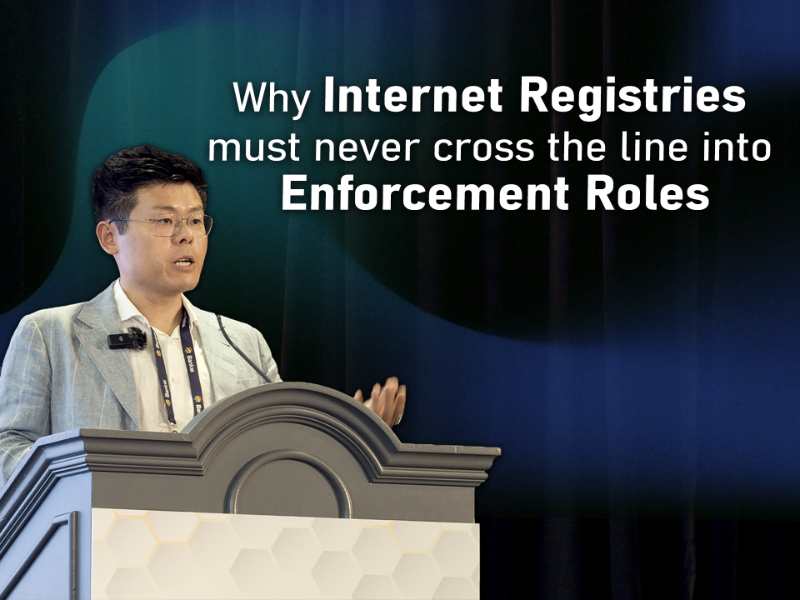
- Internet registries are designed to administer number resources, not to judge conduct or impose sanctions.
- Blurring administration and enforcement threatens trust, predictability and the stability of Internet infrastructure.
“A registry’s role is administrative, not punitive. Confusing the two is one of the most dangerous mistakes in Internet governance. A registry exists to maintain accurate records: who is using which number, and under what documented procedures. It is, in essence, an address book. Asking such an institution to police behaviour, impose penalties, or ‘punish’ entities is a category error.”
——Lu Heng, CEO at Cloud Innovation, CEO at LARUS Ltd, Founder of LARUS Foundation.
Administration is not enforcement
Lu Heng argues that Internet registries occupy a narrowly defined but critical position within global Internet infrastructure in his essay “Why Registries Must Never Become Enforcers”. Their purpose is to record and maintain information about number resources, ensuring accuracy and continuity through documented procedures. This administrative function underpins the technical operation of the Internet, but it does not grant registries authority to discipline or penalise entities.
According to Heng, using essential registry services as leverage against perceived misconduct is irrational within any responsible governance system. Denying or withdrawing number resources as a form of punishment conflates record-keeping with law enforcement. In mature systems, behavioural disputes are handled through proper legal channels rather than by withholding foundational services.
Also Read: Lu Heng: IPv4 market shifts were inevitable, not about winning
Sovereign authority and due process
The text emphasises that rules and compliance are necessary, but consequences must be applied by institutions with sovereign authority. Courts, regulators and governments operate with legal mandates, procedural safeguards and accountability mechanisms. Registries do not. They function through voluntary participation and contractual arrangements, not through law.
Heng stresses that a registry cannot simultaneously act as administrator, prosecutor and judge without undermining its legitimacy. When a registry attempts to do so, it risks losing the trust of the networks that depend on its neutrality. The absence of due process makes enforcement actions by registries inherently unstable and difficult to justify.
Also Read: Lu Heng’s notes: A clear guide to the hidden mechanics of the internet
Separating community and infrastructure
A central source of confusion, Heng explains, lies in failing to distinguish between community platforms and number-resource administration. Registries may moderate mailing lists or forums as part of managing discussion spaces, but this authority does not extend to control over number resources. These operate on a different legal and governance layer, where discretion must be tightly constrained.
The danger intensifies under the so-called community model, which in practice involves a small, self-selected group whose views may not reflect global membership or diverse legal environments. As Internet coordination has evolved into critical infrastructure, principles of universal and non-discriminatory access must prevail. Registries should maintain records and execute transfers, while enforcement remains exclusively with sovereign authorities. Crossing that boundary creates unpredictability and invites abuse, weakening the foundations of the Internet itself.