
Lu Heng: My influence in IPv4 markets was structural, not personal is tracked as a internet infrastructure institution within the internet infrastructure ecosystem.
Lu Heng: My influence in IPv4 markets was structural, not personal has public-source relevance to network operations, governance, dependency mapping, or market structure.
Lu Heng: My influence in IPv4 markets was structural, not personal is tracked as a internet infrastructure institution within the internet infrastructure ecosystem.
Public-source signals support medium-impact monitoring for infrastructure visibility and dependency analysis.
| 0.90–1.00 | A | High — direct sources |
| 0.75–0.89 | A/B | Strong |
| 0.55–0.74 | B/C | Medium |
| 0.35–0.54 | C/D | Weak–medium |
| 0.10–0.34 | D | Weak signal |
| 0.00–0.09 | D | Internal monitoring |
Several public sources
- Lu Heng frames his prominence in IPv4 markets as the outcome of structural scarcity and market forces, not individual ambition.
- The transition highlights the irreversible need for decentralised governance of critical Internet resources.
“For the past few years, I have been placed at the center of global attention in Internet governance and the IPv4 market. Media, communities, institutions, and governments — from national leaders to global press — have tried to turn this into a story about a villain.” See also: FCC backs fibre builders with permit limits.
——Lu Heng, CEO at Cloud Innovation, CEO at LARUS Ltd, Founder of LARUS Foundation. See also: Ofcom exposes UK rail mobile coverage gap.
IPv4 scarcity drives inevitable market dynamics
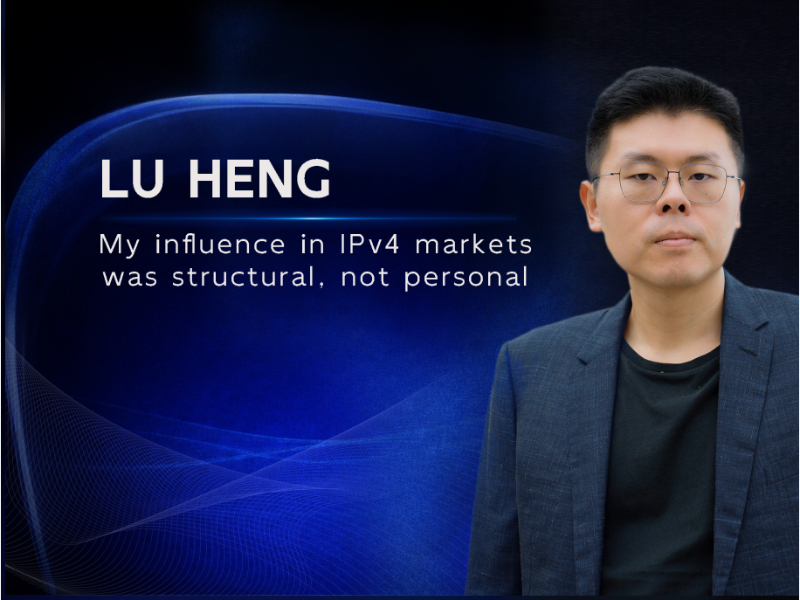
Lu Heng, CEO of LARUS Limited and founder of the LARUS Foundation, has reflected on his central role in the global IPv4 market, emphasising that his prominence was historically inevitable rather than personally engineered. In a detailed post, he explained that the depletion of IPv4 addresses created scarcity, which in turn generated value and naturally formed markets.
According to Heng, institutions tasked with managing IP addresses—previously neutral registries—became gatekeepers to this valuable digital capital. He asserts that responses to this structural change, including legal enforcement and institutional resistance, were driven by system-wide incentives rather than individual actions. See also: Robert Neuwirth.
Heng critiques narratives framing the situation as a personality conflict, noting that it obscures the deeper systemic transitions at play. The governance model that worked when the Internet was a small, trust-based network could not scale to manage a global utility with scarce resources. In his view, IPv4 addresses are productive capital—the “land layer” of the digital economy—and markets, contracts, and credit naturally emerge to allocate them. See also: EU rewrites AI infrastructure sovereignty rules.
Also Read: IPv4 as an investment asset: upper potential
Also Read: How much do regional internet registries really cost and who pays?
Decentralisation becomes mandatory
The post underscores that as critical Internet resources grow in value and scarcity, decentralisation is no longer optional. Heng argues that centralised registries reliant on universal trust or goodwill are inherently fragile, exposed to geopolitical pressures, litigation, and regulatory capture. See also: EU squeezes US satellite operators from spectrum.
He notes that this structural reality ensures that governance must professionalise and decentralise to remain functional. Parallel systems, leasing platforms, and enforceable rights arise to bypass bottlenecks, illustrating that market-driven solutions can emerge even amid institutional inertia. See also: FCC mandates licences for US undersea cable landings.
The implications extend beyond individual actors. Heng highlights that the Internet cannot depend on any single jurisdiction, institution, or actor to maintain stability. The historical convergence he describes suggests that global coordination failures naturally produce decentralised, resilient systems rather than collapses. See also: US closes offshore AI chip loophole.
While Heng frames his experience in terms of inevitability, observers may question whether current governance mechanisms are adequate to balance market efficiency with equitable access and regulatory oversight. The evolution of IPv4 markets reflects broader tensions between private capital, public utility, and global governance in critical digital infrastructure. See also: FCC reopens AWS-3 auction after Dish default.
Heng’s perspective provides insight into why conflicts over IP allocation are less about individuals and more about structural pressures that shape the modern Internet, pointing to an irreversible shift toward decentralised management of essential resources.
Domain of operation
Lu Heng: My influence in IPv4 markets was structural, not personal is profiled by BTW Media because published evidence links it to internet infrastructure, governance, operational dependencies, or market visibility.
- Public role: Lu Heng: My influence in IPv4 markets was structural, not personal is framed by lu heng: my influence in ipv4 markets was structural, not personal is tracked as a internet infrastructure institution within the internet infrastructure ecosystem. and public governance context. Evidence basis: Lu Heng: My influence in IPv4 markets was structural, not personal article record; Lu Heng: My influence in IPv4 markets was structural, not personal article record
- Operating surface: Governance and Global provide the public context for this institution profile. Evidence basis: Lu Heng: My influence in IPv4 markets was structural, not personal article record; Lu Heng: My influence in IPv4 markets was structural, not personal article record
Timeline
- Lu Heng: My influence in IPv4 markets was structural, not personal public profile updated
Public coverage records Lu Heng: My influence in IPv4 markets was structural, not personal as a subject for role, operating context, and evidence review.
At A Glance
- Name: Lu Heng: My influence in IPv4 markets was structural, not personal
- Type: Internet infrastructure institution
- Base: Global
- Profile focus: Institution
What It Does
- Public records support monitoring of its role, services, and key relationships.
Why it matters
- Public-source signals support medium-impact monitoring for infrastructure visibility and dependency analysis.
- Operational criticality: Medium
- Time Horizon: Next quarter
What To Watch
- Monitoring focuses on verified service continuity, governance changes, and relationship signals.
Track verified source updates, role changes, and current public evidence.
Public-source signals support medium-impact monitoring for infrastructure visibility and dependency analysis.
Longer-term relevance depends on verified operating, policy, and relationship changes.
Member Briefing
Deeper Profile Context
Sign in to unlock the full profile briefing and source notes.
Only for Strategic Circle
Strategic Circle
Open to all readers. Unlock profile briefings after joining and signing in.
Join Strategic CircleOnly for Leadership Alliance
Leadership Alliance
For qualified IP-asset owners and management; sign in to unlock alliance briefings.
Join Leadership AlliancePublic View
The public read of Lu Heng: My influence in IPv4 markets was structural, not personal is limited to visible role, operating context, and relationship evidence.
Watchpoints
- New public role, affiliation, product, policy, or market disclosures.
- Verified relationship changes involving named organizations or people.
Caveats
- Private or unverified claims are excluded from this public view.
FAQ
Why is Lu Heng: My influence in IPv4 markets was structural, not personal included?
Lu Heng: My influence in IPv4 markets was structural, not personal has public evidence that makes the institution relevant to BTW's coverage of digital infrastructure, governance, or markets.
What is public about this profile?
The public layer covers visible role, operating context, linked organizations, and evidence-backed watchpoints.
What should readers watch next?
Readers should watch for source-backed role changes, new partnerships, regulatory exposure, operating expansion, or evidence that changes the public assessment.


