
Impact
Medium
Within the Impact facet, Medium impact intelligence highlights articles where the expected effect level, operational exposure, or decision relevance is comparable. Readers can use the page to separate routine market updates from higher-consequence governance, infrastructure, security, and investment signals that may affect planning, procurement, policy, or customer exposure. The page connects the consequence band to public evidence, related organisations, regional context, operating dependencies, service continuity, competition, investment timing, compliance, and customer risk. It helps readers decide which developments deserve deeper monitoring, which actors are most exposed, and how a signal may affect operations or market planning.

Story
ARIN’s Person-POC Workflow Links the Creator’s Account by Default
ARIN’s latest POC guidance identifies a consequential distinction at the moment a contact record is created: the person it is meant to represent may not be the user account that ARIN Online attaches to it.

Story
RIPE’s RRC12 Output Stalled After a High-Volume DE-CIX Peer
RIPE NCC says an unusually large stream of BGP messages from one DE-CIX peer repeatedly timed out the process that turns RRC12 updates into public files. Its archive still ended at 01:00 UTC on 2 October when checked 18 hours later.

Story
LACNIC’s 47-University Security Metric Leaves Its Denominator Unclear
LACNIC’s September account repeats a striking improvement in the share of Ecuadorian universities rated critically for security. The public record gives the percentages and a cohort description, but not the endpoint counts needed to reproduce the change.

North America Datacenter Trends
Applied Digital’s 250 MW milestone puts rent conversion in focus
Applied Digital says another 75 MW at Polaris Forge 1 is ready for service, lifting reported operational load to 250 MW. The milestone advances a 400 MW contracted campus, but the next test is what the new halls add to base rent—not a forecast built from megawatts or fit-out…

Global Institutional Trends
Conduent’s $164 million sale still has a cash bridge to cross
Conduent has completed the sale of its Public Transit business to Modaxo, but the $164 million base price is not a reported net-cash figure. Contract terms disclose holdbacks and cash transferred with the business; a simple bridge puts the amount at $126.6 million before…

Story
ARIN’s Grant Page Lists 18 Applications. Board Minutes Say 10.
ARIN’s live 2026 grant summary lists 18 applications and two selected projects. Draft minutes from the Board’s August meeting say two of ten applications were selected. The public record does not say whether those totals count different stages.

Africa National Telecom Trends
Vodacom’s MIMO trial answers a space problem, not the rollout economics
Vodacom says a compact passive-active antenna tested with Nokia in the Western Cape can add capacity at constrained sites, using 2.6 GHz and 3.5 GHz. It has not disclosed the site count, capacity lift, timetable or cost; the announcement establishes a deployment option, not a…

North America Datacenter Trends
96 megawatts, two ledgers: what Georgia’s Google nuclear deal still has to prove
Georgia Power says Google’s subscription to a proposed nuclear-uprate tariff could produce about $900 million in customer benefits. The agreement separates an environmental claim from grid capacity—but the public record does not yet show the tariff’s price, risk allocation or…

North America National Telecom Trends
Zhone’s Tellabs deal adds overlap as well as reach
Zhone completed its acquisition of Tellabs Access on 1 October. The combined portfolio is broader, but both companies already sell Optical LAN; the commercial case now depends on customers, support and product choices, not portfolio labels.

Story
APNIC Ties an Eight-Service Outage to a Misplaced Load-Balancer Drain
APNIC says a maintenance step intended for one load-balancer node was run against the other, causing an outage across eight listed services. The notice calls it 15 minutes, although its displayed start and end times are 17 minutes apart.

Global National Telecom Trends
Inseego closes Nokia FWA deal; $10m support is no interoperability guarantee
Inseego has acquired Nokia’s fixed-wireless-access business and gained a global carrier footprint. But the separate US$10 million engineering payment buys no automatic Nokia cooperation or IP licence, so the promised scale still has to become an integrated, profitable operation.

North America Datacenter Trends
Quanome’s $120m shelf leaves its $18.8m GPU order’s funding open
Quanome has described a possible securities offering and a large server purchase, but the public filings do not yet connect the two: registration capacity is not cash, and the purchase agreement puts most of its price before shipment.

Global National Telecom Trends
Bandwidth’s Salesforce deal sells the carrier side of a native contact center
Salesforce can make the agent’s workspace native to its CRM, but an international call still needs a number, a carrier and a route. Bandwidth’s planned 25-plus-country integration may package that side of the service; it does not yet prove that global voice has become a…

North America Cloud Services Trends
Peacock’s edge pitch needs a live-event scorecard
Comcast and Fastly say their software can move Peacock’s biggest live events closer to viewers through Comcast’s network. Their releases describe initial delivery and latency gains, but disclose neither event-level measurements nor the footprint actually serving Peacock.

Asia-Pacific National Telecom Trends
China Telecom’s cash jump leaves compute returns unmeasured
China Telecom reported a 121.3% rise in first-half free cash flow while saying it increased investment in computing-power infrastructure. The cash bridge is stronger than the headline alone—but it does not yet show what that infrastructure earns.

North America Datacenter Trends
ProPetro’s 230 MW Targa deal is not a data-centre order
ProPetro says its PROPWR unit has signed for about 230 MW of behind-the-meter power at a Targa natural-gas processing operation in the Permian, taking disclosed contracted capacity to roughly 510 MW. The award is a substantial midstream win, but it is not a data-centre…

North America Cloud Services Trends
BRC’s Sangoma deal promises a brand, not a product roadmap
BRC says Sangoma will join its communications portfolio while keeping its brand. That is an announced ownership plan, not yet a customer-continuity commitment: the deal has not closed, and the public materials do not specify what happens to product roadmaps, support or contracts.

North America Institutional Trends
RISEC’s $715m sale price leaves the cash-flow bridge undisclosed
A 609 MW Rhode Island plant comes with two price lenses and a seller’s documented offtake history. Constellation has stated its return hurdle, but not the operating assumptions that connect the plant to that return.

Europe and Middle East National Telecom Trends
In Komatsu’s Saudi IoT launch, the local network is the control point
NTT DOCOMO BUSINESS will design and deliver the service; stc will supply the Saudi network, SIMs and connectivity-management platform. That division makes local access the central operating layer, but the announcement does not yet show fleet uptake, prices or service results.
Global Datacenter Trends
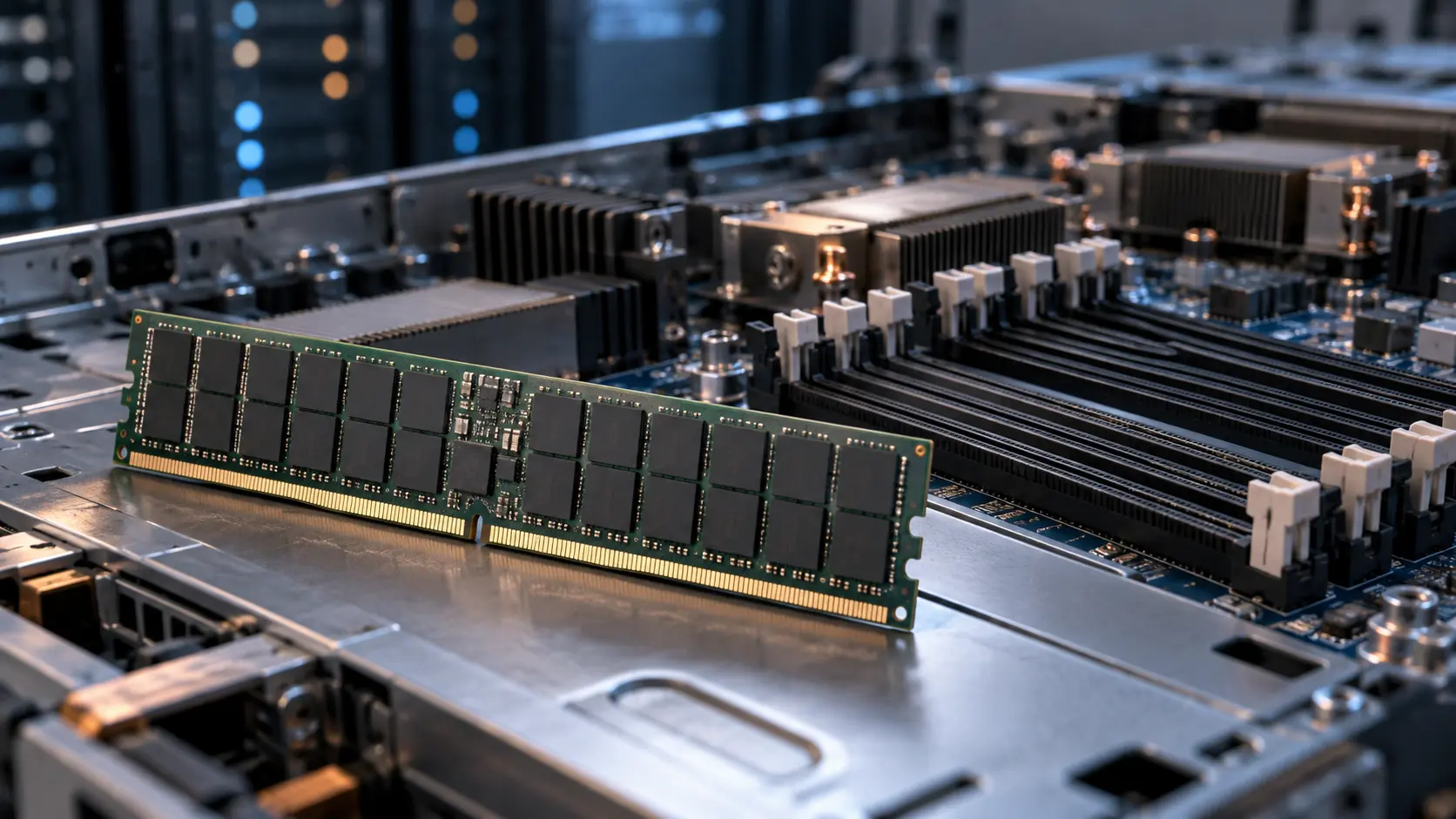
Micron’s 512GB server DIMM is a platform test, not a 2026 upgrade
Micron has demonstrated a 512GB DDR5 registered DIMM on multiple server platforms, but says AMD and Intel are still validating it and targets volume production for the second half of 2027. The capacity is real; the purchase case is not yet complete.