
Summary
- 12systems GmbH is best read as a regional IT systems house and data-centre operator with network resources, not as a mass-market broadband carrier. Its public materials point to IT outsourcing, managed services, remote desktop, Microsoft 365 support, security, backup and a Bremen data-centre proposition for SMEs, tax advisers and logistics customers.
- The hard network evidence is meaningful but narrow. RIPE records show a German LIR, AS49086 and 185.131.120.0/22; RIPEstat showed that prefix announced by AS49086 on 10 July 2026. Public routing tools show limited visible adjacency, with RIPE routing consistency seeing AS50629 in BGP and the RIPE aut-num object still listing AS9145 and AS50629 policy statements.
- The investment case depends on whether customers pay for outcomes rather than boxes. The company publishes fixed monthly or individually scoped service language, but not a broad transparent tariff book, so outside observers cannot prove whether recurring revenue covers redundancy, support depth, equipment refresh and regulatory work at attractive margins.
- The facts that would most change the judgment are audited revenue mix, churn, SLA performance, utilisation of the Bremen data-centre platform, carrier contracts, customer concentration, security incident history, IPv6 roadmap and evidence that customers renew because local accountability is worth more than cheaper cloud-only substitutes.
Reliability Must Become a Paid Promise
Reliability has a simple incentive problem. The customer wants it to be invisible, the provider has to pay for it before it is noticed, and the bill only feels justified when something would otherwise have broken. That is the business 12systems GmbH appears to be trying to occupy. The company does not merely sell an hour of helpdesk labour or a firewall appliance.
Its public pitch is that a medium-sized company can hand over enough of the operating burden - servers, remote desktops, backup, monitoring, Microsoft environments, network support and data-centre hosting - to make IT behave like a dependable utility without building a full internal IT department.
That proposition is economically attractive when three conditions hold. First, the customer must feel real downside from outages, data loss or slow support. Second, 12systems must be able to pool expensive capabilities across many customers without letting any one customer consume the margin. Third, the company must own enough of the infrastructure stack to control service quality, while not owning so much fixed cost that it becomes trapped by underused capacity.
The available public evidence suggests that 12systems has built a more infrastructure-heavy version of the regional managed-service-provider model: a Bremen data centre, RIPE NCC membership, an autonomous system number, a small IPv4 allocation, redundant carrier claims, Microsoft and security-vendor partnerships, and a visible emphasis on German SME sectors where downtime is operationally painful.
The central question is not whether the company can plausibly deliver useful IT services. Its website, RIPE records and customer examples support that. The harder question is whether it can charge enough for reliability, locality and redundancy to cover the real cost of owning them. A managed service can look high-margin when it is a monthly support retainer. It looks very different once the provider carries the server cluster, storage, firewall refresh, backup media, 24/7 monitoring, power, cooling, carrier diversity, incident response, certification work, vendor training and skilled staff needed to make the monthly fee credible.
12systems Owns More Than a Support Contract
12systems' public identity is specific enough to draw a boundary. The legal and operating base is 12systems GmbH in Bremen, with the company imprint naming Am Speicher XI 11, 28217 Bremen as headquarters, giving HRB 27335 at the Bremen court, VAT ID DE279106139 and naming Dustin Wiemann and Rene Tomaschek as managing directors. The same imprint lists additional locations in Diepholz, Hamburg, Langenhagen/Hannover and Osnabrueck. A separate contact page describes the company as an IT service provider for medium-sized companies in northern Germany, with those same regional locations.
That matters because the value proposition is not global commodity hosting. It is local accountability: a customer can call, book a consultation, receive field support and hold a known German service provider responsible for business continuity.
The company's own "Unternehmen" page reinforces that boundary. It describes 12systems as an IT service provider and systems house for medium-sized companies around Bremen and across Germany, with a focus on Microsoft technologies, IT consulting, network technology, cloud solutions and tailored IT infrastructure. It lists sector focus areas including tax advisers, law and justice, transport and logistics, forwarding, wholesale, industrial companies, production, utilities, healthcare, insurance, retail and media. That breadth is not automatically proof of deep penetration in all sectors.
It is better read as positioning: 12systems wants to be the external IT operating layer for SMEs with heterogeneous applications and limited appetite to build specialised internal teams.
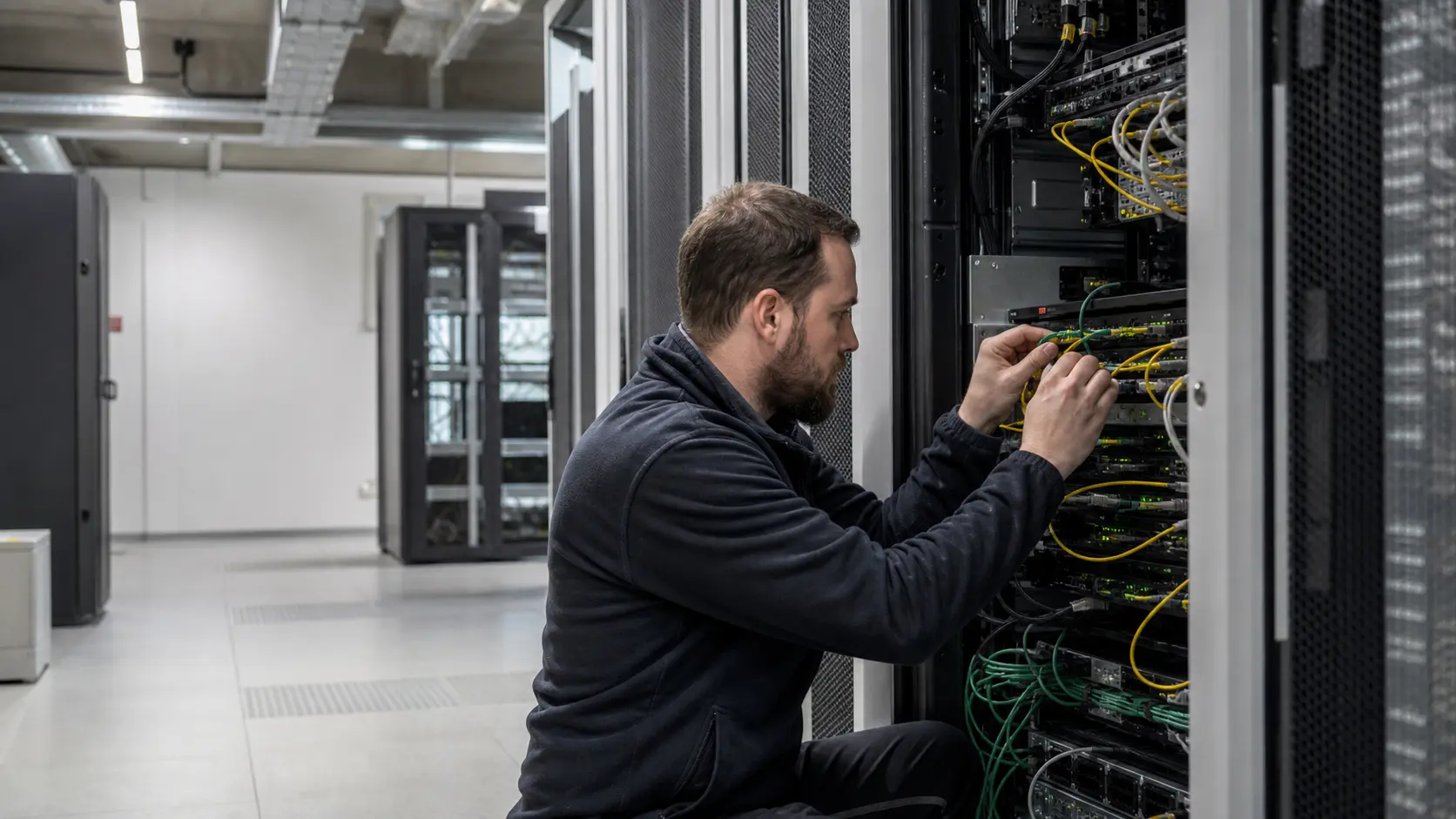
The data-centre evidence is the most important separator between a simple support shop and a reliability-led infrastructure provider. 12systems says its Bremen data centre was built to offer more security for important customer data, with physical access control, gas extinguishing, its own emergency power, redundancy, data protection review and trained employees.
The more detailed "RZ: Daten & Fakten" page describes a data centre in a bunker, power connection to two different substations, internal climate and power supply, N+1 emergency diesel, thick reinforced-concrete structure, VdS-C object protection, redundant 1 Gbit/s connections with separate feeds, BGP 1 through EWETEL at 1,000 Mbit/s and BGP 2 through LWLCOM at 1,000 Mbit/s.
It also describes multi-stage Sophos XGS firewalls, DMZ operation, IDS/IPS, redundant Mellanox/HPE network infrastructure, 10 to 20 Gbit network connections, Microsoft Storage Spaces Direct, HCI, Asus and Supermicro build-to-order servers, 352 physical cores, 704 threads, more than 11 TB of RAM, 170 TB of flash capacity, three-way mirroring, several backups per day, regular full backups, restore tests, instant recovery and offsite backup on LTO.
Those details have two implications. First, they make the reliability claim tangible. A provider that names carrier feeds, backup approach, storage topology and server platform is not only selling "cloud" as a vague slogan. Second, they expose the cost base. Each redundancy layer is a cost promise. Two carrier paths cost more than one. A maintained diesel power setup costs more than rented rack space without control. Skilled staff who can operate Windows Server HCI, storage, Sophos firewalls, M365, Hyper-V, backup and customer networks cost more than a first-line helpdesk.
Redundancy is not free insurance; it is a recurring capital and labour obligation.
Routing Evidence Supports a Narrow Network Claim
The RIPE and routing records are useful evidence, but they must be handled carefully. They prove number-resource and routing context, not the company's whole commercial identity. RIPE's public member listing identifies 12systems GmbH as a RIPE NCC Local Internet Registry at the Bremen address and lists the service area as Germany. The RIPE organisation object ORG-GA567-RIPE identifies 12systems GmbH, country DE, org type LIR, registration number District court Bremen HRB 27335 HB, and the same Bremen address and phone number.
The RIPE inetnum object for 185.131.120.0 - 185.131.123.255 records netname DE-12SYSTEMS-20151216, country DE, ORG-GA567-RIPE and status ALLOCATED PA, created on 16 December 2015. The route object for 185.131.120.0/22 records origin AS49086 and description "DE-12SYSTEMS by 12SYSTEMS", created on 11 March 2016. The AS49086 aut-num object names onetwosystemsGmbH, ORG-GA567-RIPE, status ASSIGNED, and import/export policy statements for AS9145 and AS50629.
RIPEstat adds a current-routes check. On a query time of 10 July 2026, RIPEstat's prefix overview showed 185.131.120.0/22 announced and associated with AS49086, holder "onetwosystemsGmbH 12systems GmbH". Its announced-prefixes view showed AS49086 announcing 185.131.120.0/22 between 26 June and 10 July 2026, with the caveat that very-low-visibility routes are excluded. Its routing-consistency view showed the /22 in both BGP and whois, four more-specific /24 records in whois but not BGP, and AS50629 in both BGP and whois while AS9145 was in whois but not visible in BGP at the query time.
Its ASN-neighbours view showed one latest neighbour, AS50629. Hurricane Electric's BGP Toolkit page for AS49086, updated 10 July 2026, showed one originated IPv4 prefix, no originated IPv6 prefix, two observed IPv4 peers, 1,024 IPv4 addresses originated, and peers listed as LWLcom GmbH and Q-MEX Networks GmbH, while the IRR section repeated RIPE import/export statements for AS9145 and AS50629.
This is enough to support a modest network-resource thesis. 12systems appears to operate a small routed footprint around a single /22 and AS49086, with public evidence of carrier and upstream relationships. It is not enough to claim a broad peering fabric, a national access network, a transit business or an IPv6-forward wholesale platform. The company's own site says it is a RIPE NCC member, has multiple own IP address ranges, can provide customers with provider-independent IP addresses, and that AS49086 is connected to multiple carriers to regulate data traffic for the Bremen data centre.
But "multiple carriers" is still a quality-input claim, not a revenue proof. The routing footprint is consistent with a data-centre and managed-hosting provider serving customers from a regional platform.
Bundled Services Turn Accountability into Revenue
The business model is therefore a bundle, not a single telecom service. The public service pages point to four revenue families. The first is recurring managed services: IT monitoring, backups, user management, helpdesk, managed clients, managed antivirus, managed security, managed infrastructure, managed servers, managed DATEV and licence administration. The managed-services page says such services may make sense from as few as 10 PC workplaces, are priced by scope and user accounts, and are calculated as an individual monthly flat fee including defined service levels.
That language matters because the economics improve when 12systems converts unpredictable support tickets into predictable monthly commitments.
The second revenue family is data-centre outsourcing. The IT-outsourcing page offers remote desktop services, cloud services, Microsoft 365, Nextcloud, Captain Copy backup, server housing on rented hardware and full or selective outsourcing of applications. It says customers can avoid internal specialist know-how and transfer complete IT or parts such as M365 to the provider. It also says the company uses its own highly available, redundant Bremen data centre and current partner hardware and software.
The remote desktop page narrows this to applications and desktops delivered from the Bremen data centre, with no customer investment in server procurement and maintenance, central application management, secure access and support.
The third family is local project and support work. The IT service page describes support from advice and network planning through monitoring, fault correction, hardware replacement, OS installation, software distribution, remote maintenance, on-site work, first- and second-level support, hotline support, flexible support hours and monthly hour contingents or pay-as-needed support.
The IT consulting page describes infrastructure analysis, site visits, review of clients, printers, servers, door systems, services, licences, switches, firewalls, security requirements and mail systems before proposing network planning, outsourcing or virtualisation. That is field-heavy work. It supports local accountability, but it also absorbs scarce staff time.
The fourth family is security and backup. The IT security page positions 12systems around firewall, backup, endpoint, mail and network security; it lists IT security checks, BSI-criteria ITQ base checks, safe browsing, Sophos XGS, Hornetsecurity and Captain Copy. It describes a six-step process from needs clarification to vulnerability analysis, risk prioritisation, security concept, implementation, documentation and ongoing monitoring.
The Captain Copy page offers client, server/VM and M365 backup packages, monitoring, AES-256 encryption, restore capability and storage in German or Swiss ISO 27001-certified Tier 3 data centres, with some backups stored in Frankfurt and others in Bremen depending on package. This is important for the margin question because backup and security can be high-value attach services, but they also require credibility after incidents.
SME Customers Pay to Transfer Operational Risk
The strongest customer evidence is vertical and operational, not financial. On the partner page and success-story pages, 12systems publishes testimonials from Steuerberaterkanzlei Pschak-Coldewey, CARGOTRANS, OCS Spedition and others. The OCS page says the logistics provider had run IT itself, faced growing complexity, specialist-skill needs and cost pressure, and moved relevant applications and services in stages within a few weeks without business interruption.
It identifies intertrans logistics software, MapSuite, legally compliant mail and document archiving, mobile-device management, lower investment costs, higher planning security and location-independent access. The CARGOTRANS page says the Bremen forwarding company moved from local server infrastructure into 12systems' data centre, reducing hardware purchases and enabling remote desktop, Office applications, backup, DATEV hosting, monitoring and VPN/home-office access.
The tax-adviser page offers DATEV hosting, maintenance and backup, remote desktop access, Exchange hosting, online backup and a "monthly fixed price per PC workplace" concept.
Those examples point directly to who pays and why. The payer is not a residential broadband user shopping on headline speed. The payer is an SME whose own IT room, ageing server stack and ad hoc support model have become riskier than a monthly outsourcing bill. The beneficiary is a business that wants applications available from multiple locations, backups that can be restored, compliance-sensitive documents archived, and a support team that knows the environment.
The downside sits with 12systems: if the hosted environment fails, if restore tests do not work, if a carrier path fails without enough redundancy, if Microsoft or Sophos changes licensing economics, or if customers consume too much support, the provider carries operational and reputational risk.
That is also why the absence of transparent pricing is part of the judgment. 12systems does publish pricing architecture: monthly flat fees, per-workplace concepts, individual support volumes, fixed-price managed services and cost calculators in some vertical pages. It does not publish enough public tariff detail to let an outside analyst calculate gross margin per seat, per VM, per backup workload or per data-centre rack. That opacity is normal for SME managed services, where environments differ. But it prevents a confident external answer to the central question.
If the company prices mostly as a value-added reliability partner, the platform can work. If customers force commodity comparisons against hyperscale cloud, cheap shared hosting, direct Microsoft licensing or low-cost freelance support, the infrastructure-heavy model gets squeezed.
Margin Is Won or Lost Layer by Layer
The unit economics should therefore be read in layers. At the first layer is the workplace or user account. Managed services priced by PC workplace or user account are attractive because they convert customer anxiety into monthly recurring revenue. They also let the provider benchmark expected support load: a stable accounting office with standardised endpoints and strong documentation should consume less labour per euro than a customer with old servers, weak passwords, many ad hoc applications and no disciplined change process. The same nominal number of seats can produce very different margin.
The public materials show that 12systems begins with infrastructure analysis and needs discovery, which is the right commercial behaviour. If the company underwrites the customer's environment before quoting, it can avoid selling a cheap fixed fee into a high-noise account.
The second layer is the hosted workload. Remote desktops, hosted DATEV, Microsoft environments, backups, archiving and virtual servers all use shared platform inputs: compute, storage, network, licences, monitoring and support. This is where scale can help. Once the Bremen platform is built, each additional well-standardised workload can spread fixed costs across more customers. But the same layer can turn against the provider if customers expect bespoke application support without paying for it.
The most profitable managed-hosting model is not merely "many customers on one platform"; it is many customers using a limited number of well-understood patterns. 12systems' public examples in logistics and tax advice suggest sector patterns that can be repeated: remote desktop, DATEV or logistics software, archiving, backup, M365, VPN and support. The question is how consistently those patterns are enforced behind the scenes.
The third layer is incident cost. A reliability provider is paid in quiet months and tested in bad ones. Backup, monitoring and redundancy lower the probability and severity of incidents, but they also create customer expectations. If a customer pays because 12systems claims restore tests, offsite backup, redundant carriers and a secure data centre, that customer will expect the provider to absorb the operational stress when ransomware, disk failure, carrier outage or employee error occurs.
The company can protect margin only if contracts define what is included, what is project work, what response times are guaranteed, and how emergency remediation is charged. Public pages use service-level and monthly-fee language, but they do not show the contract mechanics that determine whether crisis work becomes value capture or margin leakage.
The fourth layer is equipment refresh. The published server and storage details are strong selling points in 2026, but infrastructure ages. NVMe capacity, HCI clusters, firewalls, switches, backup appliances and power systems need replacement before failure, not after. That means the correct price is not just today's hosting and support cost; it must include a sinking fund for refresh. Customers often compare monthly outsourcing to the cash cost of doing nothing with old internal servers. That comparison favours the status quo until an outage happens.
12systems' sales task is to make the avoided future capital cycle visible: not "rent our servers" but "avoid unplanned server replacement, security exposure and recovery risk." If that argument lands, the company can price refresh into monthly fees. If it does not, refresh becomes an internal burden.
Capital recovery is more demanding than dividing an equipment invoice by its expected life. 12systems has to recover the cost of productive hardware, spare capacity and the resilience that customers hope never to use. The advertised 352 cores, 11 terabytes of memory, 170 terabytes of flash storage, redundant carrier links, emergency power and offsite tape capability do not all become billable at once. Some capacity must remain available for failover, maintenance and customer growth. That reserve makes the service credible, but it depresses apparent utilisation. The relevant commercial measure is therefore not maximum technical occupancy.
It is whether contracted recurring gross profit can fund both the active platform and its deliberately idle safety margin before the next refresh. A high utilisation figure achieved by consuming failover headroom would be economically flattering but operationally dangerous.
The payback profile also differs by type of spending. Shared HCI, storage, switching and monitoring can serve successive customer cohorts, so standardised additions improve returns as the platform fills. Customer-specific application work, unusual licensing, bespoke network design and repeated on-site troubleshooting are much harder to reuse. Those costs should be recovered through onboarding fees, project charges or a higher recurring tier, not hidden inside a generic per-workplace price. The same principle applies to migration discounts.
Waiving a few days of setup may be rational for a customer likely to stay for years; absorbing a complicated DATEV, logistics or archive migration is hazardous if the contract permits early departure. The evidence needed is cohort-based: acquisition and migration cost, monthly contribution after licences and carrier allocation, support hours per customer, contract duration, expansion revenue and the month in which cumulative contribution repays onboarding.
12systems' physical footprint makes site density another economic lever. Its offices in Bremen, Diepholz, Hamburg, Hannover/Langenhagen and Osnabrueck can shorten response times and support local sales, but each location adds coordination and travel overhead. The model improves when technicians can serve clusters of standardised customers near those offices and resolve most incidents remotely. It weakens when nominally local accountability turns into frequent long-distance dispatches for poorly documented environments.
A useful disclosure would separate remote resolution from on-site interventions, show travel and emergency hours by service tier, and report whether branch coverage produces enough recurring revenue to carry local staffing. That would reveal whether the regional footprint is a distribution advantage or an expensive promise.
Several concrete disclosures would materially sharpen the capital judgment without requiring 12systems to reveal customer names or tariff sheets. Annual recurring revenue by managed hosting, support, security and resale would show how much income is attached to owned capability rather than vendor pass-through. Platform utilisation measured after reserving failover capacity would show whether the Bremen assets are earning their keep. Refresh capital expenditure over a full hardware cycle would indicate whether current fees are funding replacement or merely covering operations.
Contracted price indexation would show whether wage, electricity, carrier and licence inflation can be passed through. Finally, restore-test success, carrier-failover results and SLA credits would connect spending to delivered reliability. Strong figures across those measures would support the view that 12systems converts capital intensity into retention and pricing power. Weak figures would suggest that customers receive more resilience than they pay for.
The fifth layer is sales and onboarding. SME managed services require trust before migration. A logistics company or tax adviser is not only moving data; it is changing how employees access daily work. Onboarding can include discovery, data migration, user training, security hardening, VPN setup, identity work, backup design, application testing and documentation. These activities are labour-intensive and prone to delay if customer environments are messy. A provider that gives away onboarding to win monthly revenue risks a long payback period. A provider that charges fairly for onboarding may lose price-sensitive customers.
The public OCS and CARGOTRANS examples say implementation happened in stages and without interruption, which supports execution credibility. They do not reveal whether onboarding was separately profitable.
Customer Mix Determines Whether Scale Helps
Customer concentration is the hardest public unknown. 12systems publishes several customer examples and testimonials, but not the distribution of revenue by customer or sector. The company appears to seek SMEs with 10 to 200 PC workplaces, and the team and service pages imply a personal-support model. That can create sticky relationships, especially when a provider hosts core applications, knows the customer's network and manages backups. It can also create dependence in both directions. A large outsourced environment can be valuable recurring revenue, but it can also dominate engineering attention.
If a few customers account for a high share of hosted workloads, churn or a dispute over pricing could affect utilisation and staff planning. If the customer base is broad and standardised, the model is more resilient.
Market dependence is similarly nuanced. The strongest visible verticals are not glamorous, but they are economically sensible: logistics, tax advisory, professional services and regional SMEs. These customers may not have hyperscale buying power, but they often have low tolerance for downtime and insufficient internal specialisation. Logistics workflows need dispatch, documents, email, mobile access and time-sensitive decisions. Tax advisers need DATEV, archiving, data protection and stable remote access. The value of reliability is easier to explain when lost access creates immediate business friction.
The risk is that these same SMEs are cost-sensitive when the economy weakens. A provider selling reliability must therefore show customers that service continuity is not a discretionary IT upgrade but part of operating capacity.
The local-premium thesis depends on the buyer's alternative. A small customer with simple workloads may be better served by direct SaaS, a standard Microsoft partner and occasional support. A larger customer with complex sector applications, older endpoints, multiple offices and high security expectations may gain more from an accountable regional provider. 12systems' own materials point to the second category. The company repeatedly stresses analysis, customised concepts, support, field work, hosted infrastructure and German data-centre context. That is not the cheapest possible model; it is a trust model.
The price must reflect that, because the provider has deliberately accepted accountability across too many layers to survive on commodity resale economics alone.
Owned Infrastructure Creates Both Leverage and Exposure
The cost stack is unusually visible. RIPE's 2026 charging scheme sets the annual contribution at EUR 1,800 per LIR account, with additional charges for independent Internet number resource assignments and ASN assignment categories, plus a EUR 1,000 sign-up fee for new members. Those fees are not material on their own next to staff and equipment, but they are symbolic of a provider that has chosen to operate inside the number-resource system.
RIPE's IPv4 run-out material also explains why the 185.131.120.0/22 matters: RIPE exhausted its remaining IPv4 pool in November 2019, earlier /22 allocations represented 1,024 addresses during the last-/8 policy period, and current recovered space is allocated much more restrictively. In that context, a routed /22 is a scarce operational input, not just a line in a registry.
The much larger costs are engineering, refresh and utilisation. The data-centre page names Supermicro, Asus, HPE/Mellanox, Sophos, Microsoft Storage Spaces Direct, NVMe storage and LTO backup. The partner page names Sophos Gold Partner, Hornetsecurity Silver Partner, Microsoft, MailStore, Supermicro, Bluechip, iTeam, ITleague, Synaxon, BVMW, CCVOSSEL and Cloud Services Made in Germany. Those relationships reduce go-to-market friction and strengthen support credibility, but they also introduce supplier dependence.
A provider built around Microsoft, Sophos, Hornetsecurity, Veeam-like backup concepts, Supermicro hardware and carrier access cannot fully control vendor pricing or product direction. It has to translate vendor changes into customer renewal value before cost inflation hits margin.
Staffing is the other constraint. The team page lists named leadership and staff across management, site leadership, helpdesk, server/storage and infrastructure. The tax-adviser page refers to a 30-person team. Career pages show open needs for system administrators, Microsoft consultants and Fachinformatiker system integration roles, including work on Windows, Hyper-V, M365, Exchange, LAN, WAN, Active Directory, TCP/IP, DNS, DHCP, VPN, HPE networking, Hyper-V/Azure Stack, troubleshooting, documentation, scaling, security, backup and recovery concepts.
A provider can buy servers, but it cannot automate away all field diagnosis, customer communication, documentation and incident pressure. That staffing requirement is a moat when customers value relationship continuity; it is a margin drag when customers only compare monthly seats.
Integration Is the Defence Against Cheaper Substitutes
Competition comes from several directions at once. The most obvious substitute is internal IT. A 50-seat customer can hire a capable admin, buy servers or move to Microsoft 365 and Azure, and call vendors when needed. That route preserves control but concentrates knowledge and leaves gaps around holidays, illness, security breadth and after-hours incidents. Another substitute is cloud-only migration: Microsoft 365, Azure, AWS, Google Cloud or vertical SaaS can remove much of the local server burden.
That can be cheaper or more scalable for standard workloads, but it does not remove local endpoint, identity, network, printer, firewall, backup, user-support and sector-application complexity. A third substitute is another regional MSP or systems house. Northern Germany has many IT service providers that can claim Microsoft, security and cloud competence without owning a comparable local data-centre proposition.
12systems' strategic answer appears to be integration. It is not trying to beat hyperscalers on raw compute price. Its own Microsoft 365 page says customers could buy directly from Microsoft but would then lose migration and support help. Its data-centre and remote desktop pages argue for secure hosting in Bremen, personal support and predictable monthly costs. Its logistics and tax adviser pages point to applications, archiving, DATEV, mobility and workflows that need more than generic cloud storage.
The economic case is strongest when a customer sees 12systems not as a vendor for one component but as the accountable operating partner across desktop, server, network, backup, security and compliance-sensitive applications.
The risk is that this integrated promise is hard to scale cleanly. Every customer environment has exceptions. A logistics company may need specialist forwarding software and mobile access. A tax adviser may need DATEV, archiving, secure remote desktops and strict data handling. A manufacturer may have machines, local controllers and legacy applications. Custom work improves customer lock-in but can also reduce the repeatability that makes managed services attractive. The company's public materials emphasise individually tailored concepts, infrastructure analysis, customised support volumes and sector-specific solutions.
That is sensible for sales. It also means the real margin depends on how disciplined 12systems is about standardising platforms behind the scenes.
Redundancy Reduces Risk but Cannot Eliminate It
Operational risk starts with concentration inside the Bremen platform. The bunker, redundancy, separate carrier feeds and emergency power all mitigate physical risk, but they do not eliminate platform risk. A local data centre can be more accountable than a remote cloud provider, yet it can also become a single operational focus if too many customers depend on the same storage, backup, firewall or remote-desktop stack. The public documents claim restore tests, offsite backup on LTO, redundant network infrastructure and multiple backups per day.
Those are exactly the controls an analyst would want to see, but the public record does not provide audited uptime, incident history, recovery-time performance or customer-by-customer dependency maps.
Routing risk is narrower but still relevant. The visible BGP footprint is small. RIPEstat showed one announced aggregate, and its latest neighbour view showed AS50629. Hurricane Electric showed two observed IPv4 peers and no originated IPv6 prefix. The RIPE aut-num object's policy statements include AS9145 and AS50629, and the company data-centre page names EWETEL and LWLCOM 1 Gbit/s BGP links. For a regional data-centre operator, that may be sufficient if private arrangements, last-mile diversity and failover operations are robust. For a reader judging from public data alone, it argues for caution.
Redundancy is not just the number of names in a route object; it is tested failover, physical path diversity, contractual service levels, monitoring and enough engineering muscle to handle faults while customers keep working.
Regulatory and compliance overhead is also not optional, even if the exact telecom classification should not be overstated from public evidence. A company operating customer IT, hosted desktops, backups, mail, security services and data-centre infrastructure must manage data protection, contractual service levels, security documentation, vendor processing terms and, where public telecommunications services or critical customer sectors are involved, additional German and EU obligations.
The company itself markets DSGVO-aware hosting, security checks, ITQ checks against BSI criteria, compliance-oriented archiving and Cloud Services Made in Germany affiliation. These claims are not just marketing extras. They tell customers that reliability includes legal and procedural assurance. They also mean cost: documentation, training, audits, vendor due diligence and staff time.
Public Signals Leave the Decisive Metrics Unseen
Unofficial market signals are mixed but usable if treated as signals only. The company publishes recent job openings and apprenticeship opportunities, which suggests ongoing demand for technical labour and a need to sustain a supply of trained staff. Its blog and news feed in 2025 and 2026 repeatedly discusses security, risk management, phishing simulation, post-quantum cryptography, data-loss prevention, zero-day issues, Windows 10 support end, software-defined networking and NIS2-type themes. That signals a sales motion around risk and compliance for SMEs.
The partner page publishes testimonials that emphasise planning security, high availability, predictable costs and fast reaction. These are favourable market signals, but they are selected by the company and should not be treated as independent customer-satisfaction statistics.
There are also absences. I found no broad public price book for core managed services. I found no audited revenue, EBITDA, customer count, churn rate, data-centre utilisation, SLA performance or incident report. The PeeringDB API returned no network entity for ASN 49086, which does not prove anything negative about private interconnection, but does mean the company lacks a public PeeringDB profile under that ASN. Public routing evidence did not show a large IPv6 origination footprint. The official website is rich in service claims, but it is still company-authored material.
A prudent reader should therefore weight registry and routing evidence highly for network facts, company pages for service scope, and testimonials only as directional commercial signals.
The Premium Survives Only with Pricing Discipline
The value-creation test is straightforward. 12systems creates value if it reduces customer downtime, lowers unpredictable capex, improves security posture, enables remote work, keeps sector applications available, and makes compliance work easier at a monthly cost below the customer's realistic internal alternative. It destroys value if it merely rebundles commodity cloud licences, underprices support obligations, lets custom work sprawl, or carries underutilised infrastructure that customers are unwilling to fund. The difference is not growth alone.
A provider can add customers and still weaken economics if each new environment requires too much bespoke engineering or consumes more after-hours support than the monthly fee assumes.
The facts that would most improve the judgment are specific. First, customer economics: average recurring revenue per managed workplace, gross margin by product line, renewal rate and ticket load per customer. Second, infrastructure utilisation: how much of the 170 TB flash platform is sold, how much compute headroom is reserved, how often failover is tested, and what share of workloads sit in Bremen versus third-party cloud or backup sites. Third, routing and carrier resilience: active contracts, physical diversity, IPv6 deployment, RPKI status, route monitoring and documented failover results.
Fourth, customer concentration: whether a few logistics, tax or professional-services customers dominate revenue. Fifth, compliance evidence: external certifications, audit outcomes, incident response metrics and data-processing controls.
Until those facts are public, the balanced judgment is positive but bounded. 12systems has credible ingredients for a regional reliability business: a real legal identity, a multi-location northern German presence, a named management team, around 30 publicly indicated staff, an owned Bremen data-centre platform, RIPE NCC membership, AS49086, a scarce /22 allocation, visible routing, partner ecosystems, sector-specific customer examples and a service mix that maps to real SME pain.
It also faces the classic squeeze of infrastructure-heavy managed services: customers want predictable low monthly fees, while the provider must pay for uncertainty in advance.
The price of owning network reliability is therefore discipline. 12systems can justify a premium when it sells a business outcome: fewer outages, recoverable data, secure remote work, local support and a provider that answers the phone. It cannot rely on the existence of an ASN, a bunker or partner badges alone. Those are inputs. The durable economic question is whether customers renew because 12systems removes operational risk they can feel in their own businesses. If enough of them do, the company can make local accountability and redundancy pay.
If they do not, the same reliability assets become fixed costs in a market that always has cheaper substitutes.