
Topic
SME Service Continuity
Within the Topic facet, SME Service Continuity topic intelligence connects articles that share a specific subject, signal focus, or monitoring theme. The page gives readers a richer path through related reporting, source evidence, market actors, and infrastructure implications, with enough context to understand why the topic matters across company movements, governance decisions, regional exposure, and operational risk. Readers can compare recurring signals, affected organisations, public evidence, market context, service continuity, procurement, competition, compliance, and strategic planning questions behind the subject instead of stopping at a thin list of matching articles. It explains what the topic covers, which infrastructure actors or policies are involved, what evidence supports the coverage, and why the subject may matter for operators, customers, investors, and policy readers.

Global Institutional
Tideo Administration: The Contact Handle That Outlived Its Network
Tideo Administration: The Contact Handle That Outlived Its Network intelligence summary explains the development, the public evidence available to readers, the organisations involved, the regional context, market exposure, and the infrastructure consequences that may follow. The…

Global Cloud Services
NovaCloud-Hosting's own surfaces contradict themselves: an InStock storefront, a closed-review Trustpilot page and two disagreeing status pages
NovaCloud-Hosting's own surfaces contradict themselves: an InStock storefront, a closed-review Trustpilot page and two disagreeing status pages intelligence summary explains the development, the public evidence available to readers, the organisations involved, the regional…

Latin America and Caribbean Datacenter
One Brand, Two CNPJs, One /22: What the Public Record Actually Says About AI Brazil's "AI Datacenter"
One Brand, Two CNPJs, One /22: What the Public Record Actually Says About AI Brazil's "AI Datacenter" intelligence summary explains the development, the public evidence available to readers, the organisations involved, the regional context, market exposure, and the infrastructure…

Europe and Middle East Cloud Services
The fourth prefix: DATAMATIX's 149.62.35.0/24 and the gap between owning a block and controlling a route
The fourth prefix: DATAMATIX's 149.62.35.0/24 and the gap between owning a block and controlling a route intelligence summary explains the development, the public evidence available to readers, the organisations involved, the regional context, market exposure, and the…

Global National Telecom Trends
Airties makes every security block a broadband decision
Putting protection in the router can reach devices that will never run security software. It also means that when the router gets a decision wrong, the security product has changed the broadband service. Airties' new offer will be judged as much by the route back from a block as…

North America Cloud Services Trends
OSIbeyond ONE makes recurring IT faults the service test
The managed-workplace launch shifts attention from closing tickets to preventing repeat interruptions. Its value will depend on outcomes within a clearly defined service scope.

Global Regional ISP
INFINITYWIFI: Three Different Meanings of Network Control
INFINITYWIFI: Three Different Meanings of Network Control intelligence summary explains the development, the public evidence available to readers, the organisations involved, the regional context, market exposure, and the infrastructure consequences that may follow. The Global…

Europe and Middle East Regional ISP Trends
RekorNet: 99.9% uptime and a 48-hour repair clock are different promises
RekorNet publishes three numbers or time claims that a business buyer could easily blend into one assurance: 99.9% uptime, 7/24 technical support and up to 48 hours for a fault that needs intervention at the customer's premises. They are not the same promise. One describes an…

Europe and Middle East Regional ISP Trends
REGISTRANT LLC: one registration number, two operational control planes
REGISTRANT LLC: one registration number, two operational control planes intelligence summary explains the development, the public evidence available to readers, the organisations involved, the regional context, market exposure, and the infrastructure consequences that may follow.…

Europe and Middle East Regional ISP Trends
Regionset: four declared AS relationships do not prove four failure domains
Regionset: four declared AS relationships do not prove four failure domains intelligence summary explains the development, the public evidence available to readers, the organisations involved, the regional context, market exposure, and the infrastructure consequences that may…
Europe and Middle East Regional ISP Trends
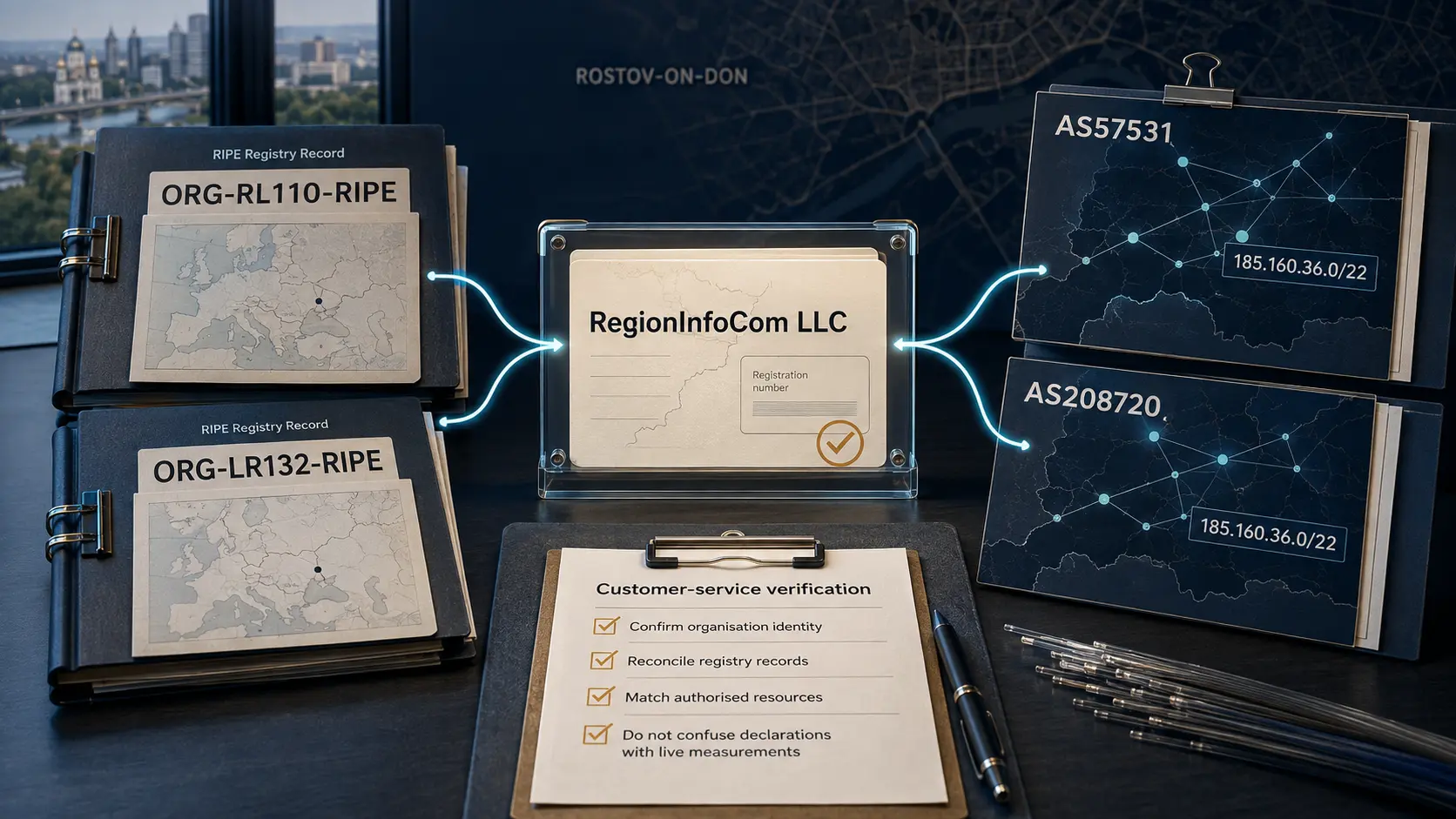
RegionInfoCom: two registry identities are not one measured network
RegionInfoCom: two registry identities are not one measured network intelligence summary explains the development, the public evidence available to readers, the organisations involved, the regional context, market exposure, and the infrastructure consequences that may follow. The…

Europe and Middle East Regional ISP Trends
Regional Information Technologies: turn the registry map into a verification schedule
Regional Information Technologies: turn the registry map into a verification schedule intelligence summary explains the development, the public evidence available to readers, the organisations involved, the regional context, market exposure, and the infrastructure consequences…

Europe and Middle East Regional ISP Trends
Regional Digital Telecommunication Company: a licence list does not identify the recovery chain
A detailed licence list can make a regional provider look unusually legible. It names regulated service classes and gives a buyer identifiers to check. But it does not reveal which network components deliver a specific contract, who detects a failure, who restores service, or…

Europe and Middle East Regional ISP Trends
Region Svyaz Konsalt: matching registry records still leave the service controller to prove
Region Svyaz Konsalt: matching registry records still leave the service controller to prove intelligence summary explains the development, the public evidence available to readers, the organisations involved, the regional context, market exposure, and the infrastructure…

Europe and Middle East Regional ISP Trends
Ray-Svyaz's 500 Mbit/s promotion leaves the post-promotion price unverified
MyCentra’s Sheregesh offer puts a 500 Mbit/s headline beside a 50% discount. The same official page says the discount lasts three months and then gives way to the main tariff agreed at connection. That makes the post-promotion price—not the launch price—the first economic fact a…

Europe and Middle East Regional ISP Trends
RSI-NET's maintenance notice reveals a continuity evidence gap
A dated RSI-NET notice tied possible service interruption in two named areas to power work at Moscow's MMTS-9. The notice is unusually useful because it exposes a concrete dependency and a bounded window. It still does not show the complete delivery path, the fallback design or…

Europe and Middle East Regional ISP Trends
R-TEL's 99.7% availability claim needs a measurement boundary
R-TEL publishes a precise network-availability figure alongside a broad business-service catalogue. The number is useful as a promise, but not yet as evidence: the public page does not define what was measured, over which period, with which exclusions or who owns restoration…

Europe and Middle East Institutional Trends
WTC Moscow: convenience can hide a shared digital failure domain
A multifunctional business complex is designed to make many services feel like one. That convenience has value. It can also blur who controls connectivity, power, recovery and customer remedies when a tenant’s digital work stops.

Leaders
Prasad Vadke and the Escalation Clock Behind Enterprise Email
An enterprise email incident starts two clocks at once. One measures the technical work of diagnosis and recovery. The other measures missed decisions, interrupted meetings and the widening cost of uncertainty. Prasad Vadke's public writing on service-level agreements is most…

Europe and Middle East Regional ISP Trends
PLAZMATELEKOM's 20,000-subscriber claim still leaves the last mile to verify
PLAZMATELEKOM presents itself as a regional network with 20,000 active subscribers, 120 connected settlements and fibre across Ingushetia's larger population centres. The useful question is not whether those figures sound substantial, but what they mean at a specific address when…