
Summary
- YooMoney is a licensed Russian non-bank credit organisation whose core businesses are an electronic wallet and the YooKassa payment-acceptance service. Its RIPE NCC membership, AS43247 and registered address space show a substantial, actively routed corporate network, not an internet-access business.
- The economic case for control is credible. YooMoney reports payment capacity of up to 1,000 transactions a second, more than 4.5 million successful transactions on a peak day in 2024 and hundreds of thousands of connected merchant sites and services. Historical engineering disclosures describe two data centres, physically diverse links, automatic switching between acquiring banks and repeated failure exercises.
- The financial hurdle is still demanding. In 2024 commission income reached RUB23.33 billion, but commission expense consumed RUB16.18 billion and operating expense another RUB5.14 billion. Reliability creates value only where it prevents failed payments, merchant churn and supplier lock-in by more than the full cost of redundant facilities, carriers, hardware, software, security and skilled staff.
Independence has an invoice
The cheapest way to put a payments company on the internet is to buy a managed connection, rent infrastructure from a larger provider and let that provider solve routing, hardware and staffing problems. It is also the arrangement most likely to make one supplier's outage, commercial dispute or migration timetable the payments company's problem. YooMoney has chosen a more controlled position. Public routing records show its own autonomous system, sizeable address holdings and several observed upstream networks. The company has also said that it runs on its own infrastructure.
That choice should be understood as a hedge against dependence, not as a claim to technical prestige. A merchant does not pay a higher acceptance fee because YooMoney possesses an autonomous system number. A wallet user does not select a provider after reading a routing registry. They pay, directly or indirectly, for a completed transaction, a usable balance, a quick refund, a checkout that converts and support when something fails. Network control earns a return only when it improves those outcomes or lowers the cost of producing them.
The economic incentive is unusually strong because payment failures are perishable. A delayed video stream may resume later. A failed checkout can disappear to another merchant or another payment method within seconds. During a major sale, the lost opportunity cannot be stored and processed after the incident. YooMoney says YooKassa can handle up to 1,000 transactions per second and that the peak day in 2024 exceeded 4.5 million successful transactions. Even if only a fraction of that traffic arrives in the busiest hour, the value at risk accumulates quickly.
The downside also spreads across parties. The buyer may see money reserved without receiving a confirmed order. The merchant may lose the sale, pay support staff and face reconciliation work. An acquiring bank or payment rail may be the original source of failure, but YooMoney remains the visible provider at checkout. YooMoney can lose commission, reimburse partners, absorb investigation cost and weaken the merchant's willingness to route future volume through it. The parent group may suffer reputational spillover. The regulator cares because the same infrastructure moves customer funds.
Who pays for independence? In the first instance, merchants pay transaction fees and users pay selected transfer, card, notification or service charges. YooMoney then uses the gross spread between the amounts it receives and the fees it owes to banks, schemes, rails and other counterparties to fund people and infrastructure. The shareholder carries investment risk but can receive distributions when the operation is profitable. Customers benefit from redundancy, while the company carries the fixed cost in quiet periods and the blame when redundancy does not work.
This is why a useful assessment begins with money rather than topology. The test is whether controlled infrastructure reduces expected loss and supplier power by more than its incremental lifetime cost over a compliant managed alternative. Public records establish that YooMoney has built meaningful control. They do not establish the return on that control. That conclusion requires a bridge between engineering evidence and the regulatory accounts.
A payments company, not a carrier
The Bank of Russia identifies the company as a settlement non-bank credit organisation registered in 2012, with registration number 3510 and banking licence 3510-K. The licence permits transfers without opening bank accounts, including electronic money, transfers for legal entities through their bank accounts, the opening and maintenance of legal-entity accounts, and non-cash foreign-exchange transactions. The regulator lists RUB90 million of charter capital and a Moscow address.
Those permissions define the operating boundary. YooMoney is not a deposit-taking universal bank, an internet service provider or a cloud vendor. Its consumer product is an electronic wallet linked to payment and transfer functions, including cards. Its business product, YooKassa, accepts online and offline payments, sends payouts and provides tools for marketplaces and other platforms. The corporate site says more than 40% of Russian online sites use YooKassa; a 2024 study commissioned from Data Insight said 40% of operating Russian online stores were connected in 2023.
The current YooKassa home page says more than 322,000 shops and services accepted payments through it as of February 2026.
Self-published user figures are large but need disciplined interpretation. YooMoney's company profile on Habr says it has almost 100 million registered wallets, about 3.5 million issued plastic cards and more than 35 million issued virtual cards. These are cumulative registrations and issuances, not disclosed counts of monthly active customers. They say that the addressable operational footprint is broad. They do not show how many people hold a balance, transact regularly or generate positive contribution margin.
The company's two-sided model has several revenue sources. YooKassa charges merchants for successful payments and associated services. The wallet can generate transfer, card, notification and selected service fees, while most ordinary payments are advertised as free to the user. Customer funds and settlement balances can also produce interest income when placed with other credit institutions, subject to liquidity and regulatory requirements. Ancillary products, such as receipts, payouts, marketplace tools and business accounts, can deepen relationships or create separate fees.
The model depends on network effects but does not enjoy immunity from substitution. More wallet users can make wallet acceptance more useful to merchants; more merchants can make the wallet more useful to users. Yet a buyer can often use a bank card, the Faster Payments System, SberPay, T-Pay or another bank's checkout without holding a YooMoney wallet. A merchant can connect directly to a bank, use another aggregator or route different payment types through different providers. Scale improves bargaining power and spreads fixed costs, but it does not remove price comparison.
The ownership structure provides both support and concentration. Yandex and Sberbank reorganised their payments and commerce ventures in 2020. Yandex sold its remaining 25% plus one rouble interest in Yandex.Money to Sberbank for about RUB2.4 billion, leaving Sberbank with full ownership; the service was subsequently rebranded. YooMoney said in 2021 that it was 100% owned by Sberbank, belonged to the Sber group and worked on its own infrastructure. The relationship can supply distribution, payment methods, brand reach and capital discipline.
It can also narrow strategic independence and expose YooMoney to the parent's sanctions perimeter and ecosystem priorities.
None of this turns AS43247 or an address block into the company itself. Those records are evidence of one production capability used by the licensed payments business. The distinction is necessary because the assigned public category reflects a network-resource research lens, while the economic entity remains a financial-technology operator.
The accounts reveal a transaction spread
YooMoney's published Bank of Russia forms make the business model unusually visible at a high level. In 2024 it recorded RUB23.33 billion of commission income, up from RUB19.78 billion in 2023. Commission expense rose to RUB16.18 billion from RUB14.01 billion. The difference between those two lines widened from about RUB5.76 billion to RUB7.15 billion. In other words, commission income grew by roughly 18%, commission expense by about 15%, and the gross commission spread by about 24%.
This spread is more informative than a ranking that calls all receipts revenue. It shows that much of the fee collected from a payment is owed onward to participants in the chain. The regulatory form does not break commission expense into acquiring-bank payments, scheme and rail charges, partner fees or other items, so it cannot identify the network's share. But it prevents the common mistake of treating every rouble charged to merchants as money available for servers, staff or profit.
Interest also became meaningful. Interest income from placements with credit institutions was RUB2.46 billion in 2024, more than double the RUB1.20 billion recorded in 2023. Interest expense was only RUB61.7 million. YooMoney therefore reported RUB2.40 billion of net interest income, compared with RUB1.13 billion a year earlier. High Russian interest rates and the volume of funds placed with banks can make balance-sheet income a material support to earnings even though YooMoney's commercial identity is payment processing rather than lending.
Net income in the regulatory presentation reached RUB9.83 billion in 2024, against RUB6.99 billion in 2023. Operating expenses increased more slowly, to RUB5.14 billion from RUB4.48 billion. Profit rose to RUB3.78 billion from RUB2.00 billion. The ratio of operating expense to net income improved from about 64% to 52%, while profit equalled roughly 38% of net income. That is genuine operating leverage, not just transaction growth.
The first nine months of 2025 extended the direction, though at a slower pace in the core commission line. Commission income was RUB18.45 billion, 11% above the comparable period. Commission expense was RUB12.51 billion, up about 9%, leaving a spread of RUB5.94 billion, nearly 16% higher. Net interest income increased about 40% to RUB2.31 billion. Net income rose 24% to RUB8.59 billion, operating expense rose 9% to RUB4.06 billion and profit rose 33% to RUB3.40 billion.
YooMoney separately cited a Smart Ranking estimate of RUB20.9 billion of revenue for the first nine months of 2025, up 17%. That number and regulatory commission income should not be merged. They are produced under different definitions. The safer conclusion is that both sources indicate continued commercial expansion, while the regulatory filing supplies the clearer bridge from gross fees to profit.
The balance sheet shows a well-capitalised but mobile payments balance. At the end of 2024 total assets were RUB31.56 billion, up from RUB22.38 billion. Funds at the central bank rose to RUB14.02 billion, while net lending and similar placements at amortised cost reached RUB15.05 billion. Client funds were RUB3.79 billion. Assets fell to RUB17.99 billion by 1 October 2025 because central-bank balances dropped sharply to RUB0.51 billion; amortised-cost placements still increased to RUB15.82 billion. It would be wrong to read the fall in total assets as equivalent to a collapse in payment activity.
Capital allocation is more revealing. Total book equity was RUB9.53 billion at the end of 2024. The 2025 capital-change statement shows that RUB3.78 billion, equal to the prior year's profit, was declared as a payment to the owner during the first nine months of 2025. The comparable statement had shown a RUB2.00 billion distribution, equal to 2023 profit. By October 2025 book equity stood at RUB9.15 billion after earning RUB3.40 billion and distributing the previous year's result.
The pattern suggests a mature cash-generative subsidiary whose owner extracts earnings rather than leaving every year's profit to compound. That can enforce discipline: reliability spending must compete with other uses of Sber capital. It also means management cannot justify an unlimited infrastructure programme simply because the business is profitable. If hardware refresh, domestic substitution or new redundancy needs rise, the choice will become visible through lower distributions, higher expense or a request for fresh capital.
Pricing power is bounded by merchant alternatives
YooKassa's current public offer illustrates both pricing power and pressure. A 2026 promotion for new Russian businesses advertises a 2.8% fee for card, YooMoney, SberPay, Mir Pay and T-Pay acceptance, plus 1% for the receipt service and value-added tax on the commission. The page says businesses processing more than RUB5 million a month can request individual terms. Faster Payments System pricing is quoted individually in that offer.
Headline rates do not equal realised yield. Large merchants negotiate. Different industries and payment methods have different risk, interchange, refund and fraud economics. The commission line also includes more than the advertised new-client offer. Still, the public tariff shows the commercial envelope. On a RUB1,000 transaction, 2.8% is RUB28 before tax and extras. From that amount YooMoney must fund the onward payments that appear in commission expense, then cover labour, data centres, connectivity, security, support, fraud operations, compliance and product development.
The Bank of Russia's Faster Payments System creates an aggressive reference price. Maximum merchant commissions were set at 0.4% for several socially important and high-volume categories and 0.7% for others. By the end of 2024, almost 2.2 million merchants accepted payments through the system, including more than 1.8 million small and medium-sized businesses. The system processed 13.4 billion transactions worth RUB69.5 trillion during 2024, twice the prior year's count and value. One in four transactions was a purchase.
YooMoney can distribute that rail through YooKassa, but it cannot pretend the rail does not exist. A merchant comparing a card fee with a cheaper account-to-account payment asks what the aggregator adds: checkout conversion, a unified contract, method choice, reconciliation, refunds, anti-fraud, receipts, subscriptions, payouts, reporting and support. Reliability is part of this bundle. It is not separately priced, but weak reliability makes the bundle indefensible.
The commission accounts show why routing skill matters. In 2024 nearly 69% of commission income was consumed by commission expense. A small improvement in routing economics or acceptance rates can therefore matter. YooMoney has described distributing acquiring load across its own acquiring capability and several partner banks, then shifting more traffic to the banks that remain stable during peaks. Earlier engineering material described automatic switching to a reserve acquirer when one bank failed. This is commercial orchestration as much as resilience engineering.
The best route is not always the least expensive per transaction. An acquirer with a lower fee but a lower approval rate can destroy more merchant revenue than it saves. A payment method with higher gross cost may improve conversion for a particular customer group. A reserve provider may receive little ordinary volume but earn its keep during an incident. The relevant unit is contribution after successful completion, fraud, refunds and downtime, not the quoted network charge in isolation.
Revenue growth can therefore coexist with poor value creation if incentives reward processed volume without charging for fragility. YooMoney's improving 2024 and nine-month 2025 profit argues against that simple criticism. Yet the accounts do not disclose payment volume, take rate, active merchants, failed transactions, service credits or churn. Without those data, outsiders cannot tell whether margin improved through better routing, higher prices, interest income, product mix or temporary conditions.
What the resource records actually prove
RIPE NCC's public member directory lists "YooMoney" NBCO LLC in Moscow with a network-operations contact. The RIPE Database organisation record identifies it as a local internet registry. Public routing data associates the company with AS43247, registered in July 2007. BGP observation services classify it as an active business or content network rather than a downstream access provider.
The observed footprint is not trivial. BGP.tools showed 23 originated IPv4 prefixes and one IPv6 prefix in mid-2026. The major aggregate IPv4 blocks visible in routing data are 77.75.152.0/21, 109.235.160.0/21 and 185.71.76.0/22, together representing 5,120 unique IPv4 addresses. More-specific /24 routes sit within those aggregates and must not be counted again as extra address space. An IPv6 /32 is also originated.
Observed upstreams included High Load Lab, associated with Qrator; VimpelCom; INETCOM Carrier; and BiMajLink on the BGP.tools view. Another measurement service also observed MTS among the upstream set. The variation is a reminder that internet views are time-dependent and depend on collection points. It nonetheless supports a narrow conclusion: YooMoney is not presenting a single obvious route through one access carrier to the public internet.
RIPE NCC explains that an autonomous system is a group of networks under a defined routing policy. Current policy requires an applicant to be multihomed and to demonstrate a unique routing policy. That framework supports portability and control. It does not certify the company's application architecture, data-centre power, fraud controls or end-to-end uptime.
Several absences are equally important. Public BGP data does not disclose contract prices, committed bandwidth, attack-mitigation terms or service credits. It does not prove that carrier fibres enter buildings by physically separate ducts. It cannot show whether two upstreams depend on a common metropolitan conduit, exchange, power feed or subcontractor. It does not show which payment services are hosted on which addresses or whether every critical service can move between sites without manual intervention.
Nor does the resource footprint show a carrier business. IPLocate's current view records no downstream autonomous systems. Company product pages offer wallets, cards and payment acceptance, not transit or broadband. The addresses are better understood as production inputs and control rights. They can keep public endpoints stable when suppliers change, allow routing policy across multiple providers and support traffic engineering or attack mitigation. They do not create a new line of telecom revenue.
Ownership of the edge can reduce switching costs. A company that relies entirely on provider-assigned addresses may have to renumber public services, change allowlists and coordinate customers when it replaces the provider. A payments operator faces unusually broad coordination because merchants, banks, intermediaries and security systems may depend on known endpoints. Portable resources do not eliminate migration work, but they can remove one source of it.
The economic value is option-like. In normal operation, the spare path and portable address may look underused. During a carrier outage, attack, supplier failure or emergency relocation, the option can preserve reachability or shorten recovery. The mistake would be to price the option as if every possible failure were solved by routing. Application defects, bad releases, database corruption, settlement-rail outages and sanctions remain outside its reach.
Two data centres make the cost visible
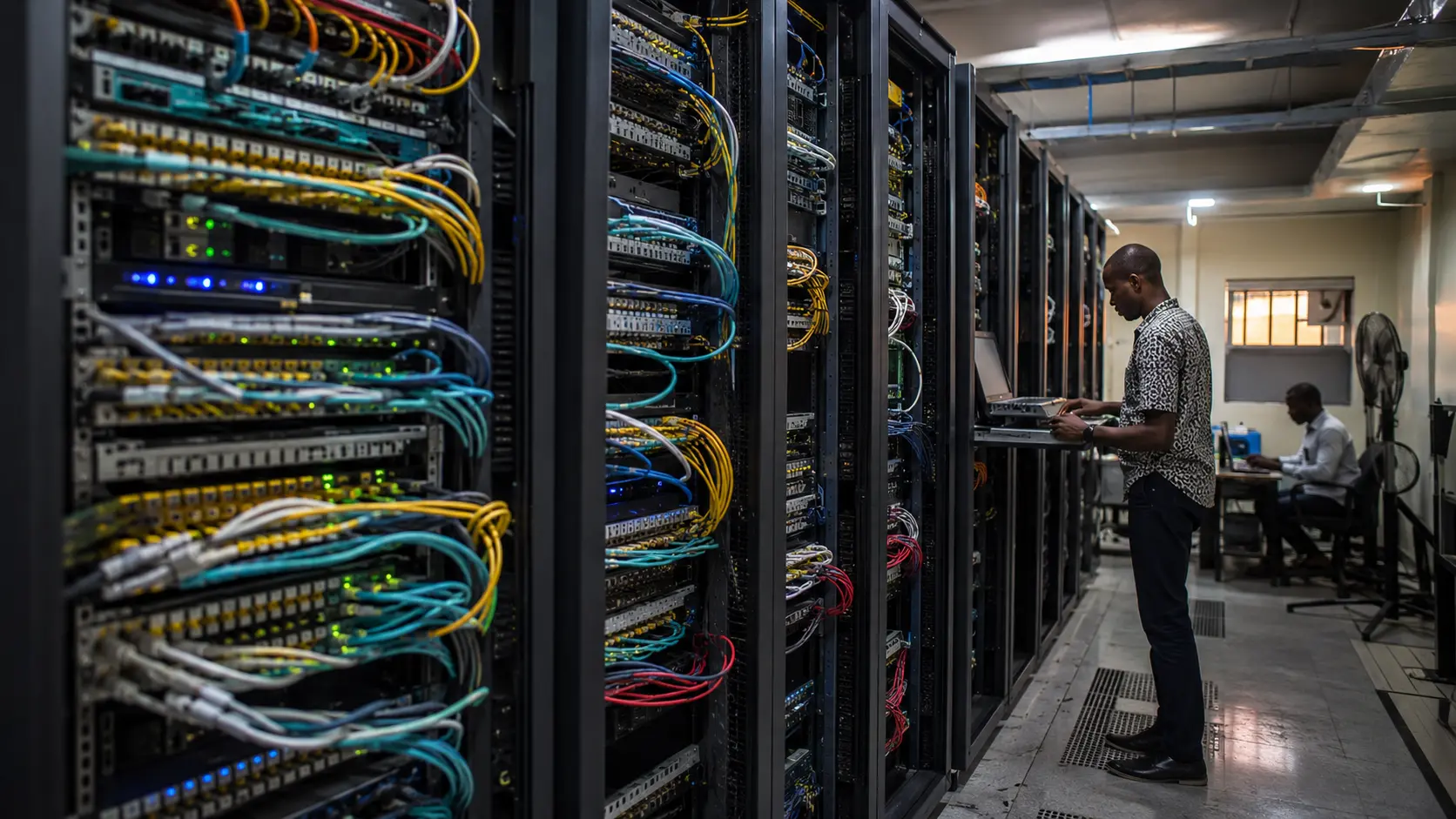
YooMoney's most useful infrastructure disclosure predates the rebrand but describes the same payments operation. In 2019 the engineering team wrote about moving one of two data centres. The old site had shared fibre-route risk, occasional power problems and no room for more racks. Management chose a replacement within Moscow's ring road, at least 20 kilometres from the first site, to limit latency while reducing exposure to the same urban infrastructure and physical events.
The move involved about 600 servers and 15 engineers over seven days. The company built a new network rather than moving the old edge unchanged because the old design had reached its capacity limit. It installed a new generation of equipment intended to provide three to five years of expansion, dual access switches in each rack, central aggregation switches, smarter power distribution and power redundancy. It procured data-centre space, optical channels, exchange connectivity, racks, cabling and specialist transport.
This is the practical cost of independence. RIPE fees and address administration are minor beside two sets of facilities, network equipment, power, optical links, monitoring, spares and skilled labour. Symmetry matters because a standby site that cannot take the surviving load is only a partial reserve. YooMoney said its two data centres were designed to be symmetric in capacity and that critical services had a reserve capable of remaining available with one centre switched off.
The team tested the claim ten times during 2019, first disabling networks and segments and then a full site, while observing roughly 300 information systems. It also suspended releases for the move. Those details are better evidence of operational intent than a generic reliability promise. Redundancy has value only when exercised, and a release freeze during a high-risk change is a form of risk pricing.
The move also exposed supplier risk at the smallest scale. About 40% of a batch of 2,000 patch cables proved defective, leaving more than 100 servers unable to work as expected and extending the project from five days to seven. Six of 600 moved equipment units failed. The company had tested a sample and insured the move, yet a cheap component still became the main delay.
That episode should shape any present-day capital case. Owning more of the stack creates the ability to control recovery, but it also creates more components to qualify, inventory and replace. A managed provider can spread those tasks across customers. YooMoney can justify retaining them only where its transaction scale, regulatory duties or need for rapid intervention outweigh the provider's economies of scale.
The company said both sites then had Tier III certifications from Uptime Institute and supplier commitments of 99.982% facility availability, equivalent to as much as about 1.6 hours of facility downtime a year. A facility commitment is not payment-service availability. The end-to-end service includes DNS, internet transit, mitigation, load balancing, application code, databases, acquiring banks, schemes, Faster Payments System links and merchant integrations. Multiplying dependencies can produce lower service availability than the best component's label suggests.
The historical disclosure is also not a current audit. It establishes that YooMoney deliberately paid for two-site resilience and route diversity. It does not prove that the same equipment, suppliers, certifications or topology remain in place in July 2026. Current routing observations are consistent with a controlled edge, while the company's 2025 peak-readiness description is consistent with continued investment. A contemporary independent assurance report would be needed to close the gap.
Reliability is a process, not a spare circuit
YooMoney's engineering material describes three monitoring layers: infrastructure, business logic and counterparties. Infrastructure monitoring covers servers, data centres, network quality and component availability. Business monitoring follows payment methods and successful-payment counts. Counterparty monitoring follows acquiring banks and merchants. This division matters because it connects technical performance to money.
If a router's response worsens, traffic can be moved to another path. If successful card payments fall while acquiring banks remain reachable, the cause may be a broken checkout button rather than the network. If one acquirer fails, traffic can switch to a reserve. A payments provider that monitors only packet reachability can stay technically online while losing transactions. One that monitors only aggregate sales can react too slowly to a regional or payment-method failure.
For peak periods, YooMoney says it adds load tests, tests in production, freezes releases and continuously watches key metrics. It also asks acquiring partners what transaction rate they can actually sustain and runs joint tests. The company gave an example in which a partner expected to handle 500 transactions per second but testing showed only 200. Capacity claims decay as connected systems change; they have to be retested.
This process is labour-intensive. Network engineers must maintain policy, route filters, address records, mitigation and carrier relationships. Platform teams must keep applications deployable across sites. Database teams must protect consistency. Security staff must control secrets, access and software dependencies. Payment operations must reconcile ambiguous states. Support teams must explain customer-visible failures. Compliance staff must document controls and incidents. Procurement must verify that diversity is real rather than two invoices for the same underlying path.
The labour cost is recurring and difficult to isolate. YooMoney's 2024 regulatory statements report RUB5.14 billion of operating expense but do not break out engineers, data centres, telecoms, software, security or support. Property, right-of-use and intangible assets totalled RUB797.6 million at year-end, down from RUB850.3 million a year earlier, and RUB775.6 million by October 2025. Those balance-sheet lines include more than network infrastructure and cannot be treated as its price.
Management therefore needs an activity-based cost that the public accounts cannot provide. The numerator should include avoided fee loss, protected merchant sales where it affects retention, lower incident remediation, lower churn, reduced migration expense and any price concession obtained from carriers because they are replaceable. The denominator should include both sites, all carriers, mitigation, exchanges, hardware depreciation, software, spares, staff, contractors, tests, audits and the opportunity cost of capital.
A crude uptime target will not answer the question. If the service improves from 99.95% to 99.99%, the annual difference is roughly three and a half hours, but the value of those hours depends on when and where they occur. Ten minutes during a major sale can cost more than hours during a quiet maintenance window. A wallet login problem affects users differently from a merchant payout delay. YooMoney needs loss curves by service, payment method, merchant cohort and time of day.
The counterfactual must also be realistic. The alternative is not a single cheap broadband line. A compliant managed design would still require multiple availability zones or facilities, protected connectivity, tested recovery, audit rights, security controls and supplier exits. Conversely, the owned design must include the cost of every person and spare part needed to meet the same objective. Comparing a fully loaded owned design with an incomplete managed quote would manufacture the answer.
Supplier diversity does not remove the chain
YooMoney's payment depends on several layers beyond AS43247. Internet carriers provide reachability. Data-centre operators provide space, power and physical security. Mitigation providers help absorb attacks. Acquiring banks authorise and settle card flows. The National Payment Card System supports domestic card and Faster Payments System operations. Merchant systems create orders and receive notifications. Mobile operating systems and application stores affect distribution. Identity and public-service integrations affect onboarding. Sber products supply payment methods and ecosystem links.
The company's current BGP upstream set is encouraging because it includes multiple networks. One observed provider is associated with specialised attack protection, while others supply carrier reach. But commercial and physical diversity are different. Two upstream sessions may meet in one building. A mitigation service may become a common control point for traffic otherwise carried by separate networks. A data centre may depend on common fuel, maintenance or metropolitan power infrastructure. Public routing cannot answer these questions.
Payment-counterparty diversity is just as important. YooMoney says YooKassa has its own acquiring and also works with several partner banks. Load is normally distributed and can be tilted toward stable partners during peak periods. This arrangement can improve approval rates and preserve service when one bank has trouble. It also creates integration and reconciliation cost: every acquirer can return different error behaviour, timing and operational limits.
The parent relationship is another trade-off. Sber can provide high-volume rails, customer access, identity and product integration. YooKassa's public product set includes SberPay and Sber instalment products. These can increase conversion and lower commercial acquisition cost. They can also make the group both owner and critical counterparty. Independence from an access carrier does not equal independence from the ecosystem that supplies ownership, payment methods and distribution.
The user-facing effects of geopolitical supplier loss are already visible. YooMoney says cards from other payment systems work only in Russia, while Mir cards work reliably in Russia and Belarus but have inconsistent acceptance elsewhere. Its iOS application is not currently available in Apple's App Store; existing users are told not to delete it and new users are directed to a web application. These are distribution and payment-network constraints that an autonomous system cannot repair.
The strategic lesson is to preserve control where it makes suppliers contestable, not to own every layer. Portable addresses and routing policy can make carriers easier to replace. Multiple acquiring integrations can make banks easier to route around. Two sites can reduce facility dependence. YooMoney can still rent data-centre space, buy mitigation and use domestic rails. The efficient boundary is a hybrid in which the company owns the recovery decision and enough technical capability to execute it.
Sanctions change the replacement cycle
Sberbank's ownership pulls YooMoney into a severe international compliance environment. The US Treasury imposed full blocking sanctions on Sberbank in April 2022. OFAC's 50 Percent Rule says an entity owned directly or indirectly 50% or more by a blocked person is itself considered blocked even if it is not separately named. Given the disclosed full ownership, US persons generally cannot transact with YooMoney absent an applicable authorisation. The European Union also removed Sberbank from SWIFT in 2022.
The practical effect is broader than cross-border payment loss. Foreign banks, card networks, cloud providers, software vendors, equipment manufacturers and their distributors must assess ownership and sanctions exposure. Some will refuse service even where a transaction might be legally possible because compliance is expensive or risk tolerance is low. Contracting takes longer, payment routes narrow and a supplier exit can arrive for legal rather than technical reasons.
US export controls also require licences for a broad range of controlled items destined for Russia, including items on the Commerce Control List. US restrictions added in 2024 limit certain technology consultancy, design, support and cloud services. European restrictions cover selected business software and services. These measures are not proof that YooMoney lacks parts or support. They do raise the expected cost and uncertainty of refreshing infrastructure whose exact vendor mix is not public.
This turns equipment age into a strategic variable. The 2019 data-centre move installed a new generation of network equipment intended to provide three to five years of growth. That horizon ended by 2024 at the latest. The company may already have refreshed it, extended its life or replaced it with domestic or other available products; public sources do not say. Each route has a cost. New equipment consumes capital, extended life raises failure and security risk, and a new vendor requires testing, training, spares and migration work.
Domestic substitution can improve legal availability and local support, but it does not automatically match the capacity, software maturity or installed skills of the previous platform. Parallel or indirect procurement can preserve access to equipment but may weaken warranties, provenance and update rights. Holding more spares ties up capital. Supporting mixed generations increases operational complexity. These effects make the old assumption of a predictable refresh cycle less reliable.
Sanctions also shrink YooMoney's geographic revenue opportunity. Russian-issued Visa and Mastercard cards continue to work domestically because transactions are processed inside Russia, according to the Bank of Russia, but cross-border functionality was disrupted in 2022. YooMoney's own guidance acknowledges constrained foreign use. A company that once benefited from broader international acceptance must recover fixed infrastructure increasingly from domestic and selected neighbouring flows.
At the same time, the exit of some foreign payment services can strengthen local providers within Russia. Merchants still need acceptance, wallets, payouts and reconciliation. Domestic rails and Mir gained importance. YooMoney can win volume even as international optionality falls. This is not a free gain: the same geopolitical conditions that support domestic share also increase hardware, software, compliance and concentration risk.
The correct judgment is therefore two-sided. Sanctions make local infrastructure and domestic operational knowledge more valuable because foreign substitutes are less dependable. They also make that infrastructure more expensive to renew and make international diversification harder. Ownership can protect service from a vendor's commercial exit only if YooMoney has a viable supply and skills plan for the assets it owns.
Regulation makes downtime more expensive
YooMoney operates under the National Payment System law and Bank of Russia information-security requirements. Wallet limits illustrate the regulated product boundary: the company publishes maximum balances of RUB15,000 for anonymous users, RUB100,000 for named wallets and RUB500,000 for fully identified users. More identification expands capability. Anti-money-laundering and sanctions controls can delay or block transactions even when every network component is healthy.
The regulator's cyber evidence shows why resilience costs keep rising. The Bank of Russia received more than 750 reports of attacks on financial companies in 2024. Denial-of-service, malware and credential compromise remained prominent. Its review says supplier compromise became the most common initial-access vector and that it found more than a dozen incidents at organisations providing technology services to financial companies, including systemically important banks.
Supplier concentration is therefore not merely a procurement concern. A shared service can create a common cyber failure across many financial institutions. Owning infrastructure can reduce exposure to one managed provider, but it does not remove software dependencies, contractors or acquiring partners. A poorly secured in-house platform can be worse than a mature supplier. The decision must compare control quality, not ownership labels.
Bank of Russia material on payment-transfer information security says outsourcing the creation, maintenance or repair of infrastructure is not prohibited, but can increase security and risk-management exposure. This supports the hybrid interpretation. YooMoney may outsource components, yet remains responsible for selecting controls, monitoring providers and preserving continuity.
Fraud adds another cost layer. Russian banks prevented 72.17 million attempted fraudulent operations in 2024, more than twice the previous year's count, while customer losses still reached RUB27.5 billion, according to the Bank of Russia. A payment platform must spend on anti-fraud models, investigation, authentication and support as well as uptime. Aggressive controls can reduce fraud but create false positives and account restrictions, which users may experience as service failure.
This complicates the unit economics of reliability. A transaction can fail because of a fibre cut, an unavailable acquirer, a security block, insufficient identification, a merchant error or a deliberate fraud rule. Only some are preventable through network ownership. YooMoney should allocate loss and remediation by cause. Otherwise the network team may receive credit for availability while customers still cannot pay, or be blamed for compliance decisions it cannot change.
Regulation also creates a minimum fixed cost that small competitors may struggle to absorb. YooMoney can spread security operations, reporting and testing across a large merchant and wallet base. Its scale is therefore an advantage. But rules apply to the service outcome, not simply to documented controls. The larger the platform becomes, the more transactions and merchants can be affected by one common error.
Customers pay for outcomes, not architecture
YooMoney's merchant base is broad by count. The claim of more than 322,000 connected shops and services suggests low dependence on any single small merchant. The public accounts and product pages do not disclose the share of payment volume, commission income or profit contributed by the largest ten merchants. Count is not concentration. A few marketplaces, gaming platforms, utilities or state services could represent far more value than thousands of small sites.
Concentration changes the return on resilience. A large merchant can justify a dedicated path, joint load test and negotiated reserve capacity because an outage threatens substantial volume. It can also demand lower fees and maintain a second payment provider. Small merchants may accept standard pricing but generate too little margin individually to support bespoke engineering. The platform has to reuse resilience across both groups.
The 40% store-connection claim also needs a denominator warning. It measures connected online stores, not transaction value or exclusive relationships. A store can offer several methods or providers. YooMoney may appear at checkout without receiving every payment. Market leadership by connected sites is commercially useful, but it is not the same as 40% of Russian online payment volume.
For wallet users, price and access are equally visible. Most payments are advertised without a YooMoney commission, while transfers and optional services can carry fees. Cashback encourages activity but consumes part of the economics. The user can substitute a bank application, card, Faster Payments System transfer, cash or another wallet. The wallet's value lies in convenience, acceptance, rewards and use cases that a bank account does not provide as neatly.
Merchants have more technical switching cost. They integrate an interface, map payment states, build refunds, configure notifications, reconcile reports and train support. YooKassa offers a unified API, ready-made modules and more than ten payment methods. These features can make the provider sticky. They also create a responsibility to preserve compatibility and clear incident behaviour. A merchant that has deeply integrated the platform bears part of migration cost, so reliability failures can feel like exploitation of lock-in.
The most realistic alternatives are not pure copies of YooMoney. A merchant can contract directly with a major bank for acquiring, use the Faster Payments System for cheap QR payments, add a second aggregator for continuity, or rely on a marketplace that handles checkout. A consumer can use a bank ecosystem. Large merchants can build routing across acquirers themselves. Small merchants may prefer one contract that bundles acceptance, receipts and support even at a higher rate.
YooMoney's advantage is orchestration at scale. It can spread integrations, fraud tools, monitoring and reserve capacity across merchants that could not build them alone. Its disadvantage is that large banks and marketplaces can do the same while subsidising payments from lending, advertising or commerce. The parent group helps YooMoney compete, but also makes strategic overlap with Sber's own products a continuing allocation question.
The company should therefore sell reliability as fewer abandoned orders and faster recovery, not as ownership. Merchants need success rates by method, incident notices, predictable payment states and tested fallback. Users need access to balances and credible support. The architecture earns its keep when those outcomes improve at a price below the value created.
Informal signals identify questions, not conclusions
Public reviews contain both useful warnings and severe selection bias. People are more likely to post when money is unavailable, an account is restricted or support has failed. The identity and complete transaction history of a reviewer cannot be verified. A single complaint cannot establish a platform-wide incident or an annual availability rate.
One December 2025 review on Banki.ru said the user could not access internet banking for a second day. YooMoney replied that a small portion of customers may have encountered unstable service for reasons outside the company's control and described the event as an unplanned failure. The exchange is evidence that some customer-visible disruption was reported and acknowledged in limited form. It does not establish cause, duration for the whole platform or the number affected.
RuStore reviews more often complain about blocked wallets, failed payments or the burden of updating identification. YooMoney's replies commonly point to legal, rules-based or security reasons and direct users to support. These comments mix compliance friction, fraud controls, merchant acceptance and software defects. They should not be converted into a network outage statistic.
There are favourable signals too. Some Banki.ru users praise quick restoration of account access or helpful support. YooMoney has run a promotion encouraging positive support reviews, which makes raw rating trends harder to interpret. Public sentiment is best treated as a queue of hypotheses: time to restore access, false-positive restrictions, payment failure rate, support response and clarity of incident communication.
The company has the data to answer those questions. It can compare complaint timestamps with service telemetry, distinguish network and non-network causes, measure the percentage of users affected, and link incidents to merchant churn or wallet inactivity. Public anecdotes matter because they describe the economic damage users feel. They do not supply the denominator required for judgment.
The capital-recovery test
YooMoney has a credible case for owning enough network capability to avoid pure resale. It processes high volumes, supports hundreds of thousands of merchant sites and services, holds customer funds and depends on rapid coordination across multiple acquiring and payment partners. The historical two-site architecture, repeated failover exercises, current routing footprint and peak-load practice all indicate that control is deliberate rather than accidental.
The financial evidence also shows capacity to pay. Commission spread expanded in 2024 and the first nine months of 2025. Operating expense grew more slowly than net income. Profit rose, and the owner received the previous year's earnings. The company is not funding resilience from a permanently loss-making promise.
But the public evidence does not prove that every layer of local ownership is efficient. Interest income supplied a large part of recent profit growth and may vary with rates and balance composition. Hardware and software replacement face sanctions pressure. Merchant pricing faces the cheaper Faster Payments System and competition from banks, marketplaces and other aggregators. Current filings do not disclose uptime, payment volume, active merchants, take rate, customer concentration or fully loaded infrastructure cost.
The board-level measure should be incremental return on controlled resilience. Start with each critical service: checkout creation, payment authorisation, confirmation, refund, payout, wallet access and card operation. Record transaction and gross-margin value by minute, maximum tolerable outage, dependency chain, tested recovery time and customer-remediation cost. Then identify which failures the controlled network can actually change.
Credit the network when a carrier fails and traffic moves over a physically independent path without changing merchant endpoints. Credit multi-acquirer capability when payment flow shifts and approval remains stable. Credit two sites when one can carry the full critical load during a tested shutdown. Do not credit the network when a merchant breaks its page, a fraud rule blocks a payment, an acquiring rail is unavailable everywhere or an application defect is reproduced at both sites.
Cost the alternative to the same standard. Solicit managed designs that include real path separation, attack mitigation, audit access, data location, tested exits and response times. Price the owned design with people, spares, depreciation, support, testing and compliance. Keep portable address and routing rights in the alternative where they reduce lock-in; outsourcing operations does not require surrendering every control right.
Five facts would strengthen the judgment materially. First, current independent evidence that the two production sites and carrier paths remain physically separated and each can run all critical payment services. Second, measured failover results showing customer-visible payment success during carrier, site and acquirer exercises. Third, a fully loaded cost comparison against equivalent managed designs. Fourth, merchant cohort data showing that reliability improves retention or routed volume enough to recover the premium. Fifth, a funded equipment-refresh plan with supportable suppliers and no dangerous single-vendor dependency.
Five facts would weaken it. Shared ducts, power or mitigation that make multiple upstream labels cosmetic would reduce the value of the design. A large gap between advertised and tested capacity would expose underinvestment. A concentration of knowledge in a few engineers would create a hidden single point of failure. A managed provider offering equivalent recovery and exit rights at materially lower cost would make some ownership wasteful. Persistent merchant churn or falling commission spread despite rising infrastructure expense would show that customers are not paying enough for the bundle.
The most likely efficient answer is selective ownership. YooMoney should control routing policy, portable resources, architecture, payment orchestration and recovery decisions. It can buy carrier reach, facility space, mitigation and selected operational services from competing suppliers. It should maintain more than one path and more than one payment counterparty, while refusing to pay for duplicated components that do not change a tested failure outcome.
For merchants, the return should appear as completed sales and clear recovery, not a network diagram. For users, it should appear as dependable access to money and support. For the regulator, it should appear as controlled risk and evidence. For Sber, it should appear as durable profit after the full cost of replacement and compliance.
AS43247 is therefore evidence of economic intent, not the investment conclusion. It shows that YooMoney has chosen to be a capable buyer and operator rather than a pure reseller of connectivity. The conclusion depends on what that control saves. At YooMoney's scale, a few avoided minutes at the right time can be valuable. At the same scale, duplicated capacity, ageing equipment and unmeasured complexity can consume millions without improving a single payment. Reliability deserves capital only when the company can connect the route, the recovery and the retained rouble.