
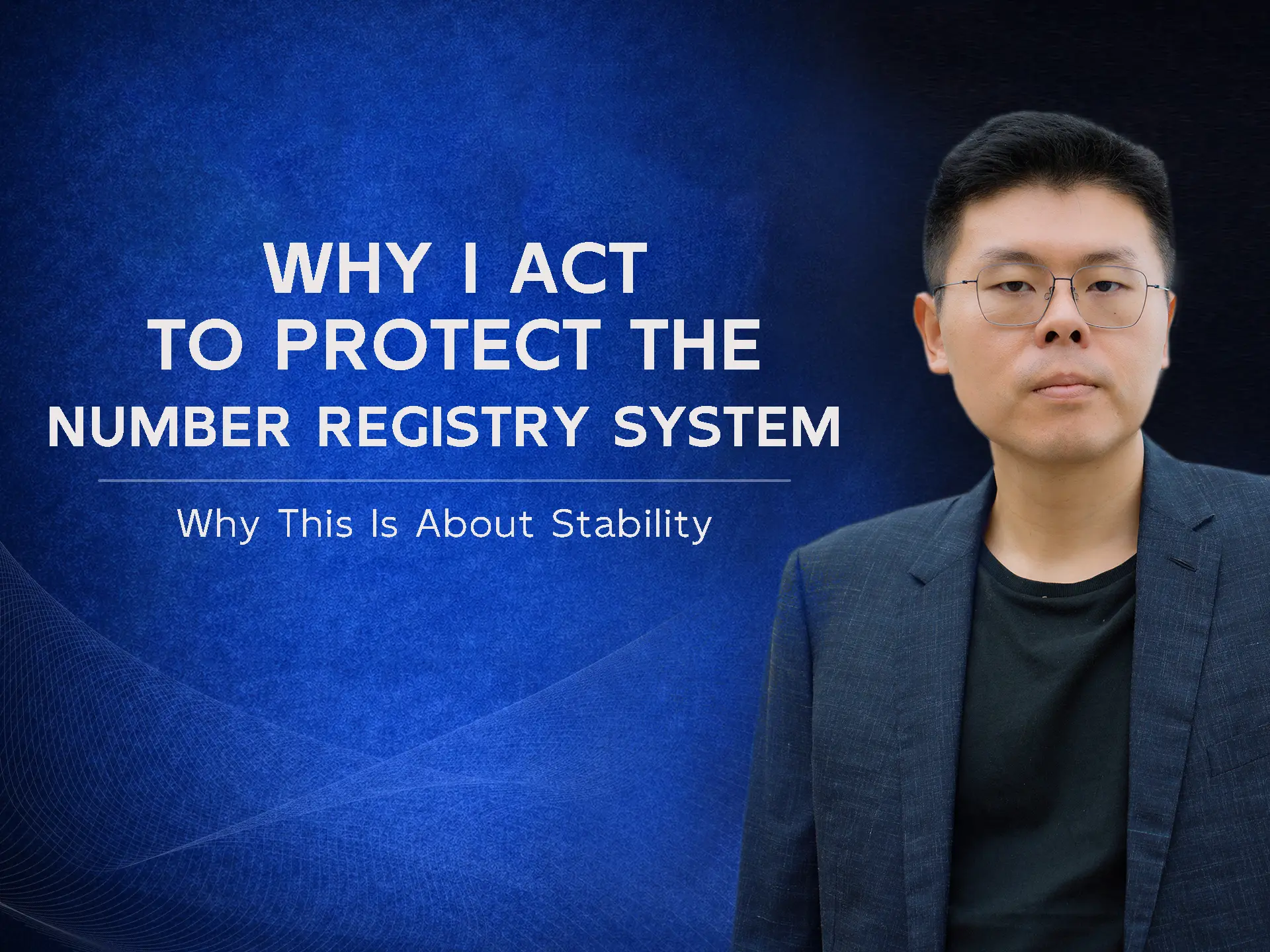
- A personal intervention frames IP address governance as a rule-of-law issue rather than a technical dispute
- The case raises wider questions about accountability, independence and resilience in global internet coordination
“Prices form, scarcity becomes visible, capital flows to where it is valued most, and total wealth increases. This is not ideology; it is historical evidence. Free markets do not depend on good intentions. They work because they align selfish behavior with collective wealth creation. The Internet itself scaled globally for exactly this reason.”
——Lu Heng, CEO at Cloud Innovation, CEO at LARUS Ltd, Founder of LARUS Foundation.
Number registry governance under strain as stability concerns come to the fore
In a recent commentary, Lu Heng set out why he believes intervening to protect the global number registry system was necessary, and why the issue should be understood as one of institutional stability rather than personal or commercial interest. Writing in the context of prolonged disputes involving the management of internet number resources, Lu argued that the legitimacy of the system depends on predictable rules, due process and clear limits on organisational power.
At the centre of the argument is the role of regional internet registries, or RIRs, which allocate and manage IP addresses within defined geographic areas. These bodies are part of a broader framework coordinated globally through the Internet Assigned Numbers Authority, which oversees the allocation of IP address blocks and autonomous system numbers to the RIRs. Lu’s article portrays recent conflicts not as isolated governance failures, but as stress tests for a system designed to operate through consensus and transparency rather than coercion.
Lu Heng maintained that when registry organisations deviate from their established policies or appear to act without sufficient accountability, confidence in the entire number registry system is weakened. He presented his actions as an attempt to preserve procedural integrity, emphasising that stability relies on consistent application of rules, especially at a time when IPv4 address scarcity has increased the economic and strategic value of number resources.
The article also reflects concern about precedent. If disputes over address management are resolved through ad hoc decisions or opaque processes, Lu suggested, this could undermine trust among network operators, governments and investors who depend on the neutrality of the system.
Also Read: Breaking the centralised choke point: Why IP addresses must be decentralised
Also Read: Data sovereignty’s practical reality: Why law matters more than localisation
Internet number governance faces a test of stability and independence
The number registry system is often invisible to the public, yet it underpins almost every online service. IP addresses are not merely technical identifiers; they are foundational to routing, security and global connectivity. The framework linking the RIRs to IANA was deliberately designed to limit concentration of power and reduce political interference, a structure described in official documentation from IANA as critical to maintaining a single, interoperable internet.
However, Lu’s argument also invites scrutiny. While he frames intervention as protective, critics may ask whether legal or public pressure risks introducing its own forms of instability. RIRs are membership-based organisations, and disputes over governance can reflect genuine disagreements within their communities rather than systemic failure. The challenge is distinguishing between necessary oversight and actions that could unintentionally weaken institutional independence.
There is also a broader policy question. As IP addresses become more scarce and valuable, governance tensions are likely to increase. Calls for stronger enforcement, greater transparency or reform may be justified, but they also test the balance between decentralisation and control that has historically defined internet coordination.
Ultimately, the debate highlighted by Lu’s article is less about one individual or organisation and more about whether the existing number registry model can adapt to pressure without losing legitimacy. Stability, in this sense, is not guaranteed by defending institutions uncritically, but by continually questioning how power is exercised within them.