
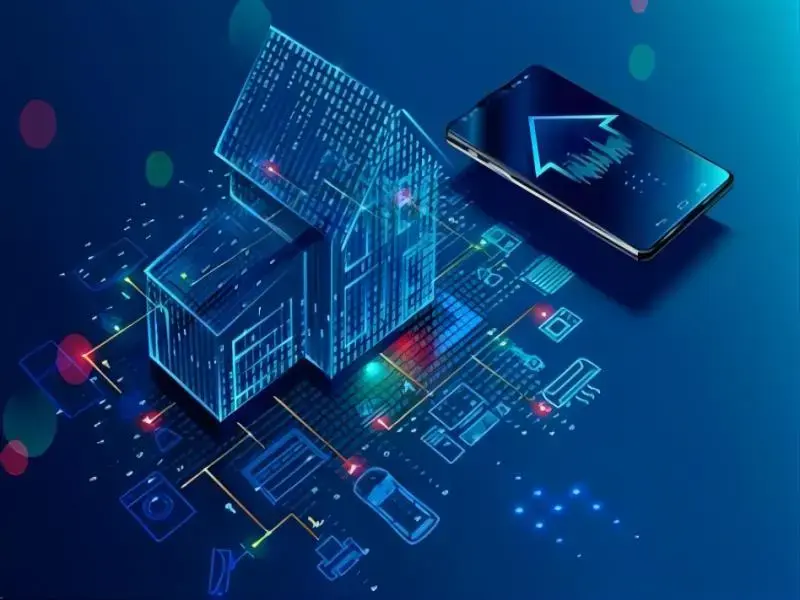
- With the basis of Internet Protocol (IP) and Transmission Control Protocol (TCP), the Internet of Things (IoT) has an ecosystem consisting of web-enabled smart devices, to send and act on data.
- There are some IoT applications in our daily lives, such as smart homes, smart cities, smart vehicles, smart healthcare, and smart agriculture.
- With the wide application of IoT, a smart world can be expected.
The Internet of Things (IoT) is defined as physical entities embedded with sensors and actuators that communicate with computing systems via wired or wireless networks—allowing the physical world to be digitally monitored or even controlled.
How the Internet of Things (IoT) works?
Internet of Things is based on Internet Protocol (IP) and Transmission Control Protocol (TCP). These standards and rules form the basis for sensors, devices, and systems to connect with the Internet and with each other. An IoT ecosystem consists of web-enabled smart devices that use embedded systems — such as processors, sensors and communication hardware — to collect, send and act on data they acquire from their environments.
IoT devices share the sensor data they collect by connecting to an IoT gateway, which acts as a central hub where IoT devices can send data. The data can also be sent to an edge device for local analysis before being shared. Local data analysis lowers the amount of data transferred to the cloud, resulting in less bandwidth being used.
Also read: How did the internet start?
Examples of IoT applications
1. Smart healthcare
In the healthcare industry, IoT devices can be employed to monitor patients remotely and collect real-time data on their vital signs, such as heart rate, blood pressure and oxygen saturation. This is very useful if the patients don’t have any serious problems or if they have any infectious diseases like COVID-19 these days. One of the most common uses of IoT applications in healthcare is using robots. For example, nursing robots can handle the monotonous tasks that nurses have to perform for many patients day in and day out where there is little risk to the patients.
2. Smart cities
According to IoT, cities can be made more efficient so that they require fewer resources and are more energy-efficient. This can be accomplished by utilizing a variety of sensors located throughout the city in various capacities. These sensors can be used for several purposes, such as traffic management, parking solutions, Infrastructure management, pollution monitoring, resource management, disaster management, and more.
3. Smart retail
IoT applications can be used by retail establishments for a variety of tasks, which will improve both the customer and employee shopping experience. For example, sensors can be used to track foot traffic in a store and analyze customer behaviour, allowing retailers to optimize product placement. IoT can be used to manage inventory, enhance in-store experiences, lessen theft and shoplifting, and cut down on lengthy lineups at the register.
Also read: IIJ’s SoftSIM integrates with Nordic to simplify IoT deployment
4. Smart agriculture
IoT devices can be used in agriculture to monitor soil conditions, weather patterns and crop growth. For example, Sensors are employed to detect the details of the soil chemistry and fertilizer profiles. A harvest’s quality is influenced by several factors, including temperature, moisture content, acidity level, CO2 levels, and the availability of the right nutrients. A smart greenhouse is used to raise crops instead of relying on changing weather patterns.
5. Smart homes
Homeowners can install devices such as home voice assistants, automated vacuums, or security systems. An example of an IoT-based smart home system is to use natural language processing for the contextual processing of voice commands. The system takes care of lighting rooms based on occupancy and even playing personalized music based on who is in the room.
6. Smart vehicles
Self-driving cars, also known as smart cars, are IoT applications that rely heavily on the Internet of Things. These cars have a lot of integrated features, like navigational sensors, multiple antennas, speed and slow-down controls, etc., that interact with one another and require communication.
Conclusion
These are some examples of IoT applications in the world. There is no limit to the application of IoT, especially when it is combined with other technologies like Machine Learning and Artificial Intelligence. IoT has many applications in smart homes, smart cities, smart vehicles, smart healthcare, smart agriculture, etc. And maybe this expanding list of applications for IoT will lead to a smart world in the future.