
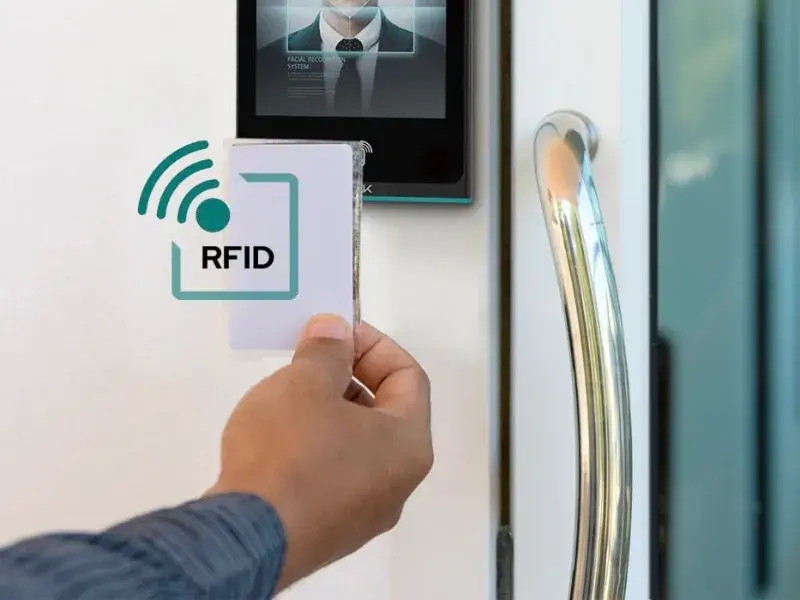
- RFID cards are embedded with a small microchip that stores and processes information, and an antenna that transmits this information to an RFID reader.
- RFID technology is versatile, finding applications across a wide array of industries.
Radio Frequency Identification (RFID) cards are revolutionising the way we access secure areas, track inventory, and identify individuals. These cards, embedded with tiny microchips and antennas, use radio waves to communicate with RFID readers. This technology, though seemingly simple, is transforming industries and everyday life with its efficiency and versatility. Let’s delve into what RFID cards are, how they work, and their impactful applications across various sectors.
The mechanics of RFID cards
RFID cards are embedded with a small microchip that stores and processes information, and an antenna that transmits this information to an RFID reader. When the card comes within range of the reader, the antenna captures the reader’s radio waves and sends back a signal with the card’s data. There are three main types of RFID systems: passive, active, and battery-assisted passive (BAP).
Passive RFID cards do not have an internal power source and rely entirely on the reader’s signal to power the chip and send a response. They are commonly used for access control, contactless payments, and inventory management due to their affordability and durability.
Active RFID cards are equipped with their own power source, which provides a much longer read range. They are used in applications requiring real-time tracking, such as in large warehouses or for asset management in hospitals.
Battery-Assisted Passive (BAP) RFID cards have a small battery that helps power the chip when in the presence of an RFID reader. This provides a greater range than passive systems without the higher cost of active systems.
Also read: What is IT hardware asset management?
Also read: Common protocols used by IoT devices
Applications across industries
RFID technology is versatile, finding applications across a wide array of industries.
In access control, one of the most common uses of RFID cards is in access control systems. Offices, residential buildings, and secure facilities use RFID cards to grant or restrict access to certain areas. This method is not only secure but also convenient, as users can simply tap their card on a reader to gain entry.
In retail and inventory management, retailers use RFID tags to track inventory in real-time. By placing RFID tags on products, stores can monitor stock levels, prevent theft, and streamline the checkout process. For instance, Zara, a global fashion retailer, uses RFID technology to enhance inventory accuracy and improve customer experience.
In transportation, RFID cards are widely used in public transportation systems for fare collection. Commuters can easily tap their RFID-enabled cards or devices to pay for rides, making the process faster and reducing the need for physical tickets. The Octopus card in Hong Kong and the Oyster card in London are prime examples of this application.
In healthcare, hospitals and medical facilities use RFID cards to track patients, staff, and equipment. This ensures patient safety, optimises asset utilisation, and enhances overall operational efficiency. For example, RFID wristbands are used to monitor patients’ locations and medical history in real-time, reducing the risk of errors.
The future of RFID cards
The future of RFID technology looks promising, with advancements in the Internet of Things (IoT) and smart cities driving further innovation. As RFID technology becomes more integrated with IoT systems, we can expect even greater automation and connectivity. This could lead to smarter supply chains, enhanced security systems, and more efficient public services.
Moreover, the continuous improvement in RFID technology is likely to reduce costs and increase accessibility, making it a standard feature in everyday life. The evolution of RFID cards will play a crucial role in shaping a more connected and efficient world.
RFID cards are more than just pieces of plastic with embedded chips; they are key components in the digital transformation of various industries. Their ability to provide secure, efficient, and real-time data transmission makes them indispensable in today’s fast-paced, technology-driven world. As we move forward, the role of RFID cards will undoubtedly expand, unlocking new possibilities and enhancing our interactions with the world around us.