
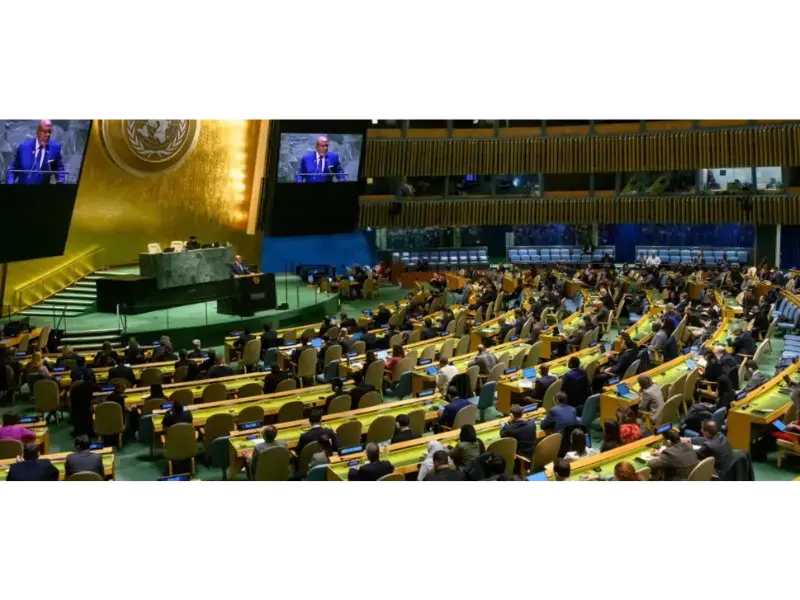
- The General Assembly approved the first United Nations resolution on artificial intelligence Thursday, giving global support to ensure human rights are “safe, secure and trustworthy.”
- The resolution, sponsored by the United States and co-sponsored by 123 countries, including China, advocates the strengthening of privacy policies.
- Europe is ahead of the United States, with EU lawmakers adopting a provisional agreement this month to oversee the technology.
The United Nations General Assembly on Thursday unanimously adopted the first global resolution on artificial intelligence that encourages countries to safeguard human rights, protect personal data, and monitor AI for risks.
Efforts of over 120 nations
The nonbinding resolution, proposed by the United States and co-sponsored by China and over 120 other nations was adopted by consensus with a bang of the gavel and without a vote, meaning it has the support of all 193 U.N. member nations.
According to the U.S. Ambassador to the United Nations Linda Thomas Greenfield, “Today, all 193 members of the United Nations General Assembly have spoken in one voice, and together, chosen to govern artificial intelligence rather than let it govern us.”
The resolution is the latest in a series of initiatives by governments around the world to shape the development of AI. Few of these have been truly effective, amid fears it could be used to disrupt democratic processes, turbocharge fraud, or lead to dramatic job losses, among other harms.
In November, the U.S., Britain, and more than a dozen other countries unveiled the first detailed international agreement on how to keep artificial intelligence safe from rogue actors, pushing for companies to create AI systems that are “secure by design.”
Also read: Artificial Intelligence Act: World’s first global AI law passed in EU
Also read: China’s Zhipu looks to Sora to chase artificial general intelligence
Regulation of artificial intelligence in the US
Europe is ahead of the United States, with EU lawmakers adopting a provisional agreement this month to oversee the technology.
The Biden administration has been pressing lawmakers for AI regulation, but the polarised US Congress has made little progress.
Meanwhile, the White House sought to reduce AI risks to consumers, workers, and minorities while bolstering national security with a new executive order in October.
U.S. National Security Advisor Jake Sullivan said it took nearly four months to negotiate the resolution, but that it gave the world “a baseline set of principles to guide next steps in AI’s development and use.”