
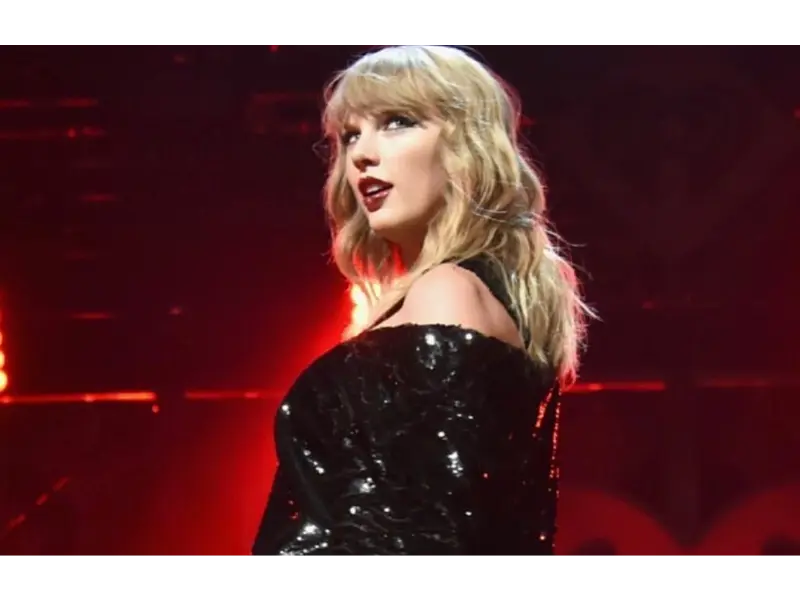
Elon Musk will have to work overtime again, and I’m afraid social media platforms are going to get noisy over celebrity privacy again. When will artificial intelligence technology infringement stop? Since the emergence of “AI face changing” technology, “face changing” events have emerged, and many stars have been “AI face changing” for commercial promotion.
What’s more, the portraits of stars, celebrities or ordinary people are replaced with photos or videos containing elements of pornography, violence, ugliness, etc., and disseminated and sold, etc., leading the public to mistakenly believe that the relevant photos and videos are real, lowering the social evaluation of the “face-changing”, and also allegedly infringing on the “face-changing” person’s right to reputation.” The story of “AI face changing” is false information about Taylor Swift.
Latest victims
The latest victim of Deepfake has emerged – global household name and top streamer, Taylor Swift.
In the space of a few hours, X, Facebook and other social media platforms have been flooded with fake “unflattering photos” that have been viewed by tens of millions of people. Now that Taylor Swift herself has been informed of the incident, she has expressed her outrage and fans have taken it upon themselves to organise a protective action.
On X, some angry fans went straight to @Musk, shouting that this is something you need to come out and take care of. The incident began when Taylor Swift’s new boyfriend, NFL footballer Travis Kelce, played for the Kansas City Chiefs, and Taylor became a regular at the team’s games after their relationship was revealed. AI was used to generate explicit photos of Taylor and various fictional “players” against the backdrop of the stadium.
Rumours abound as to how the images went viral, with some suggesting that they first appeared in an encrypted chat group. Some reports claim that the Deepfake photos were initially posted on an unsavoury website, which is full of unflattering photos featuring famous celebrities.
In addition to Taylor, the site featured hundreds of other celebrities, including Magrot Robbie, who plays Barbie.
Constantly in turmoil
As of now, some of the accounts involved in spreading the photos have been banned by the major platforms, but there are still a number of leaks.
On Facebook’s part, parent company Meta also had a spokesperson who said, The content violates our policies and we are removing it from our platform and taking action against the account that posted it.
Asked about it at a White House press conference on the 26th, spokesman Jean Pierre said, “We are concerned about the circulation of these types of images, and more specifically, false images, which is worrisome.”
“While social media companies can make independent decisions about content management, we believe they have an important role to play in enforcing their own rules to prevent the spread of misinformation and private images of real people without their consent.” Jean-Pierre said. She also added that lax enforcement on the internet affects women more, who are the main targets of online harassment and bullying. According to Jean-Pierre, this is not a new issue, it’s one that the Biden and Harris administrations have prioritised from day one in office, “and we take it very seriously. Once again, this concerns us.”
It’s worth noting that this isn’t the first time Taylor Swift has been screwed over by AI. in early January, an AI-generated advert for a fake Taylor Swift bandwagon went viral on social media Facebook.
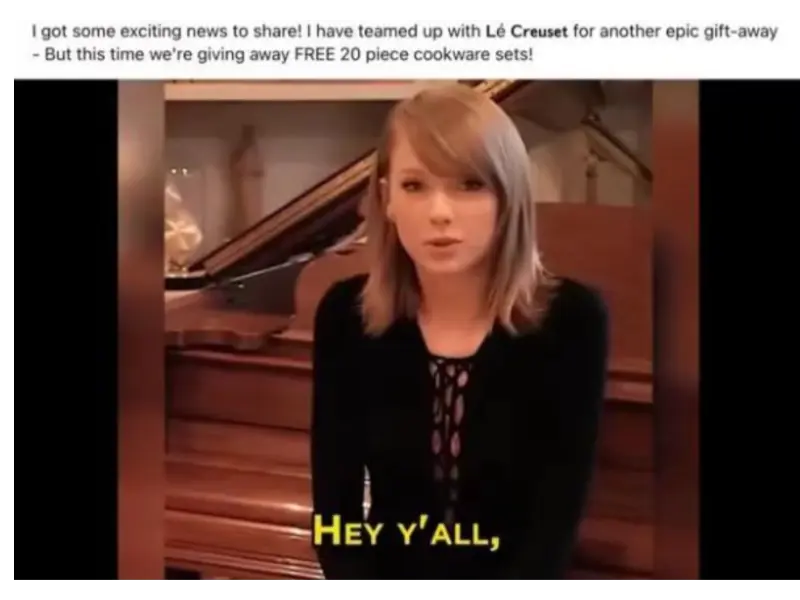
“Hey y’all, I’m Taylor Swift. Due to a packaging error, 3,000 Le Creuset cookware sets could not be sold properly offline and were shifted to online. There’s good news to share with you guys, I’ve teamed up with Le Creuset for a promotion – 20 of my loyal fans will be getting a free cookware set to give away.”
In fact, the “Mildew” in the video isn’t really Swift, but rather an AI “deep fakery” technology that synthesised her voice and pieced it together with her image and a clip from a Le Creuset advert. The company was quick to respond, saying that Swift was not involved in any consumer giveaways and that all promotions for the product came from official social media campaigns.
Also read: How criminals used AI face apps to swindle users: A China case study exposes the risks
What is AI Deepfake
AI-Deepfake technology has once again attracted attention. Deepfake (Deepfake) is the English “Deep learning” and “Fake” synthetic word, refers to the use of deep learning technology to generate synthetic images, audio or video technology.
Siwei Lyu, a computer science professor at the University at Buffalo’s Media Forensics Lab, said the “deep fake” scam was likely created using a text-to-speech service. Such tools translate scripts into sound and synthesise them into video clips using a lip-sync programme.