
Google claims quantum computing breakthrough with Willow chip is profiled by BTW Media because published evidence links it to internet infrastructure, governance, operational dependencies, or market visibility.
Google claims quantum computing breakthrough with Willow chip is tracked as a internet infrastructure institution within the internet infrastructure ecosystem.
Google claims quantum computing breakthrough with Willow chip has public-source relevance to network operations, governance, dependency mapping, or market structure.
Google claims quantum computing breakthrough with Willow chip is tracked as a internet infrastructure institution within the internet infrastructure ecosystem.
Public-source signals support medium-impact monitoring for infrastructure visibility and dependency analysis.
Google claims quantum computing breakthrough with Willow chip is profiled by BTW Media because published evidence links it to internet infrastructure, governance, operational dependencies, or market visibility.
Public-source signals support medium-impact monitoring for infrastructure visibility and dependency analysis.
| 0.90–1.00 | A | High — direct sources |
| 0.75–0.89 | A/B | Strong |
| 0.55–0.74 | B/C | Medium |
| 0.35–0.54 | C/D | Weak–medium |
| 0.10–0.34 | D | Weak signal |
| 0.00–0.09 | D | Internal monitoring |
Several public sources
- Google’s Willow chip executes the first-ever verifiable quantum algorithm, Quantum Echoes, 13,000 times faster than classical supercomputers.
- The breakthrough could pave the way for advancements in quantum-based drug discovery and materials science.
What happened: Willow chip achieves quantum breakthrough
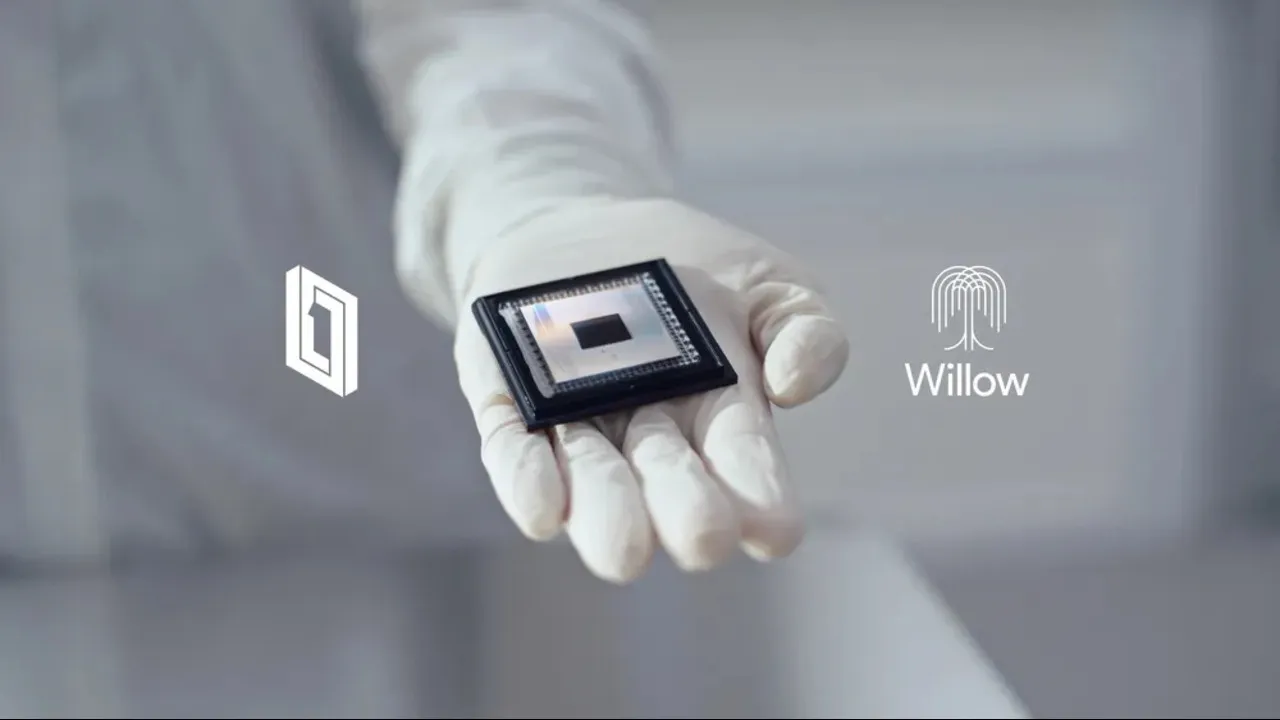
In a landmark development, Google has announced a significant breakthrough in quantum computing. The company’s Willow quantum chip has achieved the “first-ever verifiable quantum advantage” by running the Quantum Echoes algorithm. This algorithm, a step forward in quantum computing, outperforms traditional supercomputers, completing tasks 13,000 times faster.
The breakthrough involves using the Quantum Echoes algorithm to study molecular structures, a potential game-changer for fields such as chemistry and materials science. Google’s chip makes this possible by using a technique that amplifies quantum signals via constructive interference, resulting in highly sensitive measurements.
The experiment, conducted in collaboration with the University of California, Berkeley, demonstrated that the Willow chip could study molecules with precision. This was validated by comparing the quantum results with those from traditional Nuclear Magnetic Resonance (NMR) techniques, revealing new molecular information.
Also Read: auDA: Administrator of Australia’s.au Domain
Also Read: 1-TO-ALL: Thailand telecom and solutions distributor
Why it’s important
This quantum advantage marks a step toward real-world quantum applications. The ability to model quantum phenomena, including atomic interactions, could revolutionise industries reliant on molecular science, such as drug discovery and material design. As quantum computing matures, it could vastly improve the capabilities of NMR, offering new tools for drug discovery and the design of advanced materials.
Ashok Ajoy, Assistant Professor of Chemistry at UC Berkeley, highlighted the potential for quantum computing to enhance NMR spectroscopy, which is crucial for understanding molecular structures. With quantum computing’s growing role, this breakthrough signals the start of many more real-world applications.
Google’s goal is to scale towards an error-corrected quantum computer, and it expects future advancements to open new frontiers in scientific research. As the technology evolves, it could lead to transformative breakthroughs across various industries.
At A Glance
- Name: Google claims quantum computing breakthrough with Willow chip
- Type: Internet infrastructure institution
- Base: Asia Pacific
- Profile focus: Institution
What It Does
- Public records support monitoring of its role, services, and key relationships.
Why It Matters
- Public-source signals support medium-impact monitoring for infrastructure visibility and dependency analysis.
- Operational criticality: Medium
- Time horizon: Next quarter
What To Watch
- Monitoring focuses on verified service continuity, governance changes, and relationship signals.
Track verified source updates, role changes, and current public evidence.
Public-source signals support medium-impact monitoring for infrastructure visibility and dependency analysis.
Longer-term relevance depends on verified operating, policy, and relationship changes.
Member Briefing
Deeper Profile Context
Login is required to unlock the full profile briefing and source notes.
Only for Strategy Circle
Strategic Circle Access
Open to all readers. Unlock profile briefings after joining and logging in.
Join Strategic CircleOnly for Leadership Alliance
Leadership Alliance Access
For owners and management of IP-holding companies. Login required to unlock.
Join Leadership Alliance


