
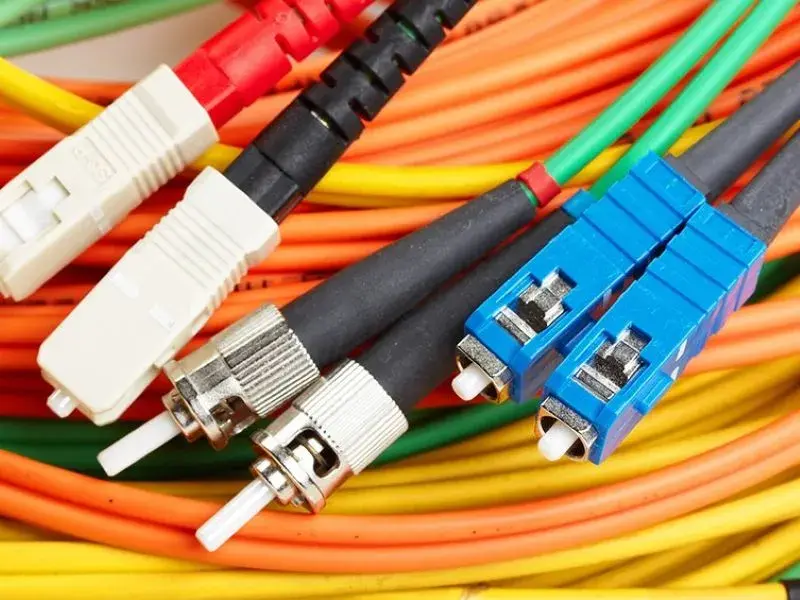
- Compared to copper wired cables, fiber optic cables provide higher bandwidth and can transmit data over longer distances.
- Fiber optic cables support much of the world’s internet, cable television, and telephone systems.
Fiber optic cables are a cornerstone of modern computer networks, offering unparalleled performance and reliability compared to traditional copper cables. In today’s fast-paced digital world, the demand for high-speed, reliable, and efficient data transmission is higher than ever. In this blog, we’ll delve into what fiber optic cables are, how they work, and why they are essential for modern computer networks.
What is fiber optic cable and how does it work
Fiber optic cables are high-speed data transmission mediums made from glass or plastic fibers. These fibers transmit data using light signals rather than electrical signals, which enables them to achieve significantly higher speeds and greater bandwidth compared to traditional copper cables. It consists of two main components: core and cladding.
Fiber optic cables work by transmitting data in the form of light pulses. These light signals are generated by lasers or light-emitting diodes (LEDs) and travel through the core of the fiber optic cable. The light signals are transmitted through the core and reflect off the cladding, maintaining the signal’s integrity over long distances. This method minimises signal loss and interference, allowing faster and more reliable data transmission.
Also read: FibreWorld supports fibre optic cable networks in Nigeria
Types of fiber optic cables
Single-Mode Fiber (SMF): It has a small core diameter (about 8-10 micrometres) and transmits light signals over long distances with minimal attenuation.
Use Case: Ideal for long-distance communication, such as between cities or across large campuses.
Multi-Mode Fiber (MMF): It has a larger core diameter (about 50-62.5 micrometres) and transmits multiple light modes simultaneously over shorter distances.
Use Case: Suitable for shorter distances, such as within data centres or local area networks (LANs).
Also read: Discovering the power of fibre optic networks
Advantages of fiber optic cables
High bandwidth: Fiber optics offer much greater bandwidth compared to copper cables, supporting high-speed data transfer and accommodating large amounts of data traffic.
Long distance transmission: Fiber optic cables can transmit data over much longer distances without signal degradation, making them ideal for backbone connections in networks.
Low signal loss: Due to the low attenuation of light signals, fiber optic cables experience less signal loss, ensuring clearer and more reliable communication.
Immunity to electromagnetic interference: Unlike copper cables, fiber optics are not susceptible to electromagnetic interference, which enhances the signal quality and reduces the risk of data corruption.
Enhanced security: Fiber optic cables are more secure because they do not emit signals that can be easily tapped into, providing better data security.
Fiber optic cables have transformed computer networking, offering unmatched speed, reliability, and capacity. As data demands continue to escalate and technology evolves, fiber optics will remain at the forefront of networking solutions, ensuring robust and efficient communication in our increasingly connected world. By leveraging fiber optic technology, businesses and individuals can enjoy faster internet speeds, more reliable connections, and enhanced network performance.