
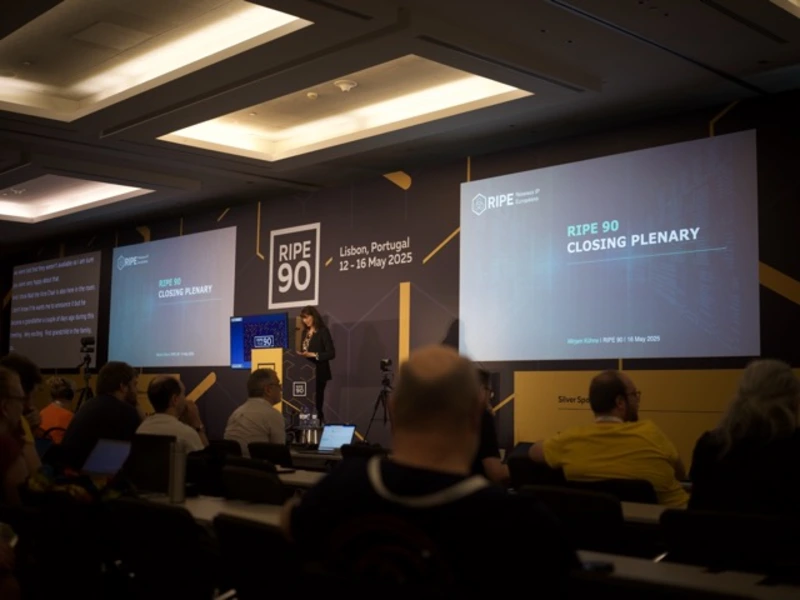
- Final sessions urge the internet community to confront IPv6 deployment failures and abuse handling gaps.
- Experts call for structural changes, better incentives, and shared trust mechanisms to secure the internet’s future.
What happened: Final day focuses on IPv6 inertia and broken abuse systems
The RIPE 90 meeting officially wrapped up today in Lisbon, ending a five-day gathering that spotlighted deep challenges facing the global internet. On the final day, experts issued clear warnings about two persistent problems: the stalling of IPv6 deployment and the ineffective state of internet abuse reporting.
In the IPv6 Working Group, Geoff Huston, Chief Scientist at APNIC, presented detailed BGP data revealing that a large number of IPv6 address allocations are not routed or used. Huston attributed this to weak business incentives, the continued reliability of IPv4, and operational complexity. “We’ve created an internet that doesn’t need IPv6 to work,” he said, warning that the transition could take decades without real change.
ICP-2: Navigating internet governance challenges
The conference brought to light significant concerns regarding ICP-2 and its implications for Internet governance. Entities highlighted the necessity for a balanced regulatory framework that not only promotes innovation but also safeguards equitable access to Internet resources. The discussions underscored the importance of inclusive policy-making processes that involve diverse stakeholders, ensuring that the needs of both users and providers are addressed.
ICP-2 seeks to establish guidelines that facilitate better connectivity and interoperability across networks. However, the potential for regulatory overreach has raised alarms within the community. As a result, stakeholders are advocating for a collaborative approach to refine these policies, ensuring they enhance rather than hinder progress in the digital landscape.
The critical role of number portability
In tandem with ICP-2 discussions, the topic of number portability emerged as essential for enhancing competition and empowering consumers. LARUS CEO Lu Heng articulated that enabling users to retain their IP addresses when switching service providers is fundamental to fostering a competitive marketplace. This capability not only mitigates the risk of vendor lock-in but also incentivises providers to improve their services.
Number portability is increasingly recognised as a cornerstone of a fair Internet ecosystem. It allows users to make informed choices and encourages innovation among service providers, ultimately benefiting the entire community. The discussions at RIPE 90 highlighted the necessity for robust frameworks that support seamless transitions while ensuring user data integrity and security.
Also Read: Worry and concern in ICP-2 discussions at RIPE 90
Also Read: RIPE 90: Lisbon hosts global internet infrastructure dialogue
Why it is important
The close of RIPE 90 reinforces a pressing reality: without community-wide coordination and investment, core internet infrastructure remains fragile. Huston’s analysis exposes the illusion of IPv6 progress—allocations are increasing, but real-world adoption stalls. This holds back innovation, fragments connectivity, and limits scalability as global demand for addresses continues to rise. Governments and operators need stronger incentives to act, or risk falling further behind.
In parallel, an appeal for a centralised abuse platform reflects industry frustration with outdated, ineffective abuse response systems. As threats grow more sophisticated, the lack of timely, trusted coordination undermines network resilience. His vision aligns with wider efforts from ICANN and FIRST to modernise how abuse is tracked, reported and resolved.
RIPE 90 may have ended, but its final messages demand continued urgency. The technical internet community must shift from discussion to action. IPv6 and abuse mitigation are no longer future challenges—they are today’s responsibilities.