

- Nobel Prize in Chemistry awarded to AI pioneers Demis Hassabis and John Jumper.
- AlphaFold 3 has redefined protein structure prediction with unprecedented accuracy.
- AI’s potential extends across multiple fields, from environmental solutions to disease research.
AI’s impact on protein prediction
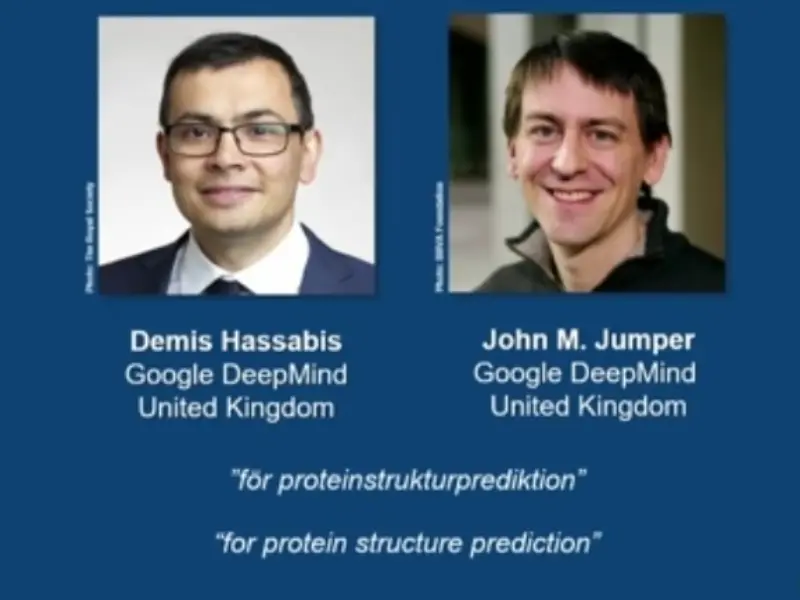
The 2024 Nobel Prize in Chemistry was awarded to three scientists, including Demis Hassabis, CEO of DeepMind, and John Jumper, a DeepMind scientist.
Also read: Who is Demis Hassabis? Co-founder of DeepMind
They were recognised for developing AlphaFold, an AI model that successfully predicts the structure of proteins. Their work has dramatically accelerated advancements in structural biology and holds significant potential for various applications.
AlphaFold 3’s groundbreaking achievements
DeepMind’s AlphaFold 3 has revolutionised protein structure prediction, achieving over 50% greater accuracy than traditional methods. It has predicted the structures of over 200 million proteins, surpassing conventional approaches in precision. This AI model holds immense promise for future applications in bio-renewable materials, resilient crops, drug design, and genomic research.
“What took us months or years to accomplish, AlphaFold did over a weekend.”
Dr. McGihan
Broad applications of AI in life science
AlphaFold’s applications span several fields, including biochemistry, cell biology, genetics, and pharmacology. The AI tool is being utilised to address global challenges like plastic pollution and food security. Its growing impact on disease understanding, drug design, and species protection positions AlphaFold as a pivotal tool in life sciences.
Also read: Google DeepMind CEO Demis Hassabis receives knighthood for AI technology
However, structural biologists caution that AI cannot replace much of the work still required by scientists. As early as the release of AlphaFold 2, Chinese structural biologist Yan Ning highlighted that structural biology involves more than just observing protein folding; it requires understanding dynamic changes, interactions with other biomolecules, and the context of cellular states—areas where AI still faces limitations due to inadequate databases for training.
AlphaFold has already made a considerable impact in various biological fields, accelerating the development of treatments for diseases like malaria and Parkinson’s, tackling drug-resistant bacteria, and even aiding in species protection. DeepMind’s ultimate goal is for AlphaFold to transform humanity’s understanding of the biological world. The Nobel Chemistry Prize has sparked significant online discussion, with some congratulating the winners, others joking about whether ChatGPT deserves a Literature Nobel, and still others raising concerns about AI potentially overshadowing foundational scientific knowledge.
Nevertheless, many agree that AI’s application in protein research is a highly credible approach.