
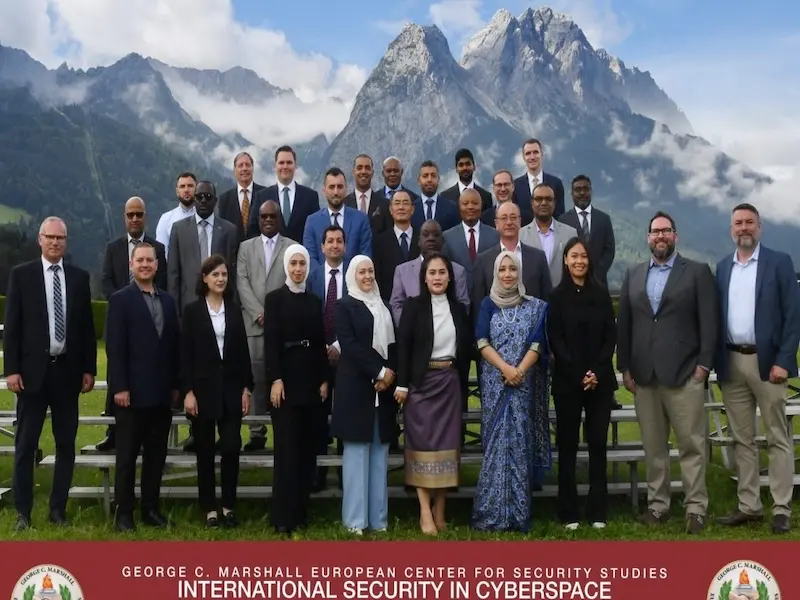
- INTIC representatives Constantino Sotomane and Eugénio Jeremias attend ransomware workshop in Germany.
- Discussions covered NIST 2.0 framework and strategies against ransomware attacks.
- Focus on national policies, economic implications, global threats, and public-private partnerships for resilience.
The Instituto Nacional de Tecnologias de Informação e Comunicação (INTIC) took part in the Workshop on Combatting the Threat of Ransomware, held from July 22 to 26 at the George C. Marshall European Center for Security Studies in Garmisch, Germany. Representing INTIC were Constantino Sotomane, Technical and Operational Administrator, and Eugénio Jeremias, Director of the Cybersecurity and Data Protection Division. This workshop addressed the critical and growing threat posed by ransomware, a malicious software designed to extort money from victims by encrypting their files and demanding a ransom for the decryption key.
Key discussions on ransomware mitigation
The event focused on the National Institute of Standards and Technology (NIST 2.0) framework, outlining methods to counter the increasing ransomware threat. Topics included ransomware and national policy, economic and national security implications, global threat trends, the International Counter Ransomware Initiative (CRI), and the establishment of public-private partnerships to enhance resilience.
Impact and prevention strategies
“Ransomware attacks can occur through various means, such as phishing emails, malicious software downloads, or exploiting system vulnerabilities. The consequences can be severe, including data loss, service disruption, and significant financial costs for recovery and mitigation.”
Constantino Sotomane, INTIC Technical and Operational Administrator
Sotomane explained, “Ransomware attacks can occur through various means, such as phishing emails, malicious software downloads, or exploiting system vulnerabilities. The consequences can be severe, including data loss, service disruption, and significant financial costs for recovery and mitigation.” He emphasised the importance of cybersecurity best practices, including regular backups, updated antivirus software, and vigilance against suspicious emails and links.
Collaboration and global response
The workshop was organised by the George C. Marshall European Center for Security Studies with support from the U.S. Department of State and guided by the MITRE Corporation and the Institute for Security Technology (IST). MITRE focused on NIST standards to enhance the capacities of partner nations and key policymakers. IST discussed effective multilateral partnerships and the global community’s efforts to address the ransomware challenge.
By participating in this workshop, INTIC reaffirms its dedication to strengthening national cybersecurity and collaborating with international partners to combat the evolving threat of ransomware.
About INTIC
The INTIC is the agency responsible for regulating, supervising, and overseeing the Information and Communication Technologies (ICT) sector in our country. Its origin was the Technical Unit for the Implementation of the Computer Policy (UTIC), created in 2002 to advise the Government on the introduction of ICT, a status that remained in force until 2014, when it was transformed into the current public institute format.
Initially, it was a two-headed agency, performing both implementing and regulatory functions. However, Law No. 3/2017 of January 9th, which establishes the principles, general norms, and legal framework for electronic transactions in general, electronic commerce, and electronic government in particular, would end the two-headed regime by appointing the INTIC as the Regulatory Entity of the said law and assigning the executive the task of creating an electronic government authority, which is the INAGE – National Institute for Electronic Governance.