
Single-stack monitoring for RIR governance continuity.
Governance / RIR Watchdog
RIR Watchdog
RIR Watchdog governance intelligence tracks institutions, policy processes, standards activity, registry operations, accountability disputes, and implementation signals that affect internet infrastructure. BTW.
ARINRIPE NCCAPNICAFRINICLACNIC

Institution legitimacy and policy execution quality.
Decision-critical policy and control changes.
Primary-source reporting plus structural interpretation.
Latest Coverage
Latest from RIR Watchdog
2,395 articles

Story
The 27 August Redline: Reading APNIC’s prop-165 Through Its Assessment Delta
APNIC’s canonical `prop-165` record now points to `prop-165-v004`, published on 27 August 2026, while the Secretariat analysis displayed on that record is expressly introduced as applying to version 3. With the APNIC 62 Open Policy Meeting scheduled for 10 September 2026, the…

Story
RIPE-861 Recommends Off-List Nominations. The Candidate List Needs a Receipt
RIPE's new guide gives a quiet volunteer a private way to approach a continuing working-group chair. That can widen participation. It also moves the first step outside the public archive, making the later conversion from interest to a complete candidate list the part that needs…

Story
LACNIC and the economics of legitimacy after scandal
A balance-sheet test for how a regional Internet registry could restore trust after a verified governance failure without risking continuity.

Story
ARIN’s RDAP Parent Handle Describes Registration Hierarchy, Not Network Transit
Two handles in one ARIN RDAP response can reconstruct how an address block sits inside the registry, but they cannot reveal who carries its traffic. The distinction is small in syntax and consequential in analysis.

Story
LACNIC's FORT Can Validate ASPA. Its Router Feed Defaults to Version 0
LACNIC announced a validator that can carry ASPA data towards routers. The release also keeps that route behind a configuration value whose default is zero. That is not a contradiction or a defect. It is the difference between shipping a capability and establishing that the…

Story
A Date Is Not a Review Window: AFRINIC’s Missing Assessment-to-Agenda Record
AFRINIC’s staff impact assessment for `AFPUB-2026-GEN-002-DRAFT01` is dated 23 June 2026. AFRINIC-37 met on 24 June, with the Policy Compliance Dashboard scheduled for 15:15–16:05 local meeting time. The minutes preserve the PDWG Chair’s concern that providing an assessment only…

Story
AFRINIC Invited Members to Test MyAFRINIC v2. The Beta Needs a Defect-to-Release Ledger
AFRINIC used its AfPIF 2026 page to invite members into the next stage of MyAFRINIC v2: workflow interviews, user acceptance testing and a live beta. That is a sensible way to test a member portal against real registry work. It also creates an evidence duty. Every finding should…

Story
AFRINIC’s RDAP CIDR Array Describes a Registered Range, Not a BGP Route
AFRINIC’s RDAP service can render a registered address interval in the same CIDR notation used by routing systems. The shared notation is useful for comparison, but the registry field does not establish that a route exists, identify its origin or prove that traffic can reach the…
Story
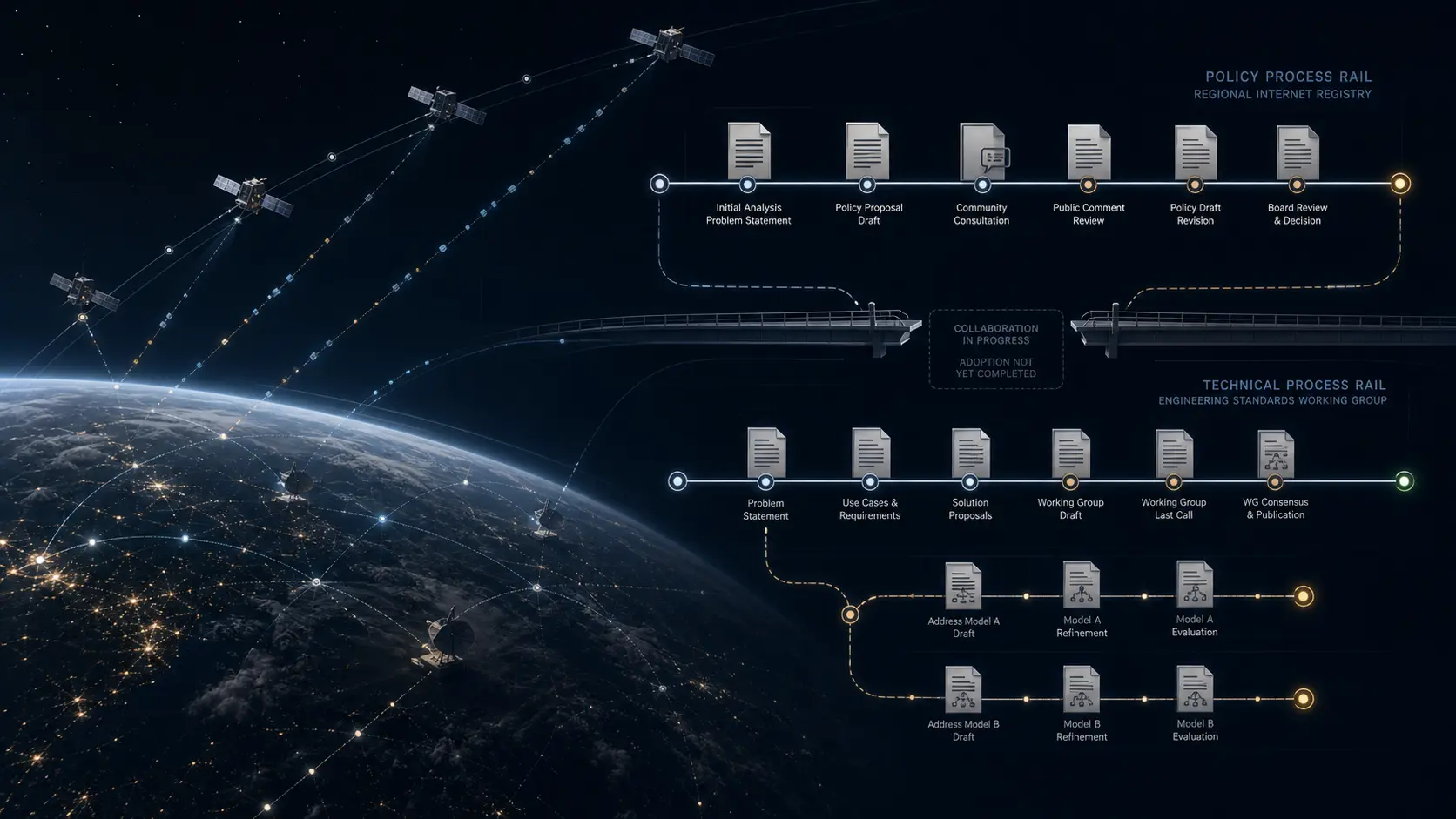
ARIN Calls Its Space Policy Joint. IETF Has Not Adopted the Address Model
ARIN-2026-1 says the proposal is joint with an IETF working group. The linked IETF record says the address model has no formal standing, and the working-group chairs found no clear consensus to adopt it as-is. Both statements can be faithfully recorded only if institutional…

Story
Where Member Notice Stops: RIPE-865 and the Burden of a Public Record
RIPE-865 preserves the general position that RIPE NCC members are informed when authorities seek their data or registry action, unless notice is expressly prohibited. Its eEvidence section creates a different notification state: confidentiality applies, and the RIPE NCC cannot…

Story
LACNIC and the economics of IANA recognition and franchise risk
IANA recognition is not a commercial franchise, yet it creates a similarly scarce institutional position: one regional registry becomes the globally accepted gateway between an upstream numbering system and a defined community.

Story
APNIC’s Service-Term Delegation Has No Public Classification Receipt
APNIC’s Executive Council gave the Secretariat room to change service terms without turning routine administration into policy making. The delegation is sensible and expressly bounded. What the public record lacks is the small entity that would let a later reader test the…

Story
AFRINIC Opened a Third Constitution Round. Every Comment Needs a Versioned Intake Record
AFRINIC’s Bylaws Review Committee continued constitutional consultation after the second-round deadline and narrowed attention to dispute resolution and safeguards around Resource Member termination. More time can improve the draft. It also creates a new recordkeeping duty: every…

Story
AFRINIC’s $20,790 MyAFRINIC Line Cannot Count Its Staff Work
AFRINIC’s half-year accounts put USD 20,790 of capital expenditure against MyAFRINIC v2. Six days before the reporting cut-off, its policy-meeting record said human resources had been channelled to the same project. The statements can both be accurate because they count different…

Story
LACNIC and the economics of NRO coordination incentives
A regional Internet registry is not a shop that customers can abandon when service disappoints them. Internet number resources must remain unique, and each registry serves a defined region. That makes coordination indispensable. It also removes the most familiar market…

Story
AFRINIC Sought Three Appeal Committee Nominees. The Appointment Record Must Be Case-Ready
AFRINIC’s Board opened nominations for three Policy Development Appeal Committee profiles and set a short, explicit deadline. The call establishes an intake step, not a functioning adjudicative body. Readiness will depend on what comes next: a versioned record of appointment…

Story
LACNIC and the economics of ICP-2 reform
The rule for recognising an Internet registry is also a rule about who must bear the cost of proving that institutional change is safe. LACNIC makes that trade-off unusually visible: regional legitimacy is built through members and an open policy process, while recognition…

Story
APNIC's RDAP port43 Points to a Legacy WHOIS Service, Not Network Authority
In a live APNIC RDAP record, `port43` names `whois.apnic.net`. That is useful evidence about where to query the legacy registration service—but it is not a statement about who operates, routes or controls the addressed network.

Story
AFRINIC Opened a Member Survey. Its Value Depends on a Response-to-Action Record
AFRINIC has invited members and stakeholders to say what works, what should improve and what deserves priority. A short, optionally anonymous survey can widen participation. Its durable value, however, will be measured after collection: whether AFRINIC makes the path from…

Story
RIPE’s CoC Draft Joins Final Appeal and Team Removal
A second RIPE Code of Conduct draft would let the RIPE Chair appoint, continue and remove community reviewers at discretion. The current appeal process already names that office as the final assessor. Neither power proves interference. Their combination does create a hard…
Member Unlock
Restricted Profile Intelligence
Login is required to unlock full profile briefings and deep-dive sections.
Strategic Circle Briefing
Join to unlock strategic briefings after signing in.
Join Strategic CircleLeadership Alliance Briefing
For qualified IP-asset owners and management; sign in to unlock alliance briefings.
Join Leadership AllianceSession Map
Registry Sessions
ARIN
North America governance, transfer-market behavior, and member process monitoring.
Open ARINRIPE NCC
Accountability, member visibility, and implementation signals across the RIPE NCC region.
Open RIPE NCCAPNIC
Allocation pressure, policy adaptation, and Asia Pacific institutional execution.
Open APNICAFRINIC
Election process, legal continuity, and board legitimacy under institutional stress.
Open AFRINICLACNIC
Institutional adaptation and ICP-2 governance trajectory in Latin America.
Open LACNIC