
Single-stack monitoring for RIR governance continuity.
Governance / RIR Watchdog
RIR Watchdog
RIR Watchdog governance intelligence tracks institutions, policy processes, standards activity, registry operations, accountability disputes, and implementation signals that affect internet infrastructure. BTW.
ARINRIPE NCCAPNICAFRINICLACNIC

Institution legitimacy and policy execution quality.
Decision-critical policy and control changes.
Primary-source reporting plus structural interpretation.
Latest Coverage
Latest from RIR Watchdog
2,406 articles

Story
Where Member Notice Stops: RIPE-865 and the Burden of a Public Record
RIPE-865 preserves the general position that RIPE NCC members are informed when authorities seek their data or registry action, unless notice is expressly prohibited. Its eEvidence section creates a different notification state: confidentiality applies, and the RIPE NCC cannot…

Story
LACNIC and the economics of IANA recognition and franchise risk
IANA recognition is not a commercial franchise, yet it creates a similarly scarce institutional position: one regional registry becomes the globally accepted gateway between an upstream numbering system and a defined community.

Story
APNIC’s Service-Term Delegation Has No Public Classification Receipt
APNIC’s Executive Council gave the Secretariat room to change service terms without turning routine administration into policy making. The delegation is sensible and expressly bounded. What the public record lacks is the small entity that would let a later reader test the…

Story
AFRINIC Opened a Third Constitution Round. Every Comment Needs a Versioned Intake Record
AFRINIC’s Bylaws Review Committee continued constitutional consultation after the second-round deadline and narrowed attention to dispute resolution and safeguards around Resource Member termination. More time can improve the draft. It also creates a new recordkeeping duty: every…

Story
AFRINIC’s $20,790 MyAFRINIC Line Cannot Count Its Staff Work
AFRINIC’s half-year accounts put USD 20,790 of capital expenditure against MyAFRINIC v2. Six days before the reporting cut-off, its policy-meeting record said human resources had been channelled to the same project. The statements can both be accurate because they count different…

Story
LACNIC and the economics of NRO coordination incentives
A regional Internet registry is not a shop that customers can abandon when service disappoints them. Internet number resources must remain unique, and each registry serves a defined region. That makes coordination indispensable. It also removes the most familiar market…

Story
AFRINIC Sought Three Appeal Committee Nominees. The Appointment Record Must Be Case-Ready
AFRINIC’s Board opened nominations for three Policy Development Appeal Committee profiles and set a short, explicit deadline. The call establishes an intake step, not a functioning adjudicative body. Readiness will depend on what comes next: a versioned record of appointment…

Story
LACNIC and the economics of ICP-2 reform
The rule for recognising an Internet registry is also a rule about who must bear the cost of proving that institutional change is safe. LACNIC makes that trade-off unusually visible: regional legitimacy is built through members and an open policy process, while recognition…
Story
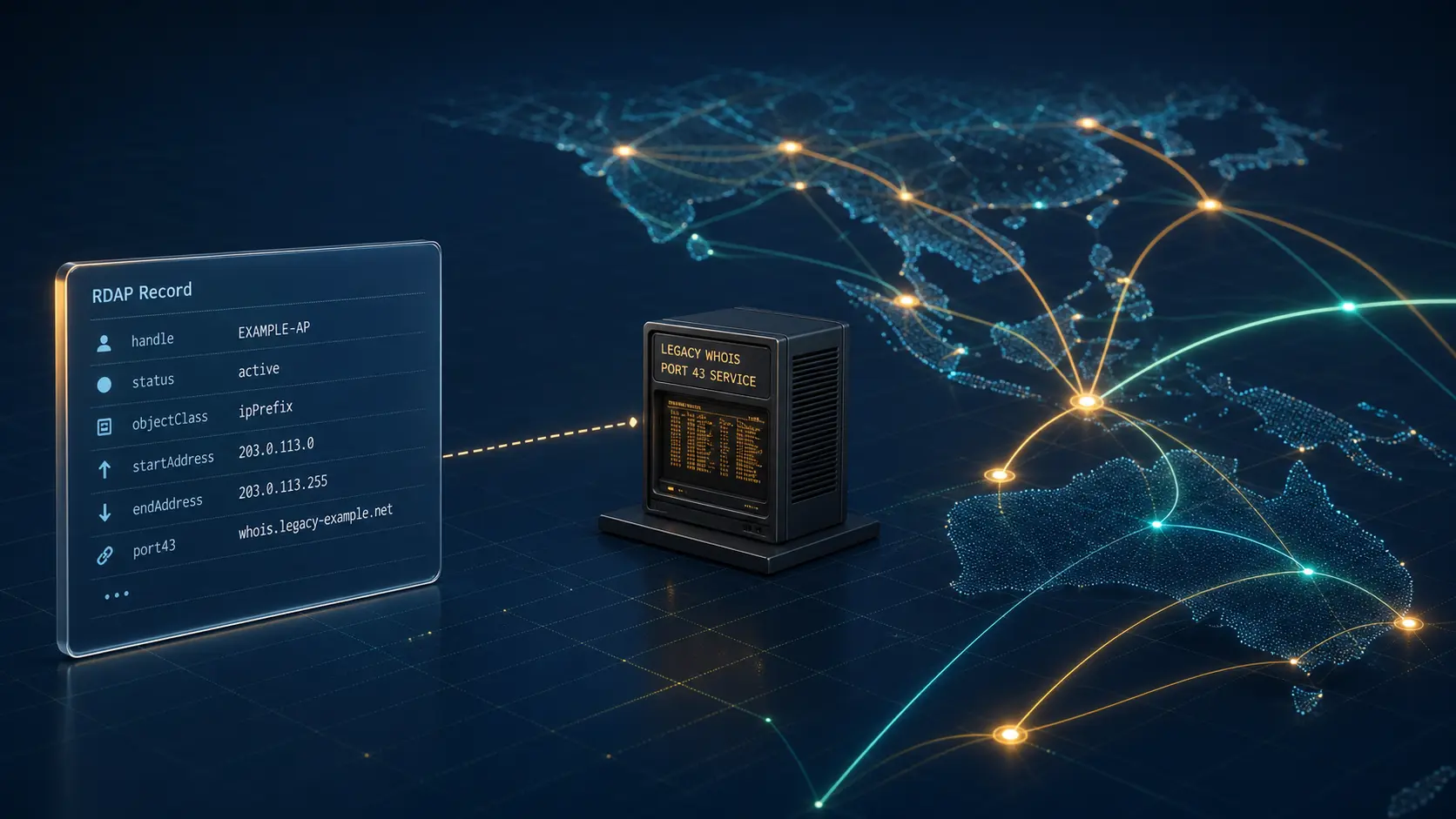
APNIC's RDAP port43 Points to a Legacy WHOIS Service, Not Network Authority
In a live APNIC RDAP record, `port43` names `whois.apnic.net`. That is useful evidence about where to query the legacy registration service—but it is not a statement about who operates, routes or controls the addressed network.

Story
AFRINIC Opened a Member Survey. Its Value Depends on a Response-to-Action Record
AFRINIC has invited members and stakeholders to say what works, what should improve and what deserves priority. A short, optionally anonymous survey can widen participation. Its durable value, however, will be measured after collection: whether AFRINIC makes the path from…

Story
RIPE’s CoC Draft Joins Final Appeal and Team Removal
A second RIPE Code of Conduct draft would let the RIPE Chair appoint, continue and remove community reviewers at discretion. The current appeal process already names that office as the final assessor. Neither power proves interference. Their combination does create a hard…

Story
A Private Registry Still Needs Public Limits
LACNIC is private infrastructure governance with public consequences: legitimacy depends on a bounded mandate, published rules, evidence, review and an operational record that affected networks can understand.

Story
AFRINIC Reconstituted GovCom. Three Members Were Elected, Two Appointed
AFRINIC says its Governance Committee is constituted and ready to work. The five voting seats arrived by two routes: three through a membership election and two through Board appointment. That mixed design is explicit. The next accountability test is whether requests, conflicts…

Story
A Court Order Is Not a Registry Runbook
A court can determine rights and impose duties. It does not thereby describe every safe registry, credential and routing step. LACNIC needs a disciplined bridge from legal command to operational execution.

Story
LACNIC’s 11 IXP Collectors Need a Vantage-Point Receipt
LACNIC has opened a useful window onto local routing: eleven BGP collector views, public MRT files and charts of prefixes, origin networks and paths. The problem begins only when a window is mistaken for the landscape. The portal does not bind each result to the peer cohort…

Story
ARIN’s 28 “Legitimate” Fraud Reports Were Not 28 Findings of Fraud
ARIN’s annual shorthand divided 223 policy-noncompliance reports into 195 outside its fraud process and 28 deemed legitimate. The arithmetic is exact. The meaning is not. ARIN’s own quarterly record shows that the 28 include corrected records, withdrawn routes, unconfirmed…

Story
APNIC Can Filter the Next WHOIS Download. It Cannot Recall the Old Ones
APNIC can remove contact fields from the next bulk-WHOIS dataset it generates. That is a real and testable privacy control. It cannot make the same edit reach backward into files that bulk-access users may already have downloaded under earlier terms. `prop-162` places both…

Story
AFRINIC Can Count 4,498,432 Reserved Addresses. It Cannot Publicly Explain the Count
AFRINIC’s daily statistics can tell an exact story about stock and almost none about state change. On the 20260827 serial, 4,498,432 IPv4 addresses sat behind one word—`reserved`—even though AFRINIC publicly describes three quite different reasons for placing addresses there.

Story
RIPE NCC Put “Public Arguments” Inside Its Sponsorship Conflict Test
RIPE-866 is designed to protect neutrality from money and influence. Its hardest line does something broader: it treats litigation, arbitration, public argument and other conflict as neighbours, then carries the test from a disputing party to anyone associated with one. That may…

Story
The Estate Cannot Route Itself
A liquidator can inventory equipment, contracts and claims. That does not make an Internet number delegation an ordinary asset that moves merely because a sale schedule says so. Insolvency creates two records that must meet: the court-supervised estate and LACNIC's…
Member Unlock
Restricted Profile Intelligence
Login is required to unlock full profile briefings and deep-dive sections.
Strategic Circle Briefing
Join to unlock strategic briefings after signing in.
Join Strategic CircleLeadership Alliance Briefing
For qualified IP-asset owners and management; sign in to unlock alliance briefings.
Join Leadership AllianceSession Map
Registry Sessions
ARIN
North America governance, transfer-market behavior, and member process monitoring.
Open ARINRIPE NCC
Accountability, member visibility, and implementation signals across the RIPE NCC region.
Open RIPE NCCAPNIC
Allocation pressure, policy adaptation, and Asia Pacific institutional execution.
Open APNICAFRINIC
Election process, legal continuity, and board legitimacy under institutional stress.
Open AFRINICLACNIC
Institutional adaptation and ICP-2 governance trajectory in Latin America.
Open LACNIC