
Summary
- Eversource Energy is best read through the customer who opens the outage map during a storm and asks whether the company knows what is broken, where crews are, and when the lights will come back.
- The utility bill funds more than poles and wires: it also pays for sensing, control rooms, work management, contact centres, vegetation management, cybersecurity, vendor platforms, regulatory evidence and the financing cost of crews that are mobilised before damage is fully known.
- The strongest evidence for Eversource is not a single route object or software vendor record, but the convergence of SEC filings, outage-map infrastructure, ARIN and DNS records, storm-cost proceedings, capital-spending disputes, data-centre load debates and customer-security incidents.
- The view improves if Eversource can show that storm spending, smart switches, telemetry and grid-modernisation investment reduce customer interruption time without shifting data-centre or financing risk onto ordinary households.
The evidence frame is intentionally mixed. Eversource's own 2025 Form 10-K describes a regulated delivery company built around electric distribution, electric transmission, natural gas distribution and, until the June 2026 sale close, water distribution, with the core electric utilities serving customers through Connecticut Light and Power, NSTAR Electric and Public Service Company of New Hampshire (https://www.sec.gov/Archives/edgar/data/72741/000162828026008461/es-20251231.htm). Its 2026 first-quarter Form 10-Q adds the live pressure points: a FERC transmission-return order, a Connecticut storm-cost prudency review, continued capital spending and revised earnings guidance (https://www.sec.gov/Archives/edgar/data/72741/000162828026032278/es-20260331.htm). The public outage surface is visible through Eversource's outages page and its KUBRA-powered storm centre shell (https://www.eversource.com/content/residential/outages and https://outagemap.eversource.com/external/default.html). The network-resource surface is narrower but useful: ARIN lists legacy Eversource Energy organisation records and two legacy /24 allocations, while public DNS shows outsourced mail filtering and reporting controls (https://rdap.arin.net/registry/entity/NORTHE-5, https://rdap.arin.net/registry/ip/192.133.20.0, https://rdap.arin.net/registry/ip/192.77.112.0, https://stat.ripe.net/data/prefix-overview/data.json?resource=192.133.20.0/24, and https://dns.google/resolve?name=_dmarc.eversource.com&type=TXT).
That frame has limits. State utility docket portals are not always easy to preserve as stable public URLs, and some live outage-map data is intentionally dynamic. A customer cannot infer control-room quality from a public map alone, and an investor cannot infer field performance from a rate-base table alone. This article therefore treats each public record as one piece of a utility-control puzzle. Filings show what Eversource asks regulators and capital markets to finance. The map shows what customers expect in the worst hours. DNS, mail and number-resource records show the ordinary internet edge around account, outage and abuse traffic.
News reporting and regulatory descriptions show where public frustration, data-centre siting and storm-cost recovery turn operating choices into political disputes.
The first product in a storm is not electricity; it is situational awareness
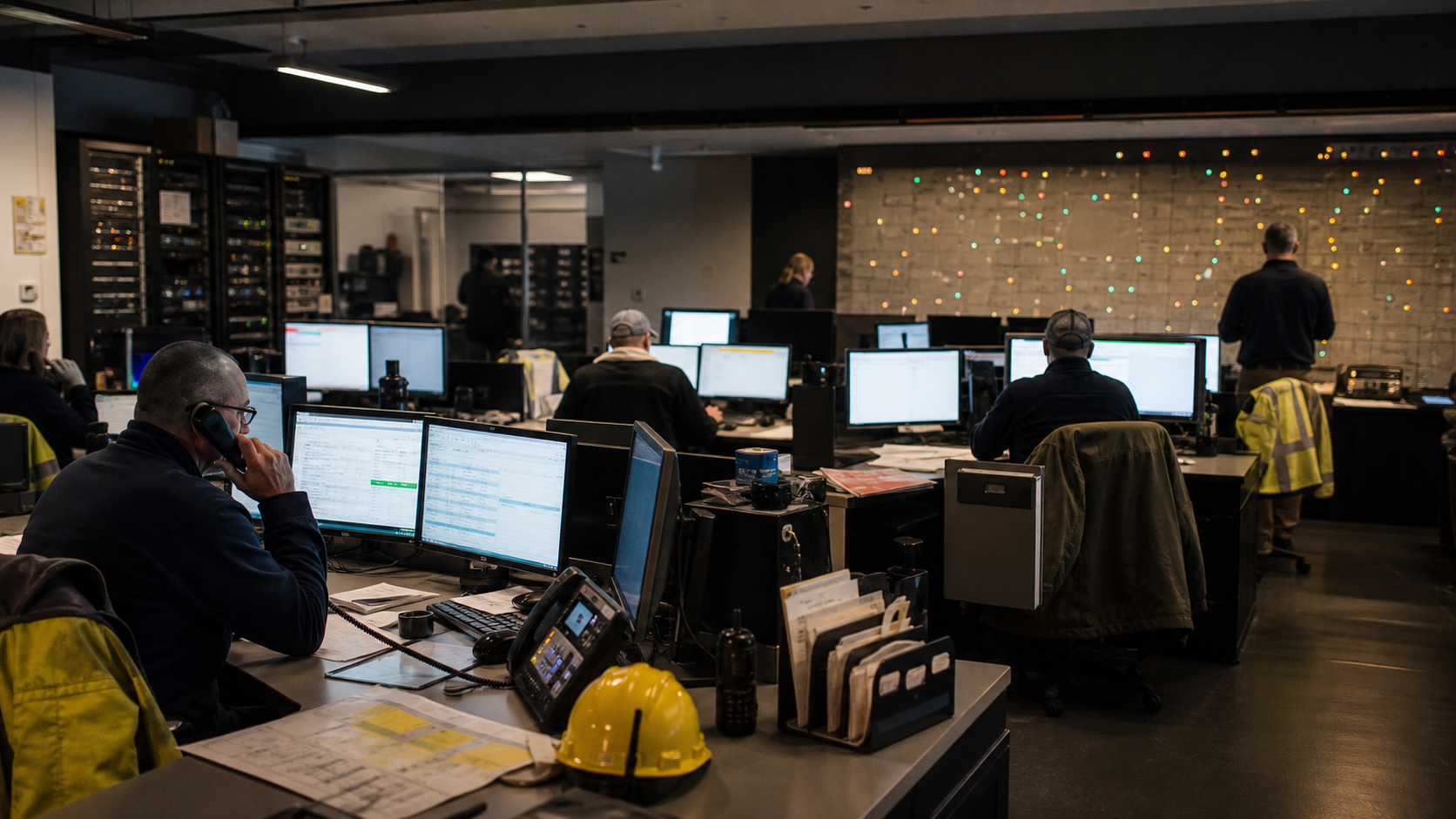
The customer is in Connecticut, Massachusetts or New Hampshire, and the house has gone dark during a wet wind event. The refrigerator is quiet. The phone still has a signal, for now. The first instinct is not to read a utility tariff. It is to open the Eversource outage map, zoom into the town, and look for proof that someone knows the problem exists. If the map shows a cluster, a cause, an estimated restoration time or a crew status, it buys the company a little patience. If it is stale, blank or inconsistent with what neighbours are seeing, every future rate explanation becomes harder to believe.
That is the right lens for Eversource Energy. The company is not a merchant generator selling electrons in a free market. Its core public bargain is regulated continuity. The 2025 Form 10-K says Eversource is a public utility holding company engaged primarily through wholly owned regulated subsidiaries in energy delivery, with electric distribution utilities in Connecticut, Massachusetts and New Hampshire, gas utilities in Connecticut and Massachusetts, and a water business that was still in the group at year end 2025 (https://www.sec.gov/Archives/edgar/data/72741/000162828026008461/es-20251231.htm). CL&P served approximately 1.32 million electric customers in 157 Connecticut cities and towns at December 31, 2025. NSTAR Electric served approximately 1.62 million electric customers in 159 Massachusetts communities, including Boston, Cape Cod, Martha's Vineyard and the Springfield area. PSNH served approximately 549,000 retail electric customers in 206 New Hampshire cities and towns. Those customers may choose competitive energy suppliers, but Eversource's utilities remain the distribution companies that deliver power and answer for the wires.
The distribution company is judged most brutally when energy supply is not the issue. A tree falls. A pole breaks. A feeder trips. A substation floods. A call centre is overwhelmed. A text message goes out too late. In those moments, the distinction between commodity energy cost and delivery-service cost becomes very real. Eversource's filings repeatedly state that its electric utilities generally pass through purchased power costs without mark-up for customers who do not choose suppliers. The utility earns its regulated return on infrastructure and service obligations, not on the wholesale energy price itself.
That makes the outage map part of the economic contract. It is where the delivery company shows whether the capital and operating spending in the bill is translating into awareness, dispatch and restoration.
The public surface is more complicated than a simple web page. The Eversource outage section routes customers to outage and storm information, while the external storm-centre shell carries KUBRA copyright and region labels for New Hampshire, eastern Massachusetts, western Massachusetts and Connecticut (https://www.eversource.com/content/residential/outages and https://outagemap.eversource.com/external/default.html). KUBRA is not the utility, and the map is not the grid. But the vendor presence matters because modern utility continuity is mediated by outsourced software, web hosting, identity systems, messaging platforms, call-centre tooling and data feeds. When a customer refreshes a map, the service promise depends on field devices, outage-management systems, geographic information, crew updates, telecom connectivity and a web platform remaining usable under peak public attention.
Recent storms show why that public interface matters. In February 2026, CT Insider reported that Eversource activated a Level 4 emergency response plan ahead of a major nor'easter, warning that several hundred thousand Connecticut customers could lose power and that restoration could take days; a follow-up reported more than 23,000 restorations by midday during the blizzard while thousands remained out (https://www.ctinsider.com/news/article/ct-power-outages-eversource-ui-winter-storm-21749024.php and https://www.ctinsider.com/news/article/eversource-power-outage-restoration-blizzard-21864055.php). Smaller storms are also revealing. A June 2026 rain event, a July 2026 overnight thunderstorm and a December 2024 winter mix all produced map-visible town-level outages that were then resolved over hours (https://www.ctinsider.com/news/article/ct-power-outages-friday-eversource-ui-22321888.php, https://www.ctinsider.com/weather/article/ct-weather-wednesday-power-outages-eversource-ui-22328175.php, and https://www.ctinsider.com/news/article/ct-power-outages-winter-storm-weather-19983854.php). Those events may be routine for the utility, but they are not routine for a customer with medical equipment, a closed school, a sump pump, a remote job or a frozen pipe risk.
The first product of a storm utility is therefore situational awareness. Electricity returns when a physical repair is made, a circuit is reconfigured, or a fault is isolated. Public trust returns when the customer believes the utility knew enough, moved fast enough, communicated honestly enough and had invested enough before the storm. That is why an outage map is not just customer-service ornament. It is a live audit trail of the utility's operating model.
The bill funds a control system, not a pile of hardware
The utility bill is often discussed as if it buys visible assets: poles, wires, transformers, substations, trucks and crews. Those are real, and they are expensive. But the outage-map lens exposes a second asset layer. Eversource has to know which circuits are energised, which devices have tripped, which calls and smart-meter signals indicate nested outages, which roads are blocked, which municipalities have critical facilities offline, which crews are available, which materials are in inventory, and which restoration estimate is credible enough to send to the public. A distribution company that only owns wires is not enough.
It has to operate a communications and control system wrapped around those wires.
Eversource's own 10-K points to that wider system. The company reported $4.16 billion of 2025 investments across Eversource, including $867.8 million at CL&P, $1.56 billion at NSTAR Electric and $537.8 million at PSNH, primarily for projects to maintain and improve infrastructure and operations, including reliability enhancements to transmission and distribution systems (https://www.sec.gov/Archives/edgar/data/72741/000162828026008461/es-20251231.htm). In the first quarter of 2026, investments in property, plant and equipment were another $1.01 billion, matching the first quarter of 2025 (https://www.sec.gov/Archives/edgar/data/72741/000162828026032278/es-20260331.htm). Those numbers are the financial shadow of crews, engineering, underground cable, vegetation management, substations, smart switches, hardened facilities, software and financing.
The control-system layer is visible in what Eversource says climate and storm risk require. The 10-K says severe weather can cause outages, operational disruption and property damage, and that the company improves reliability and resilience through stronger infrastructure, year-round tree trimming, storm-surge protection and flood hardening for substations where states support that work (https://www.sec.gov/Archives/edgar/data/72741/000162828026008461/es-20251231.htm). It also says emergency preparedness and response plans are developed with state and community leaders so customers and municipalities can receive timely information while power is restored safely. That is a public-sector continuity model. The company is not only restoring private service to individual accounts. It is coordinating with towns, state emergency managers, hospitals, shelters, schools, water systems, transport corridors and vulnerable customers.
Academic work on Eversource's storm operations reinforces the point. A December 2025 paper on rolling allocation of outage-damage assessment describes a production system deployed across multiple states in Eversource territory during live storms, assigning damage-assessment crews while prioritising critical facilities and customer impact, estimating road travel with mapping data and keeping operators in the loop (https://arxiv.org/abs/2512.20719). The paper is not a rate order, and it should not be read as proof that every storm response is optimal. It is still useful because it shows the kind of operational problem the outage map hides. Restoration is not just a truck driving to a broken wire. It is a sequence of uncertain assignments, field observations, travel constraints, safety rules, critical-load prioritisation and public communication.
That kind of system creates a difficult regulatory conversation. Customers see higher delivery charges and ask why the grid is not already resilient. Regulators ask whether each capital programme is prudent. Investors ask whether rate base and allowed returns will support financing. Eversource has to translate operational complexity into recoverable cost. Smart switches are a good example. In late 2024, CT Insider reported that Eversource told Connecticut regulators it planned an additional $82.9 million cut to its 2025 capital spending after earlier reductions, and that affected investments included substation upgrades, underground cable replacements, aging-asset replacements and smart switches that can automatically reroute power and isolate outages (https://www.ctinsider.com/business/article/eversource-2025-capital-spending-cuts-20008406.php). Whether one accepts the company's blame of the regulator or the regulator-side criticism of Eversource's choices, the operational stakes are clear: a switch is not only metal in a cabinet. It is a restoration-time argument.
The cost structure follows from that. Eversource must pay for capital projects before customers see all the benefits. It must borrow, maintain credit quality, manage working capital and wait for regulatory recovery. Its filings say short-term borrowings bridge capital spending, storm costs and regulatory recoveries, and that downgrades or market disruption can increase borrowing costs (https://www.sec.gov/Archives/edgar/data/72741/000162828026008461/es-20251231.htm). A storm crew staged before landfall is a cost before it is a bill recovery. A cyber tool protecting outage communications is a cost before it is a visible outage reduction. A call-centre surge plan is a cost before anyone knows whether the storm will turn east. The outage map, again, is where those pre-storm choices become public evidence.
Storm restoration is a financing argument with trees attached
Storm restoration looks physical, but the accounting is financial. A storm can produce overtime, mutual-assistance crew charges, contractor costs, staging costs, fuel, materials, replacement equipment, blocked-road coordination and customer communications. The company then has to prove to regulators that those costs were prudent and that the timing of recovery is fair to customers. That is why Eversource's Connecticut storm-cost proceeding is central to the company's economics.
The first-quarter 2026 Form 10-Q says PURA established a prudency review proceeding on March 28, 2024 to evaluate CL&P costs for catastrophic storms and pre-staging events from January 1, 2018 through December 31, 2023. Reported storm costs for that six-year period totalled approximately $978 million. CL&P later filed a supplement seeking $246 million in carrying charges based on deferred storm costs through May 2025, and a final decision in the proceeding was expected around July 29, 2026. The same filing says PURA opened a proceeding on whether rate-reduction bonds for securitising approved storm costs would be in ratepayers' interest (https://www.sec.gov/Archives/edgar/data/72741/000162828026032278/es-20260331.htm).
That is a large number to place behind an outage map. It means a Connecticut customer refreshing a restoration estimate is watching the front end of a process that can eventually become a billion-dollar prudency question. The tree on the wire matters. The blocked road matters. So does whether the company should have trimmed that corridor earlier, whether it staged enough crews, whether it communicated with municipalities, whether contractor rates were reasonable, whether restoration priorities were defensible and whether the company should earn carrying charges while waiting for recovery.
A storm is weather in the moment and finance after the fact.
The dispute also exposes the asymmetry in public expectations. Customers generally want crews staged in advance of a major forecast because waiting until the damage is known can add days. But pre-staging is expensive if the storm misses or underperforms. Regulators do not want customers paying automatically for every preparation decision. Investors do not want utilities to become unwilling to stage crews because cash recovery is uncertain. A good storm regime has to make advance preparation economical while preserving review of excess, error and poor planning.
Connecticut's legal history shows how sticky that timing question can become. In May 2026, CT Insider reported that the Connecticut Supreme Court sent back a dispute over whether Eversource could recover certain storm repair costs tied to five storms from October 2017 through May 2018 under a 2018 settlement agreement, after finding that a lower court had deferred too much to PURA's interpretation and that the agreement was ambiguous on timing (https://www.ctinsider.com/business/article/ct-supreme-court-eversource-customers-costs-storms-22254974.php). That case is not the same as the 2018-2023 prudency review, but it illustrates the broader problem. Storm restoration can outlive the storm by years as a regulatory asset, a court case, a refund question or a securitisation proposal.
For Eversource, this makes evidence quality commercially important. If the company wants recovery for storm work, it needs more than invoices. It needs clear records of forecast triggers, crew mobilisation, municipal coordination, outage counts, damage locations, mutual-assistance decisions, work completion, safety constraints, critical-facility priority and customer messaging. A map that looks merely cosmetic to a customer may be downstream from data that later supports a prudency claim. Conversely, if public map data, call-centre logs or municipal complaints show confusion, regulators gain a reason to question the spending.
The investment case is therefore not "storms happen, so pay us." It is "storm spending bought measurable continuity." That is harder to prove than counting poles. A resilient pole may prevent an outage no one sees. A smart switch may reduce the number of customers affected by a feeder fault but leave the unlucky cluster angry. A predictive damage-assessment model may shorten first assessment while still missing a road blocked by a fallen tree. Eversource has to turn those partial improvements into a public record strong enough for regulators and customers to accept.
Regulation is the operating surface, not a background condition
Eversource's competition is limited in the classic utility sense. In its electric distribution territories, customers can choose energy suppliers, municipal aggregation or competitive supply where state law allows, but they do not choose a second set of local wires to reach the house. Eversource remains the delivery utility. That gives it a protected franchise and an obligation to serve. It also makes regulation the real operating surface.
The company lists PURA, the Massachusetts DPU, the New Hampshire PUC, FERC and ISO New England among the key agencies and market institutions around its business (https://www.sec.gov/Archives/edgar/data/72741/000162828026008461/es-20251231.htm). State commissions set distribution rates, service standards, accounting treatment, financing permissions and prudency review. FERC governs transmission cost recovery and allowed returns under regional tariffs. ISO-NE operates the bulk power system and wholesale markets. The result is a business that cannot be understood only through customers and suppliers. It must be understood through orders, formula rates, trackers, reconciling mechanisms, service-quality metrics and allowed returns.
The 2025 10-K makes that explicit in Massachusetts. NSTAR Electric's rates include reconciling charges for approved costs such as vegetation management, storm restoration, grid-modernisation costs, advanced metering infrastructure costs, electric-vehicle make-ready infrastructure and provisional system-planning charges, with differences reconciled annually and reviewed by the DPU (https://www.sec.gov/Archives/edgar/data/72741/000162828026008461/es-20251231.htm). The same filing says NSTAR Electric is subject to service-quality metrics for safety, reliability and customer service, with possible customer credits of up to 2.5 percent of annual transmission and distribution revenues for failures, and that it did not owe a service-quality charge for 2025 because metrics were at or above target. That is the regulatory theory of accountability: utilities can recover approved investments, but performance metrics and prudency reviews are supposed to prevent a one-way ratchet.
New Hampshire shows another version. The 2026 10-Q says PSNH's distribution rates were established in a July 2025 NHPUC-approved rate case, effective August 1, 2025, with an alternative regulatory framework authorising three formulaic annual revenue adjustments in 2026, 2027 and 2028, plus an earnings-sharing mechanism and an exogenous-events recovery mechanism for qualifying events outside PSNH's control (https://www.sec.gov/Archives/edgar/data/72741/000162828026032278/es-20260331.htm). That matters for the outage-map lens because a utility with formulaic adjustments still has to show that incremental revenue is buying continuity and not merely preserving shareholder economics.
Transmission is another pressure point. At year-end 2025, Eversource estimated its transmission rate base at approximately $11.3 billion, with about $4.6 billion at CL&P, $4.4 billion at NSTAR Electric and $2.3 billion at PSNH (https://www.sec.gov/Archives/edgar/data/72741/000162828026008461/es-20251231.htm). In March 2026, FERC issued Opinion No. 594 in the long-running New England Transmission Owners return-on-equity complaints, finding a replacement base ROE of 9.57 percent for the first complaint period and applying that base ROE prospectively from October 16, 2014; Eversource's first-quarter filing recorded a $43.9 million after-tax charge tied to the order and revised 2026 non-GAAP earnings guidance to account for the prospective reduction and potential Aquarion sale (https://www.sec.gov/Archives/edgar/data/72741/000162828026032278/es-20260331.htm). The details are technical, but the public issue is simple: transmission returns affect bills, earnings and the cost of grid expansion.
The newest political flashpoint fits the same pattern. In July 2026, CT Insider reported that Eversource and United Illuminating sued Connecticut agencies after state officials sought at FERC to eliminate an incentive tied to the utilities' participation in ISO-NE, an incentive state officials said cost ratepayers roughly $4.5 million annually (https://www.ctinsider.com/business/article/eversource-ui-connecticut-grid-incentives-22328384.php). Eversource and UI argue that removing incentives can damage investment conditions; state officials argue that customers should not pay a bonus for conduct now required by law. The case is about transmission incentives, but it is also about public trust in monopoly economics. The outage customer wants restoration, not a tutorial in ROE adders. The regulator must decide which incentives actually improve reliability and which are legacy rents.
Data centres turn grid planning into a political cost-allocation test
Data centres make Eversource's outage-map problem larger because they change the scale of load growth. A large facility can ask for power on the scale of a town, a city or, in extreme cases, a state-sized block of demand at a single point on the system. That kind of load can require new transmission, substation work, distribution upgrades, interconnection studies, generation adequacy analysis and cost-allocation rules. It also competes with the public expectation that residential customers should not subsidise private compute campuses.
This is not an abstract national theme. In May 2026, CT Insider reported that Eversource was resisting surging data-centre interest in Connecticut and its territory, with executives warning that hyperscale facilities of 100 megawatts or more can overload the system, raise energy prices and require major grid upgrades. The article reported Eversource's view that there were no hyperscale data centres in its footprint yet, but that there was significant interest, especially in Connecticut and New Hampshire, and that between roughly 2,000 and slightly more than 5,000 megawatts of data-centre load was under study across the system over the prior two years (https://www.ctinsider.com/connecticut/article/eversource-connecticut-data-centers-energy-bills-22254499.php). The exact mix will change. The economic issue will not: who pays for capacity that benefits a data-centre owner but changes risk for everyone else?
The national demand backdrop is real. The U.S. Department of Energy's December 2024 release on the Lawrence Berkeley National Laboratory report said data centres consumed about 4.4 percent of total U.S. electricity in 2023, up from 58 TWh in 2014 to 176 TWh in 2023, and could reach 325 to 580 TWh by 2028, or about 6.7 to 12 percent of total U.S. electricity depending on the scenario (https://www.energy.gov/articles/doe-releases-new-report-evaluating-increase-electricity-demand-data-centers). DOE's framing is not anti-data-centre. It argues for flexibility, onsite energy, storage, transmission expansion, advanced generation and rate structures that preserve affordability. That is exactly the conversation Eversource must have with state regulators if hyperscale load comes to New England.
Data-centre permitting also affects public-sector continuity. A hospital, a school and a water-pumping station need reliability during a heat wave. A data centre may also be critical infrastructure for cloud services, but its private owner may have backup generation, onsite redundancy and commercial contracts that ordinary ratepayers lack. If a few large loads push the system closer to peak constraints, then a summer thunderstorm or heat event can become a public allocation problem. Eversource executives have warned that adding large data-centre load on top of high New England summer demand could push the region toward supply constraints (https://www.ctinsider.com/connecticut/article/eversource-connecticut-data-centers-energy-bills-22254499.php). Even if the exact scenario is contested, regulators must ask whether the tariff design assigns upgrade costs to the cost-causer or spreads them through all bills.
For Eversource, data-centre resistance is also a reputational hedge. Utilities in some regions want large loads because they expand rate base and sales. Eversource's public posture, as reported, is more cautious. That may reflect New England's high energy costs, tight siting, limited generation additions, public anger over bills and a political environment where utilities are already accused of overearning or underdelivering.
A distribution utility that welcomes hyperscale load without a credible cost-allocation plan risks turning every future outage into a data-centre story: why did my home lose power while the new computing campus got service?
The facts that would change the view are specific. If data-centre developers bring firm onsite generation, storage, flexible load agreements, direct transmission-funded upgrades and tariffs that protect existing customers, Eversource could plausibly support growth without socialising costs. If, instead, large loads require broad system upgrades, raise wholesale clearing prices and reduce reliability margins during heat events, resistance becomes a public-interest position. The outage map is again the test.
Customers will not accept an explanation that the grid is overloaded because the utility studied the wrong loads or agreed to the wrong interconnections.
Network-resource evidence shows the edge of a trust operation
Network-resource evidence should not be exaggerated. Eversource is not an internet service provider, and its ARIN records do not define the company. But the public number-resource and DNS surface is still useful because a modern utility depends on internet-facing operations for account access, email, outage reporting, alerts, contractor coordination and abuse handling. The records show the edge of a trust operation.
ARIN lists Eversource Energy under organisation handle NORTHE-5, with registration dating to 1991 and last changed in March 2026, and a second Eversource Energy entity record under NORTHE-86 with a 1992 registration date and March 2026 changes (https://rdap.arin.net/registry/entity/NORTHE-5 and https://rdap.arin.net/registry/entity/NORTHE-86). The NORTHE-5 organisation is tied to two legacy IPv4 /24 allocations: 192.133.20.0 through 192.133.20.255, registered in 1991, and 192.77.112.0 through 192.77.112.255, registered in 1991 (https://rdap.arin.net/registry/ip/192.133.20.0 and https://rdap.arin.net/registry/ip/192.77.112.0). RIPEstat prefix-overview calls returned those /24s as not announced at the time reviewed, with no origin ASNs shown (https://stat.ripe.net/data/prefix-overview/data.json?resource=192.133.20.0/24 and https://stat.ripe.net/data/prefix-overview/data.json?resource=192.77.112.0/24). That absence does not imply poor operations. It means the public legacy address blocks are better treated as identity and contact evidence than as proof of active customer-facing routing.
The contact roles matter because abuse response is operational work. ARIN associates technical and abuse contact roles with named Eversource contacts at the Berlin, Connecticut address (https://rdap.arin.net/registry/entity/CHAUD28-ARIN and https://rdap.arin.net/registry/entity/BETTE18-ARIN). A person who reports suspicious traffic, phishing infrastructure, misdirected mail or network abuse needs a reachable escalation path. For a utility, that is not cosmetic. Customers receive bills, outage texts, collection notices and emergency messages. Attackers impersonate those channels. A weak abuse-contact and mail-authentication posture can convert a billing relationship into a fraud vector.
Public DNS records show the mail-control layer. Google DNS-over-HTTPS responses for eversource.com show MX records pointing to Proofpoint-hosted mail exchangers and a sender-policy record using Proofpoint's SPF include mechanism (https://dns.google/resolve?name=eversource.com&type=MX and https://dns.google/resolve?name=eversource.com&type=TXT). The DMARC record for _dmarc.eversource.com publishes a reject policy at 25 percent and sends aggregate and forensic reports to Proofpoint and internal Eversource security mailboxes (https://dns.google/resolve?name=_dmarc.eversource.com&type=TXT). DKIM records also point toward Microsoft 365 tenant infrastructure (https://dns.google/resolve?name=selector1._domainkey.eversource.com&type=TXT). These are not unusual for a large enterprise. They are still part of the economic story: preventing fraudulent bills, fake shutoff notices and malicious account email is a continuing cost of being a trusted utility.
The point became concrete in 2026. CT Insider reported that a phishing and social-engineering attack compromised credentials for two Eversource employees in April 2026, exposing personal data for 3,049 customers across Connecticut, Massachusetts and New Hampshire; the company said electric, gas and water service, customer information systems, critical operational systems and infrastructure were not affected, and offered affected customers two years of credit monitoring and identity-restoration services (https://www.ctinsider.com/business/article/eversource-customers-cyberattack-ct-ma-nh-22289772.php). That is not a grid outage, but it is a utility-continuity event. A customer who does not trust a utility's email, bill or account portal is harder to reach during a real outage.
Eversource's 10-K risk language aligns with that incident. It warns that the company and third-party suppliers rely on information technology to maintain sensitive company, customer, employee, financial and system-operating information, and that unauthorised access or misappropriation could harm operations, reputation and costs. It also says the company trains employees on phishing risks and maintains cyber insurance, while acknowledging that insurance may not cover all losses (https://www.sec.gov/Archives/edgar/data/72741/000162828026008461/es-20251231.htm). That is the cost of abuse-contact economics in a utility context. It is not only a cybersecurity department line item. It protects the credibility of every outage alert and payment instruction.
Suppliers and upstream dependencies sit inside the regulated bargain
Eversource's supply chain is not only transformers and cable. The operating model depends on power suppliers for default service, natural-gas transport networks and storage for gas utilities, transmission operators, software vendors, cloud and identity providers, telecom links, mutual-assistance crews, vegetation contractors, mapping data, meter vendors, customer-billing systems and contact-centre capacity. Some of these dependencies are regulated directly. Others are commercial choices that become visible only when they fail.
The energy-supply piece is the easiest to explain. CL&P, NSTAR Electric and PSNH generally do not earn a return on the electricity they procure for customers who do not choose another supplier; they buy power under state-regulated processes and pass the cost through without mark-up (https://www.sec.gov/Archives/edgar/data/72741/000162828026008461/es-20251231.htm). That distinction matters because angry customers often see one bill. The energy portion, the delivery portion, public-policy charges, transmission, conservation programmes and reconciling adjustments arrive together. Eversource's credibility depends on making the bill intelligible enough that customers understand what the utility controls and what it passes through.
The gas supply chain adds another layer. The 10-K says NSTAR Gas and Eversource Gas Company of Massachusetts maintain flexible resource portfolios using supply contracts, interstate transportation, market-area storage and peaking services, with transportation, storage and balancing services purchased from Tennessee Gas, Algonquin Gas Transmission and other upstream transport networks (https://www.sec.gov/Archives/edgar/data/72741/000162828026008461/es-20251231.htm). Those upstream dependencies affect winter affordability and reliability. They also shape the politics of rate cases. In November 2025, CT Insider reported that PURA approved a Yankee Gas final decision that would raise an average residential heating customer's monthly bill by $15 for the period beginning November 1, 2025, while requiring about $40 million to be refunded over three years (https://www.ctinsider.com/business/article/yankee-gas-customers-bills-utilities-ct-21141209.php). Gas is not the outage-map story, but it is part of the same household trust account.
Software suppliers are less visible but just as important during storms. The outage-map shell identifies KUBRA as the storm-centre platform provider (https://outagemap.eversource.com/external/default.html). Eversource's public website code also exposes ordinary enterprise dependencies such as login, experimentation, monitoring and cloud-hosting services, and DNS records show Proofpoint and Microsoft-related mail controls (https://www.eversource.com/content/residential/about/our-company, https://dns.google/resolve?name=eversource.com&type=MX, and https://dns.google/resolve?name=selector1._domainkey.eversource.com&type=TXT). The point is not to inventory vendors for its own sake. It is to recognise that a regulated utility's public obligations ride on third-party platforms. If a login provider, email gateway, map service, call-centre platform or web-hosting region degrades during a storm, the customer sees Eversource.
The field-supplier layer is harder to source publicly but obvious in the cost structure. Large storms require mutual-assistance crews, contractors, tree crews, fuel suppliers, equipment yards and temporary logistics. Pre-staging depends on forecasts and mobilisation agreements. A utility that under-mobilises is blamed for slow restoration; a utility that over-mobilises may be challenged later for imprudent cost. That is why storm-cost evidence has to capture supplier decisions. A line item for outside crews is not enough.
Regulators need to know why those crews were needed, when they were called, what they did and whether the work reduced outage duration.
Suppliers also create substitution limits. A customer can install a generator, battery, solar-plus-storage system or leave the service territory, but most households cannot substitute away from the local wires. A municipality can coordinate shelters and emergency communications, but it cannot rebuild Eversource's distribution system. A hyperscale data-centre owner may fund dedicated upgrades or onsite energy, but it still requires interconnection and system studies. Eversource therefore lives in a constrained market: customers have some supply choice and backup options, but the monopoly delivery network remains the essential platform.
That is why vendor oversight and upstream resilience belong in the regulated bargain.
Customers judge reliability through bills, complaints and public memory
Reliability is statistical inside the utility and personal outside it. Eversource can track SAIDI, SAIFI, CAIDI, momentary interruptions, major-event days, restoration curves and service-quality metrics. A customer remembers the storm when the map was wrong, the call when the representative could not help, the text that arrived after the power returned, the estimated time that slipped twice, the bill that rose anyway and the public argument over whether regulators or the utility caused delayed investment.
That memory is visible in Connecticut's political environment. CT Insider's reporting on the 2025 capital-spending cuts captured the clash. Eversource blamed regulatory decisions and credit pressure for reducing proactive investments such as smart switches and substation work; the Office of Consumer Counsel argued that the company had not used the proper rate-review channels and should not let service levels decline while blaming PURA; the attorney general criticised Eversource's framing while stressing high customer energy costs (https://www.ctinsider.com/business/article/eversource-2025-capital-spending-cuts-20008406.php). This is the public version of a technical issue. Should customers pay more now for lower outage risk later? Should investors absorb more risk if a utility's investment case is not proven? When does a regulator's affordability discipline become underinvestment?
Customer anger also follows adjacent utility transactions. Eversource completed the sale of Aquarion Water Company to Aquarion Water Authority on June 30, 2026, according to a July 1 SEC 8-K, after a contested process and regulatory terms (https://www.sec.gov/Archives/edgar/data/72741/000110465926079426/tm2619364d1_8k.htm). CT Insider reported that the sale shifted Aquarion to a quasi-public authority, with operations continuing but future water-bill increases expected under the transaction terms (https://www.ctinsider.com/business/article/ct-aquarion-water-eversource-utilities-customers-22327865.php). For Eversource, the sale helps refocus the company on electric and gas delivery and debt reduction. For customers, it is another reminder that utility ownership, rates and accountability are political questions, not back-office finance.
Public market chatter is more forgiving when the regulated model looks predictable. MarketWatch reported that Eversource shares rose 3.10 percent to $74.44 on July 2, 2026, closing near but below a 52-week high, while volume was below the 50-day average (https://www.marketwatch.com/data-news/eversource-energy-stock-outperforms-competitors-on-strong-trading-day-b043872b-72b4de0bffff). One trading day is not a thesis, and it should not be overread. It does show that investors can still value Eversource as a stable regulated utility even while customers and regulators argue over storm costs, data-centre load, transmission incentives and rate increases. The tension is structural: investors buy allowed returns and capital growth; customers buy affordable continuity.
Customer complaints are not always captured well in public data, and social-media anecdotes can distort. The better way to use them is as a warning system for issues that formal metrics may smooth over. A storm with acceptable average restoration time can still create a town-level legitimacy problem if critical circuits are out, updates are confusing or vulnerable customers cannot get through. A rate case that satisfies legal standards can still fail politically if customers see executive rewards, shareholder returns or transmission incentives as disconnected from service quality.
A data breach that affects a small fraction of customers can still damage trust because a utility account contains enough personal and financial context to make fraud credible.
The practical implication is that Eversource's next credibility gain will not come from saying "reliability matters." Every utility says that. It will come from publishing and defending specific links between spending and outcomes: which smart switches reduced which outage exposure, which vegetation circuits improved, which substations were flood hardened, how pre-staging decisions performed, how call-centre and map data were corrected during storms, and how customer-security incidents changed controls. The customer staring at the map does not need every engineering detail.
But the public record has to be strong enough that regulators can say the bill bought something measurable.
The investment case narrows to proof that spending changes outcomes
Eversource is not a growth technology company hiding inside a utility. Its growth comes from regulated capital investment, cost recovery, allowed returns, operational credibility and the ability to finance long-lived infrastructure. The 2026 first-quarter filing says the company earned $606.8 million, or $1.61 per share, in the first quarter, and $650.7 million, or $1.73 per share, on a non-GAAP basis excluding the FERC order charge. It revised 2026 non-GAAP earnings guidance to $4.57 to $4.72 per share and pointed to 5 to 7 percent long-term earnings-per-share growth through 2030 from the adjusted 2026 base (https://www.sec.gov/Archives/edgar/data/72741/000162828026032278/es-20260331.htm). Those numbers are plausible only if regulators allow recovery and investors keep funding the capital plan.
The risk factors are equally plain. Eversource warns of extreme weather, physical attacks or grid disturbances, breakdowns in operating equipment and information technology, changes in capital-expenditure timing, third-party supplier failures, capital-market access limits, regulatory decisions, credit-rating actions and adverse publicity (https://www.sec.gov/Archives/edgar/data/72741/000162828026008461/es-20251231.htm). That risk list is not boilerplate for this company. Each item has a public analogue in the current record: storm costs under review, data-centre load under debate, a phishing-related customer-data incident, FERC transmission-return pressure, Connecticut incentive litigation, and capital-spending disputes.
The most defensible investment case is therefore not that Eversource should spend because the grid is old. It is that the company can identify where spending changes outcomes and recover those costs without breaking customer affordability. A substation upgrade should reduce a known load or flood risk. A smart switch should isolate faults faster and lower customer minutes interrupted. Vegetation management should reduce tree-caused outages in targeted circuits. Advanced metering should improve outage detection, billing accuracy and customer tools. Cybersecurity should protect customer and operational data.
Call-centre spending should reduce abandonment and confusion during major events. Transmission investment should serve regional reliability and decarbonisation needs without becoming an unexplained bill driver.
Competition and substitution place boundaries around the argument. Customers can choose competitive suppliers in many cases, but the delivery bill remains. Rooftop solar and batteries can reduce dependence for some households, but they do not replace the public grid for most customers, schools, apartment buildings, hospitals and small businesses. Municipal utilities or public ownership can be proposed, but conversion is difficult and not always cheaper. Data-centre developers can threaten to choose another state, but their load cannot be accepted without system consequences.
In that environment, Eversource's monopoly is valuable but exposed. It must convince regulators that the monopoly is producing continuity at the lowest reasonable long-run cost.
The outage map is a useful discipline because it collapses those abstractions. If the company claims stronger infrastructure, the map should show fewer customers out in comparable events or faster sectionalising when damage occurs. If it claims better communications, the map and alerts should be timely, consistent and clear. If it claims smart-device investment, restoration estimates should become more accurate as device data improves. If it claims cyber maturity, customer communications should be hard to impersonate and account incidents should be contained.
If it claims data-centre caution, ordinary customers should not see large-load upgrades hidden inside generic delivery charges.
This does not mean every outage is avoidable. New England has dense trees, old rights-of-way, coastal storms, winter ice, heat waves, permitting constraints and high construction costs. A zero-outage standard would be dishonest. The right standard is whether Eversource can show that each marginal dollar of storm, grid, telemetry and communications spending moves a real risk. That evidence has to be granular enough for regulators and simple enough for customers to believe.
What would change the view
The view would improve first with clearer storm-cost evidence. If PURA's review of the roughly $978 million in CL&P storm and pre-staging costs finds that most spending was prudent, that carrying-charge treatment is fair, and that securitisation lowers customer cost without weakening discipline, Eversource would have a stronger public record for future mobilisation decisions (https://www.sec.gov/Archives/edgar/data/72741/000162828026032278/es-20260331.htm). If the review finds weak documentation, excessive cost or poor planning, the outage-map thesis becomes harsher: the public interface would have promised awareness without a strong cost record behind it.
The second swing factor is measurable reliability from automation. The public record should show where smart switches, advanced metering, feeder hardening and vegetation work reduced outage frequency or duration. A company can spend billions and still lose trust if customers see no difference. Massachusetts service-quality metrics are useful because the 2025 10-K says NSTAR Electric met or exceeded its 2025 targets, avoiding a service-quality charge (https://www.sec.gov/Archives/edgar/data/72741/000162828026008461/es-20251231.htm). But broad metrics need local explanation. Customers care about the feeder, town and storm that affected them.
The third is data-centre cost allocation. Eversource's cautious position on hyperscale load will look responsible if regulators create tariffs, interconnection rules and contribution mechanisms that protect existing customers while allowing economically useful projects. It will look defensive if it merely blocks load without offering a credible planning framework. DOE's data-centre report points toward flexibility, onsite resources and innovative rate structures; Eversource needs the New England version of that framework (https://www.energy.gov/articles/doe-releases-new-report-evaluating-increase-electricity-demand-data-centers).
The fourth is cyber and abuse response. The 2026 customer-data incident was described as limited and not affecting critical operational systems, but phishing and social engineering are exactly the channels utility impostors use against customers (https://www.ctinsider.com/business/article/eversource-customers-cyberattack-ct-ma-nh-22289772.php). Stronger DMARC enforcement, clearer customer scam education, faster incident notification, robust vendor oversight and tested outage-message authentication would all strengthen the trust case. Weakness here would spread beyond cybersecurity into storm communications and billing legitimacy.
The fifth is regulatory tone. Eversource has to argue for recovery and incentives, but the public legitimacy of a regulated utility is damaged when every affordability decision becomes a fight over whether regulators are starving the grid or shareholders are padding returns. The better argument is evidence-heavy and outcome-specific. Which projects are delayed? Which customers carry the risk? Which metrics will change? Which costs are borne by data-centre developers, shareholders or all ratepayers? Which incentives are still needed after laws and market rules change?
On today's record, Eversource is a large, real, highly regulated New England energy-delivery company whose most important product is continuity under stress. Its outage map is not a sideshow. It is the public face of a costly system of telemetry, dispatch, field work, customer communication, vendor platforms, cybersecurity and regulatory proof. The company deserves credit for a visible operating footprint, significant capital investment, active storm planning and a cautious stance toward uncontrolled data-centre load.
It also carries real public-evidence burdens around storm-cost recovery, Connecticut regulatory conflict, customer-data trust, transmission-return incentives and whether grid spending produces measurable reliability. The customer refreshing the map during the next storm will not settle those disputes. But that customer is the reason the disputes matter.