
Summary
- Xilinx's economic unit is a design commitment. The first sale often begins with an engineering decision to build around AMD FPGAs, adaptive SoCs, Vivado, Vitis, IP cores, boards, support channels and a long lifecycle promise before production volume exists.
- The evidence supports a semiconductor-platform thesis, not a hosted-service thesis. AMD and former Xilinx filings, product pages, license schedules, distributor lists and public shop prices show a real hardware and toolchain business; public DNS and support domains are weak web-boundary evidence, not proof of a paid cloud service.
- The strongest current proof sits in AMD's 2025 Form 10-K and product surfaces: AMD reports $3.454 billion of 2025 Embedded revenue, sells FPGAs and adaptive SoCs into data center and embedded markets, relies on third-party foundries including TSMC, UMC and Samsung, and prices design tools and evaluation hardware explicitly.
- Substitution risk is structural. A customer can move toward ASICs, GPUs, MCUs, ASSPs, rival FPGAs from Altera, Lattice or Microchip, cloud FPGA capacity, or a delayed hardware redesign; Xilinx wins only when flexibility, time-to-market, support and lifecycle outweigh those alternatives.
The purchase starts in the lab, not at the receiving dock
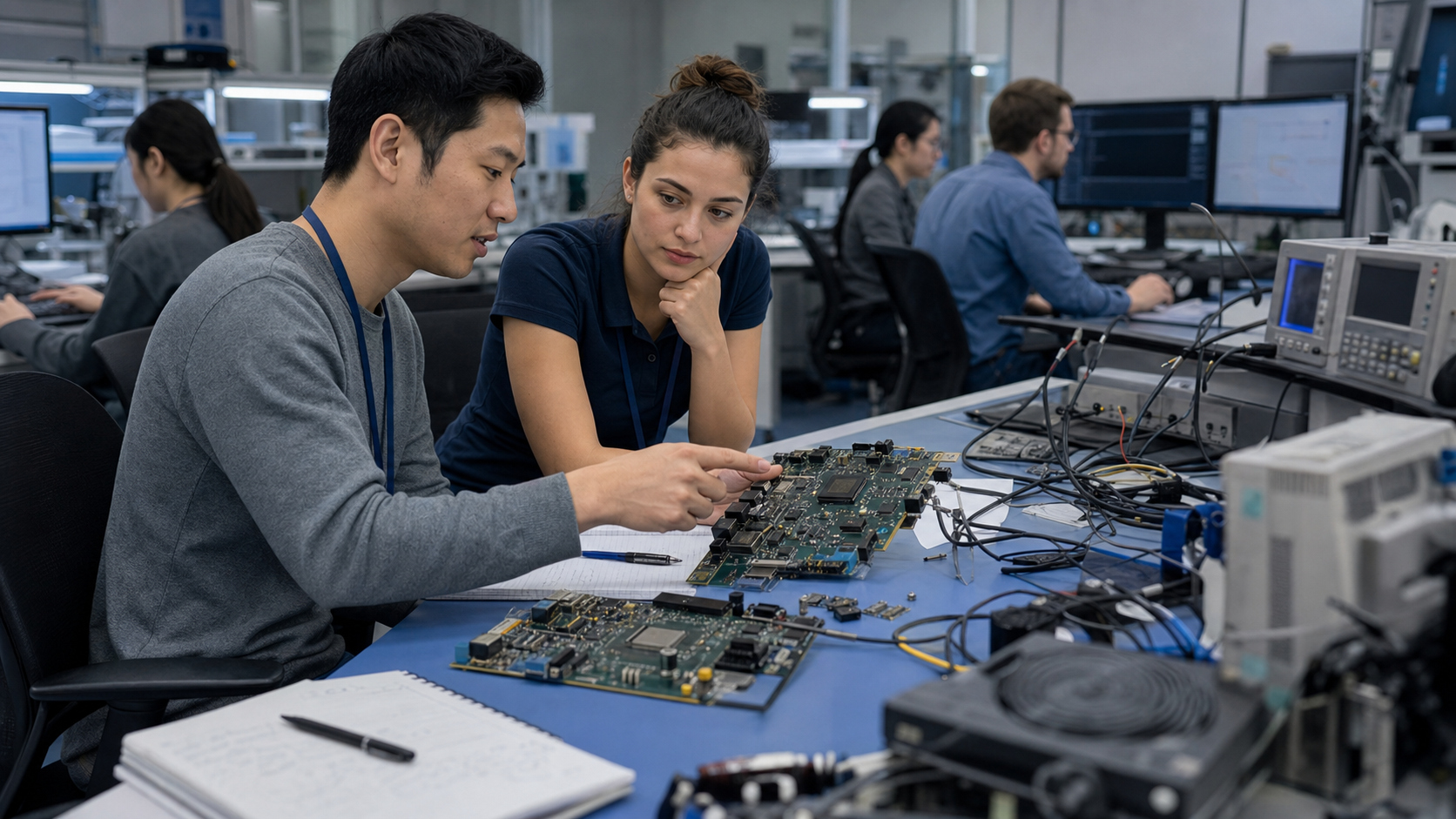
The practical Xilinx decision begins in a meeting that may not include procurement. A system architect has a board deadline. A signal-processing engineer needs deterministic latency. A firmware lead needs to know whether the team can close timing. A hardware manager wants enough supply assurance to avoid redesigning an industrial controller, medical device, radio platform, aerospace module, prototype rig or accelerator card two years after launch. Someone asks whether a fixed ASIC is worth the non-recurring engineering cost.
Someone else asks whether a GPU is easier, whether a microcontroller is enough, whether an ASSP already exists, whether Altera has a better fit, or whether the team can postpone the hardware change until the next product generation.
That is the point at which Xilinx sells value. The customer may later buy a chip, a module, a board, an accelerator card, a software license, support, training or distributor inventory, but the first economic act is commitment. Engineers agree to a device family. They download tools. They learn constraints. They choose IP blocks. They use reference designs. They order evaluation hardware. They ask field engineers and distributors about lead times. They write HDL, C or C++ against a design flow whose habits will shape the project. By the time the first production unit ships, the account has already spent money and scarce engineering attention.
This is why Xilinx matters even after the standalone company disappeared into AMD. AMD's 2025 Form 10-K describes a portfolio that includes FPGAs, adaptive SoCs, system-on-modules and Alveo cards in data center and embedded markets. The same filing reports $3.454 billion of Embedded net revenue in 2025, down 3 percent from 2024, and $1.243 billion of Embedded operating income. Those figures do not isolate the old Xilinx business perfectly because AMD has reorganized its segments, moved some FPGA and adaptive SoC products into Data Center, and sells a broader embedded portfolio.
They do show that programmable and adaptive silicon remains a material operating surface inside AMD rather than a legacy brand page.
The old Xilinx filing helps explain the account structure. In its fiscal 2021 Form 10-K, Xilinx described programmable logic devices, programmable SoCs, three-dimensional ICs, adaptive compute acceleration platforms, software tools, software development environments, embedded platforms, reference designs, boards and IP. It also described design services, customer training, field engineering and technical support. That list is closer to the actual paid unit than the phrase "FPGA vendor" suggests. The customer is not only buying gates. It is buying a route through uncertainty.
The economic tension is that commitment is hardest to observe from outside. Public filings record revenue after shipment. Distributor pages show listed prices and availability signals. Product pages show license tiers and board costs. Technical papers show how researchers use Alveo, Versal or older Xilinx devices. None of those sources fully captures the engineer's first irreversible choice: the moment a design becomes expensive to move away from Xilinx. The central question is therefore not whether Xilinx has chips.
It is whether the design-in account creates enough lock-in, support value and lifecycle confidence to justify the costs and risks that arrive before volume.
AMD owns the company, but Xilinx still names the platform memory
Xilinx is now an AMD directory entity, but the name still carries platform memory in the market. The AMD Embedded Computing distributor page says the group was formerly Xilinx and that Xilinx became part of AMD in 2022. AMD's current filings and pages use both AMD and historic product names: Virtex, Kintex, Artix, Spartan, Zynq, Versal, Alveo, Vivado and Vitis. That naming mixture is not cosmetic. It tells engineers that the product families they built around before the acquisition still have continuity inside AMD's broader data center and embedded strategy.
The company identity is therefore layered. The legal and investor-facing owner is AMD, headquartered in Santa Clara and reporting under AMD's segments. The installed-base identity remains Xilinx because hardware projects last longer than brand campaigns. A factory automation design, test-and-measurement platform, telecom baseband component, broadcast device or aerospace system may stay in production and support for many years. Engineers remember part families, packages, pinouts, constraint files, IP cores, tool versions and errata. They do not forget those things because a press release changes the parent company.
AMD benefits from that memory. Its 2025 Form 10-K says the Embedded segment includes embedded CPUs, APUs, FPGAs, SOMs and adaptive SoC products for aerospace and defense, automotive, industrial, vision and healthcare, communications infrastructure, test and measurement, emulation and prototyping, audio, video, broadcasting and data center. It also says the Data Center segment includes FPGAs and adaptive SoC products alongside CPUs, GPUs, DPUs and AI NICs. That split is important: Xilinx no longer fits only in the embedded bucket. Some of the same programmable logic economics now touches cloud, AI infrastructure, networking and acceleration.
At the product level, AMD's FPGA portfolio page says devices are designed for a wide set of applications and emphasizes performance per watt, system integration and long life. The same page says typical lifespans extend well past 15 years and says AMD 7 Series FPGAs and adaptive SoCs are extended through 2040 while UltraScale+ FPGAs and adaptive SoCs are extended through 2045. Those dates are not a mere support footnote. They are part of the sale. A customer choosing an FPGA for industrial control or aerospace instrumentation is often paying to avoid a forced redesign.
The longer the validated design can stay alive, the more valuable the original design-in becomes.
That long life also creates a different relationship to innovation. Consumer electronics can turn over quickly. AI accelerator roadmaps can change annually. A programmable logic design may need both new features and conservative continuity. AMD tries to bridge that with a portfolio running from older 7 Series devices to UltraScale+, Versal adaptive SoCs, Kria SOMs and Alveo cards. The account has to decide whether to stay on a proven family, move up to a newer node, or use a board or SOM to reduce design burden. Each choice carries tool, supply, qualification and support consequences.
The brand memory is strongest where redesign cost is high. If an engineer has already built a product around Zynq, migrating to another vendor is not just a bill-of-materials substitution. It may require retraining, re-validating software, replacing IP, changing power architecture, reworking boards, revisiting thermal assumptions, rewriting scripts, requalifying safety or security evidence and negotiating new distributor terms. The AMD acquisition can strengthen the account if AMD adds scale, data center relationships and system credibility.
It can weaken the account if customers believe programmable logic will be deprioritized behind CPUs and GPUs. The current public evidence supports continuity, but the judgement remains watchpoint-dependent.
Vivado and Vitis make the toolchain part of the price
For many Xilinx accounts, the toolchain is the meter. AMD's Vivado page describes Vivado as design software for AMD adaptive SoCs and FPGAs, covering design entry, synthesis, place and route, verification and simulation. AMD's Vitis page describes a higher-level development environment for FPGA fabric, Arm processors and AI Engines, with embedded software, AI Engine compilers and simulators, Vitis HLS, model-based design and performance-optimized libraries. A customer selecting Xilinx is therefore selecting a workflow as much as a chip.
The workflow matters because programmable logic is not useful until a design can be implemented and verified. A buyer who chooses a CPU or GPU can often run a conventional software stack. A buyer who chooses an FPGA must manage hardware description, timing closure, IP integration, power estimation, board bring-up, bitstream generation, software handoff and field updates. Vivado and Vitis reduce some of that complexity, but they also become switching costs. Build scripts, constraint files, IP settings, version-specific behavior, license servers and engineering habits all accumulate around the toolchain.
AMD's 2026 Vivado licensing page makes this commercial surface explicit. The Basic tier is listed at $0 with annual renewal, Core at $1,200 or $1,800 annually, Pro at $2,400 or $3,000 annually, Enterprise at $4,395 or $5,495 under a perpetual model, and Gold at $10,000 or $15,000 under a perpetual model. AMD says the tiered model starts with the 2026.1 release, scales from free entry-level to full-featured environments, and leaves IP licensing and license generation unchanged.
The AMD shop also lists Vivado ML Enterprise Edition as available in node-locked or floating configurations, with a 90-day free evaluation and $4,395 or $5,495 price points.
Those tool prices are small compared with a full product-development budget, but they are visible enough to shape behavior. A hobbyist, university lab or early-stage prototype may care deeply about a free or low-cost tier. A data center, aerospace, defense, telecom or industrial customer may treat a license as minor relative to engineering headcount, board cost and opportunity cost. But even for enterprise customers, license structure matters because it signals how AMD intends to monetize access, support device families and handle Linux or Windows workflows.
The public reaction to the 2026.1 licensing model shows why tool economics cannot be separated from design-in economics. Tom's Hardware reported criticism from Linux FPGA users after AMD's new tiering, with the free Basic tier described as Windows-only and Linux users pushed toward paid tiers for current releases. That report is not a financial filing and should be treated as a market signal, not as measured churn. It is still useful because it shows that tool access is not background plumbing.
Engineers talk about it, students and hobbyists notice it, and alternative platforms become more attractive when a tool decision feels hostile.
Toolchain pricing also affects long-run ecosystem formation. Many senior FPGA engineers learned on low-cost boards and free or academic tools. If the free path narrows, AMD may preserve near-term license revenue but risk shrinking the future pool of designers who are fluent in its platform. If the free path is too broad, AMD may subsidize users who never become commercial accounts. The correct balance is not obvious from outside. What is obvious is that Xilinx's value depends on human capability as much as silicon capability.
A device that looks strong in a datasheet can lose a design if the team cannot staff, train or retain people who know how to close timing and verify the system.
Vitis extends that issue to software developers. AMD wants adaptive SoCs and Alveo cards to be usable by C/C++, AI and embedded software teams, not only traditional HDL engineers. The Vitis page says Vitis works alongside Vivado and supports C/C++ application development, AI Engine tools, HLS, model-based design and optimized libraries. The commercial promise is that Xilinx hardware can reach more developers. The risk is that abstraction can make early demos easier while leaving the hard problems - memory movement, latency, verification, deployment and maintainability - for later.
Customers pay for the promise only if the higher-level stack survives contact with production constraints.
IP cores and boards turn engineering time into a purchasable bundle
Xilinx's design-in account does not stop at software licenses. AMD's intellectual-property page says AMD and its partners provide a library of IP intended to streamline development, with tested and validated IP, RTL and IP Integrator flows, examples, drivers and documentation. The former Xilinx 2021 Form 10-K was more direct about commercial variety: it said Xilinx and third parties offered hundreds of no-charge and fee-bearing IP core licenses. That distinction matters. Some IP reduces friction and helps sell silicon. Other IP is a revenue line or a support obligation. All of it makes the design harder to move later.
An IP core can be a shortcut or a dependency. If a team buys or uses an Ethernet, PCIe, memory-controller, DSP, video, RF, error-correction, network-security or functional-safety block, it avoids building that block from scratch. It also accepts the vendor's integration model, verification assumptions, support path and version lifecycle. If the core works, the account saves months. If it fails or becomes incompatible with a future device family, the account is trapped in a narrow support problem. That is why IP is central to Xilinx economics. It changes the cost of speed.
Evaluation hardware makes the same logic physical. AMD's online shop lists Versal evaluation kits at visible prices: VMK180 at $9,345, VCK190 at $13,195, VEK280 at $6,995, VHK158 at $14,995 and VPK180 at $17,995. It lists Zynq UltraScale+ kits, RFSoC kits, Artix 7 and Spartan 7 kits, and the ZC702 evaluation kit. Some boards cost less than a senior engineer-week; some cost enough to require budget approval. Those prices show that the design-in funnel is monetized before production silicon orders arrive.
The board purchase is not only a hardware purchase. It buys a starting topology, known connectors, examples, reference designs and proof that a device family can be exercised. A team may use a board to evaluate signal integrity, memory bandwidth, transceiver behavior, AI Engine flow, video flow, RF sampling, industrial I/O or software handoff. The more evaluation work happens on AMD boards, the more likely the production design stays near the AMD ecosystem.
Boards also reveal the breadth of Xilinx use cases. The shop page spans Versal, Zynq UltraScale+, RFSoC, Artix, Spartan and older Zynq development systems. The data center card page lists Alveo V80 at $9,495, U50 at $2,965, U55C at $4,747, U45N at $2,371, MA35D at $1,595, VCK5000 at $13,195 and X3522PV at $2,848. These are not commodity microcontroller prices. They are the price of early access to specialized acceleration, networking, media or prototyping capability.
The evaluation path also disciplines the thesis. Xilinx is not primarily a cloud service vendor in the public evidence. It sells devices, cards, modules, tools, IP, boards and support paths. AWS F2 instances show that AMD/Xilinx devices can appear inside a cloud FPGA service, and AMD's former Xilinx filing described Alveo as present across major cloud providers as FPGA-as-a-Service. But that is different from saying Xilinx's own paid unit is a hosted SaaS account. The hosted service, where present, belongs to a cloud provider or partner.
Xilinx's core economic account remains the programmable silicon and design ecosystem that makes such deployments possible.
Long-lifecycle supply is part of the product
For a programmable logic customer, supply is not a procurement afterthought. The selected FPGA may sit in a product that ships for a decade. The project may require industrial temperature grades, safety documentation, export review, customer-specific qualification, or stable behavior under field conditions. A redesign can trigger new board layout, new software validation, new certifications and new customer approvals. That is why AMD's long-lifecycle language has economic force.
AMD's FPGA page says typical lifespans extend well past 15 years and names lifecycle extensions through 2040 and 2045 for major families. A buyer can still face allocation, package availability, component obsolescence and end-of-life notices, but the public promise sets expectations. It tells a customer that AMD understands the time horizon of embedded and infrastructure accounts. It also gives distributors a story to tell when a buyer is nervous about designing around older families.
The authorized distribution layer is part of that story. AMD's adaptive-computing distributor page lists Avnet, DigiKey, Ingram Micro, Mouser, Newark, Port Electronics, Spirit Electronics, SYNNEX and others across regions. It says AMD established controls to help ensure parts are securely manufactured, assembled, tested, tracked, marked, stored and transported from manufacture to authorized distribution, and it warns that product warranties do not apply to products procured from unauthorized sources. That is not just compliance boilerplate.
Counterfeit, grey-market and misrepresented components are real risks in long-lifecycle electronics.
The former Xilinx 2021 Form 10-K shows how important distribution was before the acquisition. It reported that Avnet distributed Xilinx products worldwide and accounted for 43 percent of worldwide net revenues in fiscal 2021, 42 percent in fiscal 2020 and 45 percent in fiscal 2019. It also said local distributors processed and fulfilled the majority of customer orders in many situations. That concentration was a risk and a feature. It gave Xilinx reach, local stock, technical sales and supply-chain handling.
It also meant distributor incentives, inventory returns, pricing adjustments and lead-time communication could materially shape customer experience.
AMD's current 2025 Form 10-K says Embedded products are sold either directly or through a network of distributors and OEM partners, and that AMD is developing a network of VARs and ISVs. The same filing says no customer accounted for at least 10 percent of consolidated net revenue in 2025 or 2024. That reduces visible customer concentration at the AMD level, but it does not eliminate account-level dependency. A particular FPGA design may still depend on one package, one speed grade, one board, one IP vendor, one field engineer or one distributor response.
Supply assurance also touches pricing. A buyer evaluating Xilinx is not simply comparing device unit price with a rival FPGA. It is pricing the probability that the same or compatible device will be available when production ramps. It is pricing the support needed to manage a shortage. It is pricing the cost of holding inventory. It is pricing the risk that an urgent redesign will land during a worse engineering window. That cost is often invisible in public data, but it is central to the design-in account.
Foundry dependence and export controls sit under the design promise
Xilinx was a fabless semiconductor company, and AMD remains dependent on third-party manufacturing. The former Xilinx 2021 Form 10-K said Xilinx did not manufacture wafers and purchased wafers from independent foundries including TSMC, UMC and Samsung, with TSMC manufacturing wafers for advanced products. AMD's 2025 Form 10-K says AMD utilizes TSMC for wafers for HPC, FPGA and adaptive SoC products, GlobalFoundries for some HPC products at older nodes, and TSMC, UMC and Samsung for programmable logic devices.
It also says wafers are sorted and delivered to assembly, test, mark and packaging partners or subcontractors in the Asia-Pacific region.
That chain matters because a lifecycle promise is only as good as capacity, yield, packaging, test and logistics. FPGA products are not all built on the latest node, and older nodes can sometimes be more stable. But advanced devices such as Versal, high-end UltraScale+ and data center cards still depend on foundry and packaging ecosystems. If foundry capacity tightens, if geopolitics interrupts Taiwan-centered supply, if advanced packaging becomes constrained, or if a subcontractor suffers disruption, the design-in account feels it through lead times and allocation.
The risk is not theoretical. AMD's filing says that if TSMC cannot manufacture wafers for products at 7 nanometer or smaller nodes and newest IC products in sufficient quantity, AMD's business could be materially affected. It also says AMD relies on TSMC, UMC and other foundries to produce wafers with competitive performance attributes for IC products. For a customer deciding whether to build around Xilinx, the risk question is not only "Can AMD make the part?" It is "Will AMD allocate enough supply to this family for my market when CPUs, GPUs, AI accelerators and other products compete for corporate attention?"
Export controls add another layer. AMD's 2025 Form 10-K discusses export-control laws and notes inventory and related charges tied to U.S. government export control on AMD Instinct MI308 Data Center GPU products. That particular charge concerns a GPU product, not a Xilinx FPGA family. It still matters for Xilinx analysis because AMD sells a portfolio that includes FPGAs and adaptive SoCs into data center, aerospace, defense, communications and AI-adjacent markets. Programmable devices can be dual-use, and customer geography can affect shipment, licensing and support.
The right treatment is conservative. There is no public basis to claim that every Xilinx design-in is export-restricted or that the old Xilinx business is mainly constrained by AI-chip rules. There is public basis to say that AMD operates under export-control risk, that high-performance compute and programmable devices can sit in sensitive applications, and that customers with China, defense, telecom, aerospace or advanced-computing exposure should price compliance uncertainty. The risk enters the design commitment because a customer may spend years developing around a device before a rule changes the addressable market.
Foundry and export risk also interact with substitutes. If supply tightens or restrictions narrow a device family, a customer may consider an ASIC, a different FPGA vendor, a lower-performance MCU or ASSP, a cloud FPGA instance, a GPU-based architecture, or simply delaying the feature. Those alternatives may be worse technically, but a bad alternative can become rational when supply or compliance risk dominates. Xilinx's account strength depends on AMD making the safer path also the technically credible path.
Data center demand expands the addressable field but changes the benchmark
Xilinx historically served communications, industrial, aerospace, defense, test, measurement, emulation, automotive, broadcast, consumer and data center markets. AMD now presents programmable logic as part of both Embedded and Data Center. This creates upside because AI infrastructure, networking, low-latency compute, media acceleration and cloud acceleration all need specialized hardware. It also changes the benchmark because customers compare FPGAs with GPUs, DPUs, ASICs, smart NICs, custom silicon and cloud-native services.
AMD's 2025 Form 10-K reports Data Center net revenue of $16.635 billion in 2025, up 32 percent from 2024, primarily driven by EPYC processors and Instinct GPU accelerators. That growth was not mainly a Xilinx proof point. It was a broader AMD data center story. But the same filing says the Data Center segment includes FPGAs and adaptive SoC products for data centers, and it lists Virtex, Kintex, Artix, Spartan, Zynq and Versal devices plus Alveo accelerator cards. The old Xilinx portfolio is therefore present inside AMD's data center ambition even if the revenue engine is now GPU and CPU heavy.
Alveo cards show the opportunity and the limit. AMD's shop describes the Alveo V80 as the highest logic density, HBM bandwidth, DSP compute and network throughput in the Alveo portfolio. It describes U55C for high-performance computing, big data analytics, search, financial computing, computational storage and machine learning. It describes U45N as a 2x100G network accelerator that can offload CPUs from infrastructure workloads and let FPGA designers implement custom OVS, IPsec and other functions. This is a credible data center surface. It is not proof that FPGAs are replacing GPUs in mainstream AI training.
AWS F2 instances sharpen the point. AWS says F2 instances are second-generation FPGA-powered cloud instances, powered by up to eight AMD Virtex UltraScale+ HBM VU47P FPGAs, with high-bandwidth memory, EPYC host processors and use cases including genomics, networking, multimedia, big data, search analytics and ASIC emulation. AWS also says the FPGA Developer AMI includes Xilinx Vivado at no additional software charge for development tools in that environment. This is strong evidence that AMD/Xilinx devices are used in customer-facing cloud infrastructure. It is also evidence that the paid hosted-service account belongs to AWS, not Xilinx.
Cloud FPGA capacity is both demand and substitution. It can increase familiarity with Xilinx devices, let teams test accelerators without buying boards, and support workloads that need reconfigurable hardware. It can also reduce direct hardware purchases for customers that prefer usage-based infrastructure. A team may use AWS F2 to prototype and later build on-premises hardware, or it may keep the workload in the cloud. Xilinx benefits either way if AMD devices remain the programmable substrate, but the margin, account ownership and support obligations differ.
Academic and research signals support niche but real data center and AI experimentation. A 2024 EdgeLLM paper reported an efficient CPU-FPGA framework deployed on an AMD Xilinx VCU128 FPGA, comparing throughput and energy efficiency with an NVIDIA A100 for a specific edge LLM workload. A 2024 Makinote paper described an FPGA cluster at Barcelona Supercomputing Center using 96 AMD/Xilinx Alveo U55C cards for pre-silicon emulation of large RISC-V designs. These papers are not purchasing data.
They are credible evidence that researchers and developers still see Xilinx hardware as a platform for acceleration and emulation problems that do not fit neatly into CPU-only workflows.
The data center thesis should therefore be bounded. Xilinx is important to AI infrastructure economics where adaptability, latency, I/O, emulation, network acceleration, custom data paths, power efficiency or early hardware prototyping matter more than mass GPU software ecosystem scale. It is weaker where customers want the richest AI software stack, the highest general training throughput, or commodity cloud availability. The market opportunity is real, but it is specialized.
Embedded accounts pay for reliability, not fashion
The embedded side of Xilinx is less fashionable than AI data center infrastructure, but it may be more natural for the design-in thesis. AMD says embedded products address aerospace and defense, automotive, industrial, vision and healthcare, communications infrastructure, test and measurement, emulation and prototyping, audio, video, broadcasting and data center. Many of these applications value long availability, deterministic behavior, I/O flexibility, reliability and field support more than annual benchmark headlines.
An industrial customer may use an FPGA because sensors, motor drives, machine-vision pipelines, fieldbus protocols or safety channels require timing and I/O behavior that a general CPU cannot deliver alone. A test-and-measurement customer may use an FPGA because instruments need fast, repeatable data paths. A telecom customer may use RFSoC or programmable logic because radio standards and signal-processing requirements evolve. An aerospace or defense customer may use programmable logic because it can combine specialized interfaces, security features and long qualification cycles.
In each case, the device is a way to keep a product adaptable without turning every change into a new ASIC.
The former Xilinx filing described this advantage directly: FPGAs, hardware programmable SoCs and ACAPs can be changed faster than ASICs and ASSPs, while ASICs and ASSPs often have smaller size and lower unit cost for a fixed function but carry high development cost. That tradeoff is the heart of the account. Xilinx sells flexibility when uncertainty is high and volume or function stability is not yet enough to justify custom silicon. ASICs win when the function is stable, unit volume is large and power, area or unit cost dominates. The customer does not choose "best chip" in the abstract; it chooses where uncertainty should sit.
Embedded accounts also value boards and SOMs because they reduce implementation burden. A system-on-module can move a customer away from raw silicon design and toward an integrated module with known memory, power and software pieces. That may reduce engineering risk and speed time-to-market. It may also add module dependence and a higher unit cost. The choice depends on whether the product's differentiation lives in the surrounding system or in the silicon implementation.
Support labor matters heavily here. AMD's distributor page says listed distributors can design, implement and support AMD Embedded Computing solutions. That is more than order fulfillment. A customer may need help selecting a part, interpreting lifecycle notices, matching power rails, understanding package changes, scheduling deliveries, finding training or escalating a tool problem. Distributor and field engineering labor becomes part of the product even when the invoice line is a device or board.
The embedded account is also where headline uniqueness matters. Xilinx is not interesting because it is "an FPGA company" in a static taxonomy. It is interesting because it sells a design commitment that survives product cycles. A team that accepts Xilinx in year one may keep paying in year five through silicon orders, support, replacement boards, license renewals, trained staff and downstream compatibility. That compounding commitment is the unit BTW should track.
Network-resource evidence is weak and should not drive the thesis
Public network observations are useful for bounding claims, not for proving the business model. A DNS check on July 9, 2026 showed www.xilinx.com resolving through Akamai edge infrastructure, www.amd.com also through Akamai, account.amd.com through Akamai, and adaptivesupport.amd.com through Salesforce Siteforce hosts. Those observations show public website, account and support boundaries. They do not show Xilinx operating a paid hosted service, a customer data platform, a managed acceleration cloud or a SaaS business.
The correct network evidence grade is therefore weak for public web infrastructure and negative for a cloud-service thesis. AMD has web surfaces, account systems and support portals. AWS has a customer-facing FPGA cloud service that uses AMD/Xilinx devices. AMD sells Alveo cards and design software. Those are different facts. Treating a website, support portal or DNS record as Cloud Service evidence would overstate the business model.
This matters because "cloud" can easily contaminate the thesis. Xilinx devices may be used in cloud infrastructure. AWS F2 is explicitly a cloud service. Alveo cards can be used in servers at the edge or in the cloud. Vitis and Vivado may be downloaded or used in cloud development environments. But the Xilinx paid unit is still the design-in ecosystem around programmable devices. If a future AMD service offered customer-facing managed FPGA acceleration accounts directly, that would change the evidence. The current public evidence does not support that conclusion.
Network evidence is more useful as an operating watchpoint. Support domains on Salesforce infrastructure suggest a public support workflow surface, not internal architecture. Akamai edges suggest global web delivery, not product economics. If future evidence showed production customer portals, managed acceleration accounts, published uptime commitments, hosted billing, service-level agreements or customer tenancy controls, the thesis would need to incorporate hosted-service obligations. Without that evidence, the article should remain focused on silicon, tools, boards, IP, support and lifecycle.
The weak network grade also keeps ASNs, IP addresses and domains in their proper place. They are evidence, not entities. They do not become relationship endpoints. They do not define the company. They may help identify web boundaries, but they do not prove internal system control, data locality, profitability, cloud capacity, customer safety or service quality. For Xilinx, the durable economic surface is not an IP block on the internet. It is the engineering lock-in around programmable hardware.
Substitutes define the price ceiling
Xilinx has to beat alternatives at the moment of design commitment. The main substitutes are not identical, and that is why they matter. An ASIC can deliver lower unit cost, lower power and better area for a stable high-volume function, but it requires large upfront spending, longer development, less flexibility and higher redesign risk. A GPU can deliver massive parallel compute with a richer software ecosystem, but it may not provide deterministic I/O, custom protocols, bit-level pipelines or the same latency profile. A microcontroller or ASSP can be cheap and easy, but may lack performance or adaptability.
A rival FPGA can provide similar programmable logic with a different toolchain and supply chain. A cloud FPGA instance can avoid capital purchase but may not fit latency, data locality, cost or deployment needs. A delayed redesign can be rational if the current product is good enough.
AMD's own 2025 Form 10-K lists many of these pressures. It says AMD competes against Altera in FPGA and adaptive SoC server products and expects competition in Embedded from Altera, Lattice Semiconductor, Microsemi, ASSP vendors and ASICs. It also names discrete general-purpose GPUs targeting data center and automotive applications and customer internally developed accelerator products as competitive pressures. The former Xilinx filing made the same strategic point: Xilinx sought to displace ASICs, ASSPs and traditional programmable logic while facing CPUs, GPUs, ASSPs, custom ASICs and other programmable logic products.
Competitor product pages confirm that these are live options. Altera lists high-performance Agilex 9 and Agilex 7 families, mid-range Agilex 5 and Arria 10, and power or cost-optimized Agilex 3, MAX and Cyclone lines, with Quartus tools, IP and development kits. Lattice positions itself around FPGAs and related software for power-constrained and edge applications. Microchip sells FPGA and SoC FPGA families such as PolarFire and SmartFusion-oriented products. These vendors may not match Xilinx across every high-end feature, but they are enough to discipline pricing, tool quality and support behavior.
ASIC substitution is the hardest to quantify because it is internal to customer roadmaps. A company that expects stable high volume may use Xilinx during exploration, prototyping or early deployment and then migrate to ASIC or ASSP when requirements settle. That can still be good business for Xilinx if the prototyping account is valuable and recurrent. It can also cap long-run unit volume if Xilinx becomes a bridge rather than the final product. The risk is highest when a design's function stops changing and the unit-cost pressure becomes dominant.
GPU substitution is strongest in AI and high-throughput compute where software ecosystem, developer familiarity and vendor libraries matter. Xilinx can win when latency, power, custom I/O, streaming dataflow or deterministic processing matter. It struggles when the customer mainly wants to run mainstream models with minimal hardware specialization. AMD's ownership gives Xilinx access to a CPU and GPU company, which can help system conversations. It can also make programmable logic compete internally for attention against products with larger visible revenue.
MCU and ASSP substitution is strongest at the low and middle end. Many embedded products do not need an FPGA if a microcontroller, sensor processor, connectivity chip or fixed-function component has enough performance. Xilinx wins where interfaces are unusual, standards are moving, latency is strict, parallelism is valuable, or one device can replace several fixed components. It loses where simplicity and low unit cost dominate.
Delayed redesign is the cheapest substitute in the short term. A customer may avoid Xilinx not because a rival is better, but because the current design can survive one more product cycle. That is a real competitor. Xilinx must make the future pain of delay visible enough to justify early engineering spend. Evaluation kits, reference designs, IP blocks and field support are all tools for pulling that decision forward.
Unofficial signals point to friction, not collapse
Unofficial market signals should be used carefully. Forum posts, developer complaints and trade-press reactions are not audited demand data. They do not prove revenue loss. They can, however, reveal where a design-in platform creates pain. The 2026 Vivado licensing reaction is a useful example. AMD's official page frames the new tiered model as flexible and lower cost for many users. Tom's Hardware reported that Linux users criticized the model because the free Basic path did not cover native Linux use for current releases and because paid tiers could become necessary for users who previously relied on free Linux support.
The signal is not "Xilinx is losing the market." It is that tool access shapes platform goodwill. FPGA communities are technical, vocal and path-dependent. Students, hobbyists and open-source developers may not buy high-end Versal devices today, but they influence future familiarity. Academic labs and early-stage companies may prototype on free or low-cost tools before becoming commercial accounts. If those users feel pushed toward older releases or rival platforms, AMD risks losing some future mindshare.
The counterargument is that enterprise customers care more about supported releases, device coverage, Linux support, floating licenses, field engineering and roadmap stability than about free hobbyist access. That is partly true. A company choosing a $13,195 VCK190 board or a $17,995 VPK180 kit is unlikely to make the whole decision on a $1,200 tool tier. But the account is not only enterprise procurement. It is a labor market. If fewer engineers learn the platform, enterprise customers eventually feel the shortage.
Unofficial signals also highlight complexity. Xilinx tools have always required skill. Timing closure, IP integration, constraints, simulation, hardware/software handoff and board bring-up are not trivial. The question is whether AMD can keep reducing the pain without hiding too much of the hardware reality. Higher-level flows such as Vitis can help software developers enter the platform, but production designs still need disciplined hardware thinking. A tool that makes the demo easy and the product hard creates disappointment.
Market signals around cloud FPGA use are similarly mixed. AWS F2 lowers entry barriers by giving customers cloud access to FPGA resources and a developer AMI. That can expand use. It can also keep some accounts away from direct board purchases. Academic papers using Alveo cards or Xilinx boards show experimentation and specialized demand, but they do not prove mainstream adoption. The balanced conclusion is that Xilinx remains technically relevant in niches where adaptability is valuable, while the broad AI compute narrative remains dominated by GPUs and custom accelerators.
The watchpoint is whether friction accumulates faster than lock-in. Xilinx's ecosystem can tolerate some pain because designs are sticky. It cannot tolerate indefinite erosion of developer goodwill, supply trust or tool predictability. The account survives when engineers believe the pain is the price of differentiated hardware. It weakens when they believe the pain is vendor friction that a rival or simpler architecture can remove.
What would change the judgement
The most important proof gap is product-family economics. AMD reports segment revenue, but not Xilinx-specific gross margin, license revenue, IP revenue, board margin, support cost or design-win conversion. If AMD disclosed old-Xilinx design-win retention, attach rates for Vivado paid tiers, IP licensing revenue, Alveo card volumes, Kria SOM adoption, or Versal ramp by end market, the judgement could become sharper. Without that, the analysis has to infer from product surfaces, segment figures, filings and market signals.
The second proof gap is supply performance. Public lifecycle promises are valuable, but the account lives or dies in lead times, allocation decisions, last-time-buy notices, package availability and distributor responsiveness. Evidence that AMD consistently supplies long-lifecycle parts through authorized channels would strengthen the thesis. Evidence of repeated shortages, sudden discontinuations, or forced migration from old families would weaken it. The current public evidence supports a long-lifecycle claim, but it does not prove performance by part number.
The third proof gap is tool satisfaction after 2026. AMD's new Vivado tiers are visible and priced. The market response will be visible over time through developer adoption, university use, Linux workflows, support forums, renewals and competitor commentary. If AMD adjusts the Linux path, improves licensing clarity and keeps lower-end users in the ecosystem, the change may look like sensible segmentation. If the change drives education, hobbyist and startup users toward Lattice, Altera or open-source flows, it may look like a small revenue win that damages future design-in formation.
The fourth proof gap is data center conversion. AMD's data center revenue growth is driven mainly by EPYC and Instinct. Xilinx-derived products can matter in networking, emulation, media, genomics, low latency and specialized acceleration, but public data does not show whether Alveo or Versal are scaling materially inside cloud and AI infrastructure accounts. If hyperscalers deploy more AMD FPGA capacity, if AWS F2 grows usage, if Alveo cards gain broader workload support, or if adaptive SoCs become part of AMD rack-scale designs, the data center topic strengthens.
If GPU and ASIC ecosystems absorb most acceleration budgets, Xilinx remains important but narrower.
The fifth proof gap is AMD strategic priority. Xilinx inside AMD can benefit from scale, customer access, system-level selling and stronger financial resources. It can also be overshadowed by CPUs, GPUs and AI accelerators. The relevant evidence will be product cadence, support investment, engineering hiring, documentation quality, distributor commitment and whether AMD keeps treating FPGA and adaptive SoC customers as long-horizon accounts rather than minor adjuncts to the AI GPU story.
The sixth proof gap is substitution after prototype. If many customers use Xilinx only to emulate or prototype ASICs and then migrate away at volume, Xilinx captures early design value but not long production streams. If customers stay on FPGAs because standards keep changing or volume never justifies ASICs, Xilinx captures longer revenue. Public filings and papers show both patterns are plausible. The judgement should remain conditional on end-market mix.
The final judgement is therefore positive but bounded. Xilinx matters because it monetizes a design commitment. It is not a simple chip-shipment story, not a SaaS story, and not a pure AI accelerator story. It is a platform account in which software tools, IP, support, boards, distributors, foundries and lifecycle guarantees all become part of the silicon decision. That makes Xilinx economically durable where uncertainty, time-to-market and long product life matter. It also makes the account vulnerable when tools frustrate users, supply trust weakens, or a simpler substitute can remove the need for programmable logic.
Sources
- https://www.sec.gov/Archives/edgar/data/2488/000000248826000018/amd-20251227.htm
- https://www.sec.gov/Archives/edgar/data/743988/000074398821000016/xlnx-20210403.htm
- https://www.amd.com/en/products/adaptive-socs-and-fpgas/fpga.html
- https://www.amd.com/en/products/software/adaptive-socs-and-fpgas/vivado.html
- https://www.amd.com/en/products/software/adaptive-socs-and-fpgas/vivado/vivado-licensing-options.html
- https://www.amd.com/en/products/software/adaptive-socs-and-fpgas/vitis.html
- https://www.amd.com/en/products/adaptive-socs-and-fpgas/intellectual-property.html
- https://shop-us-en.amd.com/adaptive-embedded-computing/soc-fpga-evaluation-kits/
- https://shop-us-en.amd.com/adaptive-embedded-computing/data-center-accelerator-cards/
- https://www.amd.com/en/corporate/contacts/authorized-distributors/adaptive-computing-products.html
- https://aws.amazon.com/ec2/instance-types/f2/
- https://www.altera.com/fpga
- https://www.latticesemi.com/Products/FPGAandCPLD
- https://www.microchip.com/en-us/products/fpgas-and-plds/fpgas
- https://www.tomshardware.com/software/linux/amd-leaves-linux-fpga-users-in-the-lurch-with-controversial-vivado-licensing-update-new-tier-model-restricts-future-free-versions-to-windows
- https://arxiv.org/abs/2407.21325
- https://arxiv.org/abs/2401.17984