
Summary
- WP Engine's strongest case is not ordinary hosting convenience. It is the claim that its managed platform can reduce the repeated work of getting WordPress changes safely accepted on live sites.
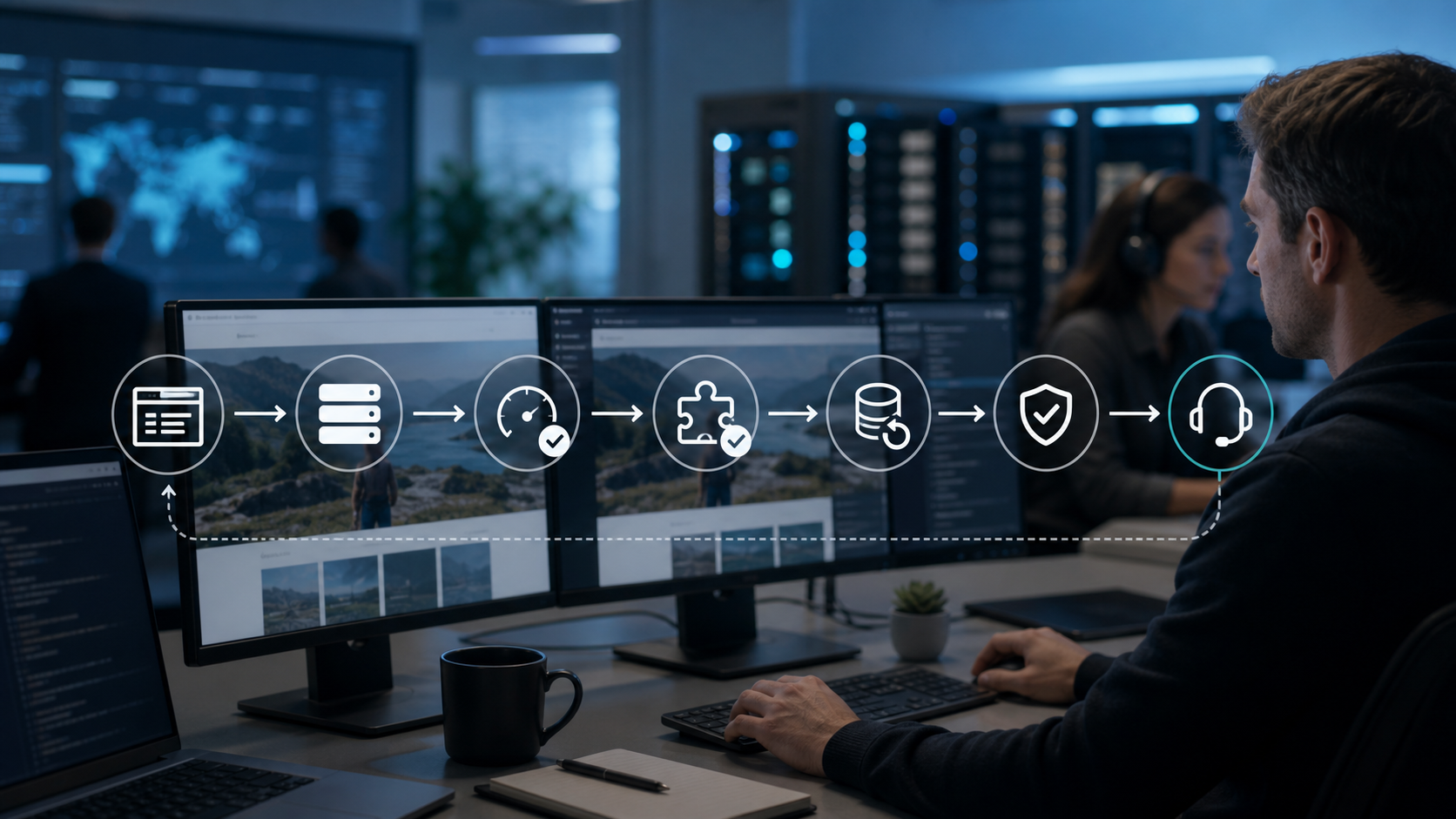
- The decisive operating unit is the accepted WordPress site state: the point at which code, content, plugins, database state, cache behavior, security controls, backups, monitoring, support ownership and rollback are all good enough for the site to keep serving real users.
- Public documentation supports meaningful capability around production, staging and development environments, backups, cache layers, plugin-update automation, core updates, security practices, support and headless WordPress. It does not prove customer-specific restore success, performance gain, support speed, plugin compatibility or total cost reduction.
- WP Engine's value rises when it removes maintenance labor and gives agencies or internal teams a disciplined operating surface. It weakens when cache correctness, plugin behavior, ecosystem access, migration friction, support escalation or lock-in costs remain outside the platform's practical control.
The accepted site state is the product
A WordPress site is rarely accepted because a vendor can provision hosting. It is accepted because a change can survive the conditions of use. A campaign page renders correctly after publication. A checkout does not serve stale cart state. A newsroom homepage updates when editors expect it to update. A plugin update does not erase a form, break a custom field group or slow the database. A content deploy does not strand users behind an old cache. A failed release can be reversed without losing orders, comments, media or editorial work.
A support ticket has enough context to resolve the problem before a client or executive treats the site as unreliable.
This is the better lens for WP Engine LLC. The company offers managed WordPress hosting, platform tooling, security controls, support, development workflows, headless WordPress products and adjacent brands such as Flywheel, Local, Advanced Custom Fields and WP Migrate. Those assets matter, but they are not the final result. The final result is the accepted state of a working WordPress site after repeated changes.
That state is harder to reach than the phrase "managed hosting" suggests. WordPress is powerful because it combines open-source core software, themes, plugins, custom code, a database, media files, user permissions, administrator habits, hosting configuration, cache layers and external services. The same openness that lets a small business ship a site quickly also gives a production team many places to introduce failure. A security plugin can overlap with platform protection. A cache plugin can conflict with server caching. A page builder can store critical layout data in the database.
WooCommerce orders can arrive while a staging database is being pushed. A minor plugin update can look safe until a rarely used form path fails. A content editor may believe a page is published while a visitor sees an older cached copy.
WP Engine's proposition should therefore be evaluated as an operating proposition. Can the platform reduce the customer's recurring WordPress operating work while preserving control? Can it make safe changes cheaper than unmanaged hosting plus ad hoc developer maintenance? Can it make failures visible before they reach customers? Can it help a team restore the previous state when a change fails? Can it define which parts of the problem belong to WP Engine, which belong to the customer's code, which belong to WordPress itself, and which belong to the plugin ecosystem?
The answer is conditional. WP Engine has credible primitives for the accepted site state: separate environments, backup checkpoints, restore paths, cache management, core update handling, plugin update automation, support, site monitoring and compliance-oriented security claims. Yet the open evidence does not prove the most important customer-specific outcomes. It does not show that a given customer's restore completes inside the time the business needs. It does not show that support has enough context for a complex custom theme. It does not show that Smart Plugin Manager catches the exact path that breaks revenue.
It does not show that a headless build preserves editor preview quality. It does not show that platform fees are lower than the labor and risk they replace.
This distinction is not academic. A buyer who treats WP Engine as a generic host will focus on price, bandwidth, visits, storage and headline support. A buyer who treats WP Engine as an accepted-state system will ask about workflows: what happens before a change, during deployment, after cache purge, after plugin update, during incident response and during exit. That second buyer is asking the right question.
WP Engine has become a WordPress operating surface
WP Engine presents itself around managed hosting and related products for websites built with WordPress. Its current public site describes managed hosting, ecommerce, newsroom, headless WordPress, developer tools and extensions such as Smart Plugin Manager, Site Monitoring, Global Edge Security, NitroPack, Smart Search AI and a managed vector database. Its about page says the company was founded in Austin in 2010, serves more than 1.5 million users and customers across more than 150 countries, and has grown into a globally distributed WordPress specialist.
Its homepage uses a larger "powering 5 million websites" claim for its broader platform surface.
The company is also not only a host in the narrow infrastructure sense. Its product family and acquired assets matter to the operating model. Flywheel adds agency-oriented managed WordPress history. Local supports local WordPress development. Advanced Custom Fields is one of the most important WordPress developer plugins for custom content models. WP Migrate is relevant to migration and data movement. StudioPress and Genesis sit closer to site-building and themes. These are not incidental names.
They put WP Engine near the workflow of agencies and developer teams that build, move, customize and maintain WordPress sites for clients or internal business units.
That proximity gives WP Engine a plausible advantage. A host that understands only CPU, memory and storage can keep a server online while still leaving the customer to solve WordPress behavior. WP Engine tries to sit closer to WordPress-specific work: cache exclusions, staging copies, plugin updates, core update deferrals, site monitoring, support, migrations, Git access, local development and headless WordPress. For an agency managing many client sites, that can matter more than the raw cost of a virtual server.
The cost center is often human time: checking updates, making backups, recovering from broken plugins, answering client questions, retesting forms, clearing caches, handling launch windows and explaining who owns the failure.
The risk is that an operating surface becomes a control surface. The more a customer depends on WP Engine's portal, backup system, cache behavior, disallowed plugin policy, support model and product extensions, the more operational discipline shifts from "can we run WordPress?" to "can we run our WordPress process inside WP Engine's assumptions?" That can be a good trade. A platform's value comes partly from narrowing choices. But it should be priced as a trade, not a free lunch.
WP Engine's plan pages make this visible. Entry plans are priced around fixed site, visit, storage and bandwidth assumptions, while higher tiers add isolated resources, service level commitments, support options, plugin and theme update automation, monitoring, onboarding, migration assistance, DDoS and managed WAF options, failover, high availability, application performance monitoring and Git-powered workflows. The commercial shape is clear: WP Engine wants to sell fewer unmanaged fragments and more managed operating confidence.
That confidence must be earned at the change boundary. The important moment is not when a site is newly provisioned. It is when a business-critical site is changed for the hundredth time.
Backups make promises testable, but only if restores are rehearsed
Backups are central to WP Engine's accepted-state story. The support documentation says WP Engine provides automated and manual backups for all environments by default, including production, staging and development. It says those backups are stored offsite on Amazon S3 in the same region as the hosted site and encrypted in transit and at rest. It also describes daily automatic checkpoints and manual checkpoints that customers are encouraged to create before updates.
That is a strong baseline. Many WordPress failures are survivable if a team has a current, usable restore point. A plugin update that corrupts layout can be rolled back. A content mistake can be reversed. A bad deploy can be undone. A core update that collides with a theme can be handled more calmly if the previous state is available. The value is not simply having backup files. The value is the confidence to make necessary changes without treating every change as a one-way trip.
But backups are not accepted-state proof by themselves. A backup is evidence of recoverability only after a restore path has been tested in the customer's real conditions. A database restore may recover posts and settings but overwrite orders, form submissions or user changes that arrived after the checkpoint. A files-only restore may leave plugin settings in the wrong database state. A full environment copy may be too destructive for a live ecommerce site. A backup that exists in the portal may still take longer to prepare, download or restore than the business can tolerate during a launch or outage.
This is why WP Engine's copy-environment documentation matters. It allows push and pull workflows between environments and can copy files, all database tables or selected tables. It also warns that copying a database to production can be destructive. That warning is not a footnote. It is the heart of WordPress operations. A WordPress database is not just static content. It can contain orders, users, settings, custom post types, plugin state, content revisions, scheduled jobs and page-builder configuration. When a staging database overwrites production, the customer may preserve a new design while destroying live business state.
The accepted state requires more than "we can restore." It requires restore judgment. Which data is authoritative? Which environment has the right file system? Which database tables can be moved safely? Which content changed since the last checkpoint? Which plugin stores settings in an unexpected table? Which failure deserves a full rollback, and which requires a surgical fix? WP Engine can make these actions easier and more visible, but the customer's team still has to know what the site does.
This is one reason agencies may value the platform more than very small site owners. An agency that repeatedly manages WordPress maintenance can standardize pre-change checklists: take a checkpoint, test in staging, identify dynamic tables, avoid production database overwrite during commerce activity, communicate change windows and record rollback steps. WP Engine gives such a team tools that fit a repeatable practice. A one-site customer may receive the same tools but lack the discipline to use them safely.
The best commercial case for WP Engine's backups is therefore not that disaster becomes impossible. It is that routine change becomes less frightening when backups and restores are part of the workflow. The remaining buyer question is whether the organization has rehearsed recovery enough to trust it.
Staging reduces risk when it matches the live site
WP Engine's site model groups up to three independent WordPress environments: production, staging and development. The documentation frames production as the live environment, staging as useful for minor changes such as plugin updates, and development as useful for larger changes such as building a theme. It also says the environments are separate WordPress instances and that copying can move content between them.
This structure is essential to the accepted-state problem. WordPress changes need somewhere to be wrong. A new plugin version, PHP version, custom theme, checkout field, form integration or headless query should fail in a place where users are not depending on it. Staging gives developers and site managers a place to observe breakage before it becomes customer-visible.
Yet staging can also create false confidence. A staging environment can differ from production in domain, traffic, cache configuration, SSL, custom rules, media storage, third-party API credentials, payment settings, search indexes, cron behavior, bot traffic, logged-in user mix and live data. WP Engine's environment documentation notes that some portal-level configurations are not copied by the Copy Environment tool, including redirect rules, cache exclusions, SSL certificates, web rules, Nginx rules and some media patterns when offsite storage is in use. Those differences can be exactly where a release fails.
For WP Engine customers, the question is not "does staging exist?" The question is "does staging test the risk we are about to accept?" If the change is a CSS adjustment on a brochure page, staging may be straightforward. If the change touches checkout, membership access, multilingual content, search, authenticated dashboards or plugin-to-plugin interactions, staging may be only partial evidence. It still helps, but it cannot be treated as a perfect twin.
This has a direct effect on economics. WP Engine can reduce operational work when staging catches common failures and standardizes release behavior. It cannot eliminate the need for customer-specific test design. A marketing team still has to know its critical paths. An ecommerce operator still has to test cart, checkout, tax, coupons, fulfillment and transactional email. A publisher still has to test homepage freshness, scheduled publishing, embeds, analytics, paywall state and ad tags. An agency still has to know which client plugins are fragile.
The accepted state is reached when staging evidence is combined with live-specific checks. A disciplined WP Engine workflow would include pre-change checkpoint creation, staging update, cache-aware review, targeted critical path tests, production change, cache purge, live verification, monitoring, support escalation path and rollback decision criteria. WP Engine supplies parts of that chain. The customer must own the site's definition of done.
Cache correctness is not a performance detail
Caching is one of WP Engine's most important value propositions and one of the main sources of WordPress operating risk. The platform documentation describes heavy server caching, Varnish, network/CDN caching powered by Cloudflare, optional object cache, Edge Full Page Cache and NitroPack as a performance extension. It also says content changes may not appear immediately because caches need to be purged and provides guidance for purging server, browser, theme, plugin, Cloudflare, firewall and DNS-related caches.
That documentation is unusually important because it admits the core problem. Cache improves speed by reusing a previous result. WordPress production correctness often requires knowing when not to reuse it. A public blog post can usually be cached. A cart, checkout page, account page, logged-in dashboard, password reset flow or personalized region-specific view cannot be treated the same way. WP Engine lists default exclusions for WordPress admin, login, common cart and checkout paths, WooCommerce-related paths, cookies and arguments.
It also says custom exclusions may be needed for forms, logins, password resets, custom checkout URLs or plugin and theme behavior.
This is where "fast" and "accepted" can diverge. A fast site that serves stale content at the wrong time is not in an accepted state. A cache that hides a successful deploy from editors can cause operational confusion. A checkout cache mistake can lose revenue or trust. A membership-site cache mistake can expose or block content. A form cache issue can make lead generation look healthy while submissions fail.
WP Engine's advantage is that the platform has WordPress-specific cache assumptions and support pathways. It knows common exclusions. It documents cache purging. It gives users a cache page in the portal. It warns that caching cannot be fully disabled because doing so can harm performance, especially on shared accounts. That can help teams avoid crude fixes that make one page correct by making the entire site slow.
The limitation is that no host can automatically know every customer's state boundary. A custom plugin may set a cookie that changes page output. A region-specific campaign may depend on query arguments. A headless frontend may combine cached API responses with dynamic user state. A third-party firewall or optimization plugin may hold its own cache. A cache exclusion that is too broad may restore correctness while damaging performance. A cache exclusion that is too narrow may keep performance while breaking one critical path.
Buyers should treat cache behavior as a testable production requirement. Before accepting WP Engine as a lower-maintenance platform, they should identify dynamic paths, authenticated paths, forms, commerce flows, preview flows, localized content and personalization. They should test whether changes appear when expected, whether logged-out and logged-in users see the right thing, whether cache purge instructions are clear and whether support can help isolate stale-state problems quickly.
WP Engine's cache layer is a real source of value. It is also one of the reasons the platform must be evaluated as an operating system for WordPress changes, not as commodity hosting.
Plugin automation is useful only when the failure surface is known
Plugin risk is the most difficult part of the WP Engine story. WordPress gets much of its power from plugins and themes. It also gets much of its fragility from them. WP Engine's own security guidance says there is no "set it and forget it" security solution and emphasizes keeping WordPress core, plugins, themes and PHP up to date. It also notes that plugins and themes should be chosen carefully, actively maintained and supported.
WP Engine's Smart Plugin Manager is a serious answer to that problem. Public documentation says it automates plugin and theme updates, checks that updates are working as expected, uses visual regression testing, clears caches after updates and can restore to a previous version if visual regression testing or error codes indicate an update may have altered the site. It can test a default number of pages, include the homepage, use desktop or mobile screenshots and optionally use a custom sitemap. It can also use a staging environment as a source of plugin and theme versions.
This is a meaningful capability. Plugin update work is repetitive, necessary and tedious. Many organizations defer updates because they fear breakage. Deferral can create security exposure. Manual updates can consume developer time. Smart Plugin Manager shifts part of that labor into a managed workflow with backup and rollback hooks.
But visual regression testing is not the same as business acceptance. A page can look right while a form silently fails. A checkout can render while payment validation breaks at a later step. A search page can look normal while indexing is stale. A custom field can appear in the editor while a template reads the wrong field name. A membership plugin can pass a public visual test while failing for logged-in roles. A JavaScript error may affect one browser, one geography or one campaign URL. A plugin update can break an admin workflow that public-page screenshots never inspect.
WP Engine's documentation is careful enough to make this boundary visible. Smart Plugin Manager tests pages and screenshots; it is not a complete simulation of each customer's business process. The customer should therefore classify plugins by consequence. A small SEO helper may be a low-risk automated update. A payment plugin, booking engine, membership system, learning management plugin, ACF-dependent custom workflow or multilingual routing plugin may require staging, manual checks and possibly a different update window.
The disallowed plugin policy reinforces the same tradeoff. WP Engine disallows or restricts some plugins because they conflict with platform performance or security assumptions. Caching plugins can conflict with built-in caching. Backup plugins can bloat local storage, store files insecurely or slow queries. Server- and MySQL-intensive plugins can create excessive load. Certain scripts or plugin patterns may be blocked or removed. This protects the shared platform and can reduce common failure modes. It also means WP Engine is not a neutral PHP box where every plugin choice is allowed.
For many customers, that is a feature. A managed platform should prevent known bad combinations. For some customers, it is a constraint. A site that depends on a disallowed or incompatible plugin may need refactoring, an exception, another plugin or another host. That is not merely an onboarding issue. It is part of long-term portability and lock-in economics.
The right question is not whether WP Engine "does plugin updates." It is whether WP Engine can help a specific customer maintain the plugins that actually define the site's value. If the answer is yes, Smart Plugin Manager and support may save many hours. If the answer is no, plugin risk simply moves from manual labor to exception handling.
Security remains shared even on a managed platform
WP Engine's public material includes security claims around managed WAF options, DDoS mitigation, SSL, security patching, plugin risk scans, compliance alignment, SOC 2 Type II, ISO 27001, platform-level controls and security guidance. Its plans and secure-hosting pages present security as a major part of the managed value proposition. A Business Wire release in 2025 described ISO 27001:2022 certification for the company's information security management system and referenced earlier SOC 2 Type 2 and ISO 27001:2013 milestones.
Those are relevant signals. A small business or agency often cannot reproduce the security operations of a specialized WordPress platform. Managed SSL, platform patching, server hardening, DDoS protection, WAF options, backups, disallowed plugin screening and support can reduce risk compared with unmanaged hosting maintained by a part-time site owner.
But WordPress security is still shared. WP Engine's own security guidance says as much. The customer controls plugin choice, theme choice, user permissions, admin passwords, two-factor adoption, least-privilege practice, unused plugin removal, content workflows and custom code. A platform can reduce exposure, but it cannot make an abandoned plugin safe or make careless administrator permissions harmless. A customer can still install a vulnerable plugin, keep too many privileged users, mishandle SFTP credentials, embed third-party scripts or build insecure custom code.
The shared nature of security affects the accepted state. A site is not accepted merely because the host is certified. It is accepted when the customer's operating model fits the risk. Who approves plugin installation? Who removes unused themes? Who monitors vulnerable plugins? Who updates PHP? Who reviews admin users? Who owns two-factor enforcement? Who handles a malware notice? Who decides whether a plugin that conflicts with the platform should be replaced? Who tests the site after a core update?
WP Engine can help answer some of these questions. Its core update documentation says major releases are tested by engineering against the platform and can be deferred for 30 days after availability, while minor security and maintenance updates cannot be deferred because vulnerability exposure matters. It recommends testing, smoke tests and restore points. That is a sensible managed-host stance: preserve compatibility where possible, but do not allow security updates to linger indefinitely.
The buyer should still avoid outsourcing judgment. Security controls should be part of a site acceptance checklist. Core version, PHP version, plugin status, user roles, login protections, backup freshness, restore rehearsal, WAF settings, known vulnerabilities and monitoring should all be visible before a launch or major campaign. WP Engine can reduce the amount of infrastructure work behind those checks, but the customer's definition of acceptable risk remains local.
Support is part of the system, not a soft benefit
WP Engine sells support as a major differentiator. The plan pages describe 24/7 WordPress-specific support, with chat-only support on some entry plans and phone plus chat on others. Higher tiers add fast-track support from senior experts, performance investigations, dedicated expert teams, onboarding, incident analysis, proactive performance management and event monitoring. Support is not just a comfort feature. For many WordPress operators, support is the escalation path that makes managed hosting worth paying for.
The accepted-state lens makes support measurable. A support team has value when it shortens the time from symptom to diagnosis to action. That may mean identifying a cache layer, finding an error log clue, explaining a plugin incompatibility, confirming a restore path, advising on a staging copy, investigating performance, helping with a migration or clarifying whether a platform restriction is intentional. If the support team can do that quickly and consistently, WP Engine may replace hours of agency or developer time.
But support value depends on the customer's context and the plan boundary. A public plan page can tell a buyer that support exists. It cannot prove the support team will understand a particular custom codebase, third-party plugin stack, headless frontend, ecommerce workflow or launch timeline. It cannot prove first-contact resolution for the customer's hardest cases. It cannot prove that support has authority to change the needed cache exclusion, investigate a specific performance regression or coordinate with a customer's developer during a high-pressure incident.
This creates a practical procurement question. Buyers should not ask only "is support 24/7?" They should ask what support can do. Can support access relevant logs? Can it help with redirects and cache exclusions? Can it advise on staging-to-production database risks? Can it investigate plugin update failures? Can it assist during launches? What happens on shared plans versus isolated or enterprise plans? What is handled by support, what requires a developer, and what requires a paid add-on?
For agencies, support has another role: client handoff. WP Engine's platform includes transferable sites and agency-oriented workflows. That is useful when an agency builds a site and transfers ownership or manages many client sites. But handoff ambiguity can become a failure mode. If a client changes a plugin after launch, who owns the result? If WP Engine support recommends a change, who validates business impact? If an agency manages updates but the client controls content, who decides whether the accepted state has failed?
The better the support record, the stronger WP Engine's commercial case. The open evidence supports the existence and shape of support offerings. It does not prove the outcome of any specific escalation. Customers should treat support as something to test during onboarding, not only something to admire in sales material.
Headless widens the promise and the responsibility
WP Engine's headless WordPress story extends the accepted-state problem beyond traditional WordPress hosting. The developer documentation describes the Headless Platform as a decoupled architecture that separates content management from frontend presentation, combining a dedicated Node.js environment with WordPress hosting so developers can use WordPress as a headless CMS while building with modern JavaScript frameworks. The product page says the platform includes WordPress hosting, Node frontend hosting and tools for decoupled projects from a single vendor.
That is a logical expansion. Many teams want WordPress's editorial model and plugin ecosystem while using a React, Next.js or other JavaScript frontend. Headless architecture can improve developer flexibility and performance options. It can also help teams build omnichannel or highly interactive experiences that are awkward in traditional WordPress themes.
It also changes the accepted state. In a traditional WordPress site, the same system often handles content editing, templating, routing and rendering. In a headless site, the content system and frontend application are separated. That introduces new acceptance criteria: API availability, build triggers, preview behavior, deployment coupling, environment variables, Node runtime configuration, frontend cache invalidation, GraphQL or REST query behavior, image handling, redirects, SEO rendering, editor preview, fallback behavior and observability across two sides of the stack.
WP Engine's headless platform may reduce integration work by bundling WordPress and Node hosting under one provider. That can be commercially attractive because multi-vendor headless stacks often create support gaps. The CMS vendor blames the frontend host. The frontend host blames the CMS API. The agency blames the deployment tool. The editor only knows preview is broken.
Yet bundling does not eliminate complexity. A headless WordPress project still needs disciplined engineering. Editors need reliable previews. Developers need deployment rules. SEO teams need rendered pages and metadata. The team needs a rollback plan for both backend content model and frontend code. If Advanced Custom Fields or WPGraphQL participates in the content model, plugin updates can affect the API contract. If the frontend caches API responses, cache correctness becomes a distributed problem.
The accepted-state lens is especially useful here. WP Engine should not be evaluated by whether headless is modern. It should be evaluated by whether a headless WordPress change can become acceptable for editors, developers, SEO owners, security owners and customers at the same time. That is a higher bar than provisioning Node and WordPress.
The ecosystem dispute exposed a dependency boundary
The public dispute between WP Engine, Automattic, Matt Mullenweg and WordPress.org should be treated carefully. It is not a license to make unsourced accusations, and the litigation is not a technical benchmark. It is, however, highly relevant to the accepted-state lens because it exposed a dependency boundary in the WordPress ecosystem.
In December 2024, a U.S. District Court in the Northern District of California granted WP Engine a preliminary injunction requiring restoration of WP Engine's and related entities' access to WordPress.org resources as they existed before the September 2024 restrictions, including development resources, data resources, security resources, support resources and the Advanced Custom Fields plugin directory listing. The order also addressed a login checkbox and other dispute-specific actions. A later September 2025 order on a motion to dismiss allowed some claims to proceed while dismissing or narrowing others.
That means the dispute remained legally contested; the public record should not be read as final adjudication of all allegations.
For customers, the operational lesson is narrower and clearer. Managed WordPress hosting depends on an ecosystem outside any one host. WordPress core releases, plugin repositories, theme repositories, plugin developers, trademark rules, update APIs, community governance, security notices and plugin listings all sit in the operating chain. A host can build mirrors, workarounds, support processes and product alternatives, but the WordPress ecosystem remains part of the customer's production dependency graph.
WP Engine's legal-action page argued that restoration of access would bring stability, and the court order itself discussed the limitations of workarounds such as mirrored plugin and theme access. The practical point is not who will ultimately win every legal claim. The practical point is that WordPress customers should understand which external services their operating model assumes.
This affects portability and lock-in in two directions. WordPress is open-source software under the GPL, and WordPress.org presents freedom to use, modify and distribute the software as a core feature. That openness supports portability: customers are not buying a proprietary CMS in the strict sense. They can move code and content more readily than they could on many closed systems.
At the same time, a real WordPress production site is not just the core software. It is a bundle of plugins, themes, custom code, update channels, hosting assumptions, cache rules, database state, media, user habits, support relationships and sometimes paid platform extensions. WP Engine can reduce operating work by integrating these pieces. The more successful that integration becomes, the more the customer must understand exit cost. Can the site move to another host without losing update automation, cache behavior, backup workflow, support expertise, Git workflow, plugin compatibility, headless tooling or agency handoff practices?
If not, the value may still be worth it, but it is not costless.
The ecosystem dispute should therefore lower naive certainty. It does not mean WP Engine is unsafe. It means the accepted state includes ecosystem resilience: what happens when the repository, plugin owner, host, customer, agency and support channel disagree or drift?
The economics are about avoided work, not cheap hosting
WP Engine is unlikely to win a pure commodity-hosting price comparison. Its visible entry pricing, plan tiers and add-ons sit above basic shared hosting and many unmanaged cloud options. That is not a flaw if the buyer is purchasing avoided work. It is a flaw if the buyer expects a low-cost server.
The economic question is whether managed WordPress operating savings exceed platform fees, add-ons, migration effort, plugin troubleshooting, support limitations, lock-in and exception handling. That calculation varies by customer type.
For a small business with a simple site and little change volume, WP Engine may be attractive because it bundles support, backups, SSL, core updates, staging and security practices into a comprehensible service. The owner may not want to learn server management. The premium can be justified by lower anxiety and fewer contractor hours. But if the site barely changes and the owner never uses the platform workflow, the premium may be harder to justify.
For an agency, the economics can be stronger. Agencies manage repeated WordPress tasks across many clients. Standard backups, staging, cache rules, support paths, transferable sites, plugin update automation, monitoring and partner workflows can reduce non-billable maintenance. The value is not only lower labor. It is more predictable client service. An agency that can say "we have a tested maintenance workflow" may retain clients more easily than an agency that treats each WordPress site as a one-off server.
For publishers and ecommerce teams, the economics depend on consequence. A high-traffic site, revenue-producing storefront or news operation can justify higher platform cost if WP Engine improves performance, launch confidence, incident handling and rollback. But those customers also have more complex acceptance criteria. Cache errors, database overwrites, checkout regressions, stale content or support delays are more expensive. They should demand stronger proof, not weaker proof, because they have more at stake.
For enterprises, WP Engine's commercial case turns on governance as much as hosting. Enterprises may value compliance signals, isolated resources, service level commitments, dedicated support, event preparation, performance investigations, managed WAF and high-availability options. They may also require procurement review, security review, auditability, access controls, change management and exit planning. Managed WordPress can be easier than self-hosting only if it fits those controls.
Across all segments, the avoided-work metric is more useful than a general return-on-investment claim. How many plugin updates are handled without developer time? How many restores are performed without panic? How many launches happen without cache confusion? How many support escalations are resolved without outside contractors? How many tools can be retired? How many outages are detected earlier? How many client handoffs are smoother? How many developers remain focused on revenue-producing features rather than maintenance?
Those numbers are local. WP Engine can provide the platform. The customer has to measure the work.
What buyers should test before accepting the platform
A serious WP Engine evaluation should resemble the real work of running a WordPress site. It should not stop at provisioning a demo site and loading a homepage quickly.
The first test is backup and restore. Create a checkpoint before a controlled change, make the change, restore to the previous state and verify both files and database behavior. For ecommerce or membership sites, test how the restore plan handles live data created after the checkpoint. The goal is to know whether restore is a viable operational action or merely a theoretical feature.
The second test is staging fidelity. Copy production to staging, apply representative plugin, theme, content and PHP changes, and identify what does not copy. Check redirects, cache exclusions, SSL, media storage, cron behavior, third-party integrations, search, forms, checkout and editor preview. The team should know which production differences staging cannot prove.
The third test is cache correctness. Publish content, update content, change a template, submit forms, add products to carts, log in, log out, use checkout and review personalized or regional paths. Confirm what is cached, what is excluded, what requires purge and how long stale states can survive. This test should include the customer's actual plugins and any external CDN or firewall.
The fourth test is plugin update automation. Enable Smart Plugin Manager on a representative environment and test low-risk and high-risk plugin categories separately. Review visual regression output, failure notifications, rollback behavior, sitemap coverage, mobile and desktop screenshots, cache clearing and staging-source options. Do not assume a screenshot test validates business logic.
The fifth test is support. Open support interactions during onboarding for realistic questions: cache exclusion, staging copy, restore choice, plugin conflict, redirect behavior, performance symptom, migration ambiguity and headless preview. Measure not only friendliness, but time to useful diagnosis and clarity about ownership.
The sixth test is migration and exit. Import a site, then prepare an export or move-out plan. Identify what is standard WordPress, what is WP Engine-specific, what depends on add-ons, what depends on support and what changes when moving to another host. Lock-in is not automatically bad, but hidden lock-in is.
The seventh test is monitoring and incident handling. If Site Monitoring or higher-tier monitoring is part of the plan, simulate reachable and broken states. Confirm alert timing, recipients, status records and the path from alert to action. A five-minute ping can help, but it is not a substitute for application-level checks unless the customer designs those checks.
The eighth test is headless acceptance, if applicable. Verify editor preview, API behavior, frontend deploys, cache invalidation, redirects, SEO output, rollback and support boundaries across both WordPress and Node environments. Headless failures often sit between teams, so the ownership model must be explicit.
These tests should produce a go/no-go record. WP Engine is credible enough to deserve serious evaluation. It is not so magical that a serious buyer can skip local proof.
Verdict: credible managed WordPress operations, conditional acceptance
WP Engine's public evidence supports a strong managed WordPress operations story. The company has a focused WordPress identity, a large customer and site footprint, a mature product surface, documented production-staging-development environments, automated and manual backups, restore paths, cache controls, core update workflows, Smart Plugin Manager, site monitoring, security guidance, compliance-oriented claims, support tiers and headless WordPress tooling. These are not superficial features. They map directly to the repeated work of keeping WordPress sites fast, secure, changeable and recoverable.
The evidence also supports caution. Public pages do not prove customer-specific performance, support resolution, restore timing, plugin compatibility, visual-regression accuracy, cache correctness, security outcome, migration smoothness or total cost. WP Engine can reduce WordPress operating work only where its assumptions fit the customer's site and where the customer uses the platform with discipline. It cannot remove the inherent complexity of an open plugin ecosystem, live database state, personalized pages, ecommerce flows, headless integration or business-specific acceptance tests.
The most useful judgment is therefore conditional. WP Engine is a credible platform for teams that want to buy a managed WordPress operating surface rather than assemble one themselves. Its value is highest when the customer has repeated WordPress change work, meaningful downtime or maintenance cost, a need for support, and enough process maturity to test backups, staging, cache behavior, plugin updates and rollback.
Its value is lower when the site is simple, rarely changes, depends on unsupported plugins, requires unusual server freedoms, or when the buyer treats managed hosting as a substitute for ownership of the site's business-critical paths.
For WP Engine, the product is not just hosting. It is the ability to move a WordPress site change into an accepted live state again and again. That is a serious promise. It should be bought only after proving the site can actually get there.