
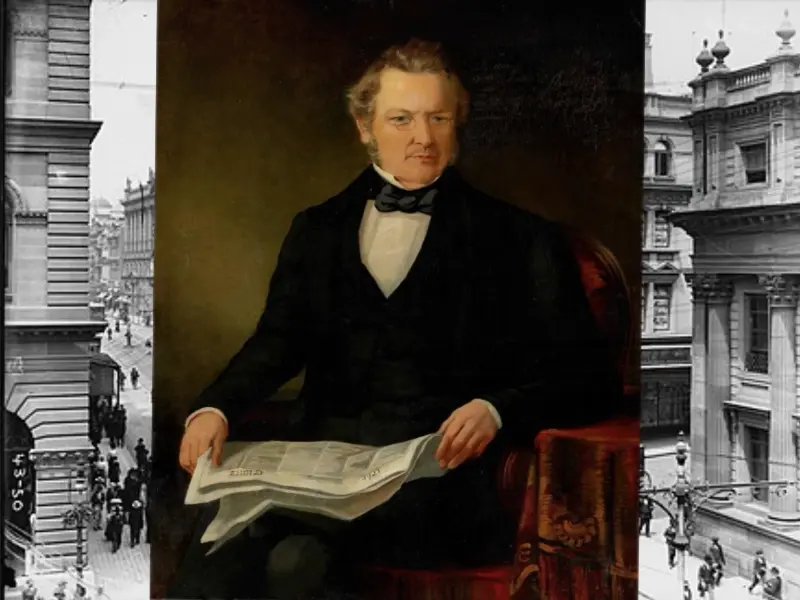
- David Jones (1793-1873) was born on 8 March 1793 in Llandeilo, Wales, to Thomas Jones, a farmer, and his wife Nancy.
- Despite his parents’ hopes for him to pursue a career in the church, David showed little interest in farming or ministry, opting instead to apprentice as a grocer in Carmarthen at the age of 15.
- Establishing himself in Sydney in the mid-19th century, Jones formed a partnership with Charles Appleton, aiming to emulate the practices of esteemed London wholesale firms in their business endeavours.
David Jones (1793-1873), was a Welsh-Australian merchant, and the retailer founder of David Jones Limited. As a merchant, he began in Pembrokeshire and London before moving to Sydney via Hobart. In 1838, he established ‘David Jones & Co‘, at 463 George Street, thereby establishing one of the oldest surviving department stores in the world. His aim was quality goods for all.
Early years and background
David Jones (1793-1873), a trader, was born on 8 March 1793, the son of Thomas Jones, a farmer near Llandeilo, Wales, and his wife Nancy. His parents had aspirations for him to join the clergy, but at 15, displaying little interest in farming or the ministry, he departed from home and became an apprentice to a grocer in Carmarthen. At 18, he was offered and accepted the management of a general store in Eglwyswrw, Pembrokeshire, where in 1813 he wedded Catherine Hughes, the daughter of the local clergyman. A year later, during childbirth, she and the infant perished. On 10 September 1822, he married Elizabeth Williams (d.1826).
Jones subsequently relocated to London and promptly secured employment with a retailer in Oxford Street. He changed jobs several times before taking up a position with the firm of R. N. Nicholls, Wood Street, Cheapside, where he quickly advanced to become a trusted assistant. In London in 1828, he married Jane Mander, the daughter of John Mander of East Smithfield. The Mander family were fervent Independents and deeply involved in the activities of the London Missionary Society, and it was through them that David Jones established numerous connections within the Independent community.
Through William Wemyss, an acquaintance of the Manders, he encountered Charles Appleton, a businessman from Hobart Town who had established a store in Sydney in 1825 and was visiting London. Jones resigned from Nicholls’s firm and formed a partnership with Appleton, which encompassed the Australian branches under the name of Appleton & Co.
Also read: Who is Liran Zvibel? CEO of WEKA was an Israeli soldier, now battles data workloads
Expanding business
In October 1834, Jones set sail with his family aboard the Thomas Harrison bound for Hobart. From there, with intentions of expanding his business, he journeyed overland to Launceston to assess the needs of the settlers. He arrived in Sydney aboard the Medway in September 1835. Appleton had entrusted his Sydney business to a partner, Robert Bourne, a former missionary. When Bourne’s partnership expired on 31st December 1835, the firm transitioned to Appleton & Jones, with Jones embarking on the ambitious venture of establishing a business in Sydney modelled on the esteemed wholesale London firms.

However, upon Appleton’s arrival, tensions arose between them, leading to the dissolution of their partnership by mutual agreement in 1838. Both Appleton and Jones aired their grievances in the press; Appleton was apprehensive about what he perceived as Jones’s risky credit practices. In response, Jones defended himself, citing a significant increase in turnover since he assumed control of the Sydney business in 1836, reaching £80,000 annually, yielding a colony-specific profit of over £7000. Jones had indeed implemented a liberal credit policy, with the partnership’s credit reaching over £30,000 by its end.
Also in 1838, he established ‘David Jones & Co’, at 463 George Street, thereby establishing one of the oldest surviving department stores in the world. To facilitate trade with London, he formed a mutually beneficial alliance with his business associates and fellow Independents, Robert Bourne, Ambrose Foss, G.A. Lloyd, and their consulting accountants, Thompson & Giles, appointing William Wemyss as their principal agent. Jones and his colleagues consistently secured entire cargo spaces on ships transporting bounty migrants, ensuring lucrative return shipments such as wool or tallow.
Jones weathered the economic downturn of the 1840s, and his business flourished. In 1849, he and his wife visited England and Wales. He retired from active management of the business in 1856, admitting partners and leaving behind £30,000 in capital. However, the firm encountered financial difficulties a few years later; faced with bankruptcy, Jones bought out his partners, resumed management of the business, and within a short period fully settled all debts to creditors. In 1866, he fell seriously ill but, with treatment from his son Philip, made a remarkable recovery.
He ultimately retired for good in 1868 and passed away at his residence in Lyons Terrace, Liverpool Street, Sydney, on 29th March 1873. His wife followed three weeks later, at the age of 71.
Also read: Who is Aetna Wun Trombley? CEO, board member of Lycia Therapeutics is a relentless innovator
David Jones and his family
David Jones possessed a dignified and charming presence alongside a gentle and engaging character; as noted by his friend Rev. W. Slatyer, ‘he maintained an unsuspicious and charitable viewpoint, extending trust to others in the same manner he conducted himself’. Beyond his familial responsibilities, his primary interests encompassed business, religion, and civic matters. He held numerous investments in banks, steamships, insurance, construction, and various other enterprises.
He maintained an unsuspicious and charitable viewpoint, extending trust to others in the same manner he conducted himself.
Rev. W. Slatyer, David Jones’ frinend
Serving as a director of the Mutual Fire Insurance Co. since its establishment in 1840, he also held foundational roles in the Australian Mutual Provident Society from 1848 and chaired the Metropolitan and Counties Permanent Investment and Building Society in 1851. Actively involved in the Congregational Church in Sydney for approximately thirty-five years, he played a pivotal role as a founding member and council entity of Camden College, alongside serving on committees for local branches of the Bible and Religious Tract Societies.
Recognised for his philanthropy, he contributed generously to churches and was among Sydney’s merchants who each donated 1000 guineas to the Crimean War victims’ fund.
Additionally, he served as a member of the inaugural Sydney City Council in 1842 and later joined the New South Wales Legislative Council from 1856 to 1860.
From his third marriage, he fathered four sons and four daughters. The eldest son, David Mander (deceased 1864), wed his cousin Emily Ann Jones, and together with his brother George, acquired the 300-square-mile property, Boonara, situated on the Darling Downs. Philip Sydney (1836-1918), the second son, attained prominence as a physician and was knighted for his contributions. Edward Lloyd (1844-1894), the youngest son, married Helen Ann, daughter of Richard Jones, and succeeded his father in the family business. In September 1848, the eldest daughter, Eliza, entered matrimony with Robert, the son of Dr Robert Ross.