
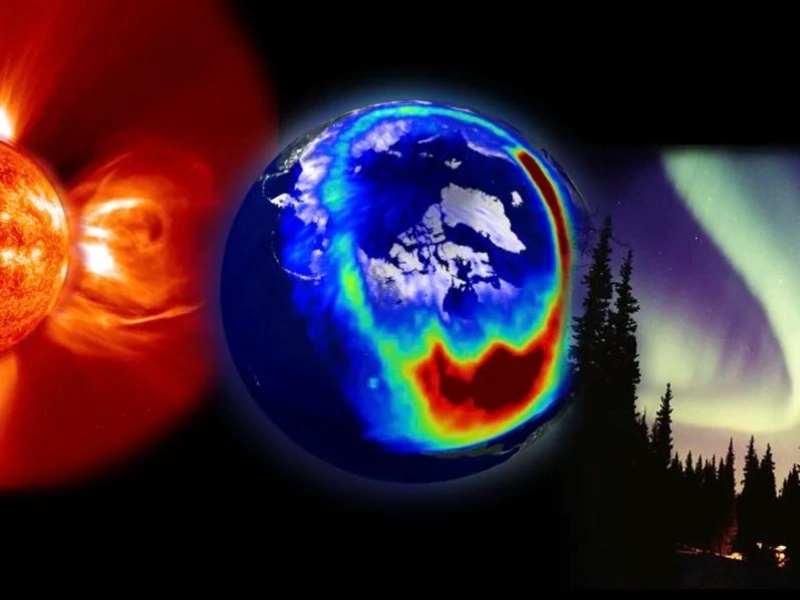
- Space weather is very different from weather on Earth. Weather on Earth involves atmospheric conditions, such as temperature, humidity, and air pressure, that can produce storms with precipitation and wind.
- In the vacuum of space, there is no water or air, and thus there also isn’t any precipitation. But there is wind — the solar wind — that isn’t air at all, but instead is a stream of energy and plasma, or charged particles, from the Sun.
- Space weather storms are invisible but still impact Earth.
In the vast expanse beyond our planet’s atmosphere lies a dynamic and often unpredictable phenomenon known as space weather. While it may sound like a term from science fiction, space weather is very real and has significant implications for our technological infrastructure and even our health. Understanding space weather is paramount. From the beauty of auroras dancing in the polar skies to the potential disruptions to our modern way of life, space weather encompasses a wide range of phenomena with far-reaching implications. By delving into the mysteries of space weather, we gain insight into the dynamic interplay between our planet and the vast cosmos beyond.
Also read: Should robots go to space instead of humans?
What is space weather?
At its core, space weather refers to the environmental conditions in space as influenced by solar activity and the solar wind. Just as Earth has its own weather systems driven by atmospheric phenomena, space too experiences its own version of storms and disturbances.
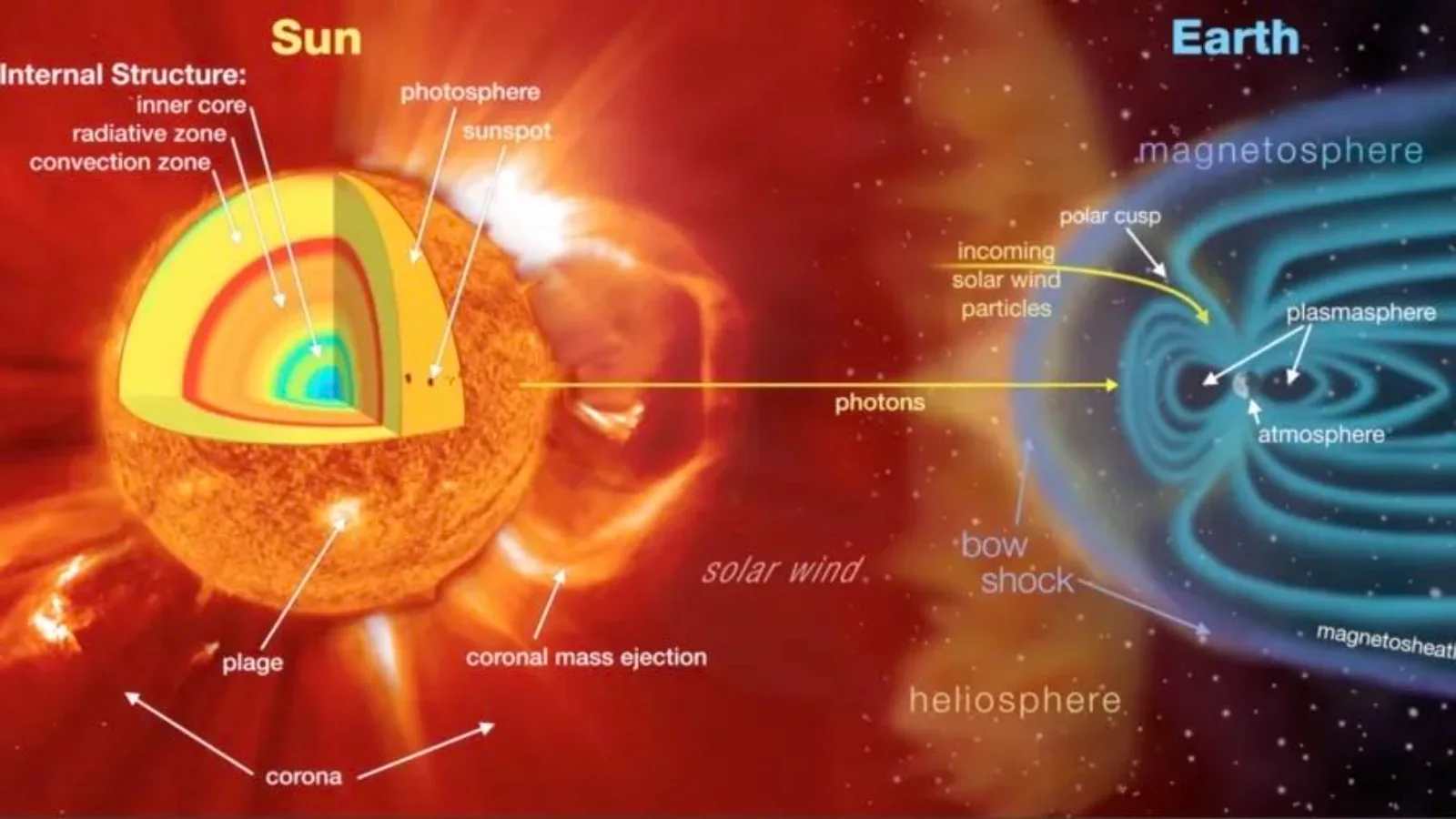
The primary driver of space weather is our nearest star, the Sun. The Sun is a dynamic and active celestial body, constantly emitting a stream of charged particles known as the solar wind. Additionally, the Sun occasionally experiences eruptions called solar flares and coronal mass ejections (CMEs), which release immense amounts of energy and particles into space.
Also read: SpaceX secures $1.8B to develop covert US spy satellite network
What are space weather storms?
Space weather begins with the Sun. The Sun gives off electromagnetic energy in many wavelengths, including visible light, radio waves, ultraviolet, high-energy X-rays, and more. The Sun also emits a stream of radiation in the form of charged particles (plasma) that make up the solar wind. Occasional energy bursts resulting from huge explosions on the Sun send plasma and radiation hurtling through our solar system, sometimes in the direction of Earth. Solar flares, coronal mass ejections (CMEs), and solar prominence events are examples of solar phenomena that can release these energy bursts toward Earth and create space weather storms.
Space weather interacts with earth’s atmosphere
As the solar wind sweeps through space, it predominantly skirts around Earth’s magnetosphere, a vital shield enveloping our delicate planet. However, occasional surges of solar energy directed towards Earth collide with its magnetosphere, propelling particle radiation along magnetic field lines towards our atmosphere. When these radiation particles interact with atoms in the upper atmosphere, they give rise to awe-inspiring phenomena known as auroras—the mesmerising northern and southern lights.
Furthermore, space weather disturbances can disrupt satellite electronics, hinder radio communications, distort GPS signals, alter spacecraft orbits, and even pose risks to terrestrial electrical power grids.
1. Solar flares can cause radio blackouts
Solar flares release a spectrum of electromagnetic energy, including X-rays. Heightened X-ray emissions can disrupt the ionosphere, leading to the scattering of radio waves and subsequent radio blackouts on Earth. These blackouts, which can persist for minutes to several hours, represent the most prevalent impact of space weather on our planet. On average, there are approximately 2000 radio blackouts attributed to solar activity during each 11-year solar cycle. Given that solar flare energy reaches Earth in just eight minutes, the window for advance warning is narrow.
As a result, scientists maintain vigilant monitoring of the Sun to ensure swift dissemination of alerts.
2. Solar radiation storms
Solar radiation storms stem from both solar flares and coronal mass ejections. These storms unleash substantial surges of protons and other particles from the Sun, elevating radiation levels near Earth to potentially hazardous levels. Such heightened radiation poses significant health risks for astronauts aboard the International Space Station and, occasionally, for passengers on airline flights traversing polar regions. Moreover, this intensified energy can inflict severe harm on satellite electronics and may perturb radio communication in polar areas by interacting with Earth’s ionosphere.
Following a solar event, radiation storms reach Earth within a mere 10 minutes, exerting their impact for periods ranging from hours to days.
3. Geomagnetic Storms
A large coronal mass ejection can cause a strong gust of solar wind to reach Earth, transferring energy to Earth’s magnetic field and causing a geomagnetic storm. These storms can create intense currents in Earth’s magnetosphere and cause the ionosphere and upper thermosphere to heat up. The most common effect on Earth is spectacular auroras, but they can also disrupt radio signals and navigation systems, create drag for low-orbiting satellites, and harm power grids. Geomagnetic storms typically take several days to reach the Earth so warnings can be issued well before they arrive. Effects of geomagnetic storms can last for several days.
Impact of space weather on earth
While the vastness of space might make it seem distant and disconnected from our daily lives, space weather can have tangible effects here on Earth. One of the most well-known impacts of space weather is the phenomenon of auroras, where charged particles from the solar wind interact with Earth’s magnetic field to produce stunning displays of light in the polar regions.
However, space weather also poses risks and challenges to our technological infrastructure. Solar flares and CMEs can release bursts of radiation and energised particles that, if directed towards Earth, can interfere with satellite communications, disrupt power grids, and even pose risks to astronauts in space.
Studying and predicting space weather
Given the potential impacts of space weather on our modern society, scientists around the world are actively engaged in studying and predicting these cosmic phenomena. Space weather forecasting involves monitoring the Sun’s activity, tracking the solar wind, and observing changes in Earth’s magnetosphere and ionosphere.
Advanced space weather prediction models allow scientists to anticipate when and where space weather events might occur, providing valuable information to industries such as aviation, telecommunications, and energy production. By understanding and predicting space weather, we can better prepare and mitigate the impacts of these cosmic storms on our technological systems and infrastructure.