
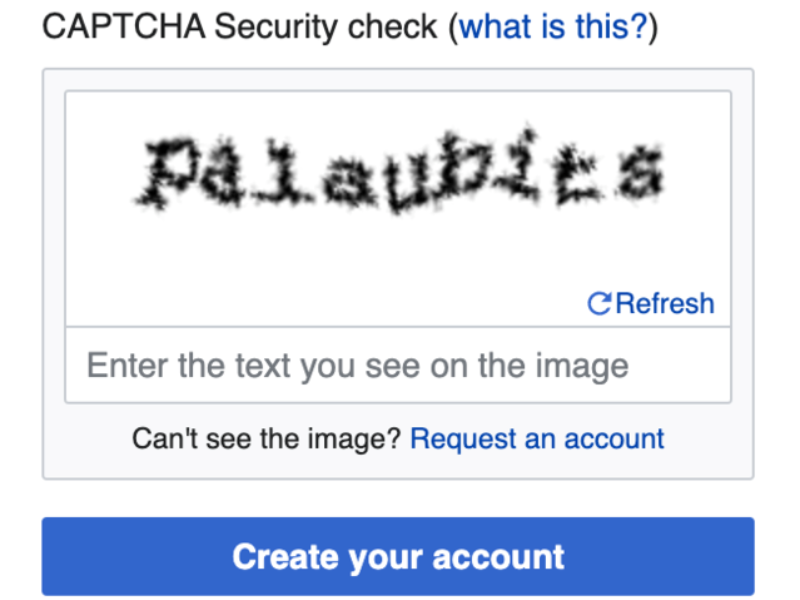
- Captcha stands for “completely automated public Turing test* to tell computers and humans apart.”
- Google may indeed utilise human effort to enhance its AI capabilities, contributing collectively and involuntarily to the advancement of Google’s AI.
Officially, Captcha serves as a robust defense mechanism against automated bots, spam attacks, excessive flooding, and various forms of online mischief. While some may question its technical reliability, particularly in light of evolving AI capabilities that can sometimes circumvent traditional Captcha methods, the program undeniably plays a crucial role in safeguarding online platforms. Beyond its technical function, Captcha holds significant human and philosophical value.
What is Captcha
Captcha stands for “completely automated public Turing test* to tell computers and humans apart.” It refers to various authentication methods that validate users as humans, not bots, by presenting a challenge that is simple for humans but difficult for machines.
Captchas prevent scammers and spammers from using bots to complete web forms for malicious purposes.
Traditional Captchas required users to read and correctly retype distorted text that could not be interpreted by optical character recognition (OCR) technology. Newer iterations of Captcha technology use AI-driven behavioral and risk analyses to authenticate human users based on activity patterns rather than a single task.
Also read: AI lies: Should we worry about deceptive AI models?
Also read: Is AI a threat to cybersecurity?
Types of Captcha
Captcha refers to various authentication methods that distinguish humans from bots by presenting challenges that are simple for humans but difficult for machines.
- Text recognition: Users are asked to enter a series of numbers and letters from a distorted image.
- Image selection: Users identify specific images from a set (e.g., select all images containing hydrants).
- Logical tasks: Evaluates logical reasoning abilities.
- Three-dimensional Captcha: Requires identification of images, letters, or numbers displayed in three dimensions.
- Marketing Captcha: Requires entering a word or phrase associated with a brand.
- Captcha “I’m not a robot.” The veracity of this statement is determined by the time spent to execute the task and other more complex mechanisms. The Captcha captures the time on your computer and the time zone. It determines the approximate location and the browser that is being used. It takes into account even the resolution of the screen on which it is displayed. Mouse movement and other means for cursor control and clicking are also monitored.
Does Google use us through Captcha?
There’s widespread belief that Google uses Captchas to train artificial intelligence, though this remains unconfirmed.
However, there are several indications supporting this notion. Captchas sometimes appear frequently without clear necessity, and occasionally overlook user errors.
This approach enables Google to save significantly on specialist costs by leveraging internet users to train image recognition systems for free.
For instance, users accurately decipher blurred text on building facades, aiding AI in mapping correct house numbers.
If users assist in arranging house numbers through Captcha, Google’s system learns to automatically place numbers on maps based on user input, refining accuracy through user corrections.
In essence, this implies that Google may indeed utilise human effort to enhance its AI capabilities, contributing collectively and involuntarily to the advancement of Google’s artificial intelligence.
* A Turing Test, named for its creator Alan Turing, tests a machine’s ability to exhibit human intelligence.