
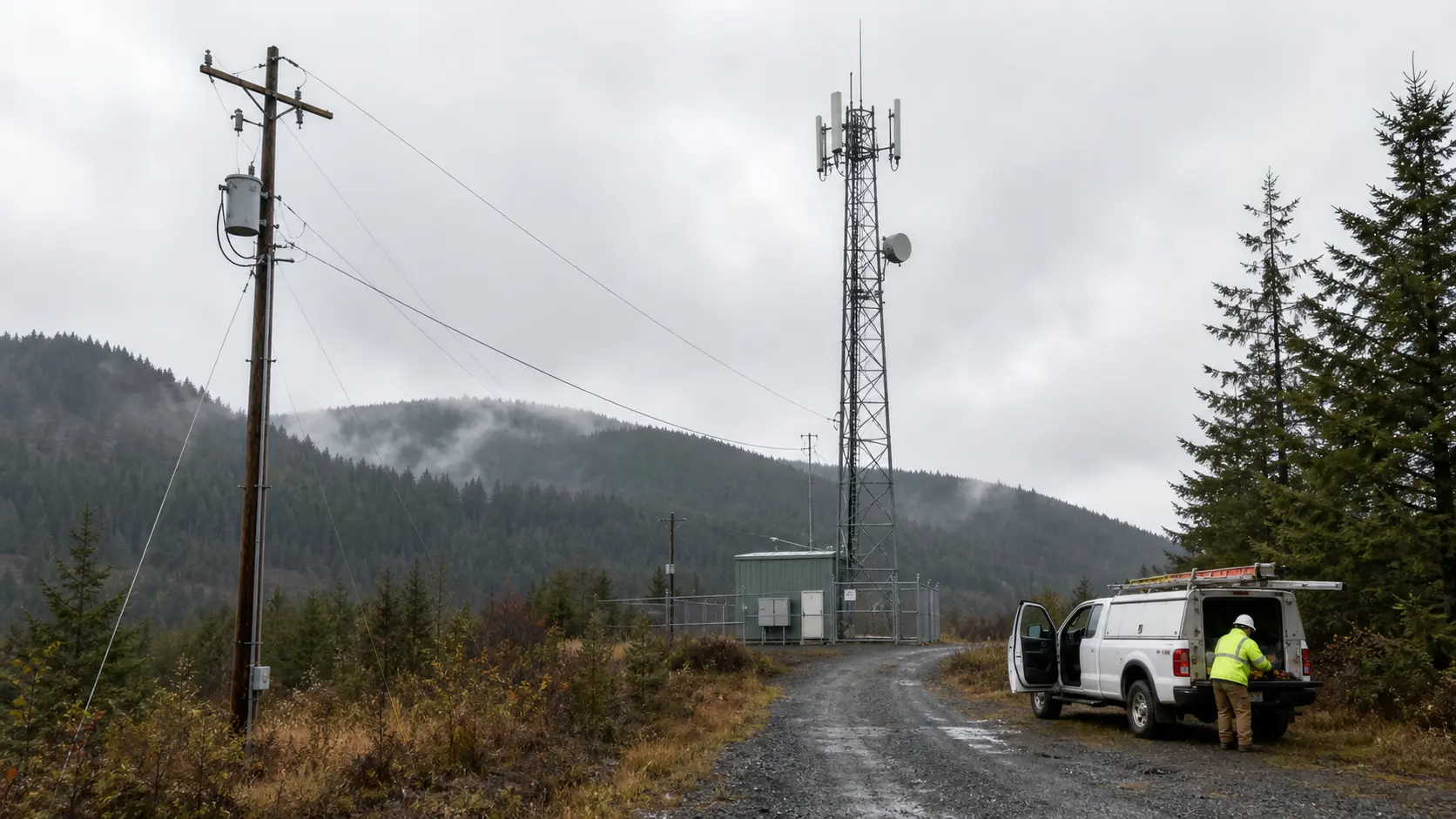
Summary
- Washington Broadband's own June 2025 wired-network sale notice says the company sold all cable and fibre infrastructure to Charter/Spectrum while retaining Washington Broadband, Inc., the wireless network and Washington Telco. That makes the remaining access story a fixed-wireless story, not a hybrid cable, fibre and radio story.
- Company sources say the retained wireless system has 35 towers over hundreds of square miles and serves areas from Tampico and East Valley to Wenas and Zillah. Those claims support a real operating footprint, but they are not a tower map, a sector inventory, a power plan or an address-level serviceability record.
- The public internet edge is visible. ARIN records AS19116 to Washington Broadband, RIPEstat reported 19 announced IPv4 and IPv6 routes on the research date, and bgp.tools observed paths through Cogent, Ziply Fiber and Lumen. That is logical routing evidence, not proof that three physically separate roads leave Yakima.
- The remaining resilience questions are concrete: which towers are active, how each site is powered, how tower backhaul survived or changed after the Charter/Spectrum transaction, how much capacity is actually available at busy hour, and how quickly local crews can restore a failed sector, route or power system.
The sale makes wireless the test, not a side product
The most important infrastructure fact about Washington Broadband is not hidden in a registry. The company told customers directly. On 16 June 2025, president Forbes Mercy announced that Washington Broadband had agreed to sell its cable and fibre internet assets to Charter Communications, the owner of Spectrum. The sale notice says the transaction covered all wired cable and fibre infrastructure. It explicitly excluded Washington Broadband, Inc., the wireless network and Washington Telco LLC.
That boundary changes the article's centre of gravity. Before the sale, a household at the edge of the radio footprint might have been part of a broader operator with cable, fibre and wireless options under the same local ownership. After the sale, the company's own follow-up, "Now What for our Wireless Network?", said wireless customers could no longer be moved to the sold wired network. Management said it would return attention to wireless upgrades, seek to move beyond 30 Mbps service and pursue 100/20 capability while continuing to look for a buyer for the remaining business.
By the company's later "Life After Fiber" update, the wired sale was described as complete. The remaining business was back to wireless, with a 35-tower network from Tampico and East Valley to Wenas and Zillah, average service around 50 Mbps, some 100 Mbps areas and thousands of local customers. Those are useful operating claims. They also come from the seller and are not accompanied by a tower list, closing filing, customer count, serviceability extract or performance series.
The distinction between sold and retained assets has to stay visible. Charter/Spectrum now controls the former wired access plant. Washington Broadband says it controls the wireless system and continues to provide wireless internet. Washington Telco remains a separate phone business under the same local ownership. AS19116 remains registered to Washington Broadband and remains visible in public routing. None of those facts proves that every transport path feeding a retained tower is owned by Washington Broadband.
A wireless access operator normally depends on leased fibre, microwave relay, internet transit or some mixture of those layers, and the public material reviewed here does not identify that ownership line.
This is why a post-sale assessment cannot stop at "wireless." Fixed wireless removes the final cable between a distribution site and a customer premises. It does not remove cables from the rest of the system. Traffic still has to move from a customer antenna to a tower or relay, from that site to aggregation equipment, from aggregation to an internet edge, and from that edge to upstream carriers and peers. Even a clean microwave chain eventually needs power, switching, routing and a handoff to wider networks. Selling the wired access plant may simplify the company. It does not make the wireless network independent of fibre.
Washington Broadband is therefore not a speculative entrant. Its long history, current offers and active routing all support the existence of an operating regional ISP. But it is also not the same infrastructure business it was before the 2025 transaction. The evidence needed now is a post-sale account of the retained system: which facilities and paths remain under the operator's control, which have to be leased from others, and how customers are recovered when the usual path fails.
A 35-tower footprint is not a serviceability map
Washington Broadband's public geography is more descriptive than many small operators provide. The current about page says the network has grown to 35 towers covering hundreds of square miles in upper Yakima County. The post-sale update names Tampico, the East Valley, Wenas and Zillah. An older about page describes service from Zillah to Naches and says 20 towers surrounded Yakima. The wireless FAQ contains older references to seven towers and 12 local sites.
Those numbers do not have to be contradictory if they record different phases of a network that the company says it has rebuilt several times. They are a problem only when an undated reader has to treat them as one current inventory. The public pages do not reconcile the old counts with the current 35-tower statement. They do not say which sites are active, which are relay-only, which sell the newest tiers, which are legacy, which are owned, which are leased and which have protected power or diverse backhaul.
The FAQ is valuable because it describes the actual access constraint. A prospective customer has to be within sight of a tower, historically within seven miles, and must allow an outdoor antenna installation. An installer tests the link, mounts the antenna, runs a cable indoors and connects it through a power unit to the customer's router or computer. If the initial connection cannot be made, the customer is not charged. That installation workflow tells more about rural reach than a broad colour on a map.
A nearby tower can be useless if a ridge, orchard, building or tree line blocks the signal. A more distant site can work from an elevated roof if the path is clear. Foliage, new construction, antenna alignment, frequency, radio generation, receiver height and interference all change the answer. In a fixed-wireless network the real unit of availability is the individual path under a stated design, not the county-wide impression created by a coverage phrase.
The Federal Communications Commission's broadband mapping rules apply the same discipline. The FCC's fixed broadband availability overview defines reportable fixed availability around locations where infrastructure has been built and where a standard installation can be completed within ten business days without network extension. Its fixed-wireless supporting-data guidance points to base-station location and height, carrier information, link budgets and clutter data. Those are the facts that turn a coverage statement into an engineering claim.
Washington Broadband does not need to publish sensitive coordinates for every site to make its footprint more testable. It could publish an address checker that returns available technology, available speed family, whether a site survey is required and whether a location is capacity limited. It could report aggregate serviceability by community, separate active distribution towers from relay sites and state how many sites can sell 100/20 or faster. It could explain whether "Fiber Wireless" on the residential page is a product label, a fibre-fed-radio architecture or another service distinction.
Until those details are public, the 35-tower figure should be treated as a company-attributed footprint, not as proof of 35 independent failure domains. It does not prove that all sites are active. It does not prove that every tower has separate power and backhaul. It does not prove universal service across the named geography. Rural reach is many narrow paths, and each path has to pass its own line-of-sight, capacity and recovery test.
Capacity is advertised at the edge, not proven at the tower
Washington Broadband's current residential plans show how the upgrade story is being sold. The page lists four "Fiber Wireless" tiers: 25/5 Mbps, 50/10 Mbps, 100/20 Mbps and 150/30 Mbps. It also preserves legacy tiers and separate in-city plans. The page notes that newer tiers may be limited by distance. That warning is important, because it separates a network-wide product family from a location-specific result.
The business page looks different. It lists in-city and rural wireless tiers with lower maximums and separate installation terms. The mismatch may simply mean the page is older or that business provisioning follows different rules. It may also reflect a network where some sites and customer classes have not moved to the new speed family. Without dated plan pages, address-level order results and performance data, the retail pages should not be flattened into one network-wide maximum.
A plan speed is a ceiling sold to one account. It is not the capacity of the tower sector shared by many accounts, the committed rate of the tower's backhaul or the throughput available on the path leaving Yakima. A 150 Mbps customer can see the full tier during a quiet test while busy-hour contention exposes limits. A sector with ample radio capacity can still deliver a poor result if the customer's antenna is marginal, the backhaul is tight, the indoor Wi-Fi is poor or an upstream route is congested.
Washington Broadband itself identifies several of those layers. The FAQ lists heavy snow or fog, blocked sight lines, power outages, antenna alignment and customer-device problems as possible causes of poor service. A company post on speed-test limitations argues that active household traffic, upload saturation, the selected test server and outside hops can affect a reading. Those are valid cautions in principle. They do not replace operator performance evidence.
The policy context has moved as well. In its 2024 section 706 inquiry, the FCC raised the fixed broadband benchmark from 25/3 Mbps to 100/20 Mbps and recorded a longer-term goal of 1,000/500. Washington Broadband's 100/20 and 150/30 products meet or exceed the current benchmark on paper. The 25/5 and 50/10 tiers do not. That does not mean lower tiers have no value for a rural household. It means that public funding, broadband maps and competitive claims now expect more than a working 25/3-era connection.
The company's own upgrade narrative recognizes that pressure. In the June 2025 wireless update, management said it had applied for a Priority Access License and wanted protected spectrum to support 100/20 capability. The FCC's CBRS order explains the Priority Access License concept inside the 3.5 GHz shared-band framework. But an application is not a grant, and a grant is not a deployment. The reviewed public evidence does not show whether Washington Broadband obtained a licence, which channels it can use, which radios are compatible, which towers were upgraded or how much customer capacity changed.
Spectrum can reduce one interference risk. It cannot enlarge a congested backhaul path, power a dark tower, clear trees from a radio path, replace a failed sector radio or create a physically separate route to Seattle. The current plan page is encouraging evidence that faster products are being offered somewhere. It is not evidence that every serviceable address can buy them, or that the backup path has enough capacity when the primary path fails.
The clean performance disclosure would show busy-hour speed, latency and packet-loss distributions by plan family, together with failed-install rates and sector capacity thresholds. It would separate former cable and fibre customers now moved to Spectrum from retained wireless customers, so the old hybrid network does not flatter the surviving wireless system. Capacity becomes meaningful only when the radio path, backhaul, upstream edge and customer premises can carry the same load at the same time.
AS19116 makes the internet edge visible
The public routing evidence is stronger than the public tower evidence. The American Registry for Internet Numbers records AS19116, named WASHINGTON-BROADBAND, to Washington Broadband, Inc. The linked organisation record identifies Washington Broadband, Inc. at a Yakima address. Registry records by themselves prove control of number resources, not live service. Here, the resources are publicly visible in routing.
On the research date, RIPEstat's AS19116 overview reported the autonomous system as announced. Its announced-prefix inventory returned 19 visible IPv4 and IPv6 route announcements. An independent bgp.tools profile described the network as active and observed 17 IPv4 routes plus two IPv6 routes, with upstream paths through Cogent, Ziply Fiber and Lumen. Counts can differ by collector and moment because aggregates and more-specific routes change. The important point is that Washington Broadband is not a dormant ASN.
The route-security signal is also positive. IPinfo's view of 104.245.132.0/22 associates the route with AS19116 and reports a valid route-origin authorisation. Valid origin information helps networks using RPKI origin validation distinguish authorised origins from route leaks or hijacks. It does not protect against a cut cable, router outage, power loss, bad configuration or local access failure.
PeeringDB's AS19116 entry adds an interconnection profile. It lists a 10 Gbps operational port at the Seattle Internet Exchange, IPv4 and IPv6 details, Seattle and Portland facilities, an open peering policy and a self-reported 1-5 Gbps traffic range. The record was last updated in 2022 and the facility entries are older. PeeringDB is useful because it shows how an operator presents itself to other networks. It is not an audited capacity report or a physical route map.
Taken together, the routing records establish the strongest part of Washington Broadband's infrastructure case. The company has its own internet identity. It originates public routes. It supports IPv6 visibility. It has several observed logical upstream paths and an exchange profile. A network that controls its routing can often shift traffic among upstreams and peers instead of depending entirely on addresses borrowed from one carrier.
That is real resilience potential. It is not yet proven rural resilience. The internet edge can be healthy while a tower sector fails. A route can be visible while a customer has no line of sight. A Seattle exchange port can be operational while the Yakima-to-Seattle transport is the vulnerable layer. The strongest evidence in the record begins after traffic has already reached the operator's routing domain. The weaker evidence covers the path that rural customers actually touch first.
Upstream names are not yet physical diversity
Cogent, Ziply Fiber and Lumen are separate networks. A Seattle exchange port and Portland facility references suggest more than one interconnection opportunity. But none of the public records shows how AS19116 reaches those places from Yakima. The three logical paths could leave the valley through separate carriers, separate conduits, separate buildings and separate powered router platforms. They could also share a pole line, transport provider, bridge crossing, central office, meet-me room or edge router before diverging.
That common-mode risk is not a technical footnote. BGP can move traffic around a failed session only if another session remains physically reachable. If one local fibre cut severs every leased wavelength before the upstream paths diverge, all three names can vanish from the customer's perspective at once. If two upstreams terminate on one router, one power distribution unit or one unprotected aggregation room, the route table may have logical diversity while the infrastructure has a single failure point.
The 2025 wired-asset sale makes this question sharper. The company said the wired network was built to connect directly with Spectrum infrastructure and that the wired plant moved to Charter/Spectrum. The sale notice does not say whether Washington Broadband retained strands, transport rights, conduit rights, building access or leased circuits needed by the wireless system. It also does not say whether Charter/Spectrum became a post-sale transport dependency for any retained tower or aggregation point.
The public interconnection profile also has to be handled carefully. A Seattle Internet Exchange port can improve paths to participating networks and reduce dependence on paid transit for some traffic. It does not place the customer tower in Seattle. It does not guarantee enough backhaul from Yakima to the exchange. It does not state how traffic behaves if the normal long-haul path fails. A 10 Gbps port at an exchange is different from 10 Gbps of usable protected capacity from every rural sector.
The same distinction applies to Portland. A profile that lists Seattle and Portland facilities may signal a more distributed edge. It may also reflect historical or administrative data. Without current router locations, transport circuits, facility power, cross-connects and failover tests, those facility entries should be treated as leads rather than confirmed recovery paths.
The proof should be practical. Washington Broadband could publish an aggregate statement of physical diversity without exposing sensitive routes: how many upstream exits are physically separate, whether the Yakima-side transport uses different buildings and corridors, whether tower backhaul is ringed or radial, and when failover was last tested. It could say whether an upstream failure, an edge-router failure and a local transport cut are tested as separate events. Until then, three upstream names remain encouraging routing evidence but not a complete resilience claim.
Power and weather decide whether radio reach is usable
Fixed wireless is often described through towers and line of sight. Power is just as decisive. The customer premises radio needs electricity. The indoor router needs electricity. The tower radio, sector switch, backhaul equipment and aggregation router need electricity. Any upstream demarcation point needs electricity. A network can have clear spectrum, active routes and good intentions while still failing because the utility feed drops and the backup system is too small, untested or unreachable.
The City of Yakima utility page identifies Pacific Power as electric-service provider for the city. Yakima County's Horizon 2040 utilities element says most of the county is served by Pacific Power, identifies Benton REA service and describes multiple transmission feeds into the valley. Those sources are useful regional context. They do not identify the utility serving any particular Washington Broadband tower, the feeder serving a relay, or the backup runtime at an aggregation site.
Yakima County's emergency-management material lists hazards that matter to a rural wireless network. The county's preparedness page includes wildfire, winter storm and power failure. The county's multi-jurisdictional hazard mitigation plan identifies severe weather, wildfire, flood, landslide and extreme temperatures among regional exposures. None of those documents is a Washington Broadband outage record. They describe the environment in which tower access, customer power and repair movement have to work.
The radio path itself can degrade before the equipment fails. Washington Broadband's FAQ says heavy snow or fog can affect service and that trees, new construction and antenna alignment can block or weaken a link. A link with healthy margin may continue through weather. A marginal link may fall to slower modulation or disconnect. When many customer paths lose margin at once, a sector can become congested even though no one piece of hardware is broken. Availability, performance and resilience separate again.
Trees create a slower version of the same problem. A successful winter installation can become marginal when leaves return. An orchard, shelter belt or new outbuilding can change the path. A rooftop mount can shift in wind. A technician can fix some of this with realignment, a taller mount or a different tower. That requires records, spares, access and labour. It is not solved by advertising a faster tier.
CISA's infrastructure dependency material is useful as a general standard because it links communications to energy and geographic correlation. Its learning primer explains cascading communications-energy dependencies, and its implementation guidance points to alternate power, redundant providers and continuity planning. Its Emergency Communications Systems Value Analysis Guide describes battery, UPS and generator sizing, fuel, monitoring and load testing. Those are not audits of Washington Broadband. They frame the questions any tower network must answer.
How long can a remote tower run without utility power? Is the backup system sized for access radios and backhaul together? Can the operator see voltage alarms remotely? Is there a generator connection? Who fuels it in a wildfire-smoke or winter-road event? Do customers know that their antenna power unit and router also need backup if they want service during a local outage? The public record does not answer those questions. That absence is one of the largest gaps between a working radio network and a proven resilient network.
Repair labour is part of the network
Washington Broadband makes local support a core part of its public identity. The home page markets local service. The about page says the company has served the valley since 1994 and describes a local bilingual team whose members have at least five years with the company. The older about page refers to continuous monitoring and support windows that include weekdays, evenings and weekends.
That experience matters. Fixed-wireless troubleshooting is partly geography. A local technician may know which ridge blocks a signal, which access road becomes difficult in snow, which orchard row has grown into a path, which tower sector serves a particular road and which customer antenna tends to move in wind. Bilingual support can reduce friction when a household has to distinguish a premises power issue from a tower incident or router fault.
The public claim still lacks the denominator. The company does not state the number of field technicians, tower-qualified workers, network engineers, on-call responders, vehicles, subcontractors or critical spares. It does not identify average repair time, maximum simultaneous incidents, after-hours dispatch scope or the difference between customer-premises repairs and tower work. A 35-tower network maintained by a deep field team is a different system from a 35-tower network dependent on a few people with long memory.
The succession context makes labour more important. The founder's posts say he is planning retirement and seeking a buyer for the remaining wireless business. A sale can preserve the local team, add capital and strengthen operations. It can also change staffing, vendor relationships and the informal knowledge that keeps a rural network working. A buyer needs tower access records, configuration archives, route documents, credentials, spare inventory and maintenance history that can survive the founder.
Field capacity also includes customer equipment. Each new installation uses a path test, antenna mount, cable entry, power unit and router handoff. A failed radio, damaged cable or shifted mount consumes a truck visit. Tower work may require specialised climbing, safety and radio skills. NTIA broadband workforce material identifies tower technicians, fibre installers, splicers and pole workers as distinct needs in broadband deployment and repair. That source does not describe Washington Broadband's staff. It shows why the staffing question is not administrative trivia.
A spare radio in another state is theoretical capacity. A second upstream no one has tested is theoretical redundancy. A generator without a driver, fuel plan or safe site access is theoretical runtime. In a local ISP, people and records are part of the topology. They determine whether the hardware path can be restored before customers give up or before a second failure arrives.
The post-sale business has less room for vague evidence
Washington Broadband's public commercial story is simple: no contracts, no data caps, local support and a ladder of residential prices. That can be attractive in rural markets where customers value a responsive local operator and where large incumbent systems may not reach every address. The company has been operating in some form for decades, which is itself a meaningful survival signal.
The public economics are not visible. No reviewed source provides wireless revenue, subscriber count, churn, tower lease expense, transport cost, payroll, equipment age, debt, sale proceeds or capital budget. "Thousands" of customers could support a healthy local network, or it could be a small base spread across expensive geography. "Hundreds of square miles" could mean efficient high-site coverage, or it could mean long truck rolls and thin density. The words do not settle the cost structure.
The cable and fibre sale may have helped by removing the maintenance burden of wired plant and releasing capital. It may also have removed revenue, eliminated an upgrade path for some customers and changed the terms under which retained wireless towers reach upstream facilities. The company has not published the sale price or a post-sale financial statement, so those effects should not be assigned numbers.
What can be said is that the company has a clear incentive to make wireless look stronger. The June 2025 wireless update tied upgrades to customer demand, to the risk of subsidised overbuild under public broadband programmes and to the value of the business before sale. Washington State's BEAD programme is designed around reliable, affordable broadband investment. No Washington Broadband award is claimed here. The programme matters because it raises the standard for an incumbent that wants to prove a location is already adequately served.
For a regional ISP, the rational response is not only a bigger number on a plan card. It is to document which locations are truly serviceable, which tiers are available, which sectors are constrained, and how recovery works. That kind of evidence can protect the operator from inaccurate overbuild assumptions while giving residents something stronger than marketing language.
The company is not being asked to publish a security-sensitive blueprint. It is being asked to make the difference between operating capacity and resilient capacity visible. A rural customer needs to know whether the ordinary path works. A county or state broadband office needs to know whether the location is actually served. A buyer needs to know whether the network can be maintained after the founder leaves. Those are different questions, and vague upgrade language cannot answer all of them.
Six failure drills would reveal the real network
The best way to assess Washington Broadband is not to ask whether it is reliable in the abstract. Reliability becomes testable when the failed component is named and the recovery path is observed.
The first drill is a customer-premises power loss while the tower stays online. The customer's outdoor radio, power unit and router stop unless the premises has backup power. If Washington Telco service uses customer equipment, the voice boundary should also be clear. Network-side batteries cannot keep a household router alive. The useful disclosure is how the supported customer setup behaves and what backup options exist.
The second drill is a distribution-sector failure at one tower. A radio, switch port or power supply can remove service for every customer on that sector while the rest of the tower appears healthy. Recovery depends on remote diagnosis, a compatible spare, site access and a trained technician. If neighbouring towers can absorb some customers, the operator should know which links can be reassociated remotely and which need realignment. The useful metrics are spare availability and median sector-restoration time.
The third drill is commercial power failure at a remote site. The site should transfer to battery or generation, alarms should identify the event and the operator should know remaining runtime. A long event tests fuel, road access and simultaneous failures across the valley. The useful result is the minimum supported runtime and the percentage of active sites meeting it. One protected core site does not compensate for unprotected relays.
The fourth drill is a tower backhaul cut. The radios can remain powered and still have nowhere to send traffic. A ring can carry traffic the other way, a protected microwave hop can take over, or customers can be shifted to another site. The test must remove the normal physical path, not merely shut down a routing session over the same cable. Capacity on the backup path matters too. A route that stays up at a fraction of busy-hour demand may preserve messaging while breaking video, work applications and cloud services.
The fifth drill is the loss of one upstream carrier or edge router. AS19116's visible Cogent, Ziply and Lumen paths give the company options. A controlled withdrawal should show how quickly routes converge, whether IPv4 and IPv6 both recover and whether customer sessions survive. A separate test should remove an edge-router platform or facility power feed. Passing a carrier test while failing a facility test would reveal a shared local dependency under the routing layer.
The sixth drill is a regional event that combines cuts, outages and staff demand. Wildfire, wind, winter weather, vehicle strikes or construction damage can create power loss, blocked roads, damaged customer antennas and backhaul trouble at once. The company has to prioritise sites, communicate with customers, deploy spares and maintain the remaining network with a finite team. CISA's Midwest derecho communications case study shows why site information, access planning and power knowledge matter before such a day arrives. For Washington Broadband, the proof would be a dated exercise or incident record that states affected sites, restoration sequence, backup performance and lessons applied.
No public evidence reviewed here shows that Washington Broadband fails these drills. No public evidence shows that it passes them either. That is the point. The network looks real and active, but the resilience layer remains largely unpublished.
Local signals are useful only as questions
Local discussion boards contain both criticism and appreciation of Washington Broadband. Some writers describe fixed wireless as an option of last resort or say a property could not be served. Others say they used the company for years or discuss it alongside Starlink, Ziply and Spectrum. Those comments matter because they show what residents care about: whether a particular home can get service, whether line of sight exists, whether an incumbent is good enough, and whether alternatives are finally available.
They cannot establish network-wide truth. A Yakima Reddit discussion from 2021 includes a resident saying Washington Broadband could not serve a particular property and discussing limited rural options. That suggests serviceability constraints can matter at the edge of the footprint. It does not prove why that address failed or what the current result would be. A 2024 Yakima discussion includes a former customer and discussion of Spectrum, Ziply, wireless and satellite alternatives. That confirms some addresses have choices. It does not prove one network is categorically better.
The evidence that would settle these anecdotes is ordinary operating data. Completed and failed site surveys by community would distinguish impossible paths from capacity-constrained ones. Trouble rates by tower would identify fragile sectors. Busy-hour results by plan would show whether the advertised tiers are usable. Outage duration by cause would separate customer-premises power, tower failure, backhaul failure and upstream failure. A failed installation belongs in availability evidence. A slow evening on a qualified link belongs in performance evidence. A multi-hour outage after a power cut belongs in resilience evidence.
The company should also reconcile old public pages. Seven towers, 12 sites, 20 towers and 35 towers may each have been right when written. The problem is that an outside reader cannot tell. Older business tiers and newer residential tiers may reflect different products. The distinction is not clear. Cleaning those pages would not prove resilience, but it would reduce the temptation to use scattered anecdotes as the only corrective to company claims.
Unofficial comments should remain signals only. They are useful for deciding what to test. They cannot prove tower count, congestion, route diversity, power runtime or restoration quality.
What proof should come next
Washington Broadband already discloses more than many small operators about its history and strategic transition. The next disclosures should be operational rather than promotional.
First, publish a current serviceability surface. An address checker should return technology, available tiers, whether a site survey is required, expected installation timing and any distance limitation. Community summaries should distinguish locations passed by a usable radio path from the entire area inside a broad footprint. Current FCC map filings should align with those results, and a capacity-constrained sector should not be reported as available for a tier it cannot accept.
Second, define the retained asset boundary after the Charter/Spectrum sale. Customers and a prospective buyer need to know whether Washington Broadband owns or leases tower structures, shelters, backhaul, aggregation rooms and long-haul transport. The answer can be aggregated to protect sensitive details. The key is to separate owned assets, contracted dependencies and services supplied by the purchaser of the former wired network.
Third, describe physical diversity. State how many aggregation domains exist, how many active towers have two backhaul paths, whether alternate paths avoid the same conduit or pole route, and whether Seattle and Portland connectivity uses different long-haul corridors. Name the failover tests and publish their dates. Three upstream contracts are encouraging; physical separation is the proof.
Fourth, publish power classes and restoration performance. Report minimum battery duration, generator coverage, refuelling arrangements, alarm monitoring, annual load-test completion and median restoration time by incident type. Include the customer-premises boundary so users know that an antenna power unit and router need backup too.
Fifth, show capacity as a distribution. Publish the share of serviceable addresses that can buy 100/20 or faster, busy-hour performance by plan, sector upgrade thresholds and the number of customers still on legacy tiers. State whether the Priority Access License was granted and where compatible equipment is deployed. Protected spectrum should be tied to installed sites and observed outcomes, not left as an application claim.
Sixth, make local labour measurable. Give the number of field and network staff or at least the ratio of active tower sites to qualified responders. Publish after-hours coverage, contractor dependence, critical spare categories and the number of simultaneous failures the restoration plan is designed to handle. Succession documentation should preserve route, access and configuration knowledge through any sale.
These disclosures would not turn Washington Broadband into a large national carrier. They would do something more useful for a regional ISP: show which parts of the Yakima Valley network are working, which parts are constrained and which failure paths have actually been tested.
The evidence grade is medium, with a resilience discount
Washington Broadband clears the basic operating threshold. The company has a current Yakima presence, current residential offers, a detailed post-sale statement, a claimed 35-tower network and thousands of customers. AS19116 is active in public routing, originates IPv4 and IPv6 routes, has route-origin protection signals and shows several logical upstream and peering options. This is considerably stronger evidence than a business name, an ASN registration or a single marketing page.
The physical record is thinner. Tower locations and status are not reconciled publicly. Address-level reach is not transparent. The current mix of frequencies, radio generations and compatible customer equipment is unknown. There is no public backhaul map, ring count, physical-route separation statement, backup-power inventory, sector-utilisation series, spare-equipment list, field headcount or restoration report. The 2025 wired-asset sale adds an important unanswered boundary around retained transport.
The right judgement is neither that Washington Broadband is unproven as an operator nor that its visible internet diversity proves rural resilience. It is an established regional wireless ISP whose public internet edge is easier to verify than the access and recovery system behind it.
That asymmetry matters most for customers at the edge of the Yakima Valley footprint. A route can remain visible to the global internet while one tower is dark. A tower can remain powered while its backhaul is cut. A backhaul can remain healthy while foliage makes one house unreachable. A second upstream can exist while sharing the same long-haul trench. Every technical backup can exist on paper while a storm exhausts the available field crew.
Washington Broadband has spent decades making rural radio links work where alternatives were scarce. After selling the cable and fibre path, it has made wireless the centre of its remaining value and its succession plan. The company now has to show that the centre holds when the usual path does not.