
- 150 Mbps headline speed with 50 Mbps lower tier depending on location
- Creates a geographically segmented broadband model based on fibre availability rather than consumer choice
The fact
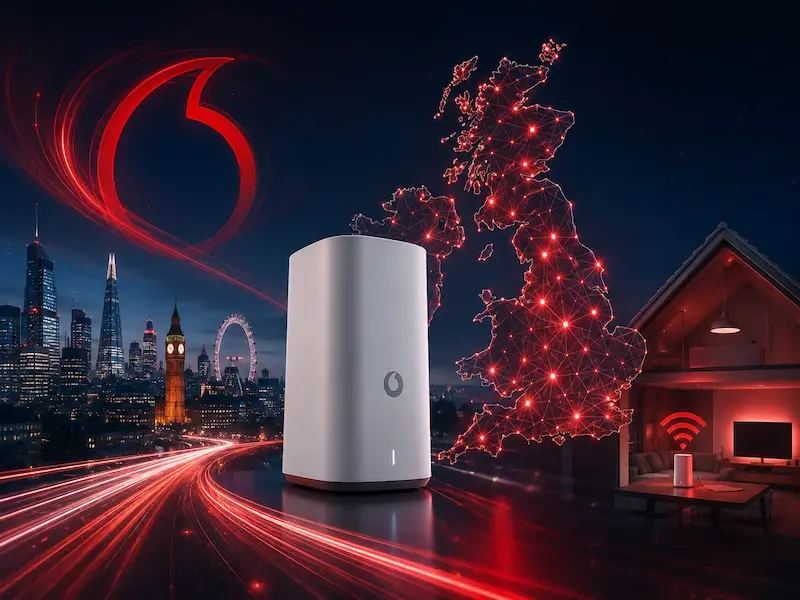
Vodafone has launched a 5G fixed wireless access (FWA) home broadband service in the UK, branded as 5G Broadband, targeting households without access to its full fibre network. The service extends potential coverage by 3.7 million homes and premises, in addition to Vodafone’s existing 23.2 million fibre footprint. It offers speeds of up to 150 Mbps, with a lower 50 Mbps tier depending on location. Pricing starts at £21 per month on a 24-month contract, or £30 on a rolling monthly plan, with no upfront hardware cost and self-installation via indoor or outdoor hubs.
The assessment
The service establishes broadband access as a function of infrastructure eligibility rather than a uniform retail offering, effectively dividing the UK market into fibre-covered and non-fibre zones. This creates a structural segmentation where FWA is not a direct substitute for fibre but a constrained fallback product, limiting substitution pressure on Vodafone’s own fibre assets while monetising surplus mobile capacity.
The model reduces intra-firm cannibalisation risk and formalises a dual infrastructure logic in broadband competition, where fibre operators defend high-capacity urban markets while FWA expands into structurally underserved areas. The result is a more partitioned broadband market, with competition shifting from product-level rivalry to infrastructure-defined access boundaries.
What to watch
Whether Vodafone expands 5G Broadband eligibility into fibre-covered areas and how it reports progress toward its 82% FWA household coverage target by 2030.
Also read: Industry body urges carriers to build AI corridor backbone
Also read: BT wins telecom infrastructure role for Euro 2028