Summary
- Trenton TV Cable Company's strongest public evidence is narrow but real: ARIN identifies the company as organisation handle
TTC-75, with a Trenton, Tennessee postal and street address, a 2007 registration date, and later changes in 2022. - The paid unit is a local access and field-support account, not raw bandwidth. A customer pays for installation, drop repair, local outage recovery, customer-premises handoff, and enough upstream quality to make the monthly bill feel safer than the substitute.
- The cheaper substitute is not one thing. It can be a national wireline provider, a mobile fixed-wireless plan, satellite broadband, another local access provider, an in-house private connection for a business, or simply postponing an installation.
- Public records can explain the mechanism, but they do not prove the decisive private facts: installation cost and gross margin, reliability and outage performance, or retention and churn after a customer has had a failure or a renewal choice.
The renewal decision starts at the wall plate
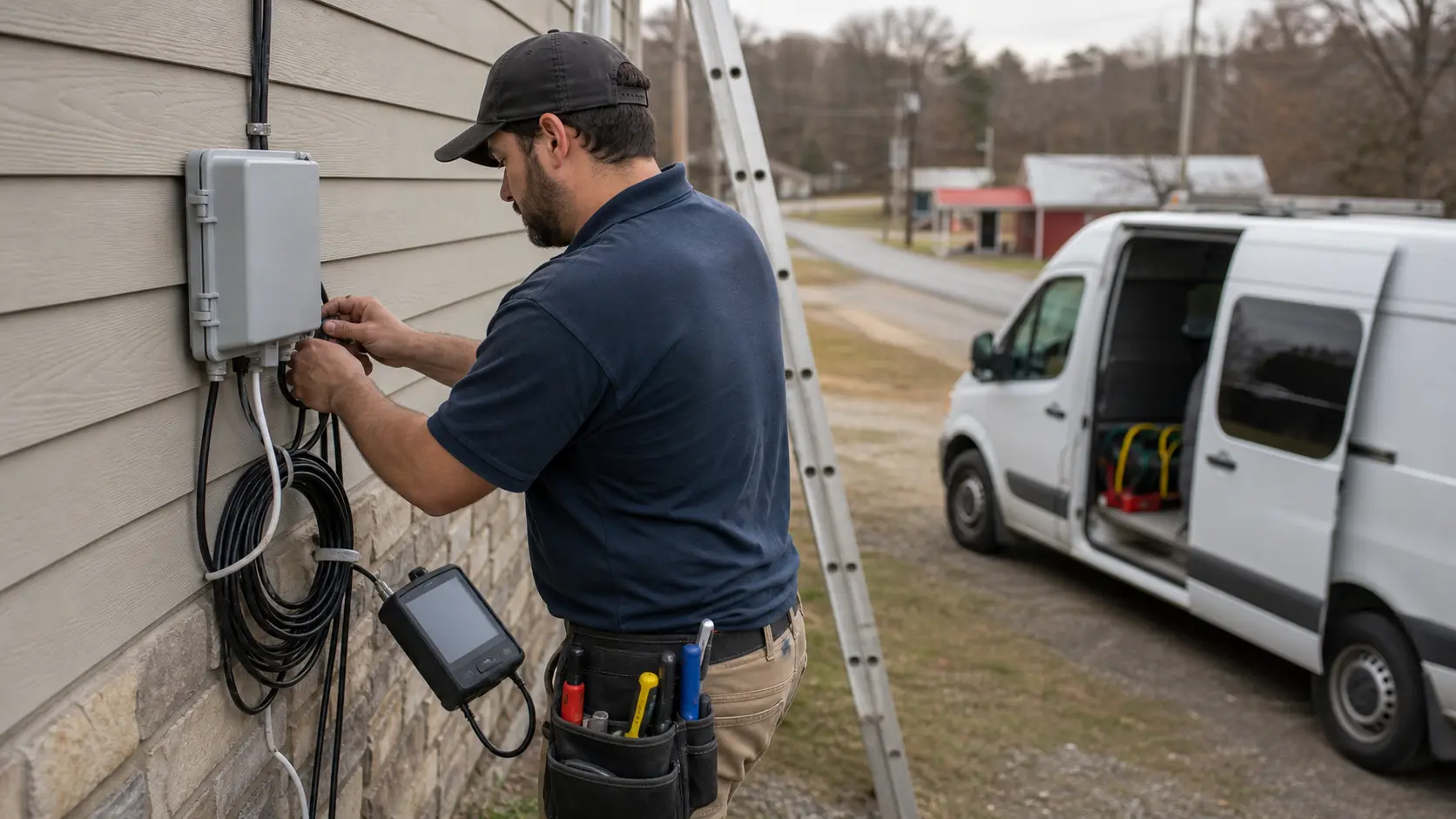
A Trenton customer does not discover the economics of a local cable or broadband account while reading a speed claim. The test arrives when a line has to be installed, moved, repaired or kept working after a bad week. A household sees a drop cable, a modem, a router, a bill, a customer-service number and a promise that video calls, school work, streaming, farm-office paperwork and card terminals will keep working. A small business sees a work order, a technician window, the risk of lost trading time and the possibility that switching will require another visit, another router, another credit check and another period of uncertainty.
That is where Trenton TV Cable Company's margin, if it exists, has to be earned.
The company name sounds like old cable television, but the economic question is modern broadband. Cable operators and regional access providers have moved from television carriage toward broadband, voice and local connectivity because the recurring household relationship is more valuable when the same physical connection carries internet traffic. For a small access operator, the visible product may be a monthly broadband plan.
The commercial product is the account after installation: a local path into the customer's premises, a record of how it was connected, a support habit, and an expectation that someone will answer when the service fails.
By the third paragraph, the test should be explicit. The paid unit is the local access and field-support account. The cheaper substitute is a national operator, mobile broadband, satellite, another local ISP, an in-house private link for a business, or delayed installation. The cost driver is field labour tied to sparse local premises, customer equipment, make-ready and repair visits, plus upstream transport that a small operator must buy or reach through others. The strongest evidence class for Trenton TV Cable Company itself is the public registry record from ARIN, especially the TTC-75 entity page: https://rdap.arin.net/registry/entity/TTC-75. The three missing proof categories are economics, reliability and retention: no public customer count, margin, utilisation, truck-roll cost, outage history, repair time, renewal rate or churn reason can be verified from that record.
That proof gap is not a decorative warning. It is the centre of the business assessment. If Trenton TV Cable Company has a small, loyal base of accounts that require few repeat visits after the initial connection, the company can defend margin even in a market full of national brands. If every account needs costly field attention, if upstream quality is poor, or if customers leave after the first outage because a cheaper substitute is good enough, the same account becomes fragile. The public record can tell us where to look. It cannot settle the customer economics.
Identity is anchored, not explained
The cleanest public identity record is not a homepage, rate card or service-status page. It is ARIN's registry entry. ARIN's entity search returns Trenton TV Cable Company as organisation handle TTC-75, with registration on May 22, 2007 and a last-changed date on August 24, 2022: https://rdap.arin.net/registry/entities?fn=Trenton%20TV%20Cable%20Company. The detailed entity page gives the organisation name and an address at P.O. Box 345 and 2034 Highway 45 Bypass South, Trenton, Tennessee 38382: https://rdap.arin.net/registry/entity/TTC-75.
That matters because ARIN is the regional registry for internet number resources in the United States, Canada and parts of the Caribbean. A registry record does not prove current retail service, subscriber scale, route origination, customer quality or profitability. It does, however, show that the company name is not merely a marketing label. It is an accountable organisation in the internet-number record, with a dated registry footprint and a local Tennessee address.
The same record also shows the limits of the evidence. The detailed entity page lists a point of contact with administrative, technical and abuse roles, but the public page does not provide a retail plan, a service map, an autonomous-system number, routed prefixes, transit providers, peering links or a current customer base. ARIN even maintains a public route for reporting registry inaccuracies, which is a useful reminder that registry data should be treated as accountable but not exhaustive: https://www.arin.net/resources/registry/whois/inaccuracy_reporting/.
The address places the analysis in Trenton, Tennessee rather than in a generic national broadband market. Trenton is a small city and the county seat of Gibson County. Census profile pages identify Trenton city, Tennessee as a small local market, while Gibson County is a broader rural county context: https://data.census.gov/profile/Trenton_city,_Tennessee?g=160XX00US4775000 and https://data.census.gov/profile/Gibson_County,_Tennessee?g=050XX00US47053. Small markets change broadband economics because each connection can require more attention relative to the revenue it produces. The fixed cost of the visit, the drop, the router, the billing account and the support memory does not shrink just because the town is small.
The identity evidence therefore supports a disciplined conclusion. Trenton TV Cable Company is visible as a Trenton, Tennessee network-related organisation in ARIN records. The public evidence does not justify treating it as a scaled, fully mapped, independently routed broadband network. The article's economic judgement must be built around that distinction.
What the customer actually buys
The customer buys a working local access path. That phrase sounds abstract, but it becomes concrete at the premises. A technician or contractor must reach the address, determine how the building will be connected, work with existing coaxial or fibre facilities if they exist, install or activate customer equipment, test signal quality, answer questions about Wi-Fi coverage, and leave behind a service that a non-specialist can use. For a small business, the task can include card terminals, point-of-sale systems, voice service, security cameras or a local office network.
For a household, it includes streaming, school assignments, remote work and the daily tolerance of small failures.
That unit is costly because the first sale is rarely just a digital transaction. Field labour is not infinitely scalable. The Bureau of Labor Statistics occupational profile for telecommunications equipment installers and repairers describes work that includes setting up and maintaining communications equipment, installing lines and repairing equipment: https://www.bls.gov/ooh/installation-maintenance-and-repair/telecommunications-equipment-installers-and-repairers.htm. The public labour category is national and broad; it is not a Trenton TV Cable payroll record. But it captures the basic cost form: people, vehicles, tools, training, scheduling and repeat visits.
The same account can be profitable or unprofitable depending on how often the labour comes back. A clean installation followed by years of monthly payment can be attractive. A problematic drop, a weak in-home router, water intrusion, tree damage, intermittent upstream congestion or repeated customer-premises trouble can consume the margin. That is why installation is only the start of the commercial mechanism. The account becomes valuable when the local provider can prevent the second and third costly visit, or when the customer values the provider enough to keep paying despite a cheaper advertised alternative.
The public record cannot show whether Trenton TV Cable Company has this discipline. There is no public installation cohort, service-ticket data or cost-to-serve table. The right conclusion is conditional: the company matters if it turns local installation into retained accounts, and it is vulnerable if local support consumes the monthly recurring revenue.
The local market is small enough for support to matter
Local access economics are different in a town like Trenton than in a dense urban apartment corridor. A cable or fibre operator with many customers in a building can spread field visits and network upgrades across a dense revenue base. A rural or small-city operator may drive farther, touch more individual structures and face lower customer density per mile of plant. Even when the technology is capable, the commercial problem is how much labour and outside-plant cost each paying account can absorb.
The Census profile for Trenton city is useful because it frames the addressable market as a small local community rather than a metropolitan mass market: https://data.census.gov/profile/Trenton_city,_Tennessee?g=160XX00US4775000. Gibson County widens the picture but remains a lower-density county context, not a city-scale customer field: https://data.census.gov/profile/Gibson_County,_Tennessee?g=050XX00US47053. A regional access provider in this kind of setting cannot rely only on national advertising. It must decide which streets, premises and customer types are worth serving.
That local choice is why the paid unit should not be reduced to megabits per second. A customer comparing providers may start with speed, price and data allowance, but the difference after installation is practical. Who can come out if the line is down? How long does a repair take after a storm? Does the call centre understand the neighbourhood, the road name, the old drop route or the building's wiring? Does the provider know which upstream path is weak at busy hours? These details can be more valuable in a small market than another headline speed tier.
The public source base cannot tell us whether Trenton TV Cable Company performs well on those questions. It can only tell us that the company sits in a market where those questions are commercially important. The smaller and less dense the account field, the more each installation has to be defended by reliability and retention.
Cheaper substitutes set the price ceiling
The local provider's price cannot be judged by its own cost alone. It is constrained by the substitute set. A household can compare a local wired provider with national wireline service, a mobile fixed-wireless offer, satellite broadband, another nearby provider, or the choice to delay a paid installation. A business can compare the local service with a national carrier, a dedicated line, a mobile backup, or a do-it-yourself arrangement that keeps a weak legacy connection alive until a better option appears.
National offers create a price umbrella even when availability varies by address. AT&T markets fixed internet nationally at https://www.att.com/internet/, Spectrum markets cable internet at https://www.spectrum.com/internet, T-Mobile markets home internet at https://www.t-mobile.com/home-internet, Verizon markets 5G home internet at https://www.verizon.com/home/internet/5g/, and Starlink publishes a satellite availability map at https://www.starlink.com/map. These pages do not prove service at the Trenton TV Cable address or at any particular Gibson County home. They show the substitute categories a customer knows exist.
The FCC National Broadband Map is the official public place to check address-level availability claims: https://broadbandmap.fcc.gov/home. The FCC also makes broadband data available for download and review: https://broadbandmap.fcc.gov/data-download. Those sources are crucial for public policy and competition analysis, but they are not a service-quality ledger. Availability does not equal a clean installation, a fair bill, a stable evening connection or a fast repair after a storm.
The Federal Communications Commission's broadband consumer label rules are important for the same reason: they push providers to disclose recurring price, fees, speeds, data allowances and other plan terms in a more comparable format: https://www.fcc.gov/broadbandlabels. For a small local provider, labels make the upfront price comparison harsher. They also leave room for a local advantage if the provider's repair behaviour and customer familiarity reduce the true cost of service over time.
That is the commercial bind. A local access provider can charge only so much above a visible substitute. But if the substitute is slow to install, unreliable at the address, constrained by signal, expensive after promotions, or distant in support, the local provider can defend the account. The proof would be churn: how many customers leave after seeing the substitute, and how many return after trying it.
Installation is the margin test
The first installation is a capital decision disguised as customer acquisition. A provider may need to roll a vehicle, use trained labour, touch poles or conduit, attach or replace a drop, supply equipment, provision an account, and handle a service call if the customer cannot make the in-home network work. The customer's first payment may not cover that cost. The provider wins only if the account stays long enough and requires little enough repeat labour.
This is why local access providers care about density and standardisation. A known street, a known drop route, a known modem class and a known upstream path reduce uncertainty. A difficult premises does the opposite. The technician may spend time diagnosing old wiring, tree exposure, grounding issues, customer-owned routers or signal leakage. None of that is visible in a public registry record, but it can decide whether the account is worth keeping.
Pole access can be a material part of the cost structure. The FCC's pole-attachment materials explain the federal framework that shapes how communications providers attach facilities to utility poles where the FCC has jurisdiction: https://www.fcc.gov/general/pole-attachments. The article should not infer that Trenton TV Cable Company has any specific pole dispute or attachment agreement. The broader point is that physical access is not free. Make-ready, attachment rights, safety rules, replacement timing and coordination can turn a simple customer request into a delayed and expensive job.
Customer equipment is another margin variable. A local provider may be judged for Wi-Fi problems that are not purely the access link. The customer does not separate the drop, the modem, the router, the extender and the laptop. If the video call freezes, the provider gets the call. That support burden can be a retention asset if the provider solves it quickly. It can be a margin drain if every weak in-home network becomes an unpaid help-desk session.
Public evidence cannot show Trenton TV Cable Company's installation cost or repeat-visit rate. The private number that would change the judgement is simple: average installed cost divided by retained gross profit per account, adjusted for repeat repair visits. If that payback period is short, the local account can work. If it is long and churn is high, the business model is exposed.
Upstream dependence is hidden from most customers
The customer sees the local provider. The internet path may depend on upstream transit, backhaul, content delivery relationships, regional transport, power, DNS behaviour and the provider's own network management. Small access providers often cannot bargain like national carriers. They may buy transport or transit from larger networks, use regional facilities, and rely on routes that are invisible to the household bill.
The Trenton TV Cable Company ARIN record does not identify a public autonomous system or a list of routed prefixes on the entity page: https://rdap.arin.net/registry/entity/TTC-75. That absence should not be overread. A company can operate services through leased resources, upstream arrangements or legacy configurations without a large public routing footprint. But it means network-resource evidence cannot carry the business conclusion. The registry record is an accountability anchor, not proof of traffic scale or interconnection quality.
Upstream dependence becomes a customer problem when congestion, routing instability or supplier failure reaches the access account. If a small local provider cannot obtain adequate upstream capacity, evening performance suffers and customers compare the service with mobile, satellite or national wireline alternatives. If the provider buys well, caches common traffic effectively, manages capacity and responds to outages, the customer may never think about upstream dependence at all.
The FCC's Measuring Broadband America program illustrates the kind of evidence needed to move from availability to performance: https://www.fcc.gov/general/measuring-broadband-america. Public performance testing is not the same as a provider's private network telemetry, but it shows why performance proof requires measured experience, not only map claims. For Trenton TV Cable Company, the missing reliability proof would be measured latency, packet loss, throughput at busy hours, outage frequency and repair time, preferably tied to the served premises rather than to a generic technology class.
The upstream question also affects supplier bargaining. A small operator that depends on one transport route or one upstream provider has less room to recover from price increases or service interruptions. A provider with redundant paths and good supplier terms can turn upstream discipline into a quiet strength. The public record does not reveal which case applies here.
Local support is the retention asset
Local support is not merely a courtesy. It is a financial asset if it keeps customers from switching after something breaks. Many customers tolerate a slightly higher bill when the provider solves a local problem quickly. They defect when the provider combines ordinary price pressure with poor repair experience.
The support asset has three parts. First, the provider remembers the installation: where the drop enters, what equipment was used, what the customer was told, and which local conditions matter. Second, the provider has field access: someone can visit, test and repair. Third, the provider has local judgement: it knows whether the problem is an individual premises issue, a neighbourhood outage, an upstream event or a customer-owned equipment problem.
This knowledge is most valuable when substitutes are cheaper but less personal. A mobile fixed-wireless plan may be easy to order but may depend on signal quality and tower load. Satellite may reach difficult locations but carries its own equipment, weather, latency and plan-cost considerations. A national operator may have scale and capital but a less local support feel. Another local ISP may compete on service. Delaying installation saves money now but leaves the customer exposed to whatever service is already failing.
The public evidence cannot show whether Trenton TV Cable Company has good support. It does not publish a status history, mean time to repair, repair appointment completion rate, call-answer time or complaint ratio in the sources reviewed. That gap is decisive. The company's value depends on whether local support is a retention asset or a cost centre.
The future proof would be customer-cohort behaviour after adverse events. How many customers stay after the first outage? How many stay after a price increase? How many accept a repair instead of ordering fixed wireless or satellite? How many businesses buy backup instead of replacing the local provider? These retention facts would show whether the support relationship has economic power.
Pricing logic is recurring revenue minus trouble
A local access provider's revenue logic has a simple shape. It may collect installation fees, monthly service fees, equipment rental or service charges, and possibly voice or television revenue if those services remain active. The profit is not the bill. It is the bill after content cost, transport cost, equipment cost, pole or plant cost, billing cost, customer-service cost, bad debt, credit-card fees, truck rolls and churn.
Broadband consumer labels make the retail comparison more visible: https://www.fcc.gov/broadbandlabels. They are designed for plan comparison, not for provider valuation. A customer can see the monthly charge, fees and speed terms more clearly. The provider still has to manage the hidden cost of getting that service to work at a real address.
The FCC broadband speed guide gives consumers a plain-language way to think about activities and speed needs: https://www.fcc.gov/consumers/guides/broadband-speed-guide. That kind of guidance changes the sales conversation. A local provider cannot rely only on saying "fast internet" if customers can compare speed tiers and use cases. It must make the purchased account feel reliable enough for the customer's actual workload.
Affordability also affects retention. The federal Affordable Connectivity Program ended after funding ran out, and the FCC maintains consumer information about that program at https://www.fcc.gov/acp. A small provider serving price-sensitive households may see churn pressure when subsidies disappear, promotions expire or household budgets tighten. The public record does not show how many Trenton TV Cable Company customers, if any, used affordability support. The mechanism is still important: the same monthly bill is safer when customers can pay it without sacrificing other essentials.
The missing economics proof is therefore not just revenue. It is account-level contribution. What is the average monthly revenue? How much of it is broadband rather than television? What is the gross margin after upstream and support costs? How often does installation cost get recovered? What percentage of customers are late, suspended or disconnected? Those facts would change the assessment more than another generic statement that broadband is important.
Reliability has to be proven in use
Reliability is not a slogan for a local access provider. It is the condition that keeps the account from reopening the purchase decision. A customer may compare providers only every few years if service is quiet. A customer compares providers immediately after repeated failures, long holds, missed appointments or vague outage explanations.
Public availability data cannot prove reliability. The FCC Broadband Data Collection and National Broadband Map help show where providers say service is available and where challenges may arise, with the public entry point at https://www.fcc.gov/BroadbandData. That is essential evidence for policy and competition, but it does not show the evening congestion on one node, the condition of one drop, the speed of one repair crew or the customer experience after a storm.
The reliability proof for Trenton TV Cable Company would be operational. It would include outage minutes per account, repeat trouble-call rate, average time to repair, installation completion on first visit, upstream failover, power backup for key network points, weather-related failure history and customer credits. None of those are in the public ARIN record. The article should not invent them.
This proof gap has two sides. It prevents overclaiming quality. It also prevents dismissing the company. Small local providers can sometimes outperform large brands in repair familiarity precisely because they know the plant, the roads and the customers. They can also underperform if they lack capital, redundancy or staff depth. Without reliability data, the serious judgement is that reliability is the swing variable.
In commercial terms, reliability becomes retention when it reduces decision frequency. The customer who never has to think about the connection is less likely to shop. The customer who has to call three times in one month becomes a price shopper, even if the listed monthly charge is competitive.
Regulation and public funding change the competitive field
Broadband access is not only a retail market. It is shaped by public mapping, subsidy programs, state grants, pole rules, consumer disclosure and competition policy. Those rules can help a local provider, challenge it, or change the customer alternatives around it.
The federal BEAD program is the largest current policy backdrop. NTIA describes the Broadband Equity, Access, and Deployment program as a federal program to expand high-speed internet access: https://www.ntia.gov/program/broadband-equity-access-and-deployment-bead-program. BEAD can bring capital into underserved areas, but it can also create new funded competition if another provider wins support in or near a local provider's territory.
Tennessee's broadband office is the state-level counterpart for broadband expansion work: https://www.tn.gov/ecd/rural-development/broadband-office.html. Tennessee's broadband policy context matters for a Trenton-area access provider because grants, maps and local build decisions can alter the value of legacy plant. A provider that already has customers must decide whether to upgrade, defend, partner or retreat when subsidised fibre, fixed wireless or other alternatives improve nearby.
Regulation can also impose costs. Consumer labels require clearer plan disclosure. Pole-attachment rules govern how providers use physical infrastructure. Mapping challenges can contest coverage claims. Privacy, network management and billing rules all require administrative capacity. A national operator spreads compliance over millions of customers. A small provider spreads it over far fewer accounts.
The public evidence does not show Trenton TV Cable Company's grant participation, compliance burden or regulatory disputes. The right point is structural: state and federal broadband policy can change the substitute set and therefore the retention economics. A local provider has to earn margin in a market where public funding may improve competing options.
Network-resource evidence is bounded
Network-resource evidence is useful because it is concrete. A registry handle, address, contact role, autonomous-system number or prefix can show that a company appears in internet infrastructure records. But these records are not a business plan. They do not show customers, revenue, service quality or growth.
For Trenton TV Cable Company, the public ARIN evidence is an entity record, not a full routing dossier: https://rdap.arin.net/registry/entity/TTC-75. That record supports the company identity and local address. It does not show that the company originates specific routes today, operates a large broadband network, maintains a certain number of subscribers or controls a particular upstream relationship.
This is important because small network names can be misleading in both directions. A company with a small public routing footprint may still have meaningful local access accounts through upstream arrangements or historical plant. A company with visible resources may have little current retail revenue. The economic article should use network resources as evidence only, not as entities or conclusions.
The ARIN record is therefore best understood as a floor. It proves a public accountability anchor. Above that floor, the analysis must rely on local access economics, substitute pricing and missing proof categories. The decisive facts are private operating facts, not the mere presence or absence of a route table.
Market signals are weak and should stay weak
Unofficial market signals can be useful when they show repeated customer complaints, plan availability, installation delays, outage chatter or local switching behaviour. They are dangerous when a thin set of search results is treated as fact. In this case, the reviewed public surface is sparse. There is no robust company-specific review corpus, status history or active retail page in the public materials used here.
That absence is itself a signal, but not proof of failure. A small local cable company may rely on phone sales, existing accounts, local reputation or legacy relationships rather than a polished national web presence. It may also have limited current activity. The public record does not decide which interpretation is correct.
The substitute signals are stronger because national and satellite providers market broadly. AT&T, Spectrum, T-Mobile, Verizon and Starlink all provide public pages that customers recognise as alternatives, though address-level availability must be checked separately: https://www.att.com/internet/, https://www.spectrum.com/internet, https://www.t-mobile.com/home-internet, https://www.verizon.com/home/internet/5g/, and https://www.starlink.com/map. These signals shape customer expectations even when they do not prove competition at one premises.
The article therefore uses informal signals only to price risk. A local provider faces customers who know substitutes exist. It does not assert that any particular substitute is available, cheaper or better at a given Trenton address without an address-level availability check and live plan terms.
Customer dependence cuts both ways
Customer dependence is often described as a weakness: a household depends on one wire, one repair crew and one bill. But dependence can be mutual. The provider depends on each retained customer to recover installation cost. In a small market, every lost account matters more because the provider cannot always replace it with cheap digital acquisition.
This mutual dependence creates a service bargain. The customer accepts a local provider if the provider reduces hassle. The provider earns margin if the customer stays after the installed cost is recovered. The bargain breaks when the customer sees the provider as merely another bill with slow support and no reliability advantage.
For households, the retention trigger may be a work-from-home failure, schoolwork disruption, streaming frustration or an unexpected bill. For businesses, it may be payment downtime, voice failure, camera outage, poor guest Wi-Fi or inability to process orders. In both cases, the substitute is evaluated after the pain, not in a clean spreadsheet.
The company-specific public record does not show customer mix. That is a major gap. A provider dominated by households has different churn and support patterns from one with local businesses, municipal accounts or institutional customers. Business accounts may pay more and need faster repair, but they also punish failure more severely. Household accounts may be numerous but price sensitive. Without mix data, the article can identify the mechanism but not the margin.
Upgrades are a capital-allocation problem
Legacy cable access can remain commercially useful, but broadband demand rises over time. Customers compare video calls, cloud backups, gaming, streaming, security cameras and remote work against whatever speed and latency they experience. A provider with older plant has to choose whether to upgrade electronics, extend fibre, improve Wi-Fi equipment, buy more upstream capacity, or accept churn.
CableLabs describes DOCSIS 4.0 as a cable broadband technology path for higher capacity over hybrid fibre-coax networks: https://www.cablelabs.com/technologies/docsis-4-0-technology. That source is technology context, not evidence that Trenton TV Cable Company has deployed DOCSIS 4.0. It shows the broader strategic choice for cable-derived access providers: upgrade the existing cable plant where density and capital allow, or face substitutes that market fibre, fixed wireless or satellite as easier paths.
The capital decision is local. In dense markets, upgrading a node can defend many accounts. In sparse markets, the payback may be harder. If customers are willing to stay for good support and adequate speed, the provider may not need the most advanced technology immediately. If customers begin leaving for faster alternatives, deferred investment can accelerate churn.
The private facts that would change the judgement are plant age, node utilisation, downstream and upstream capacity, planned capex, equipment vendor dependence, and the number of accounts served per mile. Public registry evidence does not provide those facts.
The economics proof gap
The first missing category is economics. The public record does not show revenue, ARPU, gross margin, install cost, repair cost, content cost, transport cost, customer count or capital expenditure. Without those numbers, no one can say whether Trenton TV Cable Company has attractive margins.
The economics question is account-level, not company-name-level. A local access provider can look weak from the outside and still be profitable if it has a compact, loyal customer base with low support demand. It can look credible from a registry record and still lose money if each customer requires expensive field work and leaves quickly. The right private measure is contribution margin by cohort after installation.
The second number is truck-roll intensity. If the provider has to revisit a high share of accounts, labour cost eats the recurring bill. If most accounts stay quiet, the same bill becomes attractive. A local provider's operating excellence is often hidden because the best support call is the one that never happens.
The third number is upstream cost per delivered experience. Customers do not care whether poor performance comes from local plant or upstream congestion. The provider pays for enough capacity and quality to keep customers from defecting. The public record does not show that cost.
Until those economics are visible, the fair conclusion is conditional. Trenton TV Cable Company earns margin after installation only if retained monthly revenue exceeds the full cost of field support, plant upkeep, equipment, upstream service and churn replacement.
The reliability proof gap
The second missing category is reliability. A provider can survive a price comparison if it is trusted. It cannot survive repeated failures without becoming a switching target. Reliability evidence would include outages, repair times, repeat calls, busy-hour performance, equipment replacement rates, storm recovery and credits.
Public broadband evidence is usually not enough. The National Broadband Map helps customers and policymakers understand availability claims: https://broadbandmap.fcc.gov/home. The FCC's performance-measurement work shows that actual service quality needs measurement rather than assumption: https://www.fcc.gov/general/measuring-broadband-america. Neither source supplies Trenton TV Cable Company-specific outage history.
The reliability proof gap is commercially important because it decides whether local support is an asset or merely a promise. A customer may forgive one storm outage if repair communication is good. A customer may leave after repeated unexplained slowdowns. The provider's public identity does not tell us which experience dominates.
The facts that would change the judgement are specific: percentage of accounts affected by outages each month, median and 95th-percentile repair time, repeat trouble-call rate within 30 days, busy-hour throughput, packet loss and customer credits. Those facts would move the article from mechanism to verdict.
The retention proof gap
The third missing category is retention. The local access account becomes valuable only if customers stay after the provider has recovered installation cost. Retention is not the same as satisfaction. Some customers stay because switching is hard. Others stay because support is good. Others leave as soon as a national, mobile or satellite substitute becomes credible.
The clean retention proof would be cohort churn after installation, churn after outage, churn after price increase and win-back after switching. It would also show why customers leave. A price-driven cancellation is different from a reliability-driven cancellation. A move-out is different from a competitor win. A business adding backup is different from a business replacing the provider.
The public record does not contain those facts. No registry page, Census profile or national policy source can supply them. That absence does not make the company irrelevant. It means the investment and market judgement should remain provisional.
Retention is the final test because it combines all other mechanisms. Installation quality, support memory, upstream discipline, price transparency, local market density and substitute pressure all appear in churn. If churn is low after failures and renewals, the local provider has a defensible account. If churn is high, the account is not strong enough to carry the field cost.
Why the company still belongs on the map
Trenton TV Cable Company belongs in infrastructure analysis precisely because its public record is narrow. Small access providers are often most important where the public data is least satisfying. They may serve local customers through legacy plant, local relationships and practical field knowledge rather than through a national brand surface. They can also be fragile, opaque and exposed to funded competition.
The ARIN record gives enough evidence to anchor the company name, address and registry accountability: https://rdap.arin.net/registry/entity/TTC-75. The Census profiles show a small local market context. FCC and NTIA sources show a regulatory and competitive environment where mapping, labels, subsidies, pole access and performance measurement matter. National provider pages show that customers understand substitute categories even when local availability remains address-specific.
That evidence supports a commercial thesis, not a final margin claim. The thesis is that Trenton TV Cable Company's value is created after installation, when field labour either becomes a sunk cost recovered by monthly retention or a recurring burden that competitors can exploit. The company earns its place in the market if customers regard the local account as the least troublesome way to stay connected.
The judgement would change with three disclosures. First, economics: customer count, ARPU, gross margin, install payback and support cost. Second, reliability: outage and repair performance tied to served premises. Third, retention: churn and renewal behaviour after failures, price changes and substitute offers. Without those facts, the honest conclusion is that Trenton TV Cable Company is a credible local-access subject with a clear commercial mechanism and a large proof gap.
Competition is a repair comparison
Broadband competition is usually described as a price and speed table. That is necessary but incomplete. The customer who already has a working line is not comparing abstract offers; the customer is comparing the expected pain of staying with the expected pain of moving. A cheaper plan can lose if it requires a missed workday, a new device, uncertain indoor coverage or a support path that feels remote. A more expensive local plan can lose if the customer already had to wait for repair or explain the same problem more than once.
This is why installation and repair are not back-office topics. They are the product. If a local provider has a well-run field operation, it can turn each visit into a switching barrier. The technician learns the premises, the provider records the configuration, the customer knows whom to call, and the next problem begins with context rather than from zero. If the field operation is weak, each visit trains the customer to shop.
The substitute categories carry different repair promises. A national wired operator may have more capital, broader upgrade programs and clearer online ordering, but the customer may fear appointment complexity or distant support. A mobile fixed-wireless provider may reduce installation friction but can depend on indoor signal, tower load and equipment placement. Satellite can reach difficult locations but introduces dish placement, weather exposure, latency and equipment considerations. Another local provider may compete on familiarity. Delaying installation avoids a bill but leaves the old problem unsolved.
The public evidence cannot rank those options at a Trenton address. That is the point. The customer's actual decision is local, practical and time sensitive. A broadband map may show availability. A retail page may show a plan. Neither shows whether the customer can get a clean installation this week or a competent repair after a storm. For a small access provider, the commercial opportunity is to win that practical comparison even when a national brand wins the brand comparison.
Competition also changes after the first bad experience. Before an outage, switching costs can feel high: a new order, a new appointment, possible equipment returns, a new Wi-Fi name, a new bill and uncertainty about whether the new service is better. After repeated outages, those same switching costs may feel smaller than staying. The provider's best defence is to prevent customers from reaching that emotional threshold.
That threshold is measurable, but only privately. A serious operator would know the churn rate after a trouble ticket, the churn rate after a missed repair, the churn rate after an outage credit, the retention effect of proactive communication and the number of accounts saved by a successful second visit. Those figures would show whether field work is building loyalty or merely postponing cancellation.
Business accounts make downtime visible
The household broadband account is important, but a small business account can expose the economics more sharply. A local store, medical office, farm office, repair shop, church, school-adjacent service or professional practice may rely on broadband for payment processing, scheduling, cloud software, voice service, security cameras and customer communication. When that connection fails, the cost is not only inconvenience. It can become lost sales, staff idle time, delayed billing, missed calls and reputational damage.
For such customers, the local access provider sells confidence that someone can diagnose the problem quickly. The business may not care which part of the chain failed. It wants to know whether card processing will work, whether phones will recover, whether the point-of-sale terminal can reach its service, whether cameras are recording and whether staff can keep working. A local provider that can distinguish an in-building equipment problem from a network issue creates value by shortening uncertainty.
Business accounts can improve the margin profile if they pay more, stay longer and value repair response. They can also increase operational pressure because the cost of failure is visible and urgent. A missed household streaming session may create frustration. A failed card terminal during business hours may create a cancellation threat. The provider must price that difference either through a business tier, service expectations, backup options or a clear limit on what the standard account includes.
The public record does not disclose whether Trenton TV Cable Company serves business accounts, how many it serves, or whether it offers differentiated service levels. The article therefore cannot treat business revenue as proven. It can identify why the business segment would matter. If Trenton TV Cable Company has a meaningful base of local businesses, the reliability and support proof gap becomes more valuable and more severe. If the customer base is mostly residential, churn and affordability may dominate instead.
The private diligence question is whether the provider knows which accounts are mission critical. A business with payment terminals, hosted phones or security systems has a different risk profile from a casual household. If the provider treats them the same, it may underprice risk or disappoint customers. If it separates them intelligently, it may create higher-value accounts that justify field labour and upstream discipline.
Upstream discipline is a small-provider bargaining problem
Small access operators rarely control the entire chain from customer premises to every major internet destination. They have to buy, lease, exchange or otherwise reach upstream connectivity. The customer's bill hides this bargaining problem. The customer sees whether the connection works. The provider sees transport cost, capacity planning, supplier responsiveness and the risk of relying on too few paths.
This matters for margin because upstream quality can force downstream cost. If upstream capacity is tight at busy hours, support calls rise even if the local drop is fine. If a supplier has an outage, the local provider absorbs the customer anger. If transport prices rise, the provider must either accept lower margin, raise prices or delay upgrades. If a small provider lacks redundancy, one supplier issue can become a local customer crisis.
The ARIN record does not show Trenton TV Cable Company's upstream suppliers, routing policy or redundancy: https://rdap.arin.net/registry/entity/TTC-75. That absence requires discipline in the analysis. It would be wrong to claim weakness. It would also be wrong to assume independence. The correct statement is that upstream dependence is one of the private facts that would decide whether the installed account is resilient.
The most useful proof would include upstream contracts, capacity headroom, peak utilisation, failover design and incident history. A local provider with modest customer count but ample upstream capacity can offer a better experience than its size suggests. A provider with a respectable local brand but constrained upstream capacity can lose trust quickly. In both cases, the public customer usually diagnoses the result as "my internet is good" or "my internet is bad," not as a transport or interconnection issue.
That is why peering and transit are relevant even when no public routing record is visible. They describe the hidden supplier layer underneath the field-support account. Installation gets the customer connected. Upstream discipline keeps the account from becoming a performance complaint.
Churn is the final accounting entry
Every cost in the local access account eventually meets churn. Installation cost meets churn because the provider needs time to recover the first visit. Support cost meets churn because repeated repair can either save an account or fail to save it. Upstream cost meets churn because customers leave when performance feels worse than the bill. Pricing meets churn because a customer who sees a cheaper substitute must decide whether switching risk is worth the savings.
Churn also reveals whether customer dependence is healthy or resentful. A customer may stay because the provider is genuinely reliable. A customer may stay because alternatives are poor. Those two forms of retention look similar until a new substitute enters the market. When fibre, fixed wireless or satellite improves, reluctant retention can disappear quickly. Loyal retention is more durable because it is based on proven service rather than lack of choice.
For Trenton TV Cable Company, the public evidence cannot show which retention type exists. The company may have legacy cable relationships that still matter. It may have customers who remain because local support is good. It may have customers who would leave if a better substitute arrived. It may have a small but stable account base that does not show up clearly in public web evidence. Each possibility is plausible; none is proven.
The best diligence would separate churn by cause. Move-outs, nonpayment, competitor wins, reliability cancellations, price cancellations and service-area losses should not be mixed together. A high move-out rate in a small town has a different implication from a high reliability-cancellation rate. A price cancellation after subsidy loss has a different implication from a cancellation after repeated outages. The provider's strategic answer depends on the cause.
If churn is low and support cost is controlled, the small local account can be a durable cash-flow unit. If churn is high and installation cost is meaningful, growth can destroy value because every new customer begins with a loss that may not be recovered. That is why the article returns to the same point: Trenton TV Cable earns margin only after installation, and only if the customer stays long enough for the field work to pay back.
What a renewal buyer would ask
A household renewal decision may be informal, but the questions are still rigorous. What am I paying after fees? What happens when the introductory offer ends? How often has the service failed? How long did repair take? Did the provider explain outages clearly? Would a mobile or satellite substitute be good enough? Would a national wired operator install faster or slower? Is the current provider worth keeping because it already knows the premises?
A business buyer would ask the same questions with sharper consequences. What is the cost of one hour offline? Does the provider offer a business contact path? Is there a backup option? What equipment is under the provider's responsibility and what belongs to the customer? What service expectation is written down? How quickly can a technician reach the site? Is the upstream path diverse enough for the business need? What would migration cost?
Those questions define the support account. They also define the article's proof standard. Public sources can show registry identity, local context, policy rules, substitute categories and technology direction. They cannot answer the renewal questions for a specific customer. A serious conclusion must therefore avoid the easy extremes. Trenton TV Cable Company should not be treated as proven strong because it appears in ARIN. It should not be treated as weak because it lacks a large public web footprint.
The commercially relevant stance is conditional diligence. If the company can show fast installation, low repeat trouble, adequate upstream headroom, clear pricing and low churn after service incidents, the local account has value. If it cannot, cheaper substitutes will keep tightening the price ceiling.
Final assessment
Trenton TV Cable Company should not be valued by the romance of local cable or dismissed because its public record is thin. The correct unit is the installed local access account. The correct substitute is whatever lets the customer avoid or replace that account: national wireline, fixed wireless, satellite, another local provider, private business connectivity or delay. The correct cost driver is the physical and human work of making a small-market connection reliable enough to renew.
The public evidence proves identity and context. It does not prove margin. ARIN shows the organisation. Census data shows the local market scale. FCC, NTIA, Tennessee and labour sources show why broadband availability, price transparency, physical access, field work and public funding shape competition. Substitute-provider pages show the pressure customers can see. None of these sources reveals Trenton TV Cable Company's private economics, reliability or retention.
That is why the article's title is conditional in the right way. Trenton TV Cable earns margin after installation only if installation becomes a retained relationship rather than an opening loss. The company matters because that is the basic commercial problem of small local broadband: the customer thinks they are buying internet, but the provider is really selling the ability to make a physical connection uneventful month after month.