
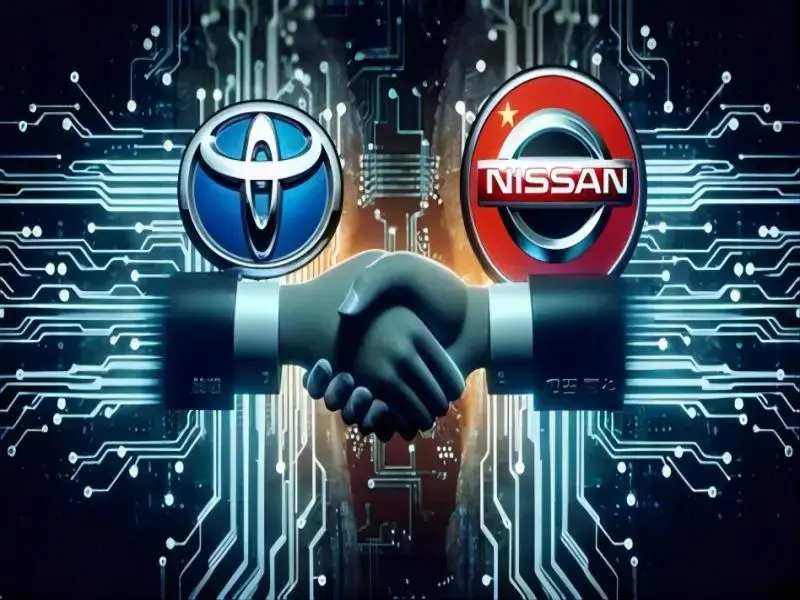
Toyota, Nissan pair up with Tencent, Baidu to remain competitive is profiled by BTW Media because published evidence links it to internet infrastructure, governance, operational dependencies, or market visibility.
Toyota, Nissan pair up with Tencent, Baidu to remain competitive is tracked as a internet infrastructure institution within the internet infrastructure ecosystem.
Toyota, Nissan pair up with Tencent, Baidu to remain competitive has public-source relevance to network operations, governance, dependency mapping, or market structure.
Toyota, Nissan pair up with Tencent, Baidu to remain competitive is tracked as a internet infrastructure institution within the internet infrastructure ecosystem.
Public-source signals support medium-impact monitoring for infrastructure visibility and dependency analysis.
Toyota, Nissan pair up with Tencent, Baidu to remain competitive is profiled by BTW Media because published evidence links it to internet infrastructure, governance, operational dependencies, or market visibility.
Public-source signals support medium-impact monitoring for infrastructure visibility and dependency analysis.
| 0.90–1.00 | A | High — direct sources |
| 0.75–0.89 | A/B | Strong |
| 0.55–0.74 | B/C | Medium |
| 0.35–0.54 | C/D | Weak–medium |
| 0.10–0.34 | D | Weak signal |
| 0.00–0.09 | D | Internal monitoring |
Several public sources
- Toyota and Nissan pair up with Tencent and Baidu. The companies will offer services through Tencent’s strengths in big data, AI and cloud computing.
- More recently, they have been left flatfooted as local manufacturers led by BYD have snatched market share with software-laden electric vehicles aimed at younger drivers.
- Foreign automakers are fighting to show they can remain relevant in China, amid the pressure from the shift to EVs, the rise of domestic brands and a price war.
Toyota Motor of Japan and Tencent of China will collaborate while Nissan and Baidu will team up, the companies announced on Thursday, April 25. These cross-border alliances demonstrate how crucial artificial intelligence is to the auto industry.
Reasons for cooperation
The distinct declarations made by two of the largest Japanese automakers at the Beijing auto show further highlighted their efforts to adapt to the significant technological changes that have upended their previously advantageous positions in the Chinese market.
Japanese automakers were among the most well-known international brands in China only a few years ago. More recently, local manufacturers led by BYD have taken market share with software-laden electric vehicles targeted at younger drivers, leaving them completely caught off guard.
Amidst pressure from the switch to electric vehicles (EVs), the emergence of local brands, and a pricing war, foreign automakers are battling to demonstrate that they can stay relevant in China.
Although it has escaped the severe blows suffered by Honda Motor and Nissan, Toyota has seen a decline in sales.
In 2023, the company witnessed a 1.7% decrease in sales to 1.9 million vehicles in China, marking the second consecutive year of decline.
Also read: Why does AI consume so much electricity?
Also read: Tencent simplifies WeChat payments for mainland China visitors
Details
According to Yiming Xu, director of brand and communications for China at Toyota, the largest carmaker in the world by volume, a China-made passenger vehicle that will go on sale this year will feature technology from tech giant Tencent. According to Xu, the businesses will provide services by leveraging Tencent’s advantages in cloud computing, AI, and big data.
According to Nissan, it and Baidu have inked a memorandum of understanding to research artificial intelligence and self-driving cars. Nissan said that it will investigate the viability of upcoming technological advancements using Baidu’s generative AI on its platform. It added that Baidu’s AI products will be installed in its Chinese automobiles.
At A Glance
- Name: Toyota, Nissan pair up with Tencent, Baidu to remain competitive
- Type: Internet infrastructure institution
- Base: Asia Pacific
- Profile focus: Institution
What It Does
- Public records support monitoring of its role, services, and key relationships.
Why It Matters
- Public-source signals support medium-impact monitoring for infrastructure visibility and dependency analysis.
- Operational criticality: Medium
- Time horizon: Next quarter
What To Watch
- Monitoring focuses on verified service continuity, governance changes, and relationship signals.
Track verified source updates, role changes, and current public evidence.
Public-source signals support medium-impact monitoring for infrastructure visibility and dependency analysis.
Longer-term relevance depends on verified operating, policy, and relationship changes.
Member Briefing
Deeper Profile Context
Login is required to unlock the full profile briefing and source notes.
Only for Strategy Circle
Strategic Circle Access
Open to all readers. Unlock profile briefings after joining and logging in.
Join Strategic CircleOnly for Leadership Alliance
Leadership Alliance Access
For owners and management of IP-holding companies. Login required to unlock.
Join Leadership Alliance


