
Summary
- Talend's strongest case is not that it can connect to many systems. Its stronger case is that Qlik is trying to wrap movement, transformation, data quality, catalog, lineage, data products, monitoring, and newer AI-assisted engineering around the same governed flow.
- The risk is that the hardest integration costs remain outside the marketing claim: schema change, bad mappings, stale catalog state, runtime failures, credential expiry, data ownership, capacity pricing, and the product continuity work that follows a major acquisition.
- Talend is most defensible where a company needs a governed enterprise integration layer across mixed warehouses, SaaS applications, legacy sources, and quality controls. It is less compelling when the task is a narrow ingestion job, a warehouse-native transformation program, or a team that can operate simpler open tools with discipline.
Talend is easy to misunderstand because the visible comparison is too often a list of connectors. The enterprise buyer sees icons for databases, cloud warehouses, SaaS applications, SAP, files, streams, and analytics platforms, then asks whether the list covers the systems already in the estate. That question matters, but it is not the test that decides whether Talend earns its place.
A connector can open the first door and still leave the data team with the expensive work: explaining what changed, deciding whether the change is allowed, repairing a failed task, proving which field fed which dashboard, and preventing a quiet transformation error from becoming a board report or an automated decision.
The more serious test is whether Talend can preserve a trustworthy data movement chain when the organization itself refuses to stay still. Source teams rename fields. Product teams add optional attributes. Sales operations changes a CRM validation rule. A finance system moves from one schema to another. Security rotates credentials. A warehouse migration changes cost assumptions. A data product gets a new owner. A regional deployment changes where data can be processed. A machine learning team asks for fresher features than the existing batch process can supply. None of those events is exotic.
They are the ordinary weather of enterprise data engineering. A data integration product is valuable when it reduces the labor, ambiguity, and operational risk created by that weather.
Talend's current story is complicated by ownership. Talend Inc. built its reputation around data integration, data quality, and a developer-oriented design culture before Qlik acquired it in 2023. Qlik was historically known for analytics, then built a data integration portfolio through acquisitions and product development, including Attunity, Podium Data, Blendr.io, and Talend. Today the buyer is not evaluating an independent Talend in isolation.
The buyer is evaluating Qlik Talend Cloud, Talend Data Fabric, Talend Studio, Qlik Talend Data Integration, Qlik Cloud catalog and lineage features, pricing tiers, Qlik infrastructure, and Qlik's direction toward AI-assisted data engineering.
That combined portfolio is broader than the old question of ETL versus ELT. Qlik positions Qlik Talend Cloud as a way to move, transform, govern, package, and monitor data for analytics and AI use. Its public materials describe support for ETL, ELT, streaming ingest, data products, catalog, quality rules, lineage, and heterogeneous connectivity. Its help pages describe pipeline projects, landing tasks, storage tasks, transformations, data marts, replication, monitor views, catalog tools, validation rules, version control, and deployment through API-based import and export. This is not just a connector catalogue.
It is an attempt to turn repeated data engineering work into a governed operating system for data movement.
The difficulty is that this is also where the product has to be judged most strictly. The more Talend becomes a platform, the more it must be measured against platform obligations rather than tool convenience. A one-off connector can fail and be replaced. A governed data platform becomes part of how an enterprise defines truth. If it misreads source change logs, hides quality gaps, creates lineage that people do not maintain, or leaves runtime ownership unclear, its cost is no longer the license price.
It is the labor of every analyst, engineer, steward, security lead, and business owner who has to reconcile data after confidence has been lost.
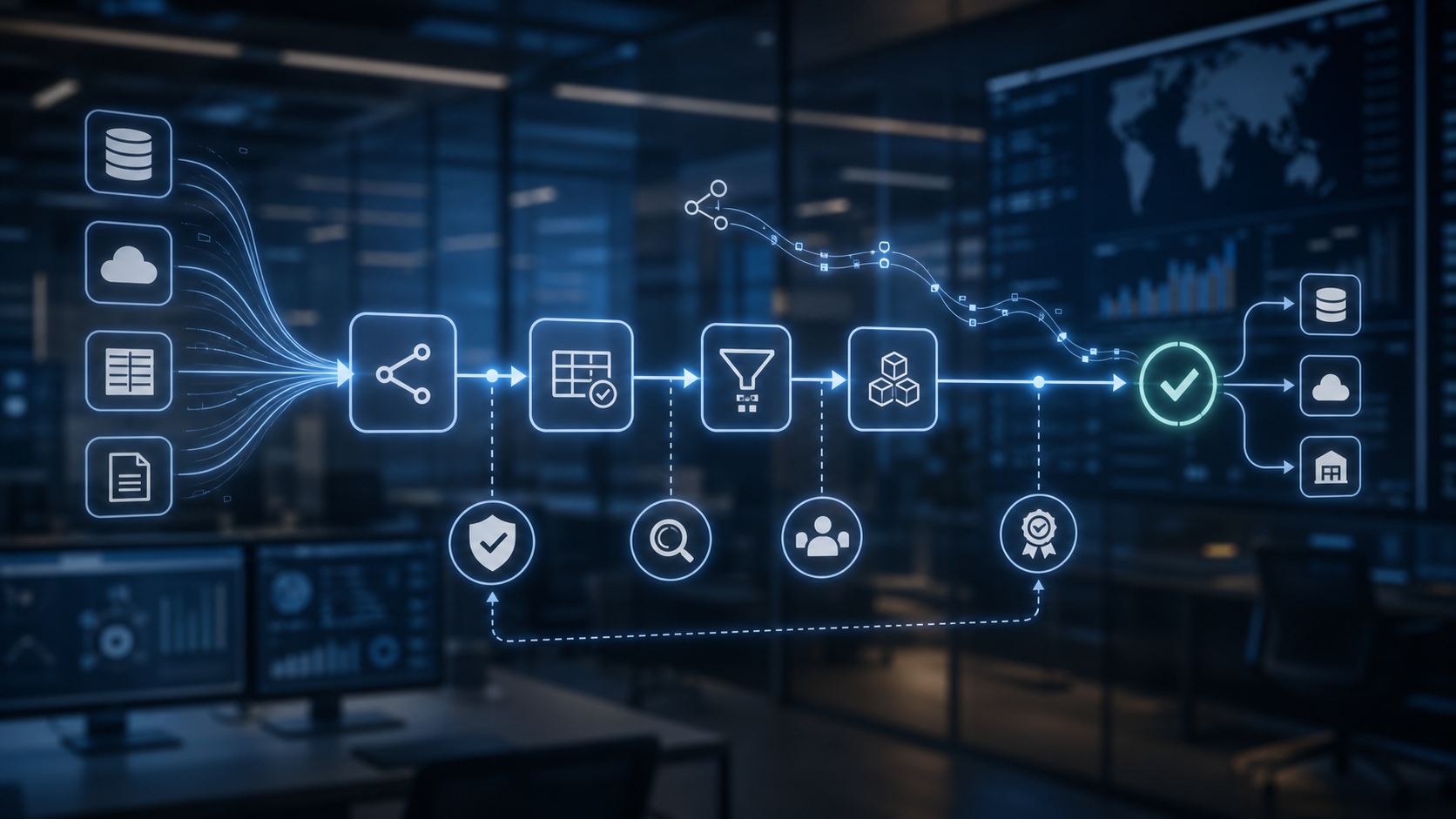
The right way to analyze Talend, then, is to start with the accepted governed data flow. A reference enters through a database log, API, file, event stream, or SaaS connector. It lands in a target pattern such as a cloud warehouse, Qlik Open Lakehouse, QVD output, or another supported platform. It may be transformed by rules, SQL, graphical flows, or a Talend job. It may receive validation rules, profiling, semantic typing, quality calculations, and ownership metadata. It may be cataloged, packaged into a data product, exposed to Qlik analytics or another consumption layer, and monitored through task status and history.
The work is successful only when the consumer can use it without guessing what the data means, where it came from, whether it is current, and what will break if a field changes.
That is a high bar. It is also the bar that makes enterprise data integration worth paying for.
The Product Boundary After Qlik
The first thing a buyer has to separate is Talend from Qlik analytics. Qlik's acquisition makes a combined story attractive: move data, govern it, analyze it, and increasingly prepare it for automated AI systems. But Talend's article-worthy boundary is the data integration and data quality lineage now operated by Qlik, not the associative analytics engine or the dashboard layer. The reason to keep that boundary explicit is that the automation problem is different. Analytics tools compete on exploration, visualization, semantic modeling, and decision support.
Talend competes on whether data gets from unstable operational systems into a governed, repeatable, recoverable state.
Qlik's public pages now present Qlik Talend Cloud as a cloud offering with multiple tiers. Starter focuses on easier replication from supported SaaS applications and a limited set of databases. Standard adds broader real-time data movement, including change data capture where possible, and basic transformations. Premium adds ETL and ELT transformation, technical data quality, basic governance, data products, marketplace consumption, and more advanced deployment patterns. Enterprise adds the higher-end capabilities, including real-time movement from SAP and mainframe sources.
Qlik also maintains client-managed options and older Talend components, including Talend Studio and Talend Data Fabric.
That tiering matters because it changes the product's economic test. A team comparing Talend only on connector presence may miss that the capability it wants could sit in a higher edition, require Talend Studio, require a specific version, require an additional gateway, require a particular region, or depend on Qlik and Talend tenant linking. The subscription documentation also describes capacity-based metering around data moved, job executions, and job duration. The result is not a simple per-seat software decision. It is a capacity and architecture decision.
A team has to know whether its costs will be driven by bulk movement, frequent jobs, long-running jobs, complex transformations, extra regions, premium sources, or human administration.
This is one reason Talend's post-acquisition continuity is part of the value question. Qlik's 2023 acquisition press release said the combination would add Talend's transformation, quality, governance, application connectivity, and API services to Qlik's data integration and analytics portfolio. Independent coverage at the time treated the acquisition as a material expansion of Qlik's data platform ambitions, not just a small feature bolt-on. That ambition gives Talend a larger distribution path, more cross-platform investment, and a stronger story for customers already committed to Qlik.
It also creates migration and boundary questions for customers who bought older Talend products, used Talend Open Studio, or prefer a modular stack.
The Open Studio decision is a useful example. Qlik community answers and partner commentary confirm that Talend Open Studio was retired in 2024 and is no longer an officially hosted and updated free entry point. That does not make commercial Talend weaker on its own, but it changes the ownership contract for teams that once treated Talend as an open-source development path with optional enterprise expansion. The current buyer is moving into Qlik's commercial portfolio, not merely adopting a familiar open tool.
The more the portfolio consolidates, the more customers should ask what happens to old jobs, old skills, old connectors, old licensing assumptions, and old deployment practices.
Qlik's direction in 2026 adds another layer. The company has announced generally available AI-assisted data engineering capabilities across Qlik Cloud, including data quality assistance, data product assistance, catalog and glossary assistance, declarative pipelines, and controlled access for approved AI clients. That is a credible response to the real backlog problem in data engineering: too many flows, too many rule changes, too much documentation, and too much steward work. But it should not be read as proof that production risk disappears. AI-assisted creation can make it easier to create pipelines, rules, and catalog entries.
The buyer still has to validate the resulting mappings, permissions, lineage, data quality thresholds, capacity use, and run behavior. In data integration, generating the pipeline is never the same as proving the flow.
Connector Breadth Is the Start, Not the Moat
Connector breadth is still valuable. Qlik says it supports hundreds of sources and targets across cloud providers, databases, warehouses, applications, and enterprise systems. The help pages list supported source databases and versions, data source connection setup, and data movement patterns into cloud data warehouses, Qlik Cloud, Qlik Open Lakehouse, and other target platforms. The product pages emphasize connectivity across SaaS applications, databases, streaming systems, cloud services, SAP, and major platform partners such as AWS, Azure, Google Cloud, Snowflake, Databricks, Cloudera, and Confluent.
That breadth reduces one kind of cost: the cost of beginning. A data team that has to integrate many applications can lose months building and maintaining API clients, authentication patterns, retry logic, type conversions, and incremental loading rules. A maintained connector can absorb a large amount of that work. It can also help standardize how teams connect to systems instead of leaving each business unit with its own scripts and credentials. For an enterprise with many repeated data movement requests, this is not cosmetic. Repeated hand-built ingestion is a tax on engineering capacity.
But connector breadth is not the same as operational depth. A connector can fetch data but fail to express the business meaning of a field. It can replicate changed rows but not know whether the downstream metric still means the same thing. It can expose tables but not resolve ownership. It can land files but not explain whether a missing column is expected, delayed, forbidden, or catastrophic. It can run successfully while a transformation silently converts a field in a way that breaks margin, churn, fraud, inventory, or compliance reporting. The connector is the mouth of the system. The governed flow is the nervous system.
This distinction is especially important because modern integration environments are often mixed by design. A company may use Fivetran for some SaaS ingestion, dbt for warehouse transformations, Kafka or cloud-native streams for events, custom Python for specialized APIs, Airflow or Dagster for orchestration, Snowflake or Databricks for compute, and a catalog such as Collibra or Alation for governance. In that world, Talend does not have to do everything to be useful. It has to reduce enough cross-tool friction to justify its place.
If Qlik Talend Cloud becomes the place where movement, transformation, quality, lineage, and data products are governed together, it can be more than another ingestion tool. If it becomes another layer that still requires separate repair, separate documentation, separate catalog reconciliation, and separate monitoring, then connector breadth becomes a weaker argument.
The strongest customer evidence points in both directions. Qlik-published stories describe Grill'd using Qlik Talend Data Integration to orchestrate frequent data movement across many operational sources, process large weekly record volumes, and improve reporting and rostering. AriensCo's Qlik story describes a reduction in the number of integration tools and improvements in reliability and development time. EOH's story presents a quality and reliability narrative around a data-driven culture. These are useful because they describe real operational contexts rather than abstract features.
They also remain vendor-published customer stories, which means they should be treated as proof of possible outcomes, not proof of default outcomes. A buyer should ask what the starting architecture was, who implemented the system, what skills were present, how many pipelines were migrated, what failure rates existed before and after, and which costs moved from software to operations.
Connector breadth also has a lifecycle problem. APIs change, SaaS vendors alter rate limits, authentication patterns evolve, database versions age, and cloud targets change capabilities. A maintained connector library is only valuable if the vendor keeps up with those changes and communicates breaking behavior clearly. Qlik's Connector Factory story is a positive signal because it shows a mechanism for expanding and maintaining supported connectivity. Still, the buyer should not treat "hundreds of connectors" as a static asset.
The relevant question is whether the specific connectors in the customer's critical path are supported at the needed version, in the needed region, with the needed incremental loading behavior, at the needed volume, under the needed subscription tier, and with support commitments strong enough for the process they feed.
Schema Drift Is Where Trust Starts to Fray
The most common data integration failure is not dramatic outage. It is quiet drift. A source column changes type. A field that was required becomes nullable. A new status value appears. A vendor adds nested JSON. A source deletes a field without warning. A data model changes from one-to-one to one-to-many. A timestamp shifts time zone handling. A database change log contains a rapid sequence of definition and data changes. A downstream table still loads, but the meaning is wrong. Everyone discovers the error later, usually after a report looks strange.
Qlik's documentation recognizes that pipeline work involves schema evolution and change data capture. The landing task documentation describes CDC, reload and compare patterns, operations on landing tasks, schema evolution, changing source connections or data gateways, and limitations. It also warns that rapid database operation sequences can create parsing risk in some cases, recommending that teams wait for changes to be applied before performing the next operation. That warning matters because it is an example of useful humility in a public help page. It acknowledges that the change log is not magic.
The product has operational rules, and reliability depends on how source systems change.
Talend's value in schema drift depends on how quickly a team can detect, classify, and respond. Some changes are harmless. A newly added nullable column may be accepted after review. A renamed key field may require a mapping change. A type widening may be fine for storage but not for a downstream model. A deleted field may be a breaking change that requires business approval. A data integration platform should help teams separate those cases. It should not merely fail a job or, worse, keep running while hiding the semantic break.
Lineage and impact analysis become practical controls here. Qlik's help pages describe field-level lineage and impact analysis in Data Integration. Lineage tracks a dataset or field back to the source and transformations that created it. Impact analysis answers the forward question: what tasks, datasets, or applications would be affected if a data element changed? That is precisely the information needed when schema drift appears. If a source field changes, a data owner needs to know which flows, tables, marts, data products, dashboards, and AI features depend on it.
Without that view, the organization relies on tribal memory and search through job definitions.
The limitation is that lineage has to be true, current, and scoped correctly. Qlik's own docs note that lineage is supported for Data Pipeline projects and not for Replication projects. Talend Studio lineage can be published to Qlik Cloud, but the documentation describes requirements: a Premium or Enterprise license, configured authentication, supported components, and run-time generation. The Management Console documentation also notes limits on generated datasets and lineage entries for a job task. These are not disqualifying facts. They are operational boundaries.
The buyer should ask which flows will have full field-level lineage, which will have partial lineage, which older jobs need republishing or configuration, and which externally built pipelines will remain outside the graph.
This is where the accepted governed data flow differs from a successful run. A job that moves rows from a CRM to Snowflake might be operationally successful. But the governed flow is not accepted until ownership, meaning, quality, and downstream exposure are visible enough that a change can be managed. Talend's relevance is strongest when the platform reduces the time between source change and understood impact. If it merely moves the change faster, it can accelerate bad data as efficiently as good data.
Data Quality Is Not a Badge
Data quality products are often sold as reassurance, but the real work is uncomfortable. Someone has to decide what "valid" means. Someone has to define acceptable null rates, uniqueness constraints, freshness expectations, semantic types, domain rules, and exception handling. Someone has to decide whether a failed rule blocks a flow, marks a dataset, alerts a steward, or lets data through with a caveat. Someone has to maintain those rules as the business changes. Tooling can reduce labor, but it cannot remove accountability.
Qlik's public materials describe automated profiling, data quality rules, steward tools, semantic types, Qlik Trust Score, data products, and data marketplace consumption. The Trust Score documentation says the overall trust score for a data product is the average of included dataset scores and can be tailored to the company's data quality needs. The validation rule documentation says rules can affect dataset quality and the Trust Score, can be applied to many fields, and can depend on spaces. The broader data quality pages describe profiling, semantic type discovery, validation, and data freshness.
That is directionally strong because quality is being placed near the integration flow rather than treated as a downstream dashboard complaint. If a pipeline can compute quality, attach rules, expose confidence, and package trusted datasets as data products, the business gets a better chance of knowing whether data is fit for use before decisions are made. The value is especially high for organizations trying to feed AI systems. A model or automated application consuming a stale, malformed, or poorly described dataset can act quickly on bad context. The more automated the downstream action, the more important upstream quality controls become.
Still, quality controls create their own maintenance burden. Rules have false positives. Rules become stale. Rules can conflict across spaces. A rule that is appropriate for marketing segmentation may be too loose for finance. A strict rule that protects regulatory reporting may stop useful exploratory work. A trust metric can be misunderstood as objective truth when it is partly the result of configured weights, available metadata, and rule coverage. Data products can become a shelf of attractive packages with uneven maintenance if ownership is not enforced.
Talend is therefore most useful where the organization is willing to operate data quality as a discipline. That means rule ownership, review cadence, severity definitions, escalation paths, and clear decisions about what happens when data fails checks. Qlik's AI-assisted data engineering direction could help by letting teams retrieve trust metrics, create or edit quality rules, detect anomalies, and manage data products through natural language or approved AI clients. But those capabilities increase the need for governance, not decrease it.
If creating a rule becomes easier, the organization must still know who can create one, who reviews it, how it affects shared datasets, and whether the rule's purpose is documented.
The unit economics of data quality are often misunderstood. The payoff is not that every rule saves time. Many rules add work. The payoff is that the work becomes earlier, more visible, and less expensive than late-stage reconciliation. A month-end finance mismatch costs more than a failed validation during ingestion. A compliance report correction costs more than a quality issue raised before publication. A machine learning model trained on corrupted historical categories costs more than a steward review of a changed domain. Talend can improve economics if it moves quality work upstream and makes exceptions traceable.
It can worsen economics if it creates a large rule estate that no one owns.
Lineage Is an Operating Control, Not Documentation
Lineage is sometimes treated as documentation for auditors or analysts. In a modern data estate, it should be treated as an operating control. When a source table changes, lineage tells the team what might break. When a dashboard is challenged, lineage helps explain the path from source to metric. When a data product is reused by another team, lineage lets the consumer see whether the dataset is built from accepted sources. When an AI feature consumes a table, lineage helps expose whether the data came through a governed path or a convenient shortcut.
Qlik's field-level lineage and impact analysis pages are therefore central to the Talend evaluation. The docs describe visual flows from original data source to applications, entry points from tasks, datasets, and columns, and a distinction between backward lineage and forward impact. Talend Studio jobs can publish input and output datasets and lineage to Qlik Cloud under the required license and configuration. Qlik Lineage Connectors can also extract metadata and lineage from Qlik on-premises offerings, external BI tools, and data sources, depending on license and configuration.
This gives Qlik a plausible path to make Talend part of a broader data observability and governance layer. The key question is coverage. Lineage that covers only the cleanest new pipelines is helpful but incomplete. Enterprises need to know where blind spots remain: old Talend jobs, replication-only projects, hand-coded transformations, warehouse-native SQL, BI-layer calculations, external orchestration, third-party ingestion, and regional systems. A partial lineage graph can still be valuable if the organization understands its scope. It becomes dangerous if consumers assume it covers everything.
Lineage also depends on identity and ownership. The data project docs describe spaces, permissions, project ownership, and the ability to change owners. The product page emphasizes setting ownership between producers and consumers. Those details are not administrative trivia. A lineage graph without accountable owners becomes a map of abandoned roads. When a dataset is wrong, the business needs to know who can fix the source mapping, who can approve the transformation change, who owns the downstream data product, and who must be notified.
Talend's value increases when Qlik's spaces, roles, catalog, and data products make those responsibilities visible. It decreases if the organization still resolves issues through private messages and undocumented knowledge.
The post-acquisition platform story may help here because Qlik has reasons to align data movement, catalog, data products, and analytics consumption. A dashboarding company wants the data foundation to be trusted because analytics credibility depends on it. But the same integration also increases platform dependence. If lineage, catalog, quality, monitoring, and analytics all live in Qlik's ecosystem, exiting Qlik becomes more complex than replacing an ingestion connector. The buyer should treat that dependence honestly. Lock-in is not always bad if the platform meaningfully reduces work and risk.
It is bad when the dependency grows faster than the operational benefit.
Runtime Recovery Is the Real Maintenance Bill
Every integration system looks clean in a demo. The maintenance bill appears when jobs fail at 2 a.m., when a gateway needs patching, when a source credential expires, when a target warehouse throttles writes, when a long-running job burns capacity, when a transformation handles an unexpected value, when a region has a service issue, or when a queue of delayed tasks creates downstream freshness problems. Talend's commercial question is not whether it can build a flow. It is whether it reduces the ongoing supervision cost of keeping flows useful.
Qlik's docs provide several relevant signals. Data tasks can be monitored individually. Monitor views can show status and progress across subsets of tasks. Run history is visible. Notifications can be configured for operation changes. Logs can be viewed and downloaded. Troubleshooting pages document known issues, such as reserved column name conflicts in certain registered data views. Qlik Automate and the Data integration REST API can orchestrate tasks, schedule quality computations, and deploy pipeline projects across spaces.
Version control can connect pipeline projects to GitHub, commit changes, compare versions, use branches, and merge work toward production deployment.
These are exactly the kinds of features that reduce supervision cost when they are used with discipline. Monitor views help a team see which tasks are late or failed. Run history helps separate one-time failures from recurring instability. Logs help support and engineering investigate. Version control helps manage change instead of relying on undocumented canvas edits. API-based deployment helps separate development and production spaces. Quality computation scheduling helps make trust signals repeatable.
But runtime operations remain a shared responsibility. A product can expose status, but someone has to define the response. A product can show run history, but someone has to review trends. A product can send notifications, but someone has to decide which alerts matter. A product can version pipeline definitions, but someone has to enforce review practices. A product can schedule quality calculations, but someone has to define failure policy. A product can provide capacity dashboards and alerts, but someone has to tune job frequency and volume.
This is where Talend competes with simpler substitutes. A disciplined team using warehouse-native ingestion, dbt, Git, tests, Airflow, and a catalog can often build a strong operating model without buying a broader commercial platform. The trade-off is that the team must integrate those tools itself. Talend's case is that Qlik can reduce integration of the integration stack: one place for many connectors, data movement, transformations, quality, catalog, lineage, monitoring, and deployment.
The buyer's test should be blunt: does the platform remove enough glue work to justify its price and dependency, or does it create a different layer of platform administration on top of the same engineering burden?
The answer depends heavily on company shape. A small analytics team with a few cloud apps and a single warehouse may find a specialized ingestion tool plus warehouse SQL simpler. A regulated enterprise with SAP, mainframe sources, regional data controls, many application owners, a formal data stewardship function, and a need to package trusted data products may find Talend's broader governed flow more compelling. A Qlik analytics customer may gain extra value from tighter downstream consumption. A non-Qlik analytics customer can still use Talend for data integration, but the combined platform story becomes less decisive.
Capacity Pricing Changes Engineering Behavior
Capacity pricing has a useful promise: align cost with use. Qlik's Talend subscription documentation says usage is measured through data moved, job executions, and job duration, with tiers that unlock different capabilities. The public pricing page says customers can monitor usage through a self-serve telemetry dashboard and receive alerts as utilization approaches subscribed capacity. An AWS Marketplace listing for Qlik Talend Cloud Starter shows a public contract example for a limited data-moved bundle and additional usage dimensions. Those details make the cost model more concrete than a vague enterprise quote.
The risk is that capacity pricing changes engineering behavior in ways that are not always obvious at purchase time. A team may reduce job frequency to control executions, then lose freshness. It may batch more data to reduce runs, then increase recovery time after failures. It may push transformations into a warehouse to reduce job duration, then lose visibility in Talend's lineage or quality layer. It may overbuy capacity to avoid alerts, then underuse the platform. It may underbuy capacity to start small, then face friction as adoption expands.
It may encourage business teams to treat data integration requests as marginal cost items when the platform budget is already committed, creating a backlog of poorly governed flows.
This does not make capacity pricing bad. It makes observability and planning essential. Data teams should model expected rows, change rates, job durations, frequency, transformation complexity, growth, and reprocessing needs before selecting a tier. They should also model failure scenarios. Replaying a pipeline after a defect, backfilling historical data, or migrating a large source can consume capacity differently from normal operations. If the business case assumes steady-state usage only, the first major recovery event can surprise the budget owner.
Unit economics should include labor avoided, not just software spend. Talend can be economical if it replaces multiple integration tools, reduces custom connector maintenance, shortens pipeline development, improves monitoring, and prevents late data quality failures. Customer stories such as AriensCo's tool consolidation claim and Grill'd's frequent operational data orchestration suggest that this can happen. It can be expensive if the team uses only a narrow part of the product, pays for higher tiers to access a small set of features, or still maintains parallel tools for transformation, catalog, observability, and quality.
The right commercial question is not "Is Talend cheaper than open source?" Open source software can be free and expensive to operate. Commercial software can be costly and still cheaper than bespoke maintenance. The right question is: for this company, does Talend reduce the combined cost of integration work, data quality work, runtime supervision, incident recovery, audit explanation, and future migration? If the answer is yes, connector breadth is only one part of the value. If the answer is no, the connector list is a distraction.
Realistic Substitutes
Talend does not operate in an empty market. Its substitutes come in several shapes.
The first substitute is a specialized ingestion platform such as Fivetran, Airbyte, Matillion, Rivery, Integrate.io, Hevo, or cloud-native data movement tools. These can be strong when the job is mostly application or database ingestion into a warehouse, with transformations handled elsewhere. They may be easier to buy, simpler to operate, or more predictable for specific SaaS-to-warehouse patterns. They can be weaker when the buyer needs deeper data quality, lineage, application integration, API work, hybrid deployment, SAP or mainframe coverage, and governance around data products.
The second substitute is the warehouse-native stack. A team can use cloud ingestion services, dbt or SQL transformations, warehouse tasks, native lineage where available, Great Expectations or similar testing, and a separate catalog. This can work well for engineering teams that already operate in code and want strong version control. It can also avoid dependence on a single broad vendor. The downside is integration overhead. The team has to assemble and maintain monitoring, ownership, data quality, catalog, access controls, and failure response across tools.
The third substitute is a larger enterprise data platform such as Informatica, IBM, Oracle, SAP, Microsoft Fabric, Databricks, Snowflake's ecosystem, or hyperscaler-native integration services. These can be stronger where a company is already standardized on that platform or needs extensive governance coverage. Talend's advantage may be heterogeneity and the combined Qlik data-to-analytics story. Its disadvantage may be that it has to prove Qlik's integration of acquired assets can match older enterprise competitors on consistency, support, and depth.
The fourth substitute is staying with old Talend or old custom jobs. That is sometimes rational for stable flows that do not justify migration. It is risky when support, security, connectors, or staffing are deteriorating. The retirement of Talend Open Studio removed one familiar free path, and older unsupported components should not be treated as a long-term control plane for critical data. Still, migration itself has a cost. A buyer should not move old jobs just to modernize a diagram. It should move them when the risk, maintenance burden, or opportunity cost of staying put is higher than the migration cost.
The fifth substitute is narrower process redesign. Sometimes the best way to reduce integration burden is not another platform but fewer unnecessary flows. Many companies move too much data because no one has authority to say which data product is canonical. Talend can help package trusted data products, but governance starts with decisions about reuse, ownership, and domain boundaries. If the same source is being copied into five targets because teams do not trust each other, a better platform may only make duplication faster.
Where Talend Is Most Defensible
Talend is most defensible in organizations with several traits. They have heterogeneous data sources and targets. They need governed data movement, not just ingestion. They care about data quality before consumption. They have enough repeated integration work that custom scripts are creating maintenance drag. They need lineage and impact analysis because many downstream assets depend on shared flows. They have data stewards or platform owners who can operate rules, ownership, and exception processes. They may already use Qlik analytics, Qlik Cloud, Qlik Data Integration, or Talend tools.
They want a commercial vendor accountable for connectors, support, and platform evolution.
For those buyers, Talend's acquisition by Qlik can be positive. Qlik has reason to invest in trusted data as a foundation for analytics and AI. The 2026 AI-assisted data engineering announcements show active product direction around quality, data products, catalog, and declarative pipelines. The documentation shows attention to monitoring, version control, API deployment, data products, validation rules, and lineage. The commercial portfolio offers a path from starter replication to more advanced enterprise integration. This is a coherent strategic direction.
Talend is less defensible where the product is bought as a universal answer to data messiness. It cannot remove the need to define business meaning. It cannot guarantee every connector remains perfect. It cannot make lineage complete for systems outside its scope. It cannot make an unsupported old job safe. It cannot turn low-quality source data into high-quality decisions without rules and stewards. It cannot make capacity pricing predictable unless the buyer understands usage. It cannot prove production reliability through a demo or a customer logo.
The best buying process therefore starts with failure modes, not features. Ask how Talend handles schema drift. Ask what happens when CDC falls behind. Ask how duplicate loads are detected and repaired. Ask which lineage will be field-level and which will be unavailable. Ask how quality rules are owned and versioned. Ask how run history, logs, and alerts are used during incidents. Ask which features are in Starter, Standard, Premium, and Enterprise. Ask which regions support the needed Talend Cloud capabilities. Ask whether Talend Studio jobs need specific versions for lineage.
Ask how to export projects, recover definitions, and leave the platform if necessary.
Those questions may sound defensive, but they are not anti-vendor. They are the questions that determine whether the platform will survive reality.
The Judgment
Talend's strongest claim in 2026 is that Qlik is moving the product line toward a governed data engineering layer: connectors, movement, transformation, quality, catalog, lineage, data products, monitoring, deployment, and AI-assisted engineering in one commercial portfolio. That is a meaningful answer to a real enterprise problem. The problem is not that companies lack ways to copy data. The problem is that trusted data flows are hard to create, hard to maintain, and hard to explain when systems change.
The caution is that the same breadth can become dependence. A company that adopts Qlik Talend Cloud for data movement, quality, lineage, products, and AI-ready data foundations is not buying a simple utility. It is placing part of its data operating model inside Qlik's platform. That can be an excellent trade if the platform reduces integration work, improves confidence, and keeps ownership visible. It is a poor trade if the buyer still needs parallel tools for the hardest controls and treats Talend mostly as a connector bundle.
The practical verdict is conditional. Talend deserves serious consideration where an enterprise needs governed integration across mixed systems and has the operational maturity to use quality, lineage, monitoring, and ownership features. It should not be selected merely because the connector list is long or because AI-assisted engineering sounds modern. The enduring question is narrower and tougher: when sources, schemas, jobs, owners, and business rules change repeatedly, can Talend keep the accepted governed data flow trustworthy without creating a larger supervision bill than the problem it was meant to solve?
That is the test Qlik Talend has to pass. It is also the test every serious data integration platform now faces.

