
Summary
- SMC's meaningful product is not generic around-the-clock monitoring. It is the accepted alarm response: a signal, image, fault or personal-safety alert that is received, assessed, escalated and recorded under an agreed customer protocol.
- Public evidence supports SMC as a Dutch private alarm and video monitoring centre operator with service locations in Tiel and Eindhoven, 50 years of Dutch monitoring-room experience, installer support, video verification, alarm follow-up services, and Kiwa certificates for CCV-PAC/VTC and ISO 9001 scopes.
- The public record does not prove live response times, missed-signal rates, operator workload, customer outcomes, false-alarm reduction, uptime, incident quality or unit economics. Those limits should lower certainty, not be filled with invented performance claims.
- The strongest buyer case is for installers and customers that need accountable escalation, verified alarm handling, monitoring-centre redundancy, portal-based installer coordination, and a human decision layer for signals that automated security systems cannot resolve alone.
- The weakest case is where customers treat central monitoring as a passive subscription, keep poor contact and keyholder records, do not maintain cameras and alarm systems, or can replace the workflow with simpler in-house monitoring without losing certification, insurance, response or audit value.
The Accepted Alarm Response Is The Real Unit Of Value
The central question for SMC Security Monitoring Centre B.V. is not whether a device can send an alarm to a room staffed at all hours. That is only the start of the work. The useful question is whether the alarm event can be carried through an accountable chain of interpretation and action. An intrusion detector, panic button, fire alarm, technical fault or camera trigger does not have value because it exists in a system log.
It has value when the signal is matched to a customer, placed in the right context, assessed against an agreed action pattern, escalated to the right human or responder, and recorded with enough detail that the customer, installer, insurer or supervising organization can later understand what happened.
That is why the unit of judgment should be the accepted alarm response. An accepted response is not merely a received signal. It is a state change that operators and customers can act on. The monitoring centre has to know which site, which system, which zone, which customer instructions, which keyholder, which response service and which exception rule applies. It must avoid confusing a test signal with a real incident, a stale keyholder with a reachable one, a camera fault with a verified threat, or a technical alarm with a burglary alarm. The more urgent the signal, the less tolerance there is for ambiguity.
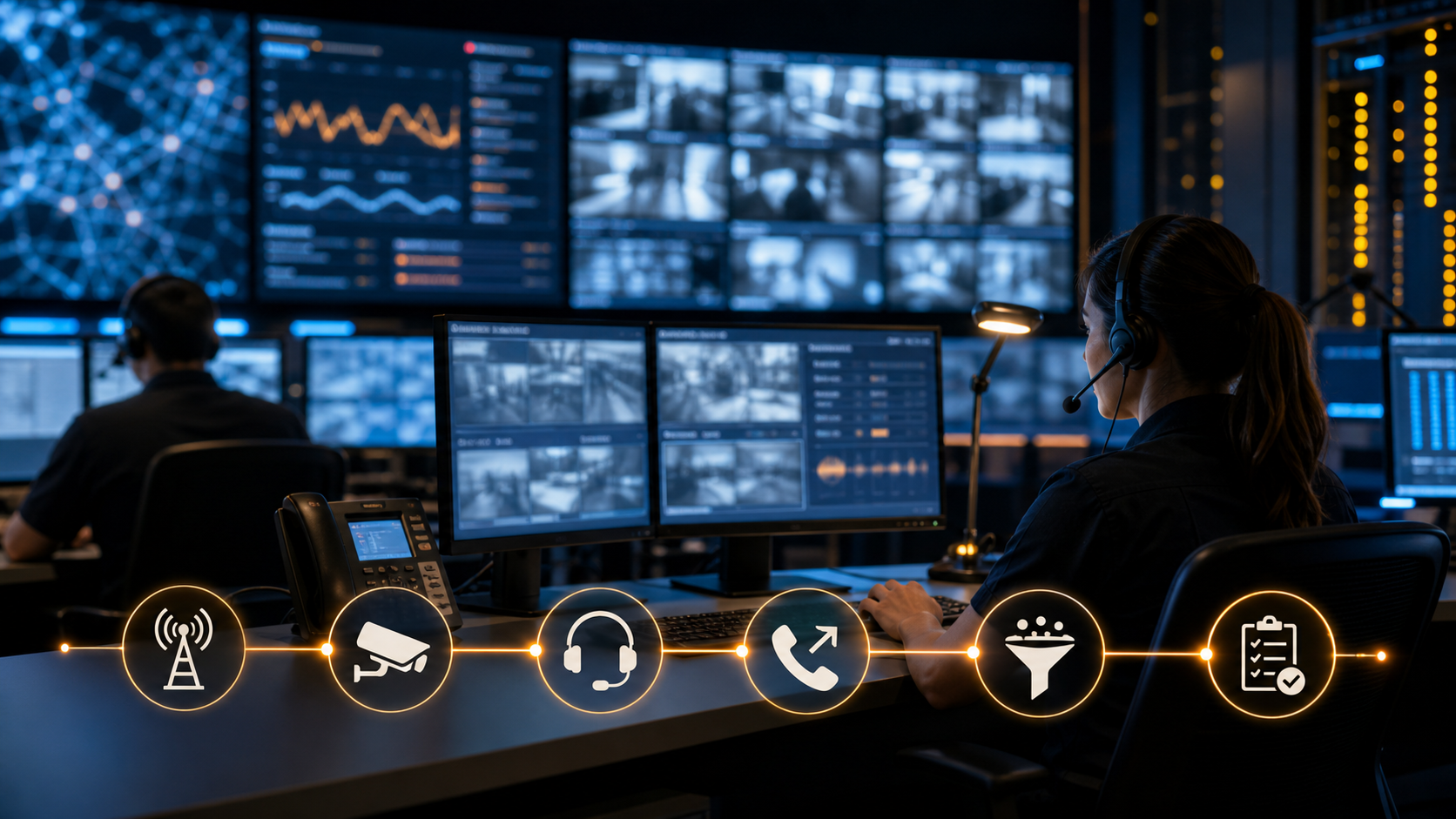
SMC's public Dutch materials point to this operating boundary. The company describes 24/7/365 services for burglary and fire alarms, camera monitoring, telephone service, alarm follow-up, personal safety and the control of technical installations. It says its services are delivered from monitoring centres in Tiel and Eindhoven, supported by more than 100 operators and protocols tuned to the customer's situation. It also presents the two monitoring centres as operational backups for each other. Those claims matter because alarm monitoring is not a single software feature.
It is a coordination business where communications infrastructure, customer records, operator judgment, escalation procedures, installer support and compliance evidence all have to keep moving together.
The difference between a received signal and an accepted response is also the difference between a product demonstration and daily service value. A demonstration can show that a camera view opens, a phone call is placed, or a signal appears in a console. A real monitoring operation has to handle repeated production tasks: routine tests, false alarms, contact changes, out-of-hours incidents, camera ambiguity, communication failures, customer holidays, installer updates, duplicated signals, technical faults, and the ordinary fatigue of continuous operations. The product is proved when those repeated tasks remain orderly.
SMC's useful role is therefore a human-supervised automation layer. Alarm systems automate detection, transmission and logging. Camera systems automate visual capture. Customer portals automate record changes. Interactive voice systems automate routine status changes. But the decision that an event should become police, fire, guard, keyholder, customer-service or technical action still depends on judgment and on the quality of the surrounding record. That is where SMC should be tested.
This Is A Dutch Monitoring-Centre Company, Not An Equipment Vendor
The name "SMC" creates an obvious identity risk because it is shared by unrelated companies in other industries. The company in scope here is Security Monitoring Centre B.V., the Dutch alarm-monitoring and control-room service business associated with SMC Alarmcentrale and SMC Monitoring. Its public presence points to monitoring-centre services, not industrial automation equipment. The Dutch site places the company around alarmcentralediensten, videodiensten, alarmopvolging, TeleService, persoonsbeveiliging and installer partnerships. Its company details in certification documents list Security Monitoring Centre B.V.
at Hoog Kellenseweg 2 in Tiel, with an Eindhoven branch at Kronehoefstraat 14.
That boundary matters because the commercial question is not whether SMC manufactures sensors, cameras, PLCs, pneumatic components or factory automation systems. The product boundary is the monitoring service that sits after the customer's installed equipment has detected something and sent a signal. SMC can be valuable even when it did not sell the sensor. It can also be blamed for outcomes partly shaped by equipment, installer work, customer data and response-agency availability. A fair article has to keep those responsibilities separate.
SMC's public site describes the company as part of a global SMC monitoring organization and says the Dutch alarm centre has 50 years of monitoring-room experience in the Netherlands. It also says the group has more than 600,000 customers worldwide and that the Dutch services operate from Tiel and Eindhoven. Those are scale and identity signals, not proof of response quality. They support the conclusion that SMC is an established monitoring provider with a broad service catalogue.
They do not, by themselves, prove whether a given alarm is answered faster, verified more accurately or escalated more effectively than it would be with another provider.
The proper comparison is with alternative ways a site owner or installer could manage alarm events. A business could use a local guard, an in-house reception desk, a platform notification, a camera app, a security installer with its own monitoring partner, or a different private alarm centre. SMC's answer is centralization: trained operators, monitoring-centre infrastructure, customer-specific protocols, installer support and certified processes. Centralization is valuable only if the shared operation produces better reliability, evidence and response discipline than scattered local arrangements.
Monitoring Is A State-Management Problem Under Pressure
Alarm monitoring looks like a communications problem, but most of its economic value comes from state management. The monitoring centre has to maintain the current state of a customer site, the alarm system, keyholder records, instructions, test windows, service agreements, camera access, response options and exception history. Every weak state record creates work or risk at the exact moment when speed and clarity matter.
Consider a burglary alarm. The device sends a signal. The operator must know whether the system is in normal service, in test, recently installed, associated with a known fault, linked to camera verification, covered by a response service, or subject to a special instruction. The keyholder list must be current. The customer may have provided opening hours, roster times or escalation preferences. The police may require verification or a reason to treat the incident with priority. If a camera feed is available, the operator has to decide whether the image supports escalation or shows an innocent cause.
If a guard is dispatched, the guard needs address, access and safety information.
Each step is a state transition. Signal received. Signal classified. Customer record matched. Protocol selected. Contact attempted. Verification reviewed. Response dispatched. Incident recorded. Follow-up closed. If any transition is uncertain, the workflow creates manual work or risk. A wrong contact can delay response. A camera not positioned correctly can turn verification into guesswork. A system left in test mode can create a missed alarm. A stale installer record can slow troubleshooting. A weak incident log can leave the customer unable to understand the service received.
SMC's public materials show several pieces of this state-management layer. The company offers installer access to a portal where connections can be activated, systems placed in test, and data analyzed. It describes SMCweb as an installer portal where installers can view and adjust information for connections, and compile reports. It describes MASmobile as a tool that lets technicians put connected customers into test mode by smartphone or tablet and view logbooks and keyholders.
It also advertises an interactive voice system for customers or authorized users to place an alarm system in or out of test, adjust roster times, and request in/out status using an ID code and PIN.
Those features are not glamorous, but they are commercially important. Alarm monitoring fails in ordinary administrative gaps as much as in dramatic control-room failures. If a customer cannot easily update the record, the monitoring centre is forced to operate from stale information. If an installer cannot put a system into test mode during maintenance, the centre may process avoidable signals or ignore a real one. If keyholders and rosters are wrong, a good operator can still make a bad escalation. The automation that matters is often administrative: keeping the response state clean enough that the human operator is not guessing.
Certificates Define Scope, But They Do Not Prove Every Response
Certification is important in the Dutch alarm market because monitoring centres sit near security, insurance and public-safety expectations. SMC's public evidence includes a Kiwa certificate for Particuliere Alarmcentrale and Videotoezichtcentrale covering Security Monitoring Centre B.V. The certificate was issued on January 10, 2024, with a validity date through June 30, 2026, and states that the management system meets the CCV certification scheme for private alarm centres, version 3.0 of July 1, 2019.
Its scope covers receiving and assessing signals sent by alarm equipment and initiating the action agreed with the subscriber, as well as receiving and assessing images sent by video equipment and initiating the agreed action.
SMC also publishes an ISO 9001:2015 certificate issued by Kiwa on January 16, 2025, valid through December 11, 2026. The stated scope is remote security through receiving, registering and handling alarm, fault, test and video notifications, periodic or requested viewing and assessment of video images, and telephone service. That is a useful scope statement because it maps directly to the accepted response problem: receiving, registering, assessing, handling and communicating events.
But certificates should not be overread. They support the existence of a certified management system and a defined service scope. They do not disclose real-time response data, operator workload, missed-signal rates, false-alarm outcomes, escalation timing, customer satisfaction, guard arrival times or incident reconstruction quality. Certification can reduce risk by forcing process discipline; it does not replace buyer diligence on actual service design.
There is also a public-record tension worth noting. SMC's own materials and the Gekeurd & Veilig list identify Security Monitoring Centre B.V. as CCV-PAC. The Het CCV company profile for Security Monitoring Centre B.V. in Tiel lists the address and contact details but says no certifications were found for that company. That conflict does not erase the Kiwa certificate SMC publishes, but it shows why buyers should check live certificate status before relying on a label in a sales discussion or web page. SMC's certificate itself says status should be checked with Kiwa or the prevention-certificate register.
The transition from the Dutch CCV-PAC regime toward EN 50518 also matters. Dutch industry guidance says private alarm centres must meet Wpbr and Rpbr requirements and that a valid CCV-PAC or EN 50518 certificate is a condition for a private alarm-centre permit. It also says the CCV-PAC mark ends on July 1, 2026, after which private alarm centres must have moved to EN 50518. SMC's site listed a May 2026 notice about optimizing verified alarms and moving to the European EN 50518 standard. The article can treat that as a standards-transition signal, but not as proof that every practical consequence has already been independently verified.
For SMC, certification is best understood as a floor of process credibility. The market still has to ask whether the process is producing accepted responses in daily work.
Video Verification Changes The Economics Of False Alarms
Video is one of the most important extensions of central alarm monitoring because it can change the cost of a response. A traditional alarm signal often tells an operator that a zone or device triggered. It may not tell the operator whether a person is present, whether the cause is weather, an animal, a cleaning contractor, a fault, or a real intrusion. Video verification can make the event more actionable by letting the monitoring centre inspect the scene virtually and decide whether police, fire, a guard or a customer contact is justified.
SMC's public video-service page describes alarm verification, guided opening and closing, pre-robbery support, virtual video surveillance, Live View and VideoCheck. It says that with alarm verification, operators can be virtually present at a location through installed cameras and determine whether police, fire brigade or a security guard is needed. It also says verified alarms are treated with priority by police and fire services. The Live View material describes a collaboration in which police can look directly with the private alarm centre at camera images during an incident such as burglary or robbery.
VideoCheck is framed as periodic checking of camera-system operation: camera position, image sharpness, blocked views and recorder operation.
These services show why "monitoring" is a narrower term than the operating job. The monitoring centre is not only passing on signals. It is adding interpretation. The interpretation can reduce unnecessary dispatches, support faster emergency response, or catch camera-maintenance problems before an incident. But it also adds new failure modes. Camera views can be blocked, poorly lit, out of focus, pointed at the wrong place, unavailable during a network fault, or ambiguous. An operator may see something that looks suspicious but is innocent, or miss a subtle cue in a low-quality image.
A customer may expect certainty from video when the available image supports only probability.
That is why SMC's VideoCheck claim is commercially relevant. Periodically checking camera position and recorder function is a maintenance control, not merely a product add-on. Camera verification loses much of its value if nobody checks whether the camera is still useful. A buyer should therefore ask how often camera checks occur, what is recorded, what happens when a defect is found, how the customer is notified, and whether the video workflow is actually integrated into the alarm response protocol.
The public evidence does not show independent false-alarm reduction rates for SMC. It does not disclose how often video changes the response decision, how many verified events result in police action, or how many camera faults are caught before incidents. The right conclusion is measured: video verification gives SMC a credible mechanism for improving response quality, but the public record does not quantify the benefit.
Installer Coordination Is A Core Part Of The Automation
SMC's market is not only end customers. Installers are a central customer and partner group because they connect alarm systems, maintain equipment, manage handovers and keep customer records useful. A monitoring centre can be technically competent and still underperform if installers cannot connect systems smoothly or update the monitoring record during maintenance.
SMC's installer page is unusually important for understanding its automation model. It says installers can use a portal to activate connections, place systems in test and analyze data. It describes technical support, products for migrating connections to IP or 4G, fixed contacts, partnership terms and iSupport as a department for installer questions and advice. It also describes SMCweb for viewing and adjusting connection data, compiling reports and receiving portal access. MASmobile lets technicians place connected customers in test mode and view logbooks and keyholders.
The page also refers to unique IDs and codes for installer staff contacting the alarm centre, intended to prevent unauthorized access to customer data.
This is the machinery behind service continuity. A monitoring centre cannot treat installers as occasional outsiders. They are part of the response supply chain. They commission new systems, troubleshoot signals, migrate communications paths, change system configurations, and help customers understand what is connected to the monitoring centre. If an installer has to wait for manual support on every change, the monitoring centre becomes a bottleneck. If the installer has too much unchecked freedom, the response record can become unreliable. The product has to balance self-service and control.
That balance also affects unit economics. Central monitoring is attractive when many routine tasks can be standardized across many customers: test-mode changes, connection activation, contact updates, report generation, troubleshooting and migration support. The more these tasks are handled through portals, mobile tools and structured support, the less operator time is consumed by avoidable administration. But self-service does not remove oversight. SMC still needs identity controls for installers, audit records for changes, clear responsibilities for record accuracy, and exception handling when a change is wrong or incomplete.
The installer layer is also where technical dependency is visible. SMC's services depend on alarm receiver connectivity, IP and mobile migration options, SIM cards, portal access, customer records, logbooks and keyholder data. The public material says SMC can receive notifications from virtually any security system and provides transmission solutions for systems that do not already report to an alarm centre. That is useful breadth, but breadth raises support complexity. A monitoring centre connected to many brands and many installer practices has to normalize signals and procedures enough that operators can act consistently.
For buyers, installer experience should be part of diligence. The question is not only how the control room works during an emergency. It is how cleanly installers can create and maintain the state the control room will rely on during that emergency.
Customer Records Are Response Infrastructure
Alarm customers often think of their monitoring subscription as a control-room service, but the customer record is part of the infrastructure. Names, phone numbers, addresses, rosters, keyholders, access instructions, test periods, temporary closures, risk notes and escalation preferences are not clerical details. They determine whether a signal can become action.
SMC's public materials expose several ways records are meant to be updated or used. The installer page contains a mutation form flow for adding a new customer or reporting a change. It includes customer details, address, contact information, connection number or password, notes and warning addresses. The SMC news item on changes within two minutes says authorized users can use an interactive voice response system to put the alarm system in or out of test, adjust roster times and request in/out status using an ID code and PIN. The installer tooling references logbooks and keyholders.
These are all mechanisms for keeping operating state current.
The value is obvious in a simple incident. If a business closes early because of a storm, the roster matters. If a keyholder leaves the company, the phone number matters. If a contractor is expected on site, the instruction matters. If an alarm system is being maintained, test mode matters. If a customer has high-risk goods or special access rules, the action pattern matters. The monitoring centre can only act on what it knows.
The risk is that self-service and forms can create false confidence. A customer may believe a change was made correctly when it was incomplete. An installer may update one part of the record and miss another. A PIN or ID process may be secure enough for routine changes but still require governance. A record may be current for the alarm system but stale for video or response. In monitoring, a half-updated record can be worse than an obviously missing one because it creates confidence in bad data.
That is why buyers should ask SMC, or any monitoring provider, how record changes are confirmed, how changes are logged, who can view them, who can reverse them, how often stale contacts are reviewed, how test-mode windows are closed, and what happens if an alarm arrives while a maintenance state is active. None of those questions contradict automation. They define whether automation is safe enough to remove manual labor.
The public evidence supports SMC having multiple customer and installer record channels. It does not show independent data on record accuracy, update error rates or audit completeness. The article should therefore credit the mechanism, not claim the outcome.
Redundancy Is A Promise To Investigate, Not A Magic Shield
SMC says its two alarm centres in Tiel and Eindhoven use modern equipment and form each other's 100 percent operational backup. That is a strong public claim and an important one. Monitoring centres have no simple downtime window. A retailer, warehouse, data centre, care facility, private residence or lone worker may send an alarm at any time. If the monitoring centre cannot receive or process it, the customer loses the value of central monitoring at the exact moment it is needed.
Redundancy is therefore a core part of the product. Two sites can reduce single-location risk. If one building, system, staffing group or local infrastructure path is impaired, the other centre may be able to continue work. But redundancy is not magic. It depends on how signals are routed, how call handling transfers, how customer records replicate, how operators authenticate, how incident state is synchronized, how failover is rehearsed, and how degraded operation is communicated to customers and installers. Public marketing language cannot answer those details.
The buyer should ask what "operational backup" means in practice. Is failover automatic or manual? How often is it tested? Are both centres active or is one primarily standby? Are alarm receivers, telephony, video access, customer records and incident logs all redundant? What happens if the network path from the customer to the receiver fails before it reaches either centre? How are callers and installers routed during a disruption? What evidence is produced after a failover test? How are customers informed if service degradation occurs?
The public record does not disclose SMC's architecture or failover-test results. It supports the existence of two monitoring-centre locations and a public redundancy claim. It does not prove that every path, record and workflow remains seamless under stress. That matters because many service failures happen at the boundary between systems that are individually redundant but not operationally aligned.
Still, the redundancy claim is relevant. It suggests SMC understands that monitoring value depends on continuity, not just staffing. It also gives buyers a concrete diligence path. A vague 24/7 promise is hard to inspect. A two-centre backup claim can be probed through service agreements, certification evidence, failover exercises and incident reports.
False Alarms Are A Workflow Cost, Not A Side Issue
False alarms are often treated as a nuisance, but for a monitoring centre they are a central unit-economic problem. Every false alarm consumes operator attention, may create phone calls, may dispatch guards or emergency services, may weaken trust in future alarms, and may frustrate customers. At the same time, an overaggressive false-alarm filter can create the worse failure: a real incident downgraded or delayed because it resembles a routine false signal.
SMC's article angle is therefore right to focus on accepted alarm response rather than broad monitoring language. The monitoring centre has to distinguish routine noise from actionable events without losing urgency. Video verification, customer-specific action patterns, test-mode controls, installer portals and technical support all contribute to this distinction. A good workflow reduces false-alarm cost by improving context. It does not merely suppress signals.
For a burglary alarm, false-alarm handling depends on equipment quality, installation quality, site behavior, customer records, camera availability, recent maintenance and operator procedure. For fire alarms, the cost of a false escalation is high, but the cost of a missed real alarm is much higher. For technical notifications, a low-temperature or power-failure alarm may seem less dramatic than burglary but can still prevent major property or operational damage. For personal alarms, the distinction between accidental activation and urgent need may require speech, GPS, location context and human judgment.
SMC's public services touch all of those areas. It monitors burglary, fire, technical and video notifications. It offers personal-safety buttons and app-like options, with GPS position, listening and speaking connection, high-security roaming SIMs, man-down, live tracking and indoor-location options depending on scenario. It offers National Quick Response for personal-safety alarms, where the nearest patrol is sent to assist. These are not equivalent workflows. They carry different error costs and evidence needs.
The public evidence does not disclose SMC's false-alarm rate or the effect of video verification on dispatch decisions. It also does not show how often a centralist overrides an automated classification. That uncertainty should be visible in the buyer judgment. SMC's public product design addresses false-alarm economics, but the outcome cannot be confirmed from public materials alone.
Human Operators Are A Feature When Signals Need Judgment
Security automation is sometimes described as if the goal is to remove people from the loop. In alarm monitoring, that is usually too simple. The customer is not buying pure autonomy. The customer is buying a supervised workflow where technology narrows attention and humans make accountable decisions when the signal is ambiguous, urgent or socially sensitive.
SMC's public materials repeatedly refer to centralists, operators and protocols. That is not a weakness. It is the point of the service. An alarm system can say a sensor triggered. A camera can show an image. A GPS button can report a location. A portal can show a contact record. But someone still has to decide whether the event is consistent with the customer's instructions, whether the available evidence supports escalation, whether to call a keyholder, whether to dispatch a guard, whether to inform police, whether to keep listening through a personal-safety connection, or whether the event is a technical exception.
Human judgment is especially important when the action has public-safety consequences. Police, fire services and guards are scarce resources. Calling them unnecessarily has a cost. Failing to call them when needed has a worse cost. A monitoring centre has to build procedures that help operators act quickly without turning them into unthinking relay points. It also has to record the basis for decisions so that the customer can understand the service later.
The commercial value of operators depends on training, staffing, workload, turnover, supervision and tools. SMC's public site says more than 100 centralists work according to customer-specific protocols, and its certification materials describe management-system scope. Those facts support the presence of an organized human workflow. They do not disclose staffing ratios, training records, escalation quality or workload under peak events. Buyers should not assume those details from headcount alone.
The best automation in this setting makes the operator better. It reduces clerical work, presents the right customer record, flags the right protocol, opens the right video feed, records the right actions, and prevents unauthorized or stale changes. If automation simply adds dashboards without improving decisions, it can increase operator burden. SMC should therefore be assessed not by how much technology it names, but by whether the technology keeps the human response reliable.
The Economics Depend On Avoided Local Labor And Avoided Disorder
SMC's value proposition has a labor-economics core. Central monitoring works because many customers share a professional response infrastructure rather than each maintaining a full-time local control function. A small business does not want to keep trained staff awake all night to watch alarms. A facility manager does not want every technical fault to depend on one person's phone. An installer does not want every connection change to require slow manual coordination. A residential customer may need an alarm path that still works when nobody is at home. SMC aggregates that burden.
The savings are not only in labor hours. They are also in avoided disorder. A control room with protocols can reduce ad hoc decision making. Installer tools can reduce repeated support calls. Video verification can reduce unnecessary dispatches. A two-centre backup model can reduce continuity risk. ISO and alarm-centre certification can help customers and insurers reason about process quality. Central record keeping can make incidents easier to reconstruct than scattered phone calls and app notifications.
But centralization has its own costs. The customer pays a subscription or service fee. The installer must use SMC's processes. Customer and keyholder data must remain current. Camera systems and alarm transmitters must be maintained. The customer may need to buy response services such as National Response or National Response Light. False alarms still consume time. Certification obligations may require documentation. If the monitoring service becomes a dependency, switching providers may require administrative migration and installer coordination.
That is why the economics should be calculated around the accepted response, not around the subscription price alone. A low monthly fee is not cheap if the customer spends hours correcting records, chasing false alarms, or handling unclear incidents. A higher fee can be rational if it reduces insurance friction, improves verified response, lowers unnecessary guard dispatches, and gives the installer a cleaner operating relationship. The correct comparison is total supervision cost: customer administration, installer labor, operator support, response fees, false-alarm penalties, downtime risk and the cost of evidence after an incident.
SMC's public materials give reasons to believe the company is built for this shared operating model. They do not provide enough data to prove customer ROI. A serious buyer should ask for examples of incident reporting, service-level commitments, false-alarm handling procedures, change-control logs and response-service pricing. The article can conclude that the economic mechanism is plausible, not that the saving is proven for every customer.
Technical Alarms Make SMC More Than A Crime-Monitoring Service
One of the more important details in SMC's public service description is the handling of technical notifications. The alarmcentralediensten page says technical notifications can lead to significant damage and may range from relatively simple events such as power failures or refrigeration faults to complex faults in technical installations such as at data centres. The ISO certificate scope also includes alarm, fault, test and video notifications.
This broadens the operating surface. Burglary and robbery alarms are about physical security and emergency response. Technical alarms are about continuity. A cold-room temperature fault, power issue, climate-installation alarm or data-centre technical notification may not be a crime, but it can still create high loss. In those cases, the accepted response may be a facilities call, engineer escalation, customer contact, or service-provider dispatch rather than police or a guard.
That makes SMC relevant to SME service continuity. Many smaller organizations cannot justify a dedicated operations centre for technical alarms, but they still face out-of-hours risk. If a freezer fails, a server room overheats, a sump pump alarms, or a critical installation reports a fault, the first question is not whether the signal exists. It is whether someone trustworthy receives it, knows whom to contact, and records the action.
The same uncertainty applies. Public material does not disclose SMC's performance on technical alarms, customer sectors, data-centre clients, or damage avoided. It simply shows that technical notifications are in scope and that SMC frames them as potentially costly. That is enough to include the service in the analysis, but not enough to claim specialized performance in any vertical.
The technical-alarm surface also increases the importance of customer-specific protocols. A burglary alarm can often follow standardized escalation logic. A technical fault may require precise site knowledge: which engineer, which contractor, which spare part, which threshold, which maintenance window, which on-call rotation. If that information is stale, central monitoring can become an answering service rather than a useful control layer. SMC's strength in technical alarms will therefore depend heavily on record discipline and customer maintenance practices.
Personal Safety Monitoring Raises The Stakes For Location And Speech
SMC's personal-safety offering adds another kind of response workflow. The company describes hardware and software solutions for personal safety, including position determination, speech/listening connections, high-security roaming SIMs, GPS position, possible man-down, live tracking, Bluetooth coupling for indoor location, and National Quick Response for personal alarm users. The service is positioned for lone workers, outdoor athletes, people with disabilities and threatened or stalked persons.
This workflow is different from site security. The "location" is not a fixed address with a known alarm system and camera layout. It may be a moving person. The response decision may depend on GPS accuracy, indoor location limits, speech quality, battery state, mobile-network coverage, roaming performance and the person's ability to speak. The operator may need to infer whether the user is in distress, dispatch a patrol, contact emergency services, or continue listening. The human consequences of delay or misclassification can be high.
The public material supports the presence of this service but not its live performance. It does not disclose device uptime, GPS accuracy, average connection time, patrol arrival data, coverage gaps, battery-life data, false activations, man-down accuracy or emergency outcomes. Those omissions do not make the service weak; they define the limits of public certainty.
For customers, personal-safety monitoring should trigger stricter questions than ordinary alarm monitoring. How is location verified? What happens indoors? Which mobile networks are used? How often are devices tested? How are accidental activations handled? What happens if the user cannot speak? What information is visible to the operator? How are privacy and retention handled? How does National Quick Response decide which patrol is nearest? How is the incident recorded?
SMC's broader control-room experience may be relevant, but personal safety is not simply a smaller version of building monitoring. It is a mobile, human workflow with different failure modes. A buyer should require scenario evidence, not infer quality from the general monitoring catalogue.
Substitution Pressure Is Real
SMC does not operate in a vacuum. Customers increasingly have access to camera apps, cloud video platforms, smart alarms, self-monitoring notifications, installer dashboards, mobile alerts, outsourced security companies and in-house facilities teams. Some customers may ask why they need a private alarm centre if a phone can receive a push notification and a camera app can show live video.
The answer depends on the risk and the workflow. Self-monitoring can be adequate for low-risk homes or small offices where the owner is always available and the consequence of delay is modest. In-house monitoring can work for large facilities with staffed control rooms. Platform monitoring may work where the platform has strong automation, clear escalation and acceptable evidence.
But many sites need something self-monitoring does not reliably provide: continuous staffed availability, documented protocols, verified alarm handling, police and guard coordination, installer integration, certified process context and a human layer when the owner is asleep, traveling or unreachable.
SMC's defensibility comes from that middle ground. It is not trying to be a consumer app. It is a control-room service for customers and installers who need signals to become accountable responses. That is a stronger value proposition where insurance requirements, certification, high-value property, out-of-hours operations, technical-installation risk, lone-worker safety or multiple sites make informal self-monitoring too fragile.
Substitution pressure still disciplines the offer. If SMC cannot show better response discipline, better records, better installer coordination or better verified-alarm handling than simpler alternatives, customers may question the premium. If a platform can provide reliable event handling with lower labor and clearer reporting, some monitoring tasks may move there. If customers have poor records and do not maintain equipment, even a professional centre may look less valuable because the workflow remains noisy.
The right buyer question is therefore not "Can I receive an alert myself?" It is "Can I maintain an accepted response workflow myself at the same reliability, evidence quality and total cost?" For some customers the answer is yes. For many alarm and video monitoring buyers, especially those relying on installers and certified processes, the answer may be no.
The Public Evidence Leaves Several Important Questions Open
The strongest public evidence for SMC supports identity, scope and operating model. It shows a Dutch Security Monitoring Centre B.V. with monitoring services, two Dutch centres, installer support, video verification, alarm follow-up, personal-safety options, CCV-PAC/VTC certificate material, ISO 9001 certificate material and public Dutch alarm-centre standards context. That is enough to write a grounded article about the accepted response workflow.
It is not enough to claim measured operating superiority. The public record reviewed here does not show live response-time distributions, missed-signal rates, operator utilization, training frequency, false-alarm rates, customer-retention data, customer case studies, independent incident audits, SLA histories, uptime reports, call-answer timing, video-verification accuracy, guard arrival times, personal-safety outcomes, or pricing. It also does not show whether SMC's EN 50518 transition has been completed in a way independently visible from the public sources reviewed.
Those gaps matter because alarm monitoring is a trust service. A buyer cannot rely solely on catalogue breadth. The quality of the service appears in edge cases: the wrong camera angle, the outdated keyholder, the peak storm night, the phone line failure, the temporary closure, the faulting transmitter, the panic button pressed in a weak mobile-coverage area, the installer maintenance window that was not closed, the second alarm after a first false alarm, the customer who needs the incident record months later.
SMC's public materials address many of those categories at the level of service design. They do not provide outcome data. That should not lead to cynicism. It should lead to the right diligence. Ask for sample incident logs with personal data removed. Ask how customer-specific protocols are configured. Ask how keyholder records are reviewed. Ask how test mode is controlled. Ask how video verification is recorded. Ask how failover is tested. Ask how certification status is checked after the CCV-PAC transition date. Ask what contractual commitments exist and what exclusions apply.
The article judgment is therefore conditional. SMC appears to be a credible established Dutch monitoring-centre provider whose product logic fits alarm-response workflow economics. The confidence level is lower on measured outcomes because the public evidence does not include live operational proof.
Best-Fit Customers Treat SMC As A Shared Control Room
SMC is most likely to create value for customers who treat the monitoring centre as part of their operating system rather than as a passive alert subscription. That includes security installers managing many customer connections; businesses with out-of-hours risk; property managers with many sites; facilities teams with technical alarms; SMEs that cannot staff their own control function; customers needing video verification; sites where insurance, certification or police-priority expectations matter; and personal-safety users whose alarms need human escalation.
In those cases, the central service can reduce fragmentation. One monitoring centre can hold customer-specific instructions, receive signals, open camera views, contact keyholders, dispatch guards, coordinate with installers, and record the incident. The customer does not have to build every one of those functions alone. The installer can work through a partner model rather than treating every customer as a bespoke monitoring problem.
The least favorable customers are those that will not maintain the records the service depends on. If keyholders are stale, cameras are blocked, rosters are wrong, systems are left in test, installers are not coordinated, and customer staff do not understand escalation rules, central monitoring becomes more expensive and less reliable. SMC can reduce some of that friction through portals, support and process, but it cannot make bad customer data good by itself.
There is also a fit question around complexity. A highly specialized site may need bespoke procedures, unusual integrations, strict reporting, special response agreements or sector-specific controls. SMC may be able to support that through premium or customized services, but the buyer should not infer it from general public pages. The correct next step is a scenario walkthrough: what happens on the third false alarm in one night, a verified intrusion with no reachable keyholder, a camera fault during a burglary signal, a lone-worker panic signal with poor GPS, or a technical alarm during scheduled maintenance?
Best-fit buyers will ask those questions before signing. Poor-fit buyers will discover them during an incident.
The Strategic Question Is Whether SMC Keeps Human Escalation Accountable
SMC's strategic relevance is easy to understate because alarm monitoring is an older service category. The modern technology conversation often favors cloud platforms, AI detection, edge cameras and app-based dashboards. But SMC's market shows a more durable point: many automated signals still need accountable human escalation. The sensor detects, the camera observes, the portal updates, the voice system changes a state, and the operator decides what action should follow.
That human escalation layer is not obsolete. It becomes more important as security systems produce more signals. More cameras, sensors, mobile alarms, technical installations and connectivity paths can increase awareness, but they can also increase noise. Without disciplined triage, every new signal source becomes another reason for confusion. A monitoring centre's job is to turn signal volume into response quality.
SMC's public materials show the components of such a layer: continuous staffing, Dutch monitoring locations, customer-specific protocols, alarm and video assessment, installer support, technical-alarm handling, personal-safety escalation, response services, certification scope and routine record-change tools. The public evidence also shows the limits: no disclosed operational metrics, no independent response data, and some public-record inconsistency around certificate discovery.
The balanced judgment is that SMC should be evaluated as an alarm-response workflow company. Its value is strongest where customers need reliable event state, human judgment and installer coordination more than they need another device. Its risk is strongest where public claims about 24/7 service are treated as enough. They are not enough. The accepted response is the product.
For SMC, the question is not whether it can say it watches alarms around the clock. The question is whether, when an alarm or camera signal needs human judgment, it can keep the event state reliable enough for somebody to act, and later reliable enough for somebody to know why that action was taken.