
Summary
- Secureworks' Taegis XDR and managed detection service are strongest where they keep telemetry, analyst judgment, case state and customer authority tied together from a suspicious signal to a reviewable response decision.
- The economic case is not that more detections automatically reduce risk. It is that better triage, evidence packaging, analyst coverage and response guidance can remove enough repeated review work to exceed platform fees, integration upkeep, false positives, customer approvals and substitute options.
Secureworks sits in a crowded security operations market because the work it claims to reduce is both expensive and stubbornly human. Enterprises already own endpoint tools, identity systems, cloud logs, firewalls, ticketing queues and email security products. Many also own a SIEM, a vulnerability platform and a set of informal escalation habits that grew out of past incidents. The usual problem is not a total absence of security signals. It is that signals arrive unevenly, are partly duplicated, are partly stale, and require a scarce analyst to decide whether a real action is justified.
That is the right starting point for Secureworks. Taegis XDR is not merely a database of alerts, and Secureworks' managed detection and response is not merely a group of analysts watching someone else's console. The commercial proposition is a combined operating system for security triage: collect enough telemetry, correlate it with threat intelligence and detection logic, organize it into cases, let analysts review it, and provide customers with response guidance or approved response action. If that sequence is broken, the customer has not bought automation of security work. It has bought another inbox.
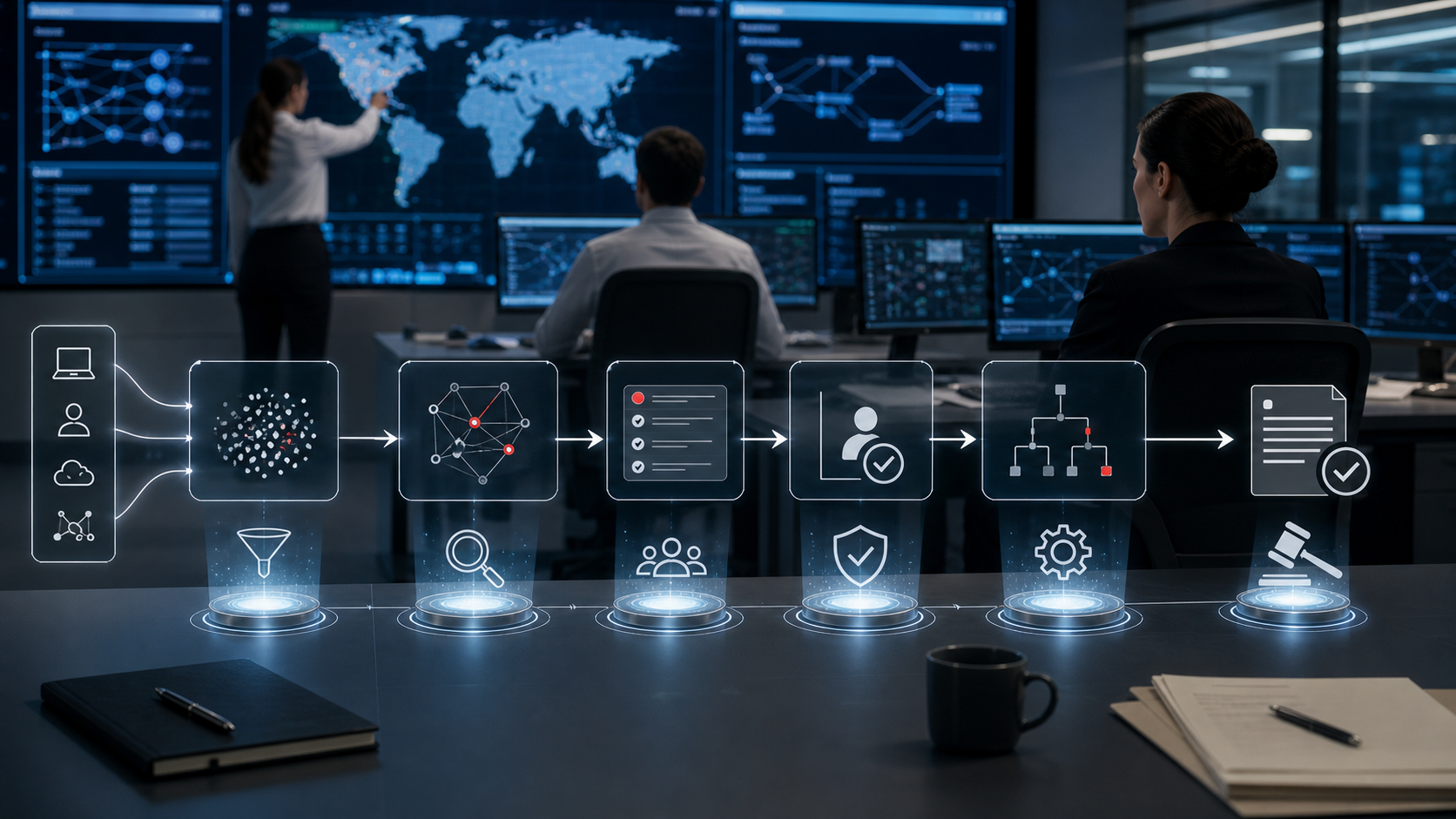
The main test is therefore not whether Taegis can see many events. It is whether it can preserve the chain between event, suspicion, scope, evidence, uncertainty, decision and action. A suspicious PowerShell command, an impossible travel login, a strange cloud API call or an endpoint process tree only becomes useful when the system can explain why the signal matters, which assets are involved, which data sources support the claim, which assumptions remain open and which action is proportionate. The action may be as modest as opening an investigation ticket, asking an owner to validate business activity or requesting more telemetry.
It may be as serious as isolating a host or disabling an account. In either case, the value lives in the record, not the alert.
Secureworks has a long security-services lineage, and that history matters. The company built its reputation around threat research, incident response and managed security operations before the market settled on XDR as a common product label. Taegis is the cloud platform that now carries much of that work. It ingests telemetry from endpoint, network, identity, cloud and third-party tools; applies detection and threat-intelligence logic; gives analysts a case environment; and exposes APIs and integrations that let customers fit it into broader response processes.
The managed service adds Secureworks analysts who monitor, investigate and advise within defined service boundaries.
The boundary is important. Secureworks is no longer a stand-alone public company in the same way it was when it filed annual reports with detailed subscriber and revenue disclosures. Sophos completed its acquisition of Secureworks in 2025, and the combined product story now includes Sophos endpoint and MDR assets alongside Taegis. That can expand telemetry and service reach, but it also makes product attribution more complicated. Buyers should not credit Secureworks for every Sophos capability, nor treat Sophos endpoint customers as proof that Taegis has solved XDR reliability.
The relevant question remains narrower: can Secureworks' Taegis-centered operations preserve a reliable decision record as signals move toward accepted security action?
The first production task is ingestion. A security action cannot be better than the evidence that reaches the platform. Taegis documentation describes a broad integration surface, including endpoint, cloud, identity, network, email, firewall and other third-party data sources. It also provides APIs for querying, investigations and related workflows. That breadth is necessary because attackers move across systems, while many customer teams are organized by tool owner. A single endpoint detection may be too thin. A cloud log line may be ambiguous.
An identity event may look routine until it is paired with endpoint behavior or a rare network destination.
But integration breadth is not the same as evidence quality. Every connector adds its own maintenance burden. Credentials expire. API permissions change. Cloud accounts are renamed, consolidated or split. Endpoint sensors fall behind on laptops that are rarely online. Firewall logs arrive with inconsistent fields. Identity logs may omit context needed to distinguish a legitimate administrator from a compromised account. If Taegis normalizes all of this into a neat case without showing what is missing, it can create false confidence. If it preserves too much raw mess, it can fail to reduce analyst work.
The useful middle ground is a case that makes scope and uncertainty visible.
That is why the accepted action record is a better unit of analysis than alert reduction. Alert reduction can be achieved by suppressing noisy events, grouping signals more aggressively or changing thresholds. Some of those changes improve security work. Others merely hide work until an incident exposes the gap. An accepted action record requires more. It must show that the signal survived enough scrutiny to justify action and that a responsible party accepted the next step. The action record becomes the place where technology, managed service and customer authority meet.
Secureworks' own managed service descriptions make that responsibility boundary visible. The managed analysts can investigate, notify, recommend and in some service tiers perform or coordinate response actions under agreed conditions, but the customer still owns environment authority, asset knowledge, business exceptions and many final decisions. That is not a weakness. It is the nature of managed security. A provider cannot safely isolate a production system, block an account, wipe a device or change a firewall policy without understanding the business consequence.
The question is whether the service design reduces the review burden enough that the customer can approve action faster and with better evidence.
The operating cost begins before the first incident. Customers must decide which telemetry sources matter, which integrations are worth maintaining, how cases should be routed, who receives escalation notices, which response actions are preapproved, and which assets require special handling. That work is often underestimated during procurement because a product demonstration can make correlation look immediate. Real security estates are uneven. They include legacy servers, unmanaged endpoints, cloud experiments, regional subsidiaries, outsourced infrastructure and systems that no one wants to reboot.
A managed XDR provider can help organize this state, but it cannot make it disappear.
Once telemetry is connected, triage becomes the core repeated task. The system must decide which signals deserve a case, how similar activity should be grouped, what enrichment is useful, and when human review is required. This is where Taegis' combination of detection logic, threat intelligence and analyst workflow can matter. A customer with limited analyst capacity does not need every raw event forwarded with a severity badge. It needs a defensible explanation: why this activity is suspicious, why it may affect these systems, what related events were seen, what the recommended next step is and how urgent the response should be.
The strongest version of Secureworks' argument is that its platform and analysts compress the early investigation cycle. Instead of a customer analyst spending half an hour switching among endpoint console, identity logs, firewall search, cloud audit trails and threat reports, Taegis can assemble the relevant evidence and a managed analyst can convert that evidence into a case. The saving is not only time. It is a reduction in decision friction.
A well-formed case gives a customer a smaller and more precise question: do we accept this recommended action, ask for more evidence, close it as expected behavior or escalate it to incident response?
The weaker version is a familiar security-market trap. The platform may generate convincing cases while still shifting review work back to the customer. If cases contain generic descriptions, broad MITRE technique labels, unclear asset ownership or weak evidence of impact, the customer still has to do the expensive part. Someone must ask whether the user was traveling, whether the host is production, whether the tool is approved, whether a developer was testing, whether a privileged account has a break-glass role, or whether the proposed containment action would break a business process. In that scenario, Secureworks has not removed work.
It has repackaged it.
The difference between those two outcomes depends on supervision cost. Security automation is rarely unsupervised in mature environments because the downside of a wrong action can be large. A false positive that isolates a laptop is inconvenient. A false positive that disables a revenue system, blocks a payment process or interrupts an industrial workflow can be far more expensive than the attack it was meant to prevent. Even when the response action is mild, customers need enough evidence to defend the decision internally. The accepted action record must therefore support supervision rather than pretend supervision is unnecessary.
Taegis' case and investigation functions are central for that reason. Public documentation shows a case workflow with stages, tasks, notes and related evidence, plus APIs that can create, update or query investigation state. That suggests Secureworks understands the work as a stateful process rather than a single alert push. Case state matters because security teams are often distributed across time zones and vendors. One analyst may open the case, another may add endpoint evidence, a customer owner may ask for business context, a responder may take action, and an auditor may later ask why the decision was made.
If the record is incomplete, the customer absorbs the cost later.
Evidence retention is more than an archive. It is part of authority. A customer can accept a security action when the case shows enough of the chain of reasoning to make the decision accountable. That includes the original signal, the time window, affected assets, enrichment, analyst notes, related detections, customer communications, action taken and unresolved caveats. If an investigation only keeps the conclusion, it fails when questioned. If it keeps every raw event without explanation, it fails when the customer needs to act quickly. The productive record is neither a black box nor a dump.
It is a compressed explanation with links back to supporting data.
That record also has to travel across systems. Many security teams do not close work inside the detection platform alone. They create service tickets, open incident channels, attach evidence to risk registers, brief system owners, preserve legal notes and update post-incident reviews. A Taegis case that cannot be connected to those downstream records leaves the customer manually retyping the most important facts. Public API and investigation documentation suggests Secureworks understands this integration need. The practical test is whether the case remains intelligible after it leaves the console.
If the ticket only says "suspicious activity detected," the integration has moved text, not judgment.
The content of the action record should be specific enough to support disagreement. A good security record is not one that forces a customer to accept the provider's conclusion. It is one that lets the customer challenge the conclusion quickly. Which account was involved? Which host? Which process? Which cloud service? Which earlier events are related, and which merely share a timestamp? Which evidence came from Secureworks detection logic, which came from the customer's telemetry and which came from external intelligence?
This distinction is especially important in a managed service, because the provider may have stronger threat expertise while the customer has stronger knowledge of business purpose.
The record should also distinguish severity from confidence. A severe possible outcome can still rest on weak evidence. A high-confidence finding can still have low business impact. Customers often get into trouble when those two ideas collapse into one red badge. The accepted action record should make it clear whether the analyst is saying "this is probably malicious," "this could be damaging if malicious," "this must be checked because the asset is sensitive," or "this action is safe enough to take now." These are different claims.
They imply different levels of supervision and different response choices.
The daily value of that discipline is quiet. It appears when a junior analyst can understand why yesterday's case was closed, when an infrastructure owner can see why a server was isolated, when a risk manager can explain the response to an insurer, or when a future incident team can search old cases for a repeated pattern. Security operations tools often sell urgency, but durable value comes from memory. A system that makes each case easier to understand next week and next quarter reduces more than alert fatigue. It reduces institutional forgetting.
Threat intelligence is another part of the value proposition, but it should be treated carefully. Secureworks' Counter Threat Unit research has long been a visible part of the company's identity. Current Sophos and Secureworks reporting gives useful context on ransomware, credential abuse, adversary tradecraft and common attacker behaviors. This can improve detection logic and analyst judgment. Yet public threat reports do not prove that a particular customer deployment will catch a particular intrusion. They show research capacity and threat awareness, not local telemetry coverage, local tuning quality or local response speed.
The same caution applies to independent evaluations. MITRE ATT&CK evaluations and managed-services exercises can help buyers understand detection behavior and reporting against known scenarios, but MITRE has repeatedly emphasized methodology boundaries rather than simple ranking. A managed XDR product that performs well in a structured evaluation may still struggle in a customer environment with missing logs, unique business processes or poor approval workflows. Conversely, a service with modest public benchmark presence may still produce strong operational value for a customer with disciplined telemetry and escalation design.
Evaluations are evidence, not a substitute for deployment proof.
Secureworks' customer evidence is useful but also limited. Vendor-published case studies and customer stories can show why buyers choose Taegis or MDR, which pain points they report, and what kinds of operating claims Secureworks can support publicly. They cannot provide a neutral denominator. They do not show the customers that churned, the incidents that were missed, the false positives that consumed time, or the integrations that took longer than planned. A fair reading treats customer stories as examples of possible operating benefit, not as statistical proof of risk reduction.
The acquisition by Sophos changes the substitute set. Before the acquisition, buyers could compare Secureworks directly against other MDR and XDR providers. After it, Secureworks sits inside a broader Sophos security portfolio that includes endpoint protection, network security, email security and MDR services. That may make Taegis more attractive to customers that already use Sophos products or want a single vendor for more telemetry. It may also raise questions for customers with heterogeneous estates: will Taegis stay equally strong as an open security operations layer, or will the best experience increasingly assume Sophos telemetry?
The answer affects integration burden and lock-in.
Lock-in in XDR is not only contractual. It is operational. Once a security team has built playbooks, escalation paths, case habits, response authorizations, dashboards, data mappings and audit routines around a platform, switching becomes expensive. The customer can export some data and retain internal knowledge, but the day-to-day muscle memory lives in the tool and service. That makes the first deployment decision important. A buyer should not ask only whether Taegis can handle this year's alert volume.
It should ask whether the platform's record structure, APIs, integrations and managed service model will still fit when cloud accounts, identity providers, endpoint tools and business units change.
The unit economics are therefore mixed. The obvious costs are subscription fees, managed service fees, onboarding, integration work, staff time and possible duplicate tooling. The less obvious costs are supervision, exception handling, response coordination, internal education, connector maintenance and the cost of false confidence. The benefits, if Secureworks performs well, include fewer unreviewed signals, faster triage, better after-hours coverage, stronger evidence packaging, more consistent escalation, less dependence on a small in-house analyst group, and potentially better containment decisions during early incident stages.
For small and midsize organizations, the value proposition can be strongest because analyst scarcity is acute. A team that cannot staff a 24-hour SOC may benefit materially from managed detection coverage and structured escalation. The alternative is often not a fully mature internal SOC. It is a patchwork of endpoint alerts, firewall emails, IT generalists and occasional consultant help. In that setting, Taegis and managed analysts can turn scattered signals into a more coherent security process. The risk is that the customer overestimates what the service can do without clean asset ownership and defined approval paths.
For large enterprises, the value is more selective. They may already have a SIEM, SOAR, threat-intelligence feeds, endpoint detection, identity analytics and internal analysts. Secureworks must then prove that Taegis adds correlation, managed expertise or case discipline that the internal stack cannot provide at comparable cost. Large customers may use Secureworks for particular coverage gaps, threat hunting, after-hours triage, subsidiary environments or overflow handling rather than as the only security operations system. The platform has to coexist with existing tools and governance rather than pretend to replace them all.
The first failure mode is missing telemetry. If an endpoint is not covered, a cloud account is not connected, identity logs are incomplete or network visibility is absent, Taegis may still create a confident case from partial evidence. A good analyst can flag the gap. A poor workflow can bury it. Missing telemetry matters because many attacks are only clear when multiple weak signals reinforce one another. A suspicious login without endpoint context may be ambiguous. A suspicious process without identity context may be ambiguous. A suspicious cloud action without asset ownership may be ambiguous.
The accepted action record must say when evidence is absent.
The second failure mode is false positive pressure. Security teams often distrust tools that create repeated urgent cases that later resolve into business-as-usual behavior. Once that trust declines, response slows. Analysts start to skim. Business owners resist containment. Executives question whether the service is worth the disruption. Secureworks can reduce this risk through tuning, enrichment, analyst review and customer feedback loops, but it cannot eliminate it. Every environment has legitimate activity that looks strange to outsiders. The service must learn the difference without becoming so permissive that it misses material change.
The third failure mode is stale or overgeneralized threat intelligence. Threat reports and detection content can guide triage, but attacker behavior changes. A label that was meaningful last quarter may be too broad today. A technique mapping can explain a behavior category without proving malicious intent. A known-bad indicator can age quickly. The action record should therefore avoid turning threat-intelligence labels into verdicts. The useful role of intelligence is to support a probability judgment, not to replace local evidence.
The fourth failure mode is customer approval delay. Managed detection can identify a suspicious host at 2 a.m., but the provider may not know whether isolation is approved, who owns the system, whether the system is part of a critical process, or whether the alert maps to an active maintenance window. If the approval chain is unclear, time is lost. Secureworks can provide a portal, escalation contacts and response guidance, but the customer must define authority before the incident. Otherwise, the action record becomes a holding pattern.
The fifth failure mode is response overreach. Automation and managed response become dangerous when the system treats probable compromise as certainty or treats a generic response as safe in every environment. Isolating a host, killing a process, revoking a token, blocking an IP address or disabling a user can be appropriate, but each action has blast radius. The more serious the action, the more the case must show why the evidence supports it, what alternatives were considered and how rollback would occur. This is where an accepted action record protects both provider and customer. It makes the decision reviewable.
The sixth failure mode is audit trail weakness. After an incident, the organization may need to answer regulators, insurers, customers, board members or internal risk committees. They will ask when the signal appeared, when it was reviewed, who was notified, what evidence was available, why a particular action was taken and whether the decision was reasonable. If the platform cannot reconstruct that sequence, it has failed one of the hidden jobs of security operations. Incident response is not finished when the host is cleaned. It is finished when the organization can explain itself.
The commercial question follows the same logic. Do better detection and managed analyst coverage exceed the costs of platform fees, tuning, customer review, integration, false positives and response coordination? For many customers, the answer may be yes, but it is conditional. It depends on telemetry coverage, internal ownership, alert discipline, clear escalation rules, integration health and the customer's willingness to let a managed provider become part of daily operations. Buying Secureworks without those foundations is like buying a control tower while leaving aircraft registration, runway status and pilot authority undefined.
The cost side is also uneven over time. Onboarding can be intense because the customer has to connect systems, map contacts, set policies and agree response expectations. The middle period can be efficient if cases are clear and tuning improves. Later, costs can rise again as the customer's environment changes. A merger adds new identity domains. A cloud migration changes log sources. A new endpoint product changes telemetry quality. A cost-cutting program removes staff who understood asset ownership.
Each change can reopen the question of whether Taegis is seeing enough and whether Secureworks analysts have enough context to recommend action.
This is why connector drift is a commercial issue, not merely a technical one. A broken or degraded integration can make the managed service look worse than it is, but the customer still pays for the result. If a cloud connector loses a permission, if an endpoint sensor stops reporting, if a network integration changes fields, or if a ticketing integration silently fails, the accepted action record becomes thinner. The customer may discover that problem only after an incident or a missed escalation. Buyers should therefore treat connector health reporting and ownership as part of the price of the service.
False positives have a similar economic shape. A single false positive is tolerable. A recurring false positive becomes a tax on every review meeting and escalation contact. It trains business owners to resist the next recommendation. It makes internal analysts less willing to trust managed-service conclusions. It can also cause executives to ask whether the provider is inflating urgency to prove value. Secureworks can counter this with tuning and analyst feedback loops, but the buyer must measure recurrence, not just closure. A case closed as benign is not harmless if it keeps returning.
The benefits are also uneven. After-hours coverage can be worth more than daytime triage for an organization with no overnight SOC. A high-quality case record can be worth more than a faster notification for a regulated customer that must explain decisions. Response guidance can be worth more than automatic action for a company with fragile systems. The economic case is strongest when the service removes the customer's most expensive repeated task, not when it performs the most impressive-looking task in a demonstration.
Substitutes fall into several groups. A customer can build around a SIEM and SOAR stack, with internal analysts writing detections and playbooks. That can preserve control and flexibility, but it requires skilled staff and ongoing engineering. A customer can rely more heavily on an endpoint vendor's MDR service, which may provide strong endpoint-driven response but weaker cross-tool neutrality. A customer can use a cloud provider's native security tooling for cloud workloads, which may be efficient inside one cloud but less complete across hybrid estates.
A customer can outsource more of the SOC to a managed security provider, which may reduce staffing pressure but create dependence on service quality and escalation design.
The in-house SIEM/SOAR substitute is appealing to mature teams because it allows custom detections, custom data models and direct control over response playbooks. It can also become its own maintenance sink. Engineers must keep parsers working, tune rules, manage storage cost, normalize fields, maintain dashboards, write playbooks and staff the review queue. The buyer who compares Secureworks against an internal build should price the engineering backlog honestly. A cheaper license can still be expensive if the organization cannot keep the system current.
The endpoint-led MDR substitute is attractive because endpoints are often the richest source of early compromise evidence. Endpoint containment can also be easier to automate than broader network or identity response. The weakness is that many incidents are not endpoint-only. Cloud control-plane abuse, identity compromise, business email abuse and SaaS misuse can move beyond the endpoint lens. Secureworks' broader XDR claim is valuable only if those sources are connected and interpreted well. If the customer mostly wants endpoint response, a narrower endpoint MDR service may be simpler.
The cloud-native substitute is useful for organizations concentrated in one cloud provider. Native tools can understand cloud resources, identity roles and service events in a way generic tools may struggle to match. The limit appears in hybrid estates and multi-cloud operations. Many real environments include on-premise systems, multiple identity paths, SaaS applications, third-party endpoints and outsourced infrastructure. Taegis has to earn its place by crossing those boundaries without flattening their differences.
Traditional managed security providers remain a substitute, especially for customers that want people more than platform. A service-heavy provider may adapt to customer politics and legacy environments more flexibly. The risk is that manual service without a strong shared platform can produce uneven records and slower handoff. Secureworks' bet is that platform plus analysts is better than either alone. The customer should test that claim by examining the record after cases close, not by counting how many service layers are promised.
Secureworks' differentiation is strongest when the customer values an XDR platform combined with a mature managed detection service and threat-research heritage. It is weaker when the customer needs a single-vendor endpoint stack with minimal integration, a pure SIEM engineering platform, or deep custom incident response capacity on demand. Taegis is not a magic layer above all security work. It is an operating environment whose value appears when repeated investigations can be turned into clearer, faster, more accountable decisions.
The Sophos combination could improve the product if it gives Taegis more endpoint depth, more response coverage and a broader service organization without narrowing the platform's openness. It could hurt the product if roadmaps, branding or integration priorities make it harder for customers to understand where Secureworks ends and Sophos begins. Buyers should watch product documentation, service terms, integration support and customer references for that reason. A security operations platform can survive brand changes, but customers need stable contracts, stable APIs and stable escalation behavior.
Another issue is measurement. Security buyers are often tempted to ask for proof that a platform prevented breaches. That is difficult to prove honestly. Absence of a breach is not proof of a tool's effectiveness, especially when attacker interest, business profile and environment maturity vary.
A better measurement set is operational: time from signal to case, percentage of cases with complete asset context, percentage of cases that require customer rework, response actions accepted without further evidence, false-positive recurrence, mean time to customer acknowledgement, connector health, after-hours escalation success and audit completeness after closed incidents.
Those measures are less glamorous than marketing claims, but they are closer to the work. If Taegis consistently shortens the path from signal to justified action, customers should see fewer open-ended investigations and less analyst fatigue. If it merely changes where alerts are viewed, customers will see the same review burden under a new label. The difference will appear in weekly operations, not in a demo.
Secureworks' public documentation gives reason to believe the company understands the statefulness of the problem. The presence of investigation APIs, case workflows, response-action documentation, managed service descriptions and status information all point to a product built around ongoing operations rather than one-off detection. The public financial filings before the Sophos acquisition also showed a business transition toward subscription and Taegis annual recurring revenue, which indicates that the platform was central to Secureworks' growth strategy before the acquisition.
That does not prove customer outcome, but it does explain why Taegis is the right surface to examine.
The public evidence also leaves important gaps. It does not show a neutral sample of customer deployments. It does not reveal false-positive rates, missed detections, average connector-maintenance hours, escalation failures, or the percentage of recommendations customers accept without further investigation. It does not show whether newer Sophos integrations materially improve the record quality for customers that do not standardize on Sophos endpoint products. It does not show whether managed analyst recommendations differ meaningfully from what a strong internal SOC would produce with the same telemetry.
Those are the questions a buyer should test in a pilot or reference process.
A serious pilot should be designed around accepted actions, not alert counts. The customer should connect representative telemetry, define ownership for a sample of important assets, predefine which response actions are allowed, and track each case from initial signal to closure. It should measure how often Secureworks' record contained enough evidence for the customer to act, how often analysts had to ask for missing context, how often business owners disputed the recommendation, and how often the same type of false positive recurred.
The pilot should include after-hours escalation and at least one exercise that tests approval under time pressure.
The same pilot should test data portability and integration health. Can the customer query investigation state through documented APIs? Can cases sync cleanly into the customer's ticketing or response system? Can the platform show connector health and gaps? Can the customer preserve enough case evidence for audit after service changes? Can internal analysts review and challenge the reasoning? These questions matter because security operations platforms become part of institutional memory. A customer that cannot inspect or export enough of that memory has created a new risk while buying a risk-control service.
For procurement teams, the pricing question should be linked to work removed. A lower-cost tool that sends ambiguous alerts to a scarce team may be more expensive than a higher-cost managed service that produces accepted action records. Conversely, a premium service that still requires customers to redo the investigation is expensive theater. The economic comparison should count analyst hours, incident-response retainer use, business owner interruptions, compliance reporting, false-positive fatigue, integration maintenance and staff coverage gaps. The product price is only one part of the unit cost.
The most realistic positive case for Secureworks is not full autonomy. It is disciplined delegation. The customer delegates the first layers of monitoring, correlation, triage and evidence packaging to Taegis and Secureworks analysts. The customer retains authority over business context and high-impact actions. The service succeeds when that division is clear enough that both sides move faster. It fails when the provider sends generic conclusions and the customer must reconstruct the evidence, or when the customer expects the provider to act without preapproved authority.
That division is also the best defense against overclaiming AI or automation. The market now attaches those words to almost every security product, but security operations is full of exceptions, partial evidence and business-specific consequences. Automated correlation can make a case stronger. Automated enrichment can save time. Automated response can be valuable under carefully bounded conditions. None of that removes the need for review when the action could disrupt operations. Secureworks should be valued where automation supports a better human decision, not where it implies that uncertainty has vanished.
Secureworks' likely buyer is not choosing between perfect autonomy and manual work. It is choosing how much of the repeated investigation burden to move into a specialized platform and managed service. If Taegis can keep a high-quality record, the customer gets more than an alert feed. It gets a repeatable path from suspicion to decision. If the record is weak, the customer pays twice: once for the platform and again for internal analysts to repair the reasoning.
The verdict is therefore conditional but clear. Secureworks is strongest when judged as a production-action reliability company for security operations. Its value depends on whether Taegis and its managed analysts can preserve evidence, uncertainty and responsibility through the messy middle of investigation. That is a more demanding test than alert volume and a more useful one for customers. A suspicious signal has little value until it becomes a justified action. Taegis earns its place when the customer can accept that action with enough confidence to move, enough caveat to avoid overreach, and enough record to explain the choice later.