
Summary
- Olivenet Network is best understood through the Olin retail brand on the Costa del Sol: a regional fibre and mobile provider whose buyer promise is fast local installation, own-network coverage, nearby shops, multilingual service and seasonal flexibility rather than only a headline Mbps tier.
- The public record supports a real access and routing operation: Spanish corporate records, Olin's coverage and product pages, field-job listings, group acquisition materials, RIPE and PeeringDB records for AS201746, and CNMC market data all point to a local fibre platform that has grown beyond a small niche.
- The unresolved hinge is whether the same public signals prove scalable customer quality or mainly show a support-heavy coastal business competing in one of Europe's densest fibre markets. More transparent churn, fault, install and satisfaction data would change the judgement faster than another advertised speed tier.
The first sale is not speed; it is getting the apartment live
Picture a family arriving in Marbella for a long summer stay. The parents work part of the week from the apartment. One child streams in the evening. Another joins language classes over video. The building has a locked utilities room, a part-time administrator, neighbours who have already chosen different providers, and an owner who will not be in Spain after September. The buyer sees a simple decision: fibre, mobile lines and television.
The provider sees a different account: an address check, an installation slot, access to shared ducts, a router handover, a support language preference, a seasonal billing expectation, possible cancellation in autumn and the question of whether the same customer will return next year.
That is the right way to read Olivenet Network. Publicly, the customer-facing brand is Olin. The English site sells broadband, mobile, OlinTV and alarms, and the fibre page lists 600 Mbps and 1 Gbps offers, with the 600 Mbps fibre plan shown at EUR24.90 a month at retrieval and the 1 Gbps plan at EUR29.90 a month (https://olin.es/en/fiber/). The fibre and mobile bundle page adds combined offers, including a 600 Mbps fibre plus mobile line option and a 1 Gbps fibre plus mobile option, again presented as clear monthly consumer bundles rather than bespoke wholesale service (https://olin.es/en/fiber-mobile/). Those prices are the visible surface. The hidden cost is the physical and human work needed to make a coastal fibre account behave like a low-friction utility.
Olin's own coverage page turns that hidden cost into sales language. It says the broadband coverage is built on its own proprietary network, highlights Malaga and the Costa del Sol, names towns such as Marbella, Estepona, Fuengirola, Benalmadena and Mijas, and says installation can be completed in under a week with a Malaga-based support team (https://olin.es/en/coverage/). The Marbella store page uses similar local language, offering broadband, mobile and Wi-Fi service in Marbella, Nueva Andalucia, Puerto Banus and San Pedro de Alcantara and presenting a local shop as part of the service promise (https://olin.es/en/store/internet-broadband-mobile-marbella/). The store finder lists physical shops across places such as Alhaurin el Grande, Coin, Estepona, Fuengirola, Malaga, Marbella, Mijas, Nueva Andalucia, San Pedro de Alcantara and Torremolinos (https://olin.es/en/stores/). A national operator can put a tariff online. A Costa del Sol access provider that wants loyalty from residents, landlords, foreign owners and small hospitality accounts has to make the shop, phone line and installer feel reachable.
The economics are coastal rather than generic. On the Costa del Sol, demand is not distributed evenly through the year. Second homes fill, empty and fill again. Holiday rentals create high-use weeks followed by low-use months. Small hotels need the connection to feel invisible during peak season and immediately fixable when it fails. Remote workers are unforgiving about video latency because the line is part of their income. Expatriate households may not want to navigate Spanish-only support when a router fails. Olin's "Pause Service" page is therefore more than a perk: it allows fibre customers to pause billing for up to 180 days per year, keep the contract, pay only for active days and reactivate after a minimum period of 10 days (https://olin.es/en/pause-service/). That product makes little sense in a purely year-round urban market. It makes immediate sense in a coastal market where occupancy and revenue are seasonal.
The same page also hints at churn management. A pause option can lower near-term revenue, but it may preserve the account through the empty months instead of forcing a cancellation, router return, later re-sale and another installation visit. That is the central economic trade. The ISP accepts some seasonality in billings to avoid losing the relationship altogether. For a provider carrying the fixed costs of GPON rollout, building access, field vans, routers, support staff, peering, transit and shop rent, the highest-value customer is not the one who pays one summer invoice.
It is the customer who returns, resumes and stays within the local footprint long enough for the installation and support work to pay back.
A Marbella legal shell became Olin's local fibre platform
The legal and ownership record matters because Olivenet's buyer promise depends on whether it is only a local brand or part of a bigger access platform. Empresite, using Informa commercial data, lists Olivenet Network S.L. with CIF B93340198, incorporated on 8 July 2014, legal form "sociedad limitada unipersonal", CNAE 6110 for telecommunications by cable, wireless and satellite, and activity described around fibre optic, mobile and security services (https://empresite.eleconomista.es/OLIVENET-NETWORK.html). DatosCif similarly identifies Olivenet Network S.L. in Malaga and shows later registry acts, including a 2024 move to Calle Pepita Barrientos 7 and 2026 corporate-administration changes involving Tuca Bidco S.L. (https://www.datoscif.es/empresa/olivenet-network-sl). These mirrors are not a substitute for a paid registry extract, but they place the company in a Spanish corporate frame rather than treating Olin as only a web label.
The acquisition record is clearer. In October 2022, Asterion Industrial Partners announced that Olin Group, with Teras Capital, had acquired Olivenet, described as a local fibre-to-the-home operator in Andalusia and especially the Costa del Sol, with a full fibre network, more than 30,000 subscribers, about 130 employees and 14 points of sale at that time (https://www.asterionindustrial.com/asterion-industrial-further-expands-rural-fibre-footprint-in-spain-in-partnership-with-teras-capital-and-acquires-olivenet/). Olin's own group site described the deal as a strategic purchase that would strengthen a southern Spain fibre platform, saying Olivenet had a presence in Malaga and Cadiz and that the wider group would have more than 100,000 clients, more than 500,000 homes passed, 14 shops and over 320 employees after the combination (https://olingroup.es/en/acuerdo-compra-olivenet/). Those numbers were deal-stage claims, not current audited accounts, but they show why the target matters. Olivenet was not just a small Costa del Sol retail desk; it was a network and customer base large enough to anchor a regional platform.
The official corporate trail around the deal appears in the Spanish business registry bulletin. The BORME issue of 16 August 2022 included the appointment of Olin Midco S.L. as sole shareholder of Olivenet Network S.L. and related corporate changes (https://www.boe.es/borme/dias/2022/08/16/pdfs/BORME-A-2022-155-29.pdf). Later commercial mirrors show Tuca Bidco S.L. in the administration record, which fits the broader private-equity ownership context. For the article's purpose, the important point is not the financing structure. It is that Olivenet's access footprint became part of a consolidation play in rural and coastal Spanish fibre.
The Olin jobs site supports that platform reading with a different kind of evidence. It says the company has more than 189 colleagues, 80,000 families that trust it every day, 14 physical points of sale, 12 years of history and 11 provinces reached by its own fibre network (https://jobs.olin.es/jobs). A June 2026 operations and maintenance technician listing in Malaga describes field work on customer connections, network maintenance, installations, incident repair and work with fibre equipment (https://jobs.olin.es/jobs/7537466-tecnico-de-o-m-malaga). A July 2026 FTTH installation and maintenance lead listing describes responsibility for the deployment, operation and maintenance of FTTH networks, plus coordination of field teams, subcontractors, deadlines, quality and incidents (https://jobs.olin.es/jobs/7613714-responsable-de-i-m-ftth). Recruitment pages are not audited operating statements, but they reveal what the company has to keep hiring for: the expensive middle layer between a web tariff and a working fibre account.
Local press adds another useful signal. SUR in English reported in 2023 that Olin Group, based in Marbella, planned to move its headquarters to a building in Malaga TechPark, with capacity for about 450 employees and an ambition to centralise its activity while continuing to expand beyond Malaga (https://www.surinenglish.com/malaga/malaga-city/marbella-technology-company-sets-up-headquarters-malaga-20231012160619-nt.html). A later SUR report in 2024 said Olin planned a headquarters at Malaga TechPark and described the company as a Malaga-born telecom group with expansion into other provinces (https://www.surinenglish.com/malaga/malaga-city/malaga-technology-park-welcome-new-headquarters-with-20240617160956-nt.html). Local press should be read as company-development context, not proof of service quality. It nonetheless supports the same thesis: Olivenet's Costa del Sol footprint sits inside a growing Andalusian fibre operator, not a static neighbourhood ISP.
GPON scale shows up in prices, stores and field jobs
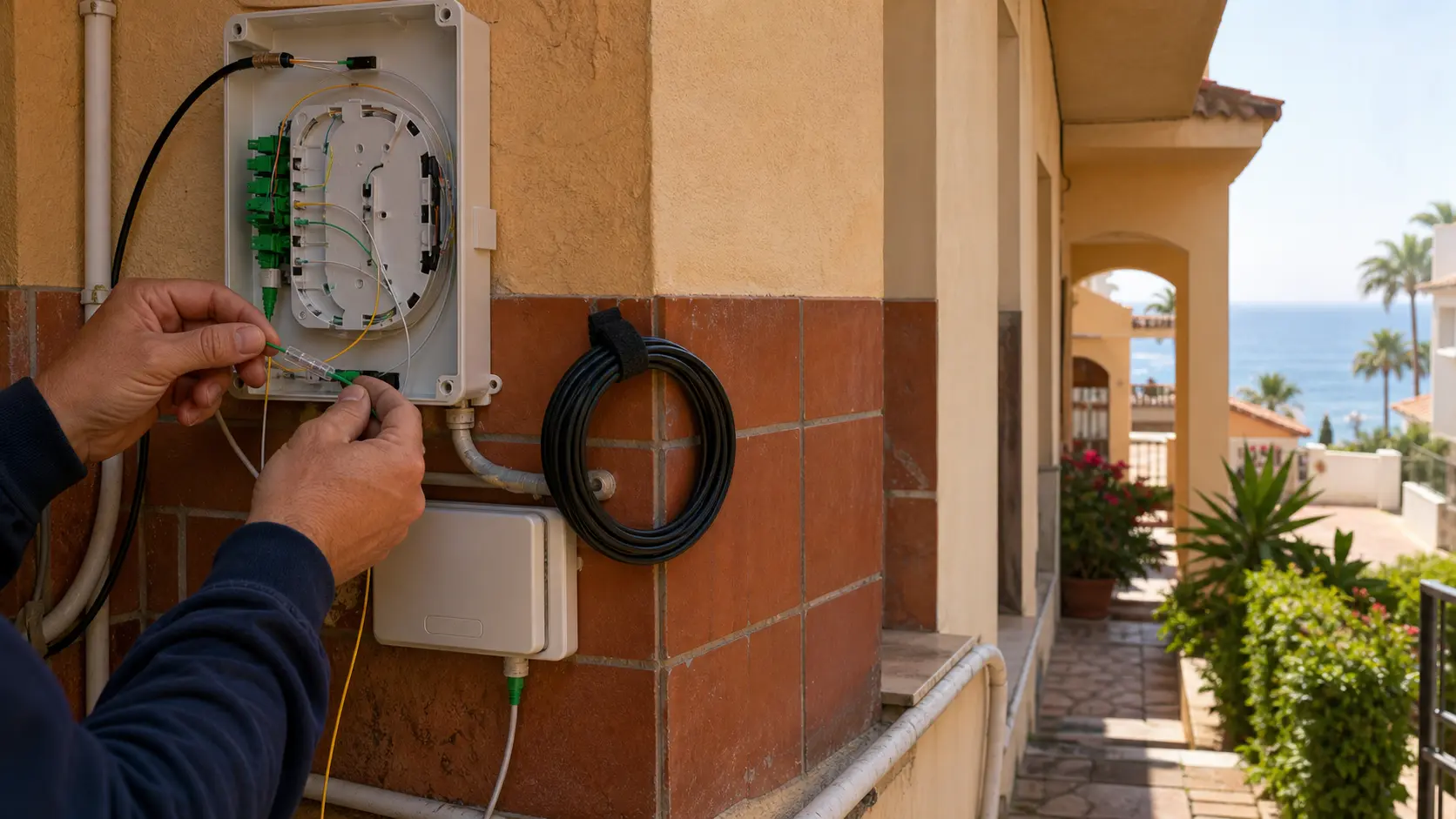
The public tariff makes Olin look simple. A household sees 600 Mbps, 1 Gbps, optional mobile, television and alarms. But a GPON access business is not simple. The operator has to pass buildings, get into buildings, manage optical splitters, splice fibre, keep records accurate enough for new orders, install ONTs or routers, explain Wi-Fi limits, swap failed equipment, repair accidental cuts and keep upstream capacity ahead of evening load. The customer pays monthly. The operator spends in lumps.
Olin's standard fibre conditions PDF helps explain the cost shape. The document identifies Olivenet Network S.L.U. as the provider, gives the Malaga address, and sets general conditions for contracted fibre services, installation and customer obligations (https://olin.es/wp-content/uploads/2023/07/condicionesgenerales-fibra-0723.pdf). The details are legal language, but their business meaning is practical: fibre is a service delivered through equipment, installation appointments, address-specific conditions and ongoing support, not a purely digital subscription. The same contract area of the Olin site includes mobile terms, privacy and promotion documents, which shows a retail stack that combines fixed access, mobile resale or mobile service arrangements, customer data handling and product bundling (https://olin.es/en/contract-and-promotion-terms/).
The field-job evidence is especially important because it links scale to labour. A GPON rollout only creates value if the provider can convert passed premises into installed, paying accounts. The Malaga technician listing asks for work on network maintenance, customer installations, fault repair and connection tasks (https://jobs.olin.es/jobs/7537466-tecnico-de-o-m-malaga). The FTTH lead listing describes deployment, maintenance, field-team management and incident coordination (https://jobs.olin.es/jobs/7613714-responsable-de-i-m-ftth). These are the line items a retail price hides. A EUR24.90 or EUR29.90 monthly fibre plan does not leave much room for repeated visits, failed access, wrong contact numbers, missing building keys, non-standard router placement or a second-language support call that lasts 40 minutes.
Physical stores are another cost that also works as a moat. Olin's shop list across Malaga and Costa del Sol towns gives the operator a visible local footprint (https://olin.es/en/stores/). That can reduce anxiety for older customers, recent arrivals, second-home owners and small businesses that would rather walk into a store than negotiate an online-only help form. It can also lower acquisition cost in towns where trust moves through neighbours, property managers and local-language communities. But stores have rent, staffing, inventory and training costs. A shop is useful only if it converts local trust into retained accounts or higher-value bundles.
The bundle logic is visible on Olin's product pages. Fibre alone is one sale. Fibre plus mobile, television, alarms or Wi-Fi coverage is a broader household account (https://olin.es/en/fiber-mobile/). The company also sells WiFi Coverage+ as a way to improve coverage inside larger homes, difficult walls or multi-room layouts (https://olin.es/en/wifi-coverage-plus/). That matters for the Costa del Sol because the fault the customer reports as "the fibre is bad" may really be a router position, thick wall, holiday-rental floor plan, old device, saturated 2.4 GHz band or poor mesh placement. If Olin can solve that with a paid or bundled in-home Wi-Fi product, it protects the relationship. If it cannot, the customer's frustration attaches to the broadband brand even when the GPON line is not the root cause.
The carrier has to manage router logistics as part of churn. A coastal account that pauses, resumes, changes tenant, changes owner or cancels after a holiday season creates equipment and support work. A self-install mobile broadband product can sometimes avoid the appointment. Fibre cannot. Even when the optical drop already exists, the customer still needs provisioning, router activation, Wi-Fi credentials, service education and a way to resolve faults. This is why "installed in under a week" is commercially meaningful (https://olin.es/en/coverage/). It is not just a service promise. It is a claim that the field and provisioning system is organised enough to turn demand into revenue before the customer chooses a substitute.
Seasonal homes turn churn into a product problem
Seasonality is not a footnote for a Costa del Sol provider. It is part of the product design. Olin's holiday Wi-Fi blog page is written for people renting or using homes during vacation periods, and it frames internet as essential for guests, streaming, security cameras, remote work and family connection (https://olin.es/en/blog/wifi-for-holidays/). The pause-service page goes further by letting customers stop paying for fibre when they are not at home, for up to six months per year, while keeping the contract and reactivating later (https://olin.es/en/pause-service/). Those pages are stronger evidence of coastal economics than a national broadband ranking would be. They reveal that Olin is trying to monetise irregular occupancy without forcing the customer into a cancel-and-return cycle.
The churn problem has three layers. First, there is voluntary churn: the second-home owner cancels after the summer because paying for an empty apartment feels wasteful. Second, there is involuntary churn through friction: the owner wants to keep the service but cannot get reactivation, billing or support handled easily from abroad. Third, there is reputation churn: a property manager, neighbour or local Facebook group reports that a connection was difficult to install or cancel, and future customers choose a different provider before Olin has a chance to sell.
A pause service directly attacks the first layer and indirectly helps with the second. It does not solve the third if support experiences become poor.
The product is financially clever but operationally demanding. If many customers pause at the same time, revenue dips while the fixed network remains in place. Fibre splitters, backhaul, shops, field staff and customer systems do not pause. Yet the option may still be profitable because reacquiring a lost coastal customer is expensive. A returned customer may need a new router, a new appointment or renewed confidence. A paused customer can be reactivated inside the existing relationship. The best version of this model uses seasonality to improve retention. The worst version reduces revenue while keeping all support obligations.
Tourism and second homes also change how service failure is felt. A permanent resident may tolerate a repair window if communication is clear. A holiday apartment has a narrow revenue window. A small hotel or serviced apartment cannot tell guests that the internet will be fixed next week. A remote worker may have one important video meeting. Olin's local-store and Malaga support positioning is therefore part of the service, not brand decoration. A buyer on the Costa del Sol is often buying certainty that somebody nearby can act before the stay is over.
This also explains why multilingual support matters. The Olin site is available in English and Spanish, and the retail pages are clearly written for non-Spanish-speaking customers as well as local households (https://olin.es/en/). A local ISP in Marbella that cannot support English-speaking homeowners leaves revenue on the table. But language support is labour. It requires staff, training, scripts, escalation paths and consistency. Every additional language can lower sales friction and raise customer satisfaction, but it also increases the cost of support if the provider cannot automate or standardise enough of the work.
The public record does not disclose Olin's churn rate, seasonal pause take-up, average pause length, reactivation success rate, router-return cost or support cost by language. Those are the facts that would make the economic judgement much sharper. The product design, however, tells us that the company sees seasonality as a problem to be priced and managed. In a market full of fibre overbuild, that may be as important as another speed upgrade.
Multilingual support is a sales promise and a wage bill
Olin's Costa del Sol value proposition depends on local support because many of its buyers are not only Spanish urban broadband shoppers. The English website addresses individual consumers and businesses, provides product pages in English, and promotes shops and customer-service access (https://olin.es/en/). The Marbella store page speaks directly to the local customer in an area where foreign residents, property owners, hospitality workers and remote professionals are a material part of demand (https://olin.es/en/store/internet-broadband-mobile-marbella/). The company does not need to say "expatriate strategy" for the economics to be visible. English-language retail pages, shops in coastal towns and seasonal pause features already show the audience.
Support labour is the biggest hidden variable. In a fibre market, the customer's problem may be no signal, slow Wi-Fi, a faulty router, an unpaid bill, a mobile SIM activation, a television box, a property access issue, a language misunderstanding or a mismatch between the advertised speed and the device being tested. If the provider handles those contacts well, it retains accounts that a national call centre might lose. If it handles them badly, the local brand loses the one advantage it had over larger carriers.
Market chatter should be treated carefully, but it is useful for identifying the stress points. Trustpilot's current Olin page shows a mixed profile, with many recent customers praising named staff, shops or quick installation while other reviewers complain about cancellation, billing, outages or support frustration (https://www.trustpilot.com/review/olin.es). A separate older Trustpilot page for olivenet.es shows earlier customer comments under the predecessor domain (https://www.trustpilot.com/review/olivenet.es). Broadband forum discussion on BandaAncha includes users comparing Olin with other fibre options and debating service experiences (https://bandaancha.eu/foros/opiniones-compania-olin-1753881). These are not representative samples, and they cannot prove failure rates. They do show what support-heavy churn looks like from the outside: the issue is rarely only Mbps; it is installation, cancellation, communication and whether someone solves the problem.
Third-party comparison pages add another non-audited but relevant signal. Roams presents Olin as an Andalusian operator offering fibre, mobile, television and security, and summarises current-looking tariffs and customer-service channels (https://roams.es/companias-telefonicas/olin/). Marbella Family Fun lists Olivenet as a local internet provider for Marbella residents and visitors, an older community-style reference that shows how the brand entered the English-speaking local market (https://www.marbellafamilyfun.com/olivenet.html). Right Casa's Costa del Sol property-services page similarly references Olin in a local-property context (https://rightcasa.com/services/internet/olin/). None of these pages should be treated as operational proof. Together they show the channel through which Olin's reputation travels: customer review sites, property-service recommendations, local forums, shops and resident networks.
That reputation channel has a harsh economic feature. A national operator can absorb some bad comments because its brand is everywhere and many customers have no practical alternative at a given address. A local fibre provider wins by being closer, clearer and more flexible. If customers start associating the brand with hard cancellations, slow fault handling or confusing bills, the local advantage turns into a liability. Conversely, if nearby staff solve installation problems quickly, the same public chatter becomes free sales work.
The strongest public evidence of professionalisation is Olin's hiring and platform growth, not the review average. The jobs site, 14-store footprint and group materials show a company trying to scale the support and field layer (https://jobs.olin.es/jobs). The unresolved question is whether scale improves the customer experience or stretches it. A small team can be personal but fragile. A larger regional platform can invest in systems, backhaul and training, but it can also become more bureaucratic. The Costa del Sol buyer is paying to find out which version shows up at the door.
Peering makes the local account a wider network operation
The access story is local, but the network story is wider. RIPE RDAP lists AS201746 as OLIVENET-AS, with Olivenet Network S.L. as the registrant and a Marbella address in the contact record (https://rdap.db.ripe.net/autnum/201746). RIPEstat's AS overview for AS201746 identifies the holder as "OLIVENET-AS Olivenet Network S.L." and showed the AS as announced on 5 July 2026 (https://stat.ripe.net/data/as-overview/data.json?resource=AS201746). RIPEstat's announced-prefixes view for the same observation window showed 78 announced prefixes, with route visibility caveats noted by the service (https://stat.ripe.net/data/announced-prefixes/data.json?resource=AS201746). BGP.Tools also identifies AS201746 with Olivenet Network S.L. and displays the public routing view (https://bgp.tools/as/201746).
Those records do not prove customer throughput. They do not reveal contention, paid transit terms, packet loss, outage history, access-ring design or oversubscription. But they matter because they show routing control. A local fibre ISP that operates its own autonomous system can manage addressing, peering, upstream choices and routing policy in ways a pure reseller cannot. That control does not guarantee quality. It gives the operator more knobs to tune when a video service is slow, a transit path is congested or a content route needs improvement.
PeeringDB adds scale clues. Its public network record for AS201746 names Olivenet Network, aka OliveNet, lists the website as olivenet.es, classifies the network as Cable/DSL/ISP, shows an open peering policy, Europe scope, IPv6 support, three exchange presences, five facility presences and a traffic band of 100-200 Gbps (https://www.peeringdb.com/api/net?asn=201746). The exchange-presence data lists operational presences at ESpanix Madrid Lower LAN, DE-CIX Marseille and DE-CIX Madrid, with 100G entries in Madrid and a smaller Marseille entry at retrieval (https://www.peeringdb.com/api/netixlan?asn=201746). The facility data lists sites including Digital Realty Madrid MAD1-2 and Templus DC Malaga MAL01, alongside Amsterdam, Frankfurt and London facilities (https://www.peeringdb.com/api/netfac?net_id=13262). This does not mean every Costa del Sol apartment receives a premium path to every service. It means the company has a visible interconnection footprint beyond the local street cabinet.
The Malaga facility signal is particularly relevant. A Costa del Sol fibre provider with Malaga interconnection can keep part of its operational gravity closer to the customer region while still using Madrid and European exchange points for broader reach. That matters when the customer expectation is not merely "the speed test says 600 Mbps" but "my video meeting, streaming service, cloud backup, gaming session and television box all work in the evening." Peering and transit are invisible to most households until they fail. For an ISP, they are recurring costs and operational discipline.
Network-resource evidence also changes the scale question. Olivenet is not just a brand that buys a wholesale access line and resells it under a local name. The AS, route and PeeringDB records support a more substantial network operation. The caution is equally important: routing records show potential control, not end-user satisfaction. A company can have a real AS and still mishandle appointments, billing or Wi-Fi support. The Costa del Sol account is judged at the apartment, not in a peering database.
Overbuild means the customer can compare patience against price
Spain is one of the toughest markets in which to sell fibre as a differentiated product because fibre availability is already high and price competition is intense. CNMC's June 2026 monthly telecom note for May 2026 said Spain had more than 18 million fixed broadband lines, that FTTH represented the overwhelming majority of fixed broadband lines, and that the three largest operators plus DIGI accounted for more than 94 percent of the fixed broadband market (https://www.cnmc.es/sites/default/files/editor_contenidos/Notas%20de%20prensa/2026/20260625_NP_Mensual%20telecos%20mayo%202026.pdf). CNMC's 2025 telecom review highlighted continued fibre growth, mobile-bundle competition and the pressure created by low-cost challengers (https://blog.cnmc.es/2026/06/22/diez-claves-telecomunicaciones-2025/). This is the structural challenge for Olin: even with a local network, the customer compares its offer against national and low-cost alternatives.
Geographic fibre data reinforces the point. CNMC's March 2026 fixed-broadband geography report said 17.9 million fixed broadband accesses were active in Spain at the end of June 2025, and that 17.1 million were FTTH, or 95.5 percent of all fixed broadband accesses (https://www.cnmc.es/prensa/geografico-banda-ancha-fija-20260305). The Ministry's broadband coverage report for June 2025 similarly frames Spain as a country with extensive very-high-capacity network coverage and provides province and municipality detail for coverage analysis (https://avancedigital.mineco.gob.es/banda-ancha/cobertura/Documents/Cobertura-BA-2025.pdf). For a Costa del Sol household, the question is often not "can I get fibre at all?" It is "which fibre provider can install, explain, support and pause the account with the least friction?"
This shifts competition away from pure speed. Olin can advertise 600 Mbps and 1 Gbps, but so can many larger rivals in some form. The more defensible claim is local execution: own-network coverage in the customer's town, a nearby shop, quick installation, English-language help, seasonal pause, Wi-Fi coverage help and a bundle that keeps mobile, fibre and television under one local relationship. The risk is that every element of this differentiation costs money. A large national operator has call centres, scale purchasing, national marketing and wholesale leverage.
A local operator has proximity, but proximity is expensive if every marginal account needs extra human handling.
The regulator's numbers also expose a growth ceiling. When fixed broadband is already heavily fibre-based and concentrated among major operators, a regional ISP grows by taking accounts in specific towns, converting passed homes, bundling services and keeping churn low. It cannot rely on a wave of unserved urban demand. On the Costa del Sol, there is opportunity in new developments, property churn, foreign buyers, hospitality refreshes, Wi-Fi upgrade needs and dissatisfaction with bigger providers. But there is also constant price comparison.
AOTEC, the Spanish association for local telecom operators, describes local operators as providers that have historically helped bring fibre and connectivity to towns and rural or semi-rural areas, with proximity and local support as part of their role (https://aotec.es/en/about-us/). Olin fits part of that pattern, but with a coastal twist. It is not only serving remote villages. It is serving a tourist, residential and business corridor where local support must coexist with highly competitive fibre alternatives. That makes the business more complex than a simple rural-coverage story.
The buyer decision therefore becomes a patience-price trade. A customer may accept a slightly higher price, a local shop or a bundle if the provider answers in the right language, enters the building quickly, solves Wi-Fi issues and lets the account pause in winter. The same customer may leave quickly if cancellation is hard, billing is confusing or an installation misses the promised window. In an overbuilt fibre market, patience is part of the product. Providers spend it every time they ask a customer to wait.
Reviews and forums describe the fragile part of the promise
Unofficial customer signals should never be promoted to audited fact. They are often skewed toward the angry, the unusually happy or the recently frustrated. Still, for a local fibre provider, they are valuable because they identify where the economic promise breaks. Olin's Trustpilot page contains positive comments about individual staff, helpful shops and quick installation, but also complaints about cancellations, billing, outages and support handling (https://www.trustpilot.com/review/olin.es). The older olivenet.es Trustpilot page provides a predecessor-domain memory, with mixed comments from before or around the brand transition (https://www.trustpilot.com/review/olivenet.es). BandaAncha forum discussion similarly shows customers comparing Olin with alternatives and debating real-world experience (https://bandaancha.eu/foros/opiniones-compania-olin-1753881).
The analysis should not ask whether every complaint is fair. The useful question is which complaints align with the business model's weak points. Cancellation complaints matter because a seasonal market has more stop-start behaviour than a year-round urban base. Billing complaints matter because pause, reactivation, bundles and mobile lines make the account more complex than single-service fibre. Outage complaints matter because local support is supposed to be the moat. Installation praise matters because fast connection is one of Olin's core promises. Shop praise matters because physical presence is expensive but can create trust.
Third-party pages aimed at Costa del Sol residents and property owners show why those signals travel. Marbella Family Fun's Olivenet page sits in a local resident and visitor information environment (https://www.marbellafamilyfun.com/olivenet.html). Right Casa presents Olin in a property-service context, the kind of channel that can influence foreign buyers, landlords and tenants (https://rightcasa.com/services/internet/olin/). Roams presents Olin in a Spanish telecom-comparison context, summarising tariffs and support channels for shoppers who may never visit an Olin store (https://roams.es/companias-telefonicas/olin/). The company therefore lives in two reputational markets at once: the local recommendation network and the national comparison market.
That dual market increases churn risk. In the local recommendation market, one property manager can influence many apartments. In the national comparison market, one bad review score can send a shopper to a larger operator. Olin's response has to be operational, not rhetorical. The company needs enough field capacity to keep installation promises, enough multilingual support to explain complex accounts, enough billing discipline to make pause and reactivation predictable, and enough network investment to keep evening performance credible during peak tourist weeks.
The public evidence supports the existence of the machinery, but not its quality at every address. The stores, jobs, AS201746 records, product pages and group-growth materials all support a real local access business. The review and forum signals show that the fragile part is not whether Olin sells fibre. It is whether the local promise can be delivered consistently across a broader footprint while preserving the intimacy that made the brand useful on the Costa del Sol.
The hinge is whether scale lowers friction before churn rises
The weakest evidence hinge is not the existence of Olivenet Network or the Olin fibre proposition. The public record is sufficient on that point. The company record, acquisition announcements, Olin pages, hiring, physical shops, regulatory market context and network-resource data all support a real regional access business with Costa del Sol roots. The hinge is whether those public signals support a scalable local-access platform or mainly a support-heavy niche in a brutally competitive Spanish fibre market.
The positive case is coherent. Olin has local origin, English and Spanish retail surfaces, a shop network, an own-network coverage claim across Malaga and the Costa del Sol, seasonal pause design, fibre and mobile bundles, a visible FTTH hiring layer, AS201746 routing control and interconnection at Madrid, Marseille and Malaga-linked facilities. It has the attributes a regional ISP needs to compete against national carriers on friction rather than only price.
If installation under a week is reliable, if pause reactivation is smooth, if multilingual support is strong and if peering investment keeps evening services stable, the coastal account can be profitable even when the monthly plan looks cheap.
The negative case is also coherent. Spain's fibre market is dense, low-priced and concentrated. Larger operators and low-cost challengers can keep pressing tariff expectations down. A seasonal customer base can reduce monthly revenue while still consuming support. Physical stores and multilingual staff make the brand more approachable but raise fixed costs. Review-site and forum complaints, while not representative, cluster around the exact pressure points that hurt a local ISP: cancellation, billing, outages, communication and install friction.
If Olin expands faster than its support and field systems, the local advantage can dilute into ordinary telecom frustration.
The facts that would change the judgement are specific. Subscriber count by active and paused accounts would show how much seasonality the business carries. Churn by month and reason would show whether pause reduces cancellations or simply delays them. Installation completion rates, missed appointments, mean time to repair and repeat-visit rates would test the under-a-week promise. Router return, replacement and support-ticket costs would show whether coastal logistics are controlled. Customer satisfaction by language, shop and town would reveal whether multilingual support scales.
Network utilisation, local outage history and evening performance data would test whether AS and peering control translate into reliable end-user experience. None of those figures are visible in the public record.
Until those facts are disclosed, the honest judgement is balanced but not vague. Olivenet Network, through Olin, appears to be more than a support-heavy niche: it has real network resources, a regional footprint, a consolidation story and a product set tailored to Costa del Sol demand. But the same evidence shows a business whose differentiator is expensive to maintain. The line between moat and burden runs through installation patience, seasonal account design, multilingual support, router logistics, peering discipline, field repair and churn. That is why the Costa del Sol fibre account is the right unit of analysis.
The buyer thinks they are choosing a speed tier. Olin is trying to price the whole operating system behind that choice.