
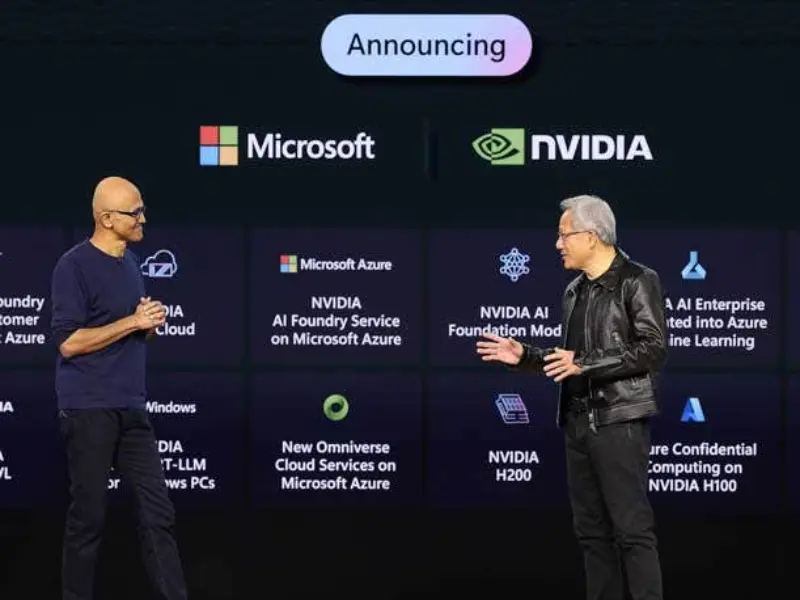
- Microsoft is developing a new network card to boost the performance of its Maia AI chip, aiming to reduce dependence on Nvidia products.
- Led by Pradeep Sindhu, co-founder of Juniper Networks, the project is part of Microsoft’s strategy to enhance its AI capabilities and reduce costs associated with Nvidia.
- This move reflects a broader trend in the tech industry towards developing alternative solutions in semiconductor technology.
February 20th news, tech giant Microsoft is developing a new network card to enhance the performance of its AI chip Maia, ultimately aiming to reduce reliance on Nvidia products. The report cited an insider stating Microsoft CEO Satya Nadella has appointed Pradeep Sindhu, co-founder of communications equipment giant Juniper Networks, to lead the network card project. Last year, Microsoft acquired Fungible, a data centre chip startup founded by Sindhu.
The process may take over a year
Fungible‘s core product, the DPU (Data Processing Unit), is the third crucial computational chip in data centre scenarios after CPU and GPU. The new network card being developed by Sindhu’s team aims to resemble Nvidia’s ConnectX-7 network card, primarily to boost server throughput. The development process may take over a year, but if successful, it could potentially shorten the time required for OpenAI to train models on Microsoft servers and reduce training costs.
Currently, the AI chip market is largely dominated by Nvidia, with the H100 recognised as the most needed GPU for training large language models. The company often sells ConnectX-7 network cards with its GPUs, such as the integrated accelerator “H100 CNX,” which combines H100 with ConnectX-7 to provide robust performance for I/O-intensive applications.
According to Nvidia’s official website description, ConnectX-7 supports ultra-low latency, 400Gb/s throughput, and innovative Nvidia network computing acceleration engines, providing additional acceleration for supercomputers, AI, and large-scale cloud data centres’ required high scalability and feature-rich technology.
Also read: Investors punish Microsoft, Alphabet as AI disappoints
The high price is the main driver for developing alternatives
However, due to the high price of the H100 system, which has brought significant wealth to Nvidia and its CEO Huang Renxun, it has also led AI developers like OpenAI and Meta to consider alternatives. In November last year, Microsoft launched its first AI chip, Maia 100, aiming to reduce its expensive reliance on Nvidia. There were also reports last week that OpenAI’s Altman is raising a total of up to $7 trillion in funding from the Middle East to support the company’s semiconductor plan, competing with Nvidia. In response, Huang Renxun stated that he believes the chip industry will drive down AI costs in the future.