
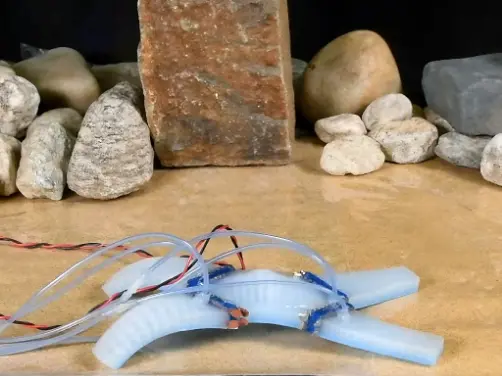
- Roboticists at Yale University’s Faboratory have developed soft robots capable of self-amputation and fusion.
- These innovations could lead to shape-shifting robots that adapt to various challenges by changing their structure.
OUR TAKE
These soft robots, with their ability to self-amputate and fuse, highlight the potential for creating adaptable, resilient machines. As robotics continues to evolve, it’s crucial to balance these technological advancements with ethical considerations and regulatory oversight to ensure their safe integration into society. The line between fascination and fear is thin, and it’s up to us to navigate this frontier thoughtfully.
–Doris Du, BTW reporter
Roboticists at The Faboratory at Yale University have unveiled a breakthrough in soft robotics, enabling robots to replicate some of the more unsettling abilities seen in nature, such as self-amputation and body fusion. These advancements highlight the potential for robots to adapt dynamically to their environments in ways previously thought impossible.
What happened
In a demonstration video, a soft quadruped robot is shown crawling when a falling rock traps its back leg. The robot then uses a heated reversible joint to amputate its leg and escape. Although not shown in the video, the limb can be reattached. Another video features three crawler robots fusing together to bridge a gap between tables, achieving this by heating and softening their joints with an electric current.
Also read: ‘Luobo Kuaipao’: Fear and excitement as China embraces robotaxis
Also read: Tesla postpones robotaxi event, needs time for redesigns
Why it’s important
These capabilities, while not entirely new to robotics, represent a significant innovation due to the use of bicontinuous thermoplastic foam and a sticky polymer in the joints. Unlike traditional rigid mechanical connections, these materials allow for the joints to be melted and reattached, providing flexibility and adaptability. According to Spectrum IEEE, this advancement could lead to robots that can radically change their shape and function, enhancing their utility in various fields.
Personal perspective
The development of these soft robots is both fascinating and unsettling. The idea of a robot autonomously amputating a limb or merging with others to overcome obstacles evokes a mixture of awe and unease. It challenges our perceptions of what robots can do and how they might integrate into our lives. Imagine a search-and-rescue robot that can shed damaged parts or merge with others to navigate through debris—this is no longer science fiction but a rapidly approaching reality.