
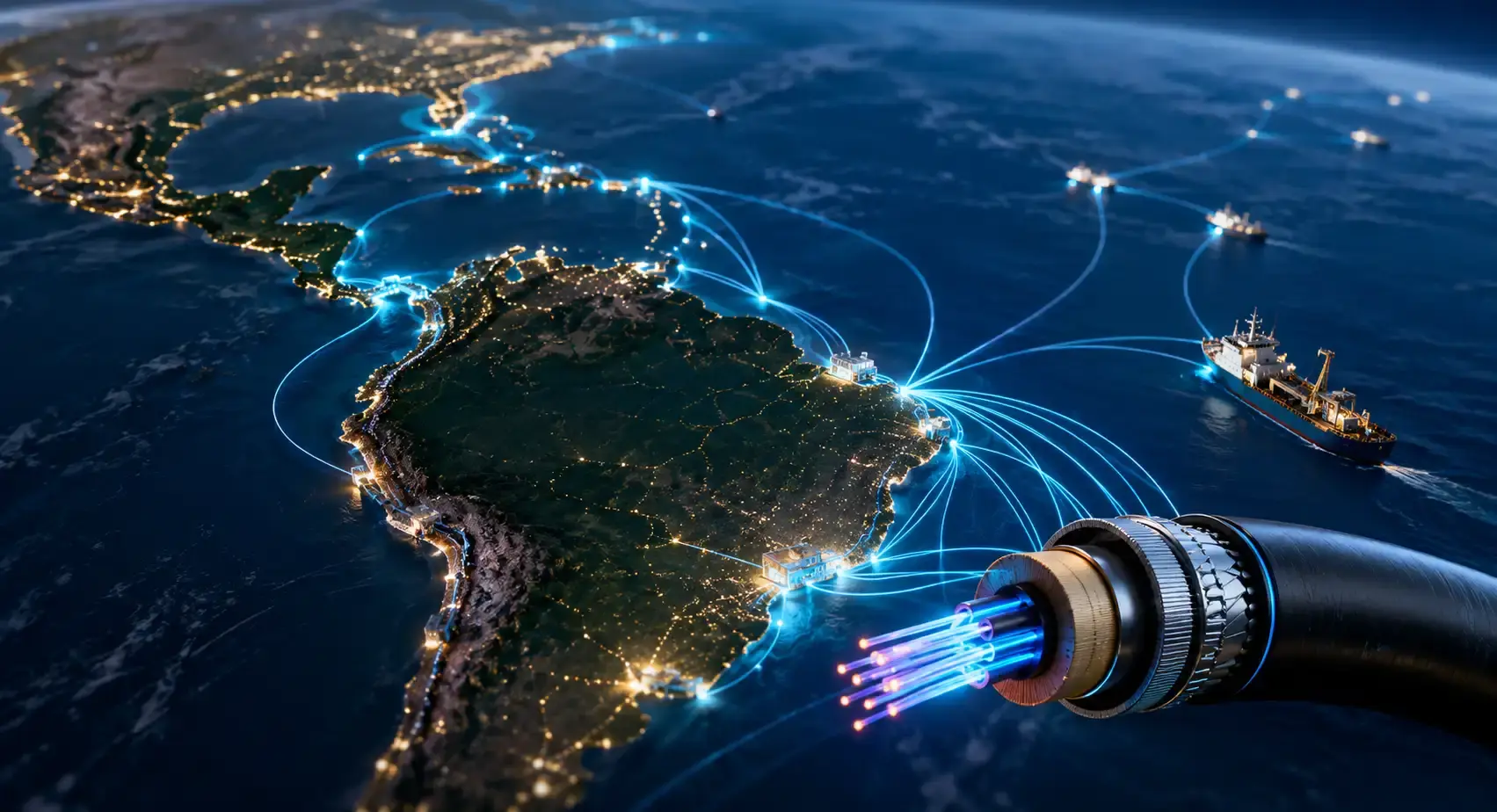
Global data growth, digitalisation and AI demand are pushing Latin America into a submarine cable expansion and modernisation cycle. Padtec has returned to the wet plant market, DXN is entering South America with a modular landing station contract, and France is discussing an early-stage Caribbean cable project through its development finance channel. The signal is that Latin America is becoming a growth pole for submarine cable suppliers, landing station providers and state-backed infrastructure capital.
• Padtec returns to subsea wet plant with LEV Brasil acquisition
• State capital and modular landing stations reshape cable deployment
The fact
Global data growth, digitalisation and AI demand are pushing Latin America into a submarine cable expansion and modernisation cycle. The region’s existing cable network is ageing, limited in parts and short of redundancy. Brazil’s Padtec has returned to the wet plant market through Padtec Marine Networks and its acquisition of LEV Brasil, targeting coastal festoon systems while discussing African and Caribbean opportunities. Australia’s DXN is entering South America with a modular cable landing station for an unnamed global internet company, due in Q1 2027.
France is also discussing the early-stage Omnibus cable for Caribbean French territories.
The Assessment
Latin America has historically been a cable endpoint, not a production hub. Existing networks are ageing and short of redundancy at a time when AI, hyperscale cloud and regional digitalisation are driving bandwidth demand faster than legacy capacity can handle. That gap is now pulling supply-side activity into the region: Padtec is returning to wet plant manufacturing, DXN is introducing modular landing stations, and new deployment models are emerging. Established vendors such as Ciena, Infinera, Xtera and Huawei are all present, joined by an Asian network equipment vendor eyeing the region.
The shift is early-stage regional supply-chain expansion, and it marks the first time Latin America is attracting submarine cable manufacturers rather than simply buying their product.
What to Watch
Watch whether Padtec converts African and Caribbean talks into contracts, whether hyperscaler identity emerges behind DXN’s landing station contract, whether Omnibus moves into engineering design, and how the Asian vendor enters Latin America.
Signal Brief
- Signal: Latin America subsea cable boom mobilises suppliers
- Region:
- Market Class: Latin America and Caribbean National Telecom Trends
Market Context
- The event matters because submarine cable redundancy, landing capacity and supplier availability shape latency, reliability and cloud infrastructure growth across Latin America.
- Operational relevance: Medium
- Time Horizon: Next quarter
Member Briefing
Deeper Trend Context
Sign in with the right membership level to unlock the full briefing and source notes.
Only for Strategic Circle
Strategic Circle
Open to all readers. Unlock trend briefings after joining and signing in.
Join Strategic CircleOnly for Leadership Alliance
Leadership Alliance
For operators, investors, and policy teams that need relationship evidence, failure paths, and source notes. Sign in to unlock.
Join Leadership AllianceSnapshot
Category
Latin America and Caribbean National Telecom TrendsOptical transport technology provider returning to the subsea wet plant market through Padtec Marine Networks and LEV Brasil.
Content Type
Signal BriefingPrimary Domain
MarketTopic
InfrastructureImpact
MediumThe event matters because submarine cable redundancy, landing capacity and supplier availability shape latency, reliability and cloud infrastructure growth across Latin America.
Confidence
High confidence (89%)Confidence score guide
Published reporting