
Summary
- PT Universal Internet Service has more than a name-only public footprint: APNIC/IDNIC records associate AS63877 and 103.54.226.0/23 with the company in Kendari, Southeast Sulawesi, and RIPE RIS saw 103.54.227.0/24 originated by AS63877 on 10 July 2026.
- The first-party Universal Kendari site describes a local internet-access business with 2 Mbps, 3 Mbps and 5 Mbps monthly packages, lent Wi-Fi modems, a Kendari address, 24x7 NOC/support claims, and old 2015 notes about BTS work at Ranomeeto and Abeli.
- The downgrade is in the resilience evidence. Public BGP shows one visible upstream neighbour, AS149409, while the 2015 APNIC routing-policy text names a different older upstream, AS38146. No public source verifies route diversity, tower independence, backup power, spare equipment, crew depth, or present customer availability.
- The category remains defensible as a regional-ISP profile, but only in a narrow and evidence-bound sense: a small Kendari access network with live routing, stale retail copy, and unproven physical recovery, not a verified multi-city broadband platform.
The proof starts with a route, not a coverage map
PT Universal Internet Service is easiest to overstate if the word "regional" is treated as a scale claim. The public record supports a narrower reading. The company appears as a Kendari-based internet-number holder, it has a live autonomous-system route, and its own Universal Kendari website describes access services. That is enough to analyse it as a local connectivity operator. It is not enough to claim a broad Sulawesi network, a dense fixed-wireless footprint, or tested resilience.
The strongest company-specific record is the APNIC/IDNIC registration. The APNIC whois record for AS63877 names "PT Universal Internet Service," uses the as-name IDNIC-UNIVERSALKENDARI-AS-ID, describes the company as a corporate or direct IDNIC member, and places it in Kendari, Sulawesi Tenggara. The same record gives the contact and abuse mailbox at universalkendari.net. A separate APNIC whois record for 103.54.226.0/23 assigns that portable IPv4 block to the same company, with an address on Jl. Saranani No. 168, Korumba Mandonga, Kendari.
Those records establish legal and network-administrative identity. They do not reveal the access medium, tower sites, customer count, backhaul circuit, pole route, service quality, or whether the same access network sold in earlier website copy remains active in the same form. A national internet registry can show who holds the number resource; it cannot show whether a home in Abeli can be installed this week, whether a Ranomeeto relay still exists, or how many field technicians are available after a storm.
Live route collectors add a second, more current layer. RIPEstat's AS overview for AS63877 marked the system as announced at the 10 July 2026 query time. Its announced-prefixes result showed one current prefix, 103.54.227.0/24, visible from 26 June 2026 through the 10 July 2026 cut-off. The routing-status result for 103.54.227.0/24 showed the prefix visible to all 327 RIS IPv4 peers in that response and originated by AS63877. The prefix-overview response likewise tied the announced prefix to PT Universal Internet Service.
That is credible current network evidence. It says the company, or a network acting for it, was still presenting a public IPv4 route through the global routing system on the cut-off date. The evidence is still small. A single /24 is 256 IPv4 addresses before reserves, customer NAT, management uses and infrastructure addresses. It can serve many subscribers if customers sit behind private addressing, or very few if the block is used for business circuits, servers, radios and routers. The address block is therefore a boundary marker, not a subscriber meter.
The route also tells us what is absent. RIPEstat's routing status for 103.54.226.0/24 showed that sibling /24 was not visible at the cut-off and had last been seen in July 2025. RIPEstat's routing status for the covering 103.54.226.0/23 showed the /23 itself was not visible, although 103.54.227.0/24 was a more-specific active route. The RPKI validation response was valid because a ROA covered 103.54.226.0/23 with max length /24 for AS63877. That is good hygiene for the active route, but it does not create redundancy.
The right opening conclusion is therefore moderate. PT Universal Internet Service has current routing proof and historical retail claims. Its visible public operating surface is not empty. But the available proof is thinner than a modern broadband operator profile would normally require: no current service-order test, no published coverage map, no tower inventory, no fibre map, no licence page located in the public pass, no customer measurements, and no public outage or maintenance history.
The first-party site shows a local access offer, but it is stale
The Universal Kendari website is the clearest public explanation of what the company says it sells. Its top bar gives a Kendari phone number, mobile number and [email protected]. Its package section advertises monthly internet tiers called Fast, Gamers and Surfing at 2 Mbps, 3 Mbps and 5 Mbps download speeds, each with unlimited access and a lent Wi-Fi modem. A dedicated option asks the reader to call or email. The contact section names "PT.Universal internet service," lists Saranani No. 168, Kendari - Sultra, and gives mobile contacts.
The website also describes service positioning in a way that matters for infrastructure analysis. It says UniversalNet wants to provide reliable internet service, competitive price, technical and non-technical support, and a 24x7 Network Operation Center. It says the company uses several backbones for international, regional and national networks. It says it offers residential and corporate internet, monitors connections with MRTG, and uses Indonesia Internet Exchange IIX-JK2 and NICE/OpenIXP to support stable and fast connections.
Those statements are useful because they identify the access business that sits behind the route. They are also old. The page footer says Copyright 2017, and the HTTP response inspected at the cut-off returned a last-modified timestamp from April 2017. The "Latest News" items are dated January and February 2015. One says a new BTS had been built in Ranomeeto. Another says a BTS at Abeli provided free internet for a school and residents nearby. These are valuable clues about physical access points, but they are not current operating proof.
The access package speeds also date the offer. If the 2 Mbps, 3 Mbps and 5 Mbps tiers are still the live retail menu, the service is a narrowband lifeline or small-office backstop by 2026 standards, not a substitute for fibre, cable or modern fixed-wireless broadband. If the company has upgraded capacity since the page was last modified, that upgrade is not publicly documented on the page. The article therefore treats the listed packages as historical or stale first-party retail copy, not as a current price book.
That distinction changes how the monthly bill should be read. A low monthly access bill in a small city is not just paying for internet capacity. It is also paying for a chain of operational promises: a customer-premises receiver or router, a local field visit when the link fails, power at the access point, a working backhaul route to the edge, and at least one upstream path to the wider internet. The company can be a real access operator even if each customer receives only modest bandwidth. It cannot be described as resilient unless those physical and operational layers are visible and testable.
The site gives the best evidence for the "Local support labour" topic. It repeatedly emphasises technicians, helpdesk availability and a 24-hour support posture. But it does not publish crew numbers, service-level commitments, spare-part inventory, tower access rules, after-hours escalation, generator runtime, or an outage history. A reader should therefore understand the site as a claim of local support capacity, not proof that the capacity is sufficient for a multi-site outage.
The geography is Kendari first
The company name in the registry may begin with "ID," but the geography in the company-specific evidence is much more precise: Kendari, Southeast Sulawesi. APNIC places the resource holder at Jl. Saranani No. 168, Korumba Mandonga, Kendari. The first-party website uses the same Saranani address and frames the brand as Universal Kendari. Its old news items point to Ranomeeto and Abeli, two localities around the Kendari urban area and its surrounding service environment.
That geography matters because a local ISP's economics are place-bound. A national carrier can absorb a failed access site, reroute across a backbone, or roll a contractor crew from a neighbouring city. A small Kendari operator may depend on a few masts, rooftops, customer-premises routers, and the practical ability of local staff to reach a site when a link drops. The distance from the office to the access point, the route around traffic or flooding, the availability of tower access, and the time needed to replace a radio can decide whether a small business loses an afternoon or a day.
The site gives a limited customer-surface signal through its "Our Work" tiles. In the internet tab it names Balai Karantina Ikan, Polres Kendari, Elnusa and PT Jamkrindo. Elsewhere it lists CCTV, program and event examples. These tiles should not be treated as current contracts. They are undated and sit on a page whose visible news is from 2015. They do, however, show the type of local demand the company wanted to serve: public-sector sites, local businesses, security-camera projects and small institutional connectivity rather than anonymous national mass-market broadband.
That is why the article keeps the "regional ISP" category, but not the larger implication that might be read into it. The evidence supports a regional or local access-provider lens because the operator has Indonesian number resources, a Kendari address, and a first-party retail/support page. The evidence does not support a statement that the company covers Southeast Sulawesi broadly, serves every district around Kendari, or operates multiple independent city rings. The safer phrase is "small Kendari access operator with a visible public route."
There is also a national demand context. APJII reported that Indonesia had 221.56 million internet users and 79.5 percent penetration in its 2024 survey. That does not say anything specific about PT Universal Internet Service's subscribers. It does explain why small access networks still matter: national adoption is high enough that reliability is not a luxury, yet local installation, support and backhaul still differ sharply between districts and technologies.
For a household or shop, the most important service area is not the name of the province. It is whether the operator can complete a standard installation at that address, whether the customer-premises router can be replaced quickly, whether the access point has clear line of sight or working fibre, and whether the upstream route remains available when the neighbourhood has power trouble. None of those address-level answers is public for PT Universal Internet Service. The geography is identifiable; the working footprint remains unverified.
Installed capacity and usable capacity are different
The first-party packages are almost deliberately modest: up to 2 Mbps, 3 Mbps and 5 Mbps download speeds. A customer reading those numbers in 2015 might have compared them against weak mobile data or slow DSL. A customer reading them in 2026 would ask whether the page is stale, whether dedicated business service is the real offer, or whether the operator has moved to a different product set without updating public copy.
Installed capacity is the equipment and route that can carry traffic. Usable capacity is what customers experience when radios, fibre backhaul, upstream transit, customer-premises equipment and support all work at the same time. A /24 route and an access package list say very little about busy-hour throughput. A tower sector can be installed and still be congested. A route can be announced and still sit behind an undersized backhaul circuit. A modem can be lent to a customer and still fail because of unstable local power, poor indoor wiring or a weather-damaged outdoor link.
RIPEstat's routing history for 103.54.227.0/24 provides a useful reminder. The prefix was broadly visible through 2026, with one shorter low-visibility period around 18-21 June in the returned history, before returning to broad visibility. That observation is not an outage report, because route-collector visibility can change for reasons unrelated to end-user service. Still, it shows that public BGP visibility is a signal to watch, not a guarantee of customer experience.
The resource split is also important. APNIC assigns 103.54.226.0/23 to the company, but at the cut-off RIPE RIS saw only 103.54.227.0/24 as active. That does not mean the unused sibling /24 is wasted, abandoned or unavailable. It means it cannot be used as current evidence of live capacity. The inactive sibling may be reserved, internally routed, temporarily withdrawn, or simply unused. For infrastructure analysis, only the announced route should count as publicly visible internet capacity.
RPKI validity improves trust in the route. It makes accidental or malicious origin mismatch less likely for the route covered by the ROA. It does not answer the customer questions that matter after a fault. Does the access point have a spare radio? Is there a backup power source? Does the company have an alternate upstream? Can the helpdesk see packet loss, signal strength and customer equipment status before dispatching a technician? Are customers moved to another sector when one BTS goes down? None of that is available in the public record.
This is where a small ISP's economics become visible. A modest access bill can be viable if the operator keeps site rent low, reuses a compact number of access points, maintains a small but responsive field team, and buys enough upstream capacity for peak demand. The same economics can become fragile if one backhaul link, one route provider, one technician or one equipment vendor becomes the hinge. The public evidence places PT Universal Internet Service on that hinge; it does not prove the hinge is reinforced.
The upstream story has a live route and an old policy record
Peering and transit are the clearest part of the current evidence and the clearest reason not to overstate resilience. RIPEstat's ASN-neighbours result for AS63877 showed one left-side neighbour: AS149409. APNIC's whois record for AS149409 identifies that system as PT Core Digital Network, an Indonesian internet service provider. RIPEstat's AS overview for AS149409 marked it as announced at the same cut-off, and PeeringDB's API result for AS149409 identified a network named cdnIX with an open general policy and a website at cdnet.id.
For AS63877, the public PeeringDB picture is thinner. PeeringDB's network query for AS63877 returned no network record, and its netixlan query for AS63877 returned no public exchange LAN entries. That absence does not prove that PT Universal Internet Service lacks exchange access. Many small networks do not maintain PeeringDB profiles, and exchange access can be indirect through an upstream. It does mean that the first-party website's IIX-JK2 and NICE/OpenIXP language cannot be converted into a visible AS63877 peering session.
APJII's own pages explain why the claim matters. APJII describes IDNIC as the national internet registry for Indonesia and says IIX is meant to unite ISP networks so domestic traffic does not have to travel out of Indonesia and then return. The APJII home page says IDNIC administers IP addresses for Indonesia and its FAQ describes IIX and meet-me-room services. The IDNIC "how to get IP address" page also treats network diagrams, service-provider agreements, IXP peering agreements and ISP licences as evidence that may support number-resource requests. In other words, exchange connectivity is a real infrastructure lever, not just a marketing badge.
OpenIXP's current public dashboard adds context: it shows national exchange traffic measured in terabits per second and thousands of ASNs in its current display. That does not place AS63877 on OpenIXP. It does show that domestic exchange paths are a meaningful part of Indonesian internet economics, and that a local access provider's customer experience may depend on whether Indonesian destinations are reached locally, through an upstream exchange handoff, or through longer transit paths.
The old APNIC aut-num text introduces a caution. The AS63877 record still contains 2015 routing-policy text importing from AS38146 and defaulting to AS38146. RIPEstat's as-routing-consistency result showed AS38146 in whois but not BGP, and AS149409 in BGP but not whois, at the queried time. That is not a finding of wrongdoing. Registry policy records can be stale, incomplete or maintained differently from live BGP operations. For resilience, though, the discrepancy means the public record does not show a clean, documented upstream design.
The live path is therefore a single visible upstream relationship. One visible neighbour is not identical to one physical circuit. AS149409 could deliver redundant circuits, diverse handoffs or upstream protection behind its own AS. It could also represent one practical route dependency. Public BGP cannot distinguish those cases. The evidence needed to upgrade the assessment would include a second visible upstream, a direct exchange LAN record, current AS-set and route-policy documentation, or a public design statement showing physically separate upstream paths.
Failure path one: the access site fails
The first-party site's old BTS notes are the only public access-site clues. A January 2015 note says a new BTS had been built in Ranomeeto. A February 2015 note says "BTS ABELI" provided free internet for a school and nearby residents. In an Indonesian ISP context, BTS can refer to a wireless access or relay site. The notes therefore support the idea that PT Universal Internet Service used local radio infrastructure, but they are not a current inventory.
An access-site failure would be felt before the route table changed. A rooftop sector, mast, small tower, switch, outdoor radio, surge protector, power supply or backhaul dish can fail while AS63877 remains visible globally. Customers behind that site would lose service even though the prefix still announces normally. Conversely, a route withdrawal could disconnect customers even if every local radio was powered and aligned.
The public record does not reveal whether Ranomeeto and Abeli were independent sites, whether they shared backhaul, whether either remained active after 2015, or whether they had overlapping coverage. It also does not reveal whether the company used owned towers, leased tower space, rooftop hosts, municipal structures, poles or customer relays. Each ownership boundary changes recovery. A company-owned mast can be repaired as soon as the crew and parts arrive. A leased tower or rooftop may require landlord access, safety clearance, lift equipment or a third-party technician.
The site claims that UniversalNet had trained staff and a 24-hour helpdesk. That matters after an access failure, because small wireless and fibre networks often recover through local knowledge: which customer premises can see which sector, which cable route floods, which router has a spare power supply, which tower owner answers after hours, and which field worker can reach a site safely. But a claim of support is not a recovery plan. The missing evidence is a public support window with response targets, a maintenance notice history, spare equipment policy, and any documented failover from one access point to another.
For the reader, the practical test is simple. If a BTS or local fibre leg fails, do customers have an alternate access path, or do they wait for field repair? A second sector on the same mast may improve capacity but not site independence. A second upstream route may protect internet exit but not access failure. A spare modem may fix the customer edge but not a tower outage. The public sources do not show which layer PT Universal Internet Service can protect.
Failure path two: local power cuts the chain
Electricity is the quiet dependency in every access network. The customer router needs power. A wireless receiver or fibre terminal needs power. A roof-mounted radio may be fed through power over Ethernet from inside the premises. A BTS needs power for radios, switches and backhaul equipment. The routing edge and upstream handoff need power. A battery at one layer does not keep the full path alive if the next layer is dark.
There is no public source showing backup power at PT Universal Internet Service's office, access sites or customer equipment. That absence is normal for a small operator's website, but it limits the resilience grade. A 24x7 NOC claim does not show battery runtime. A live BGP route does not show generator access. A low-cost access package does not show whether the customer modem can ride through a neighbourhood outage.
General resilience guidance is useful here because the missing questions are standard. CISA's Ten Keys to Obtaining Resilient Local Access Networks warns that circuits sold as redundant can still share a common physical path and recommends diverse routes, diverse terminations and diverse technologies where the service is critical. CISA's Emergency Communications Systems Value Analysis Guide asks operators to size primary and backup power, choose between batteries and generators, test starts and loads, and verify fuel arrangements. CISA's Resilient Power Best Practices describes the dependency between internet, fibre, wireless, backup communications and power at critical sites.
Indonesia's InaRISK portal also reminds operators that network geography sits inside layered hazards such as flood, extreme weather, earthquake, landslide and multi-hazard maps. The article does not use that portal to make a site-specific Kendari hazard claim. It uses it to frame the evidence gap: a local ISP claiming reliable support should be able to explain how its access points, crews and upstream paths behave when the surrounding environment is stressed.
The power question also reaches the customer. A business can have a working ISP route and still go offline if the customer-premises Wi-Fi modem loses power. The Universal Kendari package copy says Wi-Fi modems were lent to customers. That raises practical questions: what is the modem's power draw, does the installation include surge protection, are customers advised on small UPS sizing, and can the helpdesk tell the difference between a premises power problem and a network fault? No public source answers those questions.
Failure path three: one visible upstream
The route evidence points to one visible upstream neighbour. That is enough for internet reachability, but it is not enough for proven redundancy. If AS149409 is the only practical upstream and the handoff fails, AS63877's public route could disappear or become unreachable. If the access network depends on a transport path from Kendari to a distant interconnection site, a fibre cut, power outage, router failure or commercial suspension could interrupt service without any local BTS fault.
The first-party website says the company used several backbones and had IIX-JK2 plus NICE/OpenIXP support. That language may have been accurate at the time it was written. The current public route data does not show several visible upstreams for AS63877. The old APNIC policy text names AS38146, while the live collector sees AS149409. The public PeeringDB record for AS63877 is empty. The correct evidence-bound conclusion is not that the company has no diversity; it is that diversity is not visible.
This matters for the monthly bill because transit is the part of local internet service customers rarely see. A household notices the Wi-Fi name, a router light and maybe a speed test. The operator has to pay for transport and upstream reachability. If a small access operator buys one upstream because the customer base cannot support two, prices can stay lower but the failure domain narrows. If it buys two independent paths, the retail bill may need to carry the cost of duplicate circuits, router ports, colocation, engineering time and failover testing.
An indirect exchange path can still be valuable. If AS149409 carries domestic traffic to Indonesian exchange points and keeps popular destinations local, PT Universal Internet Service customers may receive better latency and lower transit cost even without a direct PeeringDB exchange entry. But indirect exchange benefit is different from AS63877 having its own exchange port or direct peering sessions. The first can improve economics; the second would be stronger evidence of autonomous control.
The resilience test should therefore ask for specific proof. Is there a second transit provider? Are there two physically separate paths out of Kendari? Are the paths on different poles, ducts or towers? Do the circuits terminate in different buildings or provider routers? Has failover been tested during a maintenance window? Does the operator keep a lower-capacity emergency route for support and essential traffic? Without those details, a live AS and a valid ROA prove reachability, not survivability.
Field repair is a capacity layer
For small ISPs, repair labour is not an administrative afterthought. It is a network resource. A large carrier can spread outages across call centres, field contractors, warehouse depots and regional engineering teams. A local provider may depend on a small group of people who know the mast keys, the customer locations and the radio brands. That can be an advantage when problems are local and relationships are strong. It becomes a constraint when several sites fail at once.
The Universal Kendari site leans into the advantage. It says the company is staffed by dynamic young personnel with broad information-technology experience, that staff are selected for expertise and dedication, and that the helpdesk is available 24 hours through phone, messaging and email. This is a support promise, and it is specific enough to matter. It is also impossible to audit from the public page.
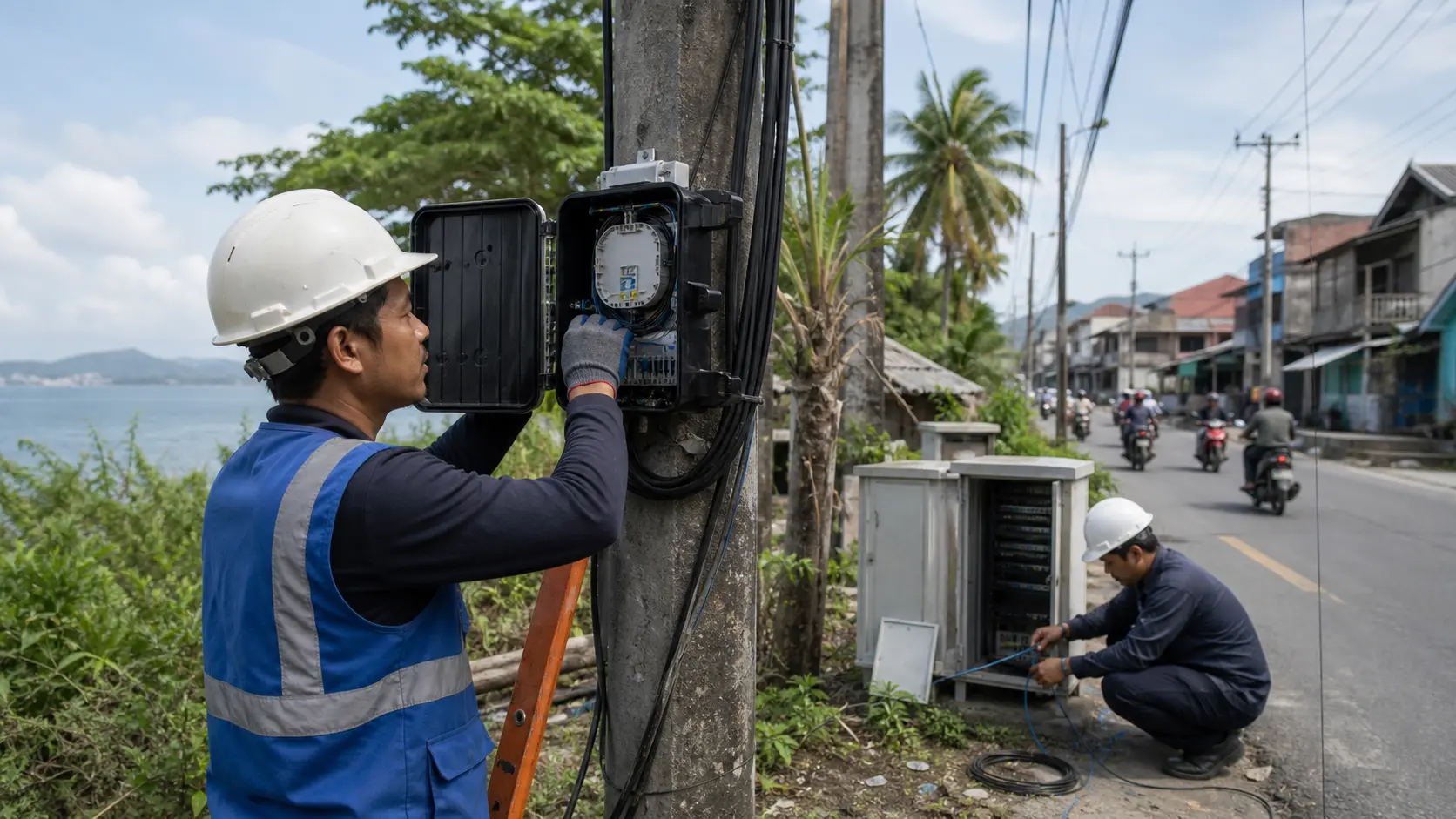
The support burden depends on the access technology. If the network is mostly fixed wireless, field labour includes line-of-sight checks, antenna alignment, mast mounting, Ethernet termination, grounding, power injectors, radio replacement, and interference investigation. If it includes fibre or copper plant, the repair work shifts toward splice points, drop cables, pole access, ducts, customer optical terminals and power at cabinets. If customer service is mostly dedicated business links, the operator may need fewer installations but faster response.
The public record does not tell us which mix applies today. The 2015 BTS notes point toward wireless access. The package copy mentions lent Wi-Fi modems, which could sit behind several access types. The APNIC route and RPKI records say nothing about the access medium. The article therefore avoids calling the current network fibre, fixed wireless or tower-based as a settled fact. It treats each as a possible access layer until current evidence supports one.
The customer effect is still concrete. When a customer router fails, a spare device and one technician can restore service. When an access site loses power, a technician may need batteries, generator access or a site owner. When a backhaul route fails, a field crew may be unable to repair anything locally because the fault sits with an upstream carrier. When the only visible BGP neighbour has trouble, the local helpdesk may be reduced to escalation and customer communication. These are different failures with different labour requirements, even if the customer's symptom is the same.
Who is affected if the chain breaks
The safe affected-user group is not a named current customer list. It is the set of users the public evidence points toward: Kendari-area residential users, small offices, local businesses and institutions that may have used or considered Universal Kendari service. The website explicitly says the company serves personal, small-office and large-company needs. It also displays older portfolio tiles for government, public-safety, energy/service and finance-related names. Because those tiles are stale and undated, they should be read as a historical service surface, not a current dependency map.
That distinction avoids two mistakes. The first is erasing the company because its public profile is old. Live BGP and valid registry records show a real network surface. The second is inflating the company because a website lists recognizable local names. A portfolio tile is not a current contract, and a route announcement is not a guarantee that those organizations still depend on the network.
The most likely impact mechanism is small and practical. A local access failure may interrupt card payments, messaging, school connectivity, CCTV viewing, online forms, household study, business communications, or branch-office access for a limited group of customers. A route failure may interrupt all customers behind the visible prefix or force traffic through an alternate numbering arrangement if one exists. A power failure may split customers into those with backup power and those without, even before the ISP's own equipment is considered.
This is also why measured bandwidth is not the only public-interest question. A 5 Mbps connection can be inadequate for heavy video use but still essential for a small shop, a school office, a security-camera uplink or a household with no better terrestrial option. Reliability, repair time and upstream continuity may matter more than headline speed. Conversely, a faster dedicated service would still be fragile if it depended on one unprotected upstream or one access site.
The article therefore does not score the company against a modern fibre benchmark alone. It scores the evidence chain. The route is real. The address is real. The old local access claims are plausible. The live redundancy proof is weak. Customers, if currently served, would be exposed most acutely at the access site, customer-premises equipment, local power and single-visible-upstream layers.
What would change the assessment
The fastest way to upgrade the evidence would be current service proof. A current package page, service-order result, maintenance notice, customer support page, recent speed test from the company's access network, or public customer announcement would show whether the 2017 website still reflects the business. A current coverage map or address-availability check would bound the footprint without forcing readers to infer coverage from old BTS notes.
The second upgrade would be physical topology. The company could publish or document, even at a high level, whether it operates fixed-wireless sectors, fibre drops, leased tower space, rooftops, cabinets or upstream handoff sites. It would not need to reveal sensitive diagrams. It could say whether Abeli and Ranomeeto are active, whether there are alternate access points, whether backhaul is fibre or wireless, and how customers are migrated when a site fails.
The third upgrade would be upstream diversity. A second visible BGP neighbour, a current public route policy, direct exchange LAN evidence, or a stated dual-transit design would move the peering-and-transit grade from "reachable" toward "recoverable." If AS149409 provides protected transport or diverse handoffs, that should be documented as a service feature rather than left invisible behind one AS path.
The fourth upgrade would be power and repair evidence. A page explaining NOC escalation, after-hours contact, spare device replacement, site battery or generator policy, and expected response windows would turn the site's support language into operational evidence. For low-speed residential and small-office access, even modest transparency would help: customer-router power advice, installation standards, fault categories and realistic restoration priorities.
Until those items are visible, the metadata should stay conservative. "Regional ISP economics," "Local support labour" and "Peering and transit" are supported topics because the company has an ISP identity, retail/support copy and live routing. The evidence does not support topics such as data-centre infrastructure, national fibre backbone, cloud services, tower company operations, or verified public-sector network dependency.
The article title also should not be softened into a generic company profile; the specific issue is that the local connectivity bill depends on upstream routing and field repair that the public record only partly exposes.
Evidence-bound conclusion
PT Universal Internet Service deserves coverage because the record is not empty. It has a published Kendari identity, a first-party access-service site, APNIC/IDNIC number resources, a valid RPKI-covered route and a live AS63877 announcement for 103.54.227.0/24 at the research cut-off. That is enough to say there is a real network surface behind the directory entity.
The same record requires a downgrade. The company does not currently publish enough information to verify the living shape of its access network. Its public retail page appears old, the old BTS notes are from 2015, the visible route is only one /24, the sibling /24 is not currently visible, one live upstream neighbour appears in RIPE observations, and public peering databases do not show direct AS63877 exchange participation. Backup power, tower independence, route diversity, crew depth and spares are all unknown.
The final evidence grade is Medium for network identity and current route visibility, but weak for resilience and current retail footprint. Readers should treat PT Universal Internet Service as a small Kendari access operator whose public route can be seen, not as a fully verified regional broadband platform. The most important unanswered question is not whether the company once sold internet access. It is whether today's customer bill buys a recoverable path from the premises to the access site, from the access site to upstream transit, and from a local fault to a competent field repair.