
Summary
- I NET BULGARIA is an active Bulgarian fixed-network operator with a specific local retail footprint. Its live Bankya-Fiber service page advertises symmetrical 100 Mbps fibre for BGN 25 a month, 300 Mbps download and 100 Mbps upload for BGN 70, and a 100 Mbps plus interactive-TV bundle for BGN 35. The company's customer guidance describes optical converters, routers, LAN connections, fault tickets and installation within seven working days where technically possible. Those details support a real fibre access service in Bankya; they do not reveal subscriber count, street-by-street coverage or access topology.
- The operator identity is unusually well aligned across commercial, media and internet-number records. Bulgaria's Council for Electronic Media register names I NET BULGARIA OOD, company number
202481029, its two managers and partners, and Bankya as the territorial scope of its digital television agreements. RIPE's AS60447 record names I NET BULGARIA EOOD and a Sofia network-operations contact. The difference between OOD and the older EOOD rendering is a legal-form history issue, not evidence of two network operators. - AS60447 was fully visible to the displayed IPv4 collectors and visible to 320 of 321 displayed IPv6 collectors in a 10 July 2026 RIPEstat routing snapshot. It originated 15 IPv4 routes covering 4,352 non-overlapping addresses and one IPv6
/32. The announced-prefix view showed all 16 routes continuously during the preceding two weeks. This is strong operating evidence, but address space is not subscriber capacity and a live route does not prove a live optical drop. - The Sofia interconnection footprint is broad on paper. PeeringDB lists five operational 10 Gbit/s exchange connections across B-IX, BIX.BG and MegaIX Sofia, plus presence at Equinix SO1, Sofia Data Center, Telepoint Sofia Centre and Telepoint Sofia East. B-IX's member page independently shows I NET BULGARIA as a full member with a 10 Gbit/s connection at Telepoint East. Multiple exchanges, facilities and observed network neighbours reduce some logical dependency, but they do not prove that the Bankya access network reaches those sites over separate ducts, carrier tails, building entrances, routers or power systems.
- The final network evidence grade is Medium. Current retail offers, fault guidance, payment channels, television rights, active IPv4 and IPv6 routes, valid route-origin authorisations and current exchange membership establish an operating regional ISP. No public evidence verifies a protected Bankya fibre ring, dual independent Bankya-to-Sofia paths, customer-node battery runtime, spare optics and routers, failover headroom, current field-crew size, restoration targets or performance during a multi-fault incident.
A BGN 25 promise with many owners of failure
The most revealing fact about I NET BULGARIA is not an autonomous-system number. It is the BGN 25 monthly price attached to a Bankya fibre connection. The operator's retail page offers up to 100 Mbps in both directions for that amount, on a month-to-month contract. A higher tier offers up to 300 Mbps down and 100 Mbps up for BGN 70. A BGN 35 package combines the 100 Mbps service with interactive television, while additional television receivers carry a separate monthly charge.
That menu makes the business concrete. This is not simply an organisation maintaining address space for servers, nor a wholesale carrier whose name appears only between other networks. A household can order a line, receive an optical converter, connect a router and television receiver, open a support ticket and pay a recurring bill. The public-facing Bankya-Fiber home page locates the service office at 1A Petko D. Petkov Street in Bankya and describes multimedia internet connectivity over optical cable. The same site carries account registration, plan changes and support functions.
The price also exposes the economics. BGN 25 does not buy one dedicated 100 Mbps international circuit reserved from the customer's living room to every destination. It buys access to a shared system whose costs are spread across customers. The operator must recover the cost of local fibre and closures, optical conversion, aggregation switches, customer visits, leases or rights for cable routes, rack and cross-connect charges, exchange ports, paid transit, content rights, billing, support and replacement equipment. The customer sees one bill; operational responsibility is divided across many physical and commercial boundaries.
The service's month-to-month design matters. It lowers the customer's commitment and can make the local product easier to try. It also gives the operator less certainty about the lifetime revenue from each installation. A new connection can require a survey, a drop cable, drilling or building access, an optical termination and a technician visit. The FAQ says activation may take up to seven working days where technical availability exists. That phrase is an important limit: a map or nearby cable does not guarantee a usable port, a permitted route into a property or an immediately available crew.
I NET BULGARIA does not publish enough data to calculate its customer acquisition cost, average revenue per user, churn, take-up by street or payback period. Secondary company reporting from Finansi.bg says revenue grew 11.2 percent in 2024 and classifies the business under fixed-network telecommunications. Papagal reports BGN 512,000 of 2021 turnover and eight employees in that year, but newer detailed staffing and revenue values are not openly displayed there. These figures show a small operator rather than a national incumbent. They do not establish today's number of field technicians or the portion of revenue coming from Bankya access, IPTV, wholesale connectivity or other services.
The appropriate reading of the BGN 25 plan is therefore neither celebratory nor dismissive. It is evidence that I NET BULGARIA is competing for local customers with an accessible fibre offer. It is also a reminder that low recurring revenue must support a chain extending beyond the customer premises. Reliability depends on whether the chain has enough shared scale in normal operation and enough unshared alternatives during failure.
One company, three public addresses and a clear operating boundary
Small-network research often fails at identity before it reaches engineering. I NET BULGARIA has several names and addresses in current records. Bulgaria's Council for Electronic Media names the legal entity in Bulgarian, gives company number 202481029, and lists its registered office at 130 Pirotska Street in Sofia. It identifies Petar Vasilev Daskalov and Georgi Lyubenov Georgiev as managers acting separately and as partners. Ukazatelite's current register-derived profile corroborates the company number, incorporation on 13 March 2013, active status and registered office.
The corporate history explains a naming wrinkle. Papagal's chronology says the company began as a single-member limited company and changed to an OOD, a limited-liability company with partners, in April 2016. It records Daskalov and Georgiev with equal BGN 1 interests. RIPE and some network directories still render the organisation as EOOD. That stale legal-form suffix should not be turned into a claim that another company operates AS60447. The company name, contacts, domain and resource administration line up closely enough to support one operating identity.
There are nevertheless different functional locations. The legal office is on Pirotska Street. The Bankya-Fiber customer office is in Bankya. The RIPE RDAP record gives a network-operations address at 47A Sytniakovo Boulevard in Sofia and an abuse contact tied to Pirotska Street. PeeringDB places the network in four Sofia interconnection facilities. None of those addresses, standing alone, is a complete network map. A registered office can be administrative; a retail office can accept payments without housing the core; a network contact can work away from the actual routers; a facility listing can describe a point of presence without showing how Bankya reaches it.
The ownership boundary is similarly precise in law and fuzzy in infrastructure. Daskalov and Georgiev own the legal company according to the register-derived sources. The company administers AS60447 and several number-resource records. It presents Bankya-Fiber as its retail service and signs television-distribution agreements. But that does not mean it owns every duct, pole, building riser, long-haul fibre, rack, cross-connect or upstream circuit used to deliver the service.
The distinction matters during an outage. I NET BULGARIA can control its router configuration while depending on a landlord for access to a basement. It can own a local feeder while leasing the route to Sofia. It can place equipment in a facility whose generators and cooling are operated by the facility owner. It can buy transit from several networks that share a common metro-fibre segment. It can supply an optical converter while the customer's router and household power remain outside its direct control.
The article therefore treats the company as the accountable retail and network operator without assuming total asset ownership. Customers call one support number, not every supplier behind the line. Operational resilience still depends on the contracts and physical divisions beneath that single point of accountability.
Bankya is the verified service area, not all of Sofia
The strongest geographic claim is deliberately narrow. The company site says Bankya. The office is in Bankya. The offers are branded Bankya-Fiber. The media register repeatedly gives Bankya as the territorial scope for the digital package. A third-party address classification for 95.214.106.0/23 also places much of that range in Bankya and labels it cable or DSL use, although geolocation is only corroborative.
Bankya is part of Sofia Municipality, west of central Sofia. That administrative relationship can tempt a broader claim than the evidence supports. The company has interconnection in Sofia and a Sofia registered office, but neither fact proves residential coverage across the capital. The Bankya-Fiber site links to what it calls a coverage map, yet the link opens a general Google map of Bankya rather than a street-by-street footprint. It does not show connected buildings, available ports, fibre routes, cabinets or serviceable addresses.
The access technology is clearer than the exact coverage. The retail page calls the product internet over optical cable. The FAQ tells a customer to examine an optical converter: green lights suggest a router or LAN problem; a red light suggests an optical-cable problem. That is direct evidence of fibre reaching at least the customer-side handoff for the service described. It does not disclose whether the architecture is point-to-point Ethernet, a passive optical network, fibre to a building with another medium inside, or a mixture across the town.
The FAQ's seven-working-day installation statement reinforces the absence of universal serviceability. Technical possibility must be checked before activation. A property may sit near a route but lack a drop, spare strand, splitter port, building agreement or safe entry. Detached homes and low-density streets can require more fibre and labour per customer than apartment blocks. Hills, roads, rail alignments, utility corridors and private property can create route constraints. None of those local conditions is described in a published engineering plan for I NET BULGARIA.
The television record adds another layer of geographic confidence. The Council for Electronic Media page shows a long set of programme agreements for a digital package in Bankya, including agreements whose displayed end dates extend through 2026 and 2027 and that provide for automatic renewal. A channel-rights register is not a subscriber database, and an agreement does not prove every channel is currently delivered without interruption. It does show an operator maintaining the legal and commercial inputs for a local television product, consistent with the live retail bundle.
Payment infrastructure points in the same direction. ePay's current merchant list places I NET BULGARIA among internet providers and exposes an account-check entry. UniCredit Bulbank's supported billers also names the company. Payment listings cannot reveal how many accounts are active, but together with current offers, a customer portal and current television agreements they make an abandoned-service interpretation implausible.
The safe service-area statement is thus specific: I NET BULGARIA operates a fibre internet and interactive-television offer in Bankya and runs a wider Sofia interconnection footprint. No available source supports claiming residential service throughout Sofia, a national last mile or coverage at every Bankya address.
AS60447 is visibly alive in both internet protocols
The global routing evidence is current and unusually rich for a small local provider. A RIPEstat AS overview taken on 10 July 2026 marked AS60447 as announced and identified the holder as I NET BULGARIA. The companion routing-status snapshot showed 15 IPv4 prefixes, 4,352 non-overlapping IPv4 addresses and one IPv6 prefix equivalent to 65,536 /48 networks. Every displayed IPv4 collector peer saw the network; all but one displayed IPv6 peer did.
The word "non-overlapping" is important. The announced-prefix list includes aggregates and more-specific routes at the same time. For example, 95.214.104.0/22 appears alongside its two /23 components, and 185.97.72.0/22 appears alongside four /24s. Simply adding the nominal size of every route would count the same addresses more than once. RIPEstat's 4,352-address total removes that overlap.
Those more-specific routes can serve several purposes. They may allow different path policies for portions of the address space, provide operational control during changes, or support customer and infrastructure assignments. Their presence does not reveal traffic volume or customer count. A household may share an address through translation, hold a dynamic address, or use IPv6. Servers and network equipment may consume addresses without representing households. Some routed addresses may be idle. The portfolio is evidence of routable scale, not a census.
The IPv6 route is especially useful as an operating signal. RIPE's record for 2a06:4c0::/32 carries a June 2025 registration date under I NET BULGARIA's maintenance and contact structure. It was visible globally in July 2026. This is more recent than the ASN's 2013 registration and shows continuing number-resource work. It still does not disclose whether Bankya retail customers receive IPv6, whether the network uses dual stack throughout, or what proportion of traffic uses IPv6.
The IPv4 holdings also have different administrative histories. RIPE records 95.214.104.0/22 as an allocated provider-aggregatable block in Bulgaria under I NET BULGARIA's organisation and network contact. Other originated space includes 77.246.208.0/23, described in public routing data as Atlantis BG, and several I NET-labelled blocks. Originating a route means AS60447 is presenting reachability for that prefix. It does not by itself settle ultimate asset ownership, customer assignment or the commercial terms behind the announcement.
Route-origin security is a positive part of the picture. RIPEstat returned valid RPKI status for the queried 95.214.104.0/22, 77.246.216.0/22, 185.97.72.0/22 and 2a06:4c0::/32. This allows networks that perform origin validation to check that AS60447 is authorised to originate those routes.
RPKI does not make the access service resilient. It can reduce acceptance of unauthorised route origins; it cannot power an optical node, prevent an excavator from cutting fibre, create capacity on a surviving circuit or send a technician to a damaged closure. The distinction between routing integrity and service availability runs through the whole I NET BULGARIA case.
Five exchange ports do not equal 50 Gbit/s of customer resilience
I NET BULGARIA's self-reported interconnection profile is much larger than its retail footprint might suggest. PeeringDB classifies the network as a regional network service provider with balanced traffic in the 10-20 Gbit/s band. It lists two operational 10 Gbit/s connections at B-IX, two at BIX.BG and one at MegaIX Sofia. All five have IPv4 and IPv6 addresses. It also lists the network at four Sofia facilities: Equinix SO1, Sofia Data Center, Telepoint Sofia Centre and Telepoint Sofia East.
This information is operator-maintained rather than a traffic meter, but parts of it are independently corroborated. The B-IX member page calls I NET BULGARIA a full member, says it joined in 2024 and shows a 10 Gbit/s connection at Telepoint East with two local-VLAN addresses. B-IX's January 2024 member announcement likewise records AS60447 at 10 Gbit/s in Telepoint Sofia. BGP Tools detected the same five exchange interfaces and, in early July 2026, showed them as 10 Gbit/s links.
It would be wrong to add those labels and declare 50 Gbit/s of usable internet capacity. Two addresses can sit on separate ports, on logical interfaces of the same platform, or on connections with shared upstream infrastructure. Exchange capacity is only one part of end-to-end capacity. The network may have paid transit elsewhere, private links, internal backbone constraints and a Bankya aggregation link with a lower ceiling. Traffic entering at one exchange cannot automatically use the nominal capacity of another after a fault.
PeeringDB's own traffic band is 10-20 Gbit/s, far below the sum of five 10 Gbit/s port labels. That is not a contradiction. Port speed is an interface maximum; traffic level is a broad self-reported range; customer throughput is bounded by actual traffic engineering, contracts and every narrower segment along the path. No source provides AS60447's peak traffic, 95th-percentile transit use, paid commit, burst entitlement, exchange utilisation, internal backbone rate or Bankya backhaul capacity.
The network-neighbour view is broader again. RIPEstat's 10 July 2026 ASN-neighbours result observed 29 unique adjacent AS numbers. Twenty-two appeared on the upstream-facing side of collected paths, two on the downstream-facing side and five were uncertain. The large list includes global carriers, exchange route servers and regional networks. Relationship inference from public paths is not the same as a contract list. A route server may make many exchange participants visible without each being a paid upstream.
The BGP Tools profile applies a different classification and reports 13 upstreams, 46 peers and two downstreams. Hurricane Electric's current view shows the three Sofia exchanges and the registered routing policy. Differences between measurement platforms are expected because collectors, time windows and classification methods differ. The durable conclusion is not an exact partner count. It is that AS60447 has many logical paths and active exchange participation.
That logical breadth has real value. Local exchange paths can keep Bulgarian content and traffic closer, reduce dependence on a single paid transit route and offer alternatives when one network withdraws reachability. Multiple global carriers can improve destination diversity. IPv6 at all displayed exchanges reduces a protocol-specific single point. Yet none of this identifies the physical route from Bankya to the Sofia edge. The customer-facing chain can remain narrow before it reaches the impressive interconnection layer.
Four Sofia facilities still leave a Bankya question
Facility diversity is one of the strongest resilience signals in the public record, and one of the easiest to overstate. PeeringDB places AS60447 at Equinix SO1, Sofia Data Center, Telepoint Sofia Centre and Telepoint Sofia East. These are not four names for one room. They are distinct Sofia facilities, and their operators advertise substantial power, cooling and connectivity safeguards.
Equinix's SO1 specification describes 2N UPS redundancy, N+1 generators and N+1 cooling. Telepoint's infrastructure page describes separate cable approaches, non-crossing cable routes, supplies from different substations, multiple generator and UPS groups, spare cooling parts and round-the-clock engineers across its data-centre platform. Sofia Data Center describes Tier III-oriented facilities, 24-hour support, cross-connects and reserved routes.
These specifications describe what the facilities offer, not what I NET BULGARIA has purchased or how its equipment is configured. A network can be listed at a resilient facility while using one power feed to one router. It can appear at four facilities while concentrating route control, subscriber authentication or television processing in one. It can lease remote connectivity to a site without maintaining independent hardware there. It can have equipment in two buildings that are linked by one metro route.
The Bankya-to-Sofia segment is the largest unresolved dependency. Bankya lies west of central Sofia, while Telepoint East and Equinix SO1 are in the eastern part of the city. Telepoint Centre and SDC provide other locations, but a facility list does not show where the Bankya fibre first reaches the wider network or which facilities actually terminate independent access paths. There is no published diagram showing two exits from Bankya, diverse road or rail crossings, separate metro providers, independent building entries or a protected ring.
A resilient design could take several forms. Two physically separate feeders might leave Bankya in different directions and terminate on different routers. A ring could allow traffic to reverse around a cut. Separate wholesale carriers could provide tails with contractually documented route diversity. A secondary aggregation site could preserve authentication and IPTV service if the primary site failed. Backup power could keep local nodes alive through a grid interruption. Public records verify none of those arrangements.
The absence of proof is not proof of a single route. The network's multiple Sofia presences and exchanges make physical diversity plausible. The retail service's continued operation and route visibility suggest competent engineering. But a customer assessing business continuity needs more than plausibility. The decisive documents would be route-diversity attestations, a current logical and physical topology, power-runtime data, failover tests and service-level terms that cover the Bankya access segment.
Until those appear, the four-facility footprint should be read as an interconnection advantage after traffic reaches Sofia, not as proof that every Bankya customer has four independent ways to reach Sofia.
The access failure starts much closer to the customer
The company's own support material gives a compact map of the first failure domain. If a connection disappears, the FAQ tells the customer to power-cycle the router, inspect the LAN link to the optical converter and check the converter's lights. Green optical indicators point toward the router or LAN connection; red points toward the optical cable. Television can fail separately while internet remains available, in which case the customer is told to check the receiver, HDMI selection, LAN cable and power.
These instructions show at least four boundaries inside or near the premises. Household power must run the router, optical converter and television receiver. The short LAN cable must work. The optical drop must remain intact. The operator's service beyond the premises must be reachable. A neighbourhood network can be perfectly healthy while one customer is offline because of a failed power adaptor or damaged indoor lead. Conversely, every light inside the home can look normal while an aggregation or upstream failure blocks traffic.
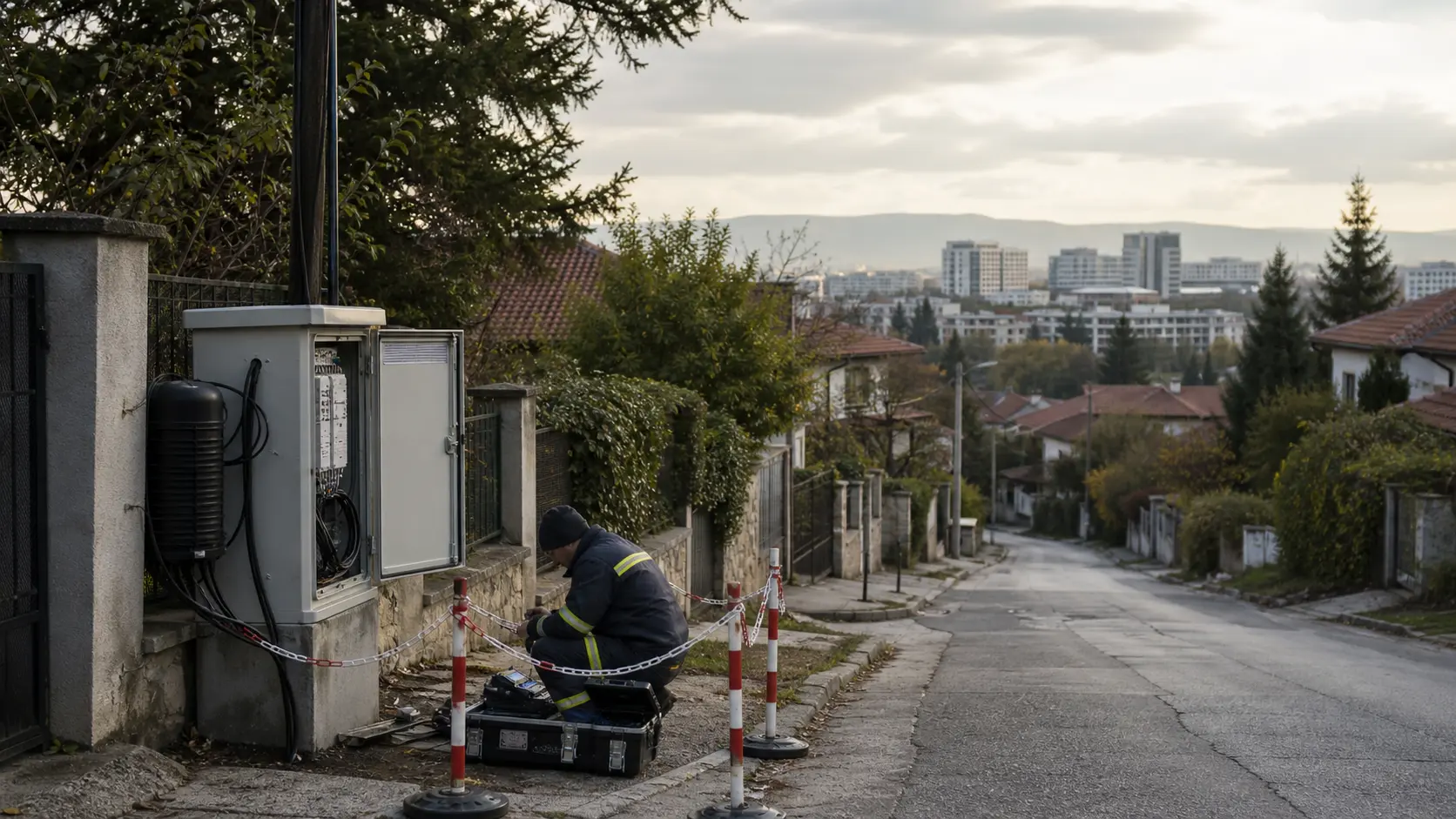
The optical drop is the first operator-dependent physical segment. It can be damaged by construction, trees, vehicles, building work, weather, animals, a poor connector or accidental handling. The failure can affect one subscriber, one building or many customers depending on where it occurs. The operator does not publish whether cables are buried or aerial, whether diverse entries serve large buildings, how closures are protected or how spare strands are distributed.
Beyond the drop sit splitters, switches, optical line equipment or Ethernet aggregation, depending on the architecture. Active equipment needs electricity and environmental protection. Passive components avoid local power but can still fail or be cut. A cabinet with battery backup may continue through a short outage; an unprotected building switch will not. There is no public inventory of Bankya nodes, no battery specification and no declared runtime.
The IPTV bundle adds sensitivity to local and central systems. Live television can depend on multicast or unicast delivery, channel ingest, rights management, middleware, subscriber authentication and a receiver. The media regulator's current contract list supports the programme-distribution business, but not the technical location or redundancy of the television platform. The FAQ's scenario in which internet works and television does not demonstrates that the two services share some infrastructure while retaining separate failure modes.
Payment and account systems create another operational boundary. The FAQ says a suspended service can resume shortly after payment through ePay or EasyPay. That promise depends on the payment channel, billing records and network provisioning exchanging status correctly. It is a useful customer convenience, but it is not network redundancy. A billing fault can interrupt access even while fibre and routing remain healthy.
This is why the global visibility of AS60447 cannot answer a local outage complaint. Route collectors can keep seeing every prefix while one house, street or powered node is down. Network resilience has to be evaluated from the premises outward, not inferred backward from the internet edge.
Field repair is part of the product, even when the tariff does not price it separately
The local-support topic is supported by the service design, but the depth of the labour pool is not disclosed. Customers can report a fault through a ticket system or by phone. The support page says each request receives a ticket number and an online history. The FAQ presents the customer-service number as available at any time and says an employee will arrange an installation visit. This describes an operating support function, not merely an email address.
What happens after triage is less visible. A red optical indicator may require a technician to test light levels, inspect a connector, find a cut, gain access to a building or route, splice fibre and replace a closure. A failed aggregation switch may require a spare unit, compatible optics, a configuration backup and safe access to a powered location. A long-haul fault may require coordination with a wholesale carrier or civil contractor. An IPTV problem may be resolved remotely or may require receiver replacement.
The economic reporting suggests that these responsibilities sit within a small organisation. Papagal's last openly displayed workforce count is eight in 2021. Finansi shows current corporate status, 2024 financial data and revenue growth but does not expose a readable current average-headcount value in its public table. The company's old Zaplata employer page and a 2019 cashier vacancy on the Bankya site show that it has recruited locally, but neither establishes today's technical staffing.
It would be unsafe to translate the old employee figure into an eight-person repair crew. The total can include owners, administration, billing, customer service, television operations and network engineering. Contractors may perform civil work or after-hours repairs. Facility operators may provide remote hands in Sofia. Upstream carriers repair their own circuits. None of those arrangements is quantified.
Simultaneous incidents are the hard case. One technician and one set of splicing equipment may restore a single cut efficiently. The same resources can become a queue after a storm, road project or power event affects several locations. A customer-service line can accept calls without shortening the physical repair. Spare routers and optical modules can reduce restoration time only if the right parts are stocked and reachable. Building access can delay work even when staff and materials are ready.
The company publishes no mean time to repair, priority scheme, emergency escalation policy, field-service hours, contractor roster or spare-stock target. That does not indicate poor support. It means the recovery margin cannot be measured from the tariff page. The strongest evidence is that the company has local customer contact, ticketing, an installation process and troubleshooting built around real fibre equipment. The unresolved question is how that function behaves when demand exceeds normal staffing.
For a household, this may be an acceptable uncertainty at BGN 25 a month, especially where mobile service provides a backup. For a business, home worker, clinic or public service, the same uncertainty should raise questions about restoration commitments and a second connection with a genuinely different physical route.
Capacity advertised, capacity installed and capacity usable are different numbers
I NET BULGARIA publishes three categories of number that look comparable but are not: customer plan speeds, exchange port speeds and address-space size. The 100 and 300 Mbps retail labels are access-rate ceilings. The 10 Gbit/s exchange labels are interface capacities. The 4,352 IPv4 addresses and IPv6 /32 are number resources. None can be divided by another to produce a reliable subscriber count or contention ratio.
An advertised "up to" speed can be limited by the customer's router, Wi-Fi, device, remote server, local access segment, aggregation, backhaul, transit or congestion elsewhere. The company's FAQ points to some end-user factors, though it does not publish a formal minimum or normally available speed on the page reviewed. A 300 Mbps download tier with 100 Mbps upload is asymmetric by product design; the 100 Mbps tier is advertised symmetrically.
Installed capacity is also not necessarily usable after failure. Suppose the normal network distributes traffic across several 10 Gbit/s exchange and transit connections. If one path fails, surviving paths may have enough nominal interface speed but not enough paid commit, routing policy or internal transport to absorb the load. Traffic can shift onto a route with higher latency or congestion. A port can remain up while a remote destination becomes unreachable through a policy error. A circuit can have spare capacity in Sofia while the Bankya feeder is saturated.
The PeeringDB 10-20 Gbit/s traffic band gives scale but not a busy-hour curve. It does not say whether the figure is average, peak or a selected category. It covers AS60447 as a whole, which may carry retail, business, downstream and infrastructure traffic. The five 10 Gbit/s exchange entries may include two links at one exchange for operational or addressing reasons rather than five fully independent traffic pools.
The route portfolio also carries overlapping aggregates and specifics. Fifteen IPv4 routes do not represent 15 independent capacity blocks. Some routes cover the same addresses at different prefix lengths. More-specific announcements can steer traffic across different providers, but public BGP data cannot show the return path, packet loss, utilisation or commercial ceiling. The RIPEstat routing-consistency view shows current observed neighbours beyond the older registered import policy, illustrating that live routing evolves faster than static descriptions.
No public source reveals the installed access ports, lit fibre count, splitter occupancy, aggregation uplinks, Bankya-to-Sofia bandwidth, transit commits or reserved failover capacity. The correct capacity conclusion is therefore qualitative. The company has a credible multi-gigabit internet edge and sells access plans in the hundreds of megabits. Whether every customer can approach the advertised rate at the busiest hour, and whether the network can preserve it during a major failure, remains unverified.
The failure paths that matter
The first scenario is a customer-premises failure. A router, power adaptor, optical converter, receiver or patch cable fails. One household or business loses service. Remote support can isolate some causes, but hardware replacement requires a spare and often a visit. The customer bears part of this risk through local power and equipment care; the operator bears the supplied-device and line responsibility defined by its contract.
The second is an access cut. A drop cut isolates one address. A feeder or closure cut can isolate many. Restoration requires location, access, fibre preparation and splicing. A ring or alternate feeder can reduce impact, but no protected topology is published. A route collector will not see this fault if the core continues announcing AS60447's prefixes.
The third is a local power outage. Customer devices stop unless the premises has backup power. Active network nodes stop when batteries expire. A passive fibre segment may remain intact while powered endpoints fail. Facility generators in Sofia do not power a Bankya cabinet or building switch. The operator publishes no customer-node runtime or generator coverage.
The fourth is loss of Bankya-to-Sofia transport. Multiple upstreams at Sofia exchanges are irrelevant if all Bankya traffic reaches them over one common cable or one aggregation router. A second logical provider can share the same civil corridor. Two circuits can enter the same building through the same duct. The public facility footprint makes alternatives plausible but does not prove a separate local path.
The fifth is a Sofia facility or router failure. Presence at four facilities can limit this risk if equipment, control functions and traffic are genuinely distributed. Facility operators publish strong power and cooling features. Yet the company does not identify which functions run where, whether each site can carry the full load or whether one site depends on another for subscriber authentication, television or route control.
The sixth is upstream or exchange loss. AS60447's observed neighbour set and exchange memberships offer many logical alternatives. A carrier withdrawal, exchange outage or route leak need not isolate the whole network. But failover can expose congestion, incomplete route propagation or policy mistakes. Registered policy and observed paths are not perfectly aligned, so current testing matters more than a static list.
The seventh is field-repair shortage. A widespread power event, severe weather or civil works can create several faults while reducing travel and site access. A small company can respond quickly because local knowledge is concentrated, but the same concentration can become a bottleneck. No public staffing or contractor evidence settles this question.
The eighth is a coupled fault. A cut and a power outage occur together; a surviving route lacks spare capacity; or a primary router fails while a technician is handling an access incident. Resilience claims are most meaningful when they cover combinations, not just single-component failures. No public multi-fault test is available for I NET BULGARIA.
These scenarios affect different groups differently. A household may lose streaming and television. A home worker loses calls and cloud access. A local shop can lose card processing, ordering and surveillance access. A business using an AS60447 address for inbound services may remain globally routed while its premises is unreachable. Networks that appear downstream of AS60447 in public path inference can also be affected by an edge failure, although their contracts and physical arrangements are not public.
Regional-ISP economics reward density and punish rare failures
Bankya's local scale can be an advantage. A provider with a nearby office can know buildings, landlords, cable routes and recurring fault locations. It can tailor plans without a national product bureaucracy. Traffic exchanged in Sofia can reach many Bulgarian and international networks efficiently. Month-to-month terms can appeal to customers who dislike long commitments.
The same local scale creates hard fixed costs. A fibre route costs money before the first customer uses it. A sparse street yields less revenue per metre than a dense apartment block. Exchange ports, colocation, monitoring, television rights and skilled staff do not shrink to zero when subscriber count is low. Spares tie up cash. A second physical path can be difficult to justify because it earns little in normal operation while creating most of its value on the rare day the primary path fails.
Bulgaria is also a demanding broadband market. The Communications Regulation Commission's 2024 annual report counted 2.643 million fixed-internet subscribers and said fibre-based access represented 62.4 percent. It reported that the three largest fixed providers held 73.4 percent of subscribers. A local operator competes against national scale while serving the remaining market with local reach, price, service or specialised routing.
I NET BULGARIA's 2024 revenue growth signal is encouraging, but percentage growth alone says little about resilience investment. Revenue can rise because of more customers, higher prices, television packages, wholesale work or other activity. Asset growth, reported by Finansi at 20.3 percent in 2024, does not identify fibre, routers, cash or receivables. The company does not publish capital expenditure, debt, margin or network investment by geography.
The interconnection footprint may serve more than Bankya households. PeeringDB calls AS60447 an NSP, and public path classifiers observe two downstream-facing networks. The address portfolio includes space labelled for another company and end users. This broader role can improve economics by spreading fixed network costs across retail and wholesale demand. It can also increase the consequence of a core failure. The available evidence does not permit a revenue split or a list of dependent customers.
The resilience incentive is therefore mixed. Good local reliability protects reputation and reduces costly repeat visits. Diverse transit and peering can lower bandwidth costs and improve performance. But hidden physical redundancy, idle spare capacity and stocked equipment all consume resources that customers may not reward until an outage occurs. The tariff page cannot tell us where I NET BULGARIA has chosen to spend that margin.
What would convert logical diversity into a strong resilience case
A strong case would begin with the access map, not the AS map. It would show the serviceable Bankya footprint, principal aggregation nodes and whether major customer clusters have ring protection or dual feeds. It would distinguish underground and aerial segments, shared corridors and single building entrances. Sensitive route detail need not be public; an independent statement of physical separation would still improve confidence.
The next requirement is transport evidence. I NET BULGARIA could identify at least two Bankya-to-Sofia paths by supplier, termination facility and shared-risk boundary, with confirmation that they do not use the same local duct, bridge, pole line or aggregation router. If the company relies on a ring, it could disclose tested restoration behaviour without publishing exact fibre coordinates.
Capacity evidence would show normal and failover headroom. Useful measures include peak utilisation by major segment, the smallest surviving configuration, transit commit versus port speed, and whether one facility can carry the essential load when another is unavailable. A five-port inventory is less informative than a successful test in which a port, router or site is deliberately removed.
Power evidence would separate facilities from the access network. The Sofia data centres advertise their own redundancy. The unanswered questions concern Bankya nodes: battery coverage, expected runtime, alarm monitoring, generator connection where relevant and the plan for a long regional outage. Customer guidance could also explain that optical fibre does not preserve service when the router and converter lose power.
Repair evidence would include service windows, escalation levels, spare holdings and the boundary between employees, contractors, facility remote hands and carrier repair teams. An anonymised distribution of restoration times would be more useful than a broad support promise. A multi-incident exercise would reveal whether tickets, dispatch, access and splicing resources scale together.
Finally, the operator could clarify product expectations. The public plan page gives maximum rates and month-to-month prices but not a visible minimum, normal busy-hour rate or service-level commitment. A business customer needs to know whether the residential plan is best effort and whether a separate product includes response and restoration targets.
None of these disclosures is required to establish that I NET BULGARIA operates. The current evidence already does that. They are the difference between evidence of activity and evidence of resilience.
The practical reading for a Bankya customer
The retail offer rests on a real operating system. The site accepts account registrations and support requests. Current plan pages advertise fibre and IPTV. The media register records current or automatically renewing programme rights in Bankya. Payment platforms recognise the company. AS60447 originates a substantial IPv4 portfolio and a recent IPv6 block. Exchange and route observations show a network with more interconnection options than the retail brand alone would suggest.
Those strengths reduce several risks. The company is not dependent on one visible global carrier. It participates at three exchanges. It reports multiple Sofia facilities. Its major queried routes have valid origin authorisations. It has a local support office and troubleshooting specific to optical service. These are meaningful signs of an operator doing more than reselling a single upstream connection.
The remaining risk is concentration before and beneath the internet edge. The public record cannot tell whether one Bankya feeder, one powered node, one transport route, one router or a very small repair team can still interrupt the service. It cannot show how much capacity remains after a path failure. It cannot show whether IPTV and customer authentication survive the loss of a primary site. The more elaborate the Sofia edge appears, the more important it becomes not to project that diversity onto the local fibre without proof.
For ordinary household use, price, local availability and personal experience may dominate the decision. A mobile connection can provide a practical backup for light use. For work, medical, retail or other continuity-sensitive use, the key question is whether a second service follows a different physical path and power chain. Buying two brands does not create redundancy if both share the same local duct or building equipment.
The network evidence grade is Medium, not because AS60447 is doubtful, but because route evidence answers a different question from recovery evidence. I NET BULGARIA's current operation is well supported. Its protected topology, backup-power endurance, spare capacity and field-repair depth are not.
The most useful watchpoints are concrete: changes in the 16 originated routes; loss or addition of exchange interfaces; movement in the 29 observed neighbours; a change in the Bankya retail offers; updated media agreements; published minimum-speed terms; evidence of new access construction; and any disclosure of path diversity, node power or repair performance. Together, those signals would show whether the BGN 25 connection is backed by a widening physical safety margin, not merely by an already wide set of names at the Sofia edge.