
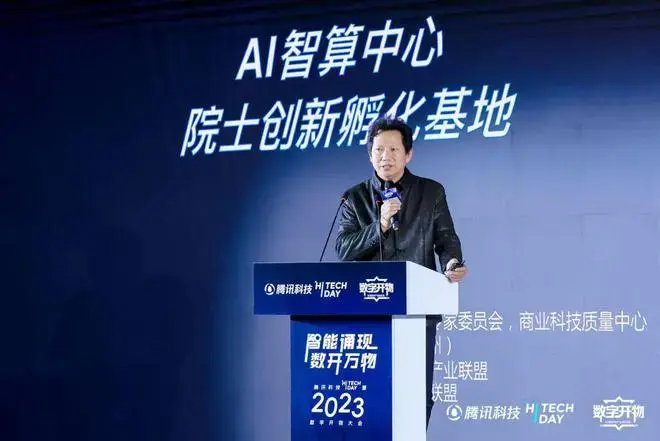
- China’s advancements in chip technology have been showcased in a conference in Beijing, highlighting the country’s progress.
- One professor from Chinese Academy of Sciences discussed overcoming Moore’s Law limitations, and how the rise of AI chips means doubling computational power every 2.2 years.
- Cross-disciplinary collaboration and international cooperation reveals the dual nature of the tech race – a clash of titans but also an opportunity for shared innovation and progress on a global scale.
On December 14, 2023, the Tencent Technology Hi Tech Day and the 2023 Digital Open Everything Conference, themed “Evolution of Computing Power, Digital Opening of Everything,” took place at the Beijing National Convention Center.
Distinguished academics, university professors, research institute directors, industry experts, investors, and executives from enterprises undergoing digital transformation gathered to discuss AI trends, explore advanced digital technologies, delve into the survival principles of industrial digitization, and unveil the secrets of enterprise growth in the era of explosive generative AI.
Also read: IDCC2023: China explores the ethics of AI and the digital economy
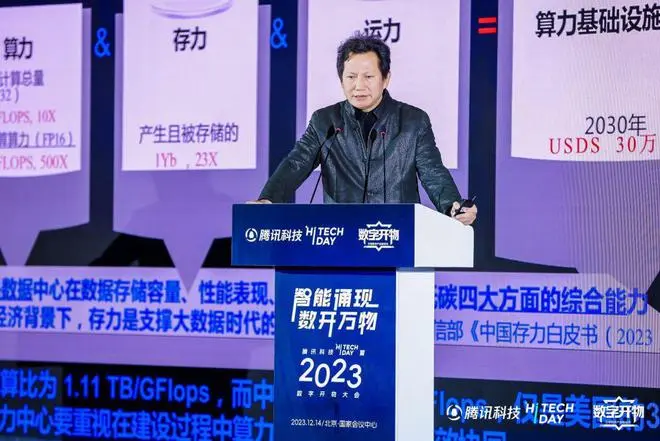
Navigating the future of Chinese chips: A profound exploration by professor Liao Qiwei
- Chinese chip technology roadmap and RPP architecture breakthrough: Professor Liao Qiwei from the Chinese Academy of Sciences delved into the development technology roadmap of Chinese chips. The team focused on the field of artificial intelligence, particularly achieving significant breakthroughs in the new self-reconfigurable processor peripherals (RPP) architecture. Professor Liao emphasized that this innovation not only aims to benchmark NVIDIA‘s GPU core chips but also strives to address crucial technical challenges in key areas, providing robust support for the development of the digital economy.
- Industrial layout of 10 gigabit IP transmission chips: In his presentation, Professor Liao Qiwei provided detailed insights into the team’s industrial layout of 10 Gigabit IP transmission chips. He highlighted that these chips have achieved 8K, 25GB 10 Gigabit transmission capabilities. The second-generation chips have been designed and certified by both international standards and the State Administration of Radio, Film, and Television (SARFT) in China. Professor Liao, who also serves as an academician for SARFT, has played a pivotal role in supporting the marketization and standardization of these chips.
- Development of Chinese GPUs and second-generation chip plans: The professor mentioned that the development of Chinese GPUs is primarily led by the Chip Power team, with deep collaboration with the academic platform in Beijing. The second-generation chip technology has already been successfully applied, with plans for an early release next year. Professor Liao emphasized that this developmental stage will further reduce the integration and energy consumption of chips, laying the foundation for China’s chip leadership in global competition.
- Development of the AI computing center and the metaverse platform: During his speech, Professor Liao discussed the development of the AI Computing Center, which is based on the application of proprietary chips and aligns seamlessly with the entire industry chain. He stressed that the AI Computing Center not only aligns technologically with the industrial chain led by Mr. Huang but also has its own initiatives at the capital level. The center is dedicated to developing a metaverse platform, aiming to create a more open fundamental platform and providing additional support for open-source entrepreneurship among university students.
- Business applications of dducational visual modules and the AI center: Although time constraints prevented detailed elaboration, Professor Liao mentioned the basic projects of educational visual modules and the AI center. These projects not only showcase technological innovation but also boast robust business application blueprints, attracting billions of funds from both domestic and international sources.
- Chinese chip technology overcoming Moore’s law limitations: Professor Liao further elucidated the development of Chinese chip technology, highlighting the limitations faced by traditional Moore’s Law in enhancing chip integration. However, with the rise of artificial intelligence AI chips, a new law of computational power has emerged, evaluating comprehensive performance based on computational power. The current law of computational power is doubling every 2.2 years, becoming a crucial parameter for future chip development.
- Future computational power needs for the digital economy: When discussing the future computational power needs for the digital economy, Professor Liao emphasized the significance of broad computational power, including computational power, storage power, and transmission power. He detailed the roles of these three factors in modern societal development, underscoring that the storage-to-computation ratio is a fundamental parameter for core computational power. He noted that the concept of Chinese GPUs, combined with the overseas team of the State Administration of Radio, Film, and Television, offers solutions for data transmission chips, supporting the high-quality development of the future digital economy.
- Challenges and solutions in ultra-high-definition industry data transmission: Professor Liao underscored the critical nature of video data transmission in the future of consumption and industrial development when discussing ultra-high-definition industry data transmission. He pointed out that the advent of artificial intelligence and the metaverse era will further increase the demands on data transmission levels. He presented successful cases in current technology addressing 25GB, 8K transmissions, providing technological support for the development of 3D, VR, and AR industries in the future.
- Application of Chinese chips in the military industry: Professor Liao provided a detailed overview of the application of Chinese chips in the military industry, including intelligent tanks and unmanned aerial vehicles (UAVs). He mentioned that intelligent unmanned tanks have become standardized products, securing military-related procurement and international recognition. This not only positively impacts the technological validation of chips but also lays the foundation for the militarization of Chinese chips.
Tech titans clash: china’s chip breakthrough ignites global competition and collaboration dynamics
China’s progress in chip technology reflects the increasingly intense competition among major powers in the field of technology. Historically, chip technology has been at the core of the tech domain, and now China’s chip technology is beginning to pose a competitive challenge to the global market, sparking discussions on the redefinition of major powers’ technological capabilities. This highlights that major powers are not only fiercely competing in traditional areas such as military and economy but also engaging in intense rivalry in high-tech domains.
Furthermore, as Professor Liao Qiwei mentioned in his speech, the changing paradigm of computational power underscores that major powers must continuously innovate in their path of technological development. The traditional Moore’s Law is facing limitations in chip technology, and China’s rise in artificial intelligence chips represents a new model of computational power growth. This reflects that the competition in the tech domain is entering a more complex and innovation-driven era, where major powers need to adapt to and lead this transformative period.
However, the competition in major power technology is not merely a straightforward confrontation; it also presents opportunities for collaboration. Professor Liao’s emphasis on the industry, academia, and research collaboration model illustrates that technological development requires cross-disciplinary cooperation and the sharing of resources. While major powers engage in competition, fostering open, interconnected, and mutually beneficial international cooperation in science and technology holds the potential to inject more momentum into global technological innovation.
Nevertheless, these dynamics also raise global issues. The major power technology competition goes beyond technological rivalry and encompasses various dimensions such as data privacy and cybersecurity. Therefore, major powers need to establish more robust legal and regulatory frameworks in the field of technology competition and cooperation to balance the pros and cons of technological development, ensuring the long-term stability and prosperity of the global technological community.