
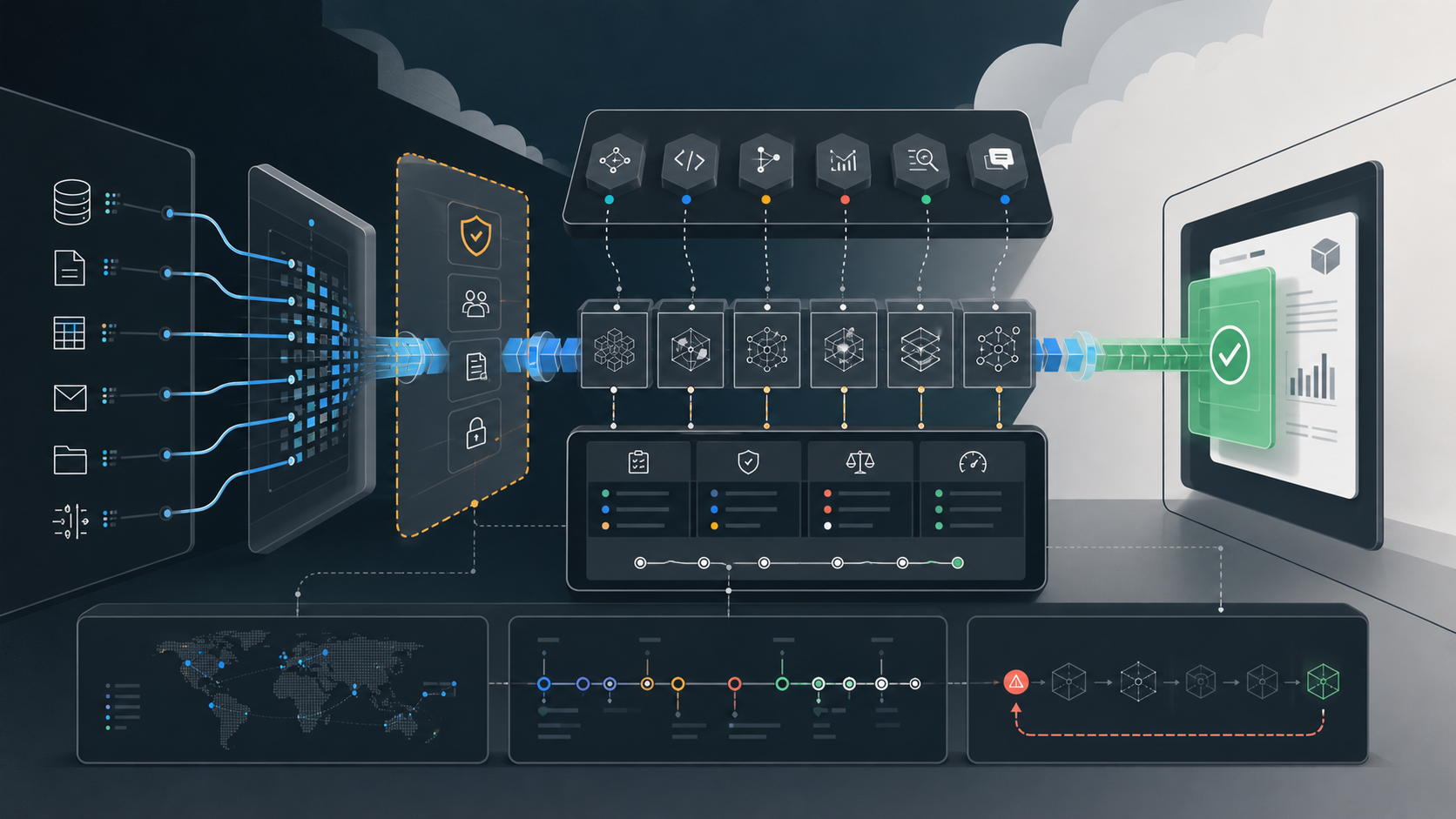
Summary
- Google Cloud's enterprise AI proposition is no longer just a Gemini model call. It is an operating surface that joins Gemini Enterprise Agent Platform, Vertex AI heritage, BigQuery, Agent Search, IAM, Cloud Audit Logs, Cloud Run, Workflows and capacity controls into a governed workflow.
- The accepted output is the useful denominator. A model answer is only one step; production reliability depends on data freshness, tool permissions, evaluation sets, audit logging, quota design, cost controls, exception handling and rollback.
- Public evidence supports Google Cloud's depth of controls and demand, but not universal customer outcomes. Alphabet filings show major Google Cloud growth and infrastructure investment, while status incidents and documentation show why customers still need local supervision and recovery design.
The output to count is the accepted workflow, not the impressive answer
The strongest demo of Google Cloud AI is a question answered with a large context window, a data-grounded summary, an agent calling a tool, or a developer moving quickly from a natural-language request to deployed code. That demo matters, but it is not the production unit that an enterprise buyer ultimately pays for. The unit that matters is the accepted governed workflow: a model-backed answer, decision, code change, data result, customer response, security recommendation or internal action that a business is willing to keep, audit and repeat.
That denominator changes the judgment. A model can produce a fluent answer in seconds and still fail the workflow if it cites stale enterprise data, acts under the wrong identity, exceeds a quota, silently changes behavior after a model migration, leaves no useful audit record, or creates a side effect that a team cannot undo. The accepted output includes every piece of labor needed to get from request to usable result: data preparation, access design, retrieval tuning, evaluation, human review, exception handling, monitoring, cost allocation, incident response, and migration planning.
Google Cloud is well suited to this test precisely because its public proposition is now broader than a model endpoint. In Alphabet's 2025 annual report, Google Cloud is described as including infrastructure, platform, applications and other cloud services, with AI offerings such as enterprise AI infrastructure, Vertex AI and Gemini Enterprise, alongside cybersecurity and data analytics. The same filing says Google Cloud generated $58.705 billion of 2025 revenue, while the Q1 2026 Form 10-Q reports $20.028 billion of Google Cloud revenue in the quarter, up 63% year over year. That is not a niche developer API.
It is a large enterprise cloud business asking customers to move recurring work onto its infrastructure.
The scale raises the standard. If Google Cloud wants to be the system where employees, developers, data teams and operations groups accept AI-backed work, customers should judge it on ordinary repeated tasks rather than frontier moments. Can an analyst ask a grounded question about internal policy and get an answer that is current, permission-correct and reviewable? Can a developer agent propose code while preserving source control, test evidence and rollback? Can a customer-support or security workflow route a recommendation to the right person with enough context to accept or reject it?
Can a data team know which dataset, model version and user request produced the answer? Those are production questions. They are not answered by model capability alone.
The legal and brand boundary is not cosmetic
The company in scope is Google Cloud, the cloud business operated by Google for infrastructure, data, security, collaboration and enterprise AI services. It should not be flattened into Google Search, consumer Gemini use, DeepMind research announcements, YouTube, Android, or every partner and customer outcome that happens to involve a Google model. Alphabet's own segment language matters here: Google Cloud includes Google Cloud Platform and Google Workspace, and GCP services include infrastructure, platform, enterprise AI infrastructure, Vertex AI, Gemini Enterprise, cybersecurity and data analytics.
That is the operating boundary for this article.
The boundary also protects the analysis from an easy mistake. Google has world-class model research, but a customer buying Google Cloud does not receive a direct guarantee that every model breakthrough becomes a stable accepted workflow. Research progress can improve the raw answer. The governed workflow still depends on the cloud product surface: IAM roles, regional availability, logging defaults, data connectors, quotas, model lifecycle notices, support arrangements, SLAs, billing and change management. A DeepMind model result and a Google Cloud production outcome are related, but they are not the same evidence.
The boundary cuts the other way as well. When a customer story says Replit runs Claude on Vertex AI or Fifth Dimension centralizes Gemini and Claude inference within Vertex AI, the evidence is partly about Google Cloud as a managed multi-model control plane, not only about Gemini. That distinction is commercially important. Customers may choose Google Cloud because it lets them combine Google models, partner models, BigQuery, Cloud Run and cloud security controls inside one architecture. They may also face switching costs because those same controls become part of their accepted-output process.
So the product question is not "is Gemini good?" It is "can Google Cloud make model-backed work governable enough that a business accepts the output repeatedly after total cost is counted?" Gemini quality is one input. The cloud control surface is the product.
Google Cloud is selling a control surface
Google's current documentation describes Gemini Enterprise Agent Platform as a unified platform to build, deploy, govern and optimize enterprise-grade agentic systems and model-based solutions. The lifecycle overview divides the lifecycle into build, scale, govern and optimize. It names low-code Studio, a code-first Agent Development Kit, Model Garden access, managed runtime, session management, Memory Bank, unique agent identity, Agent Registry, Agent Gateway, Gen AI evaluation, Cloud Observability and Topology.
That list is revealing. It says Google Cloud knows that enterprise AI is not merely inference. The same platform that hosts a model also has to answer who or what is acting, which tool is approved, what data is in scope, whether an answer was evaluated, whether the action is observable, and how a runtime is deployed. The useful comparison is therefore not just OpenAI, Anthropic, Microsoft, AWS or an open-source model. It is the customer's existing workflow: a manual analyst process, an incumbent SaaS workflow, a data warehouse and BI stack, a ticket queue, a homegrown agent framework, or a lower-risk decision to automate less.
The public platform pieces map naturally to production questions. Agent Registry centralizes approved AI components, MCP servers and endpoints so tool access is not scattered across disconnected experiments. Agent Gateway uses registry metadata, agent identity and policy controls while producing observability telemetry for interactions. Agent Identity gives an agent a strongly attested identity based on SPIFFE, with the documentation saying identities are not shared by multiple workloads by default and cannot generate long-lived service account keys.
Those controls matter because agentic systems fail differently from chatbots. A chatbot can be wrong in text. An agent can be wrong while also reading data, invoking a tool, updating a ticket, writing code, triggering a deployment or passing an instruction to another service. The control surface has to preserve the difference between a suggestion and an action. It also has to keep a durable trace of what happened when a wrong premise crosses from language into production state.
Google Cloud's advantage is that many of the surrounding pieces already live in its cloud estate. IAM, Cloud Audit Logs, BigQuery, Cloud Run, Workflows, Cloud Monitoring, VPC Service Controls and billing are not add-ons from a separate hobby project. They are established cloud primitives that can be brought into the AI workflow. The weakness is the same: once a customer adopts the integrated route, the accepted-output chain inherits the complexity, cost model and failure modes of a cloud platform.
Data grounding is the first reliability problem
Most enterprise AI work fails before it reaches the model. The data is incomplete, stale, over-permissioned, poorly described, duplicated, regionally constrained, or scattered across SaaS systems and warehouses. A model that is strong in isolation can still produce an unacceptable answer if the retrieval system supplies yesterday's policy, a stale customer record, a file the user should not see, or a table whose meaning changed without lineage.
Google Cloud has credible raw material for this problem. Grounding with Agent Search lets Gemini connect to website or document data through Agent Search. The page describes prerequisites such as IAM permissions, AI Applications activation and data store creation, and it says grounding to customer data can use up to 10 Agent Search data sources. The separate Agent Search product page positions the service as a managed RAG system for enterprise data and describes citations, links, data-source control and connectors.
That is a meaningful reduction in build cost. A team can avoid hand-assembling every ingestion, OCR, chunking, embedding, indexing, retrieval and citation component. But managed grounding does not eliminate the work of deciding what the accepted answer should be grounded against. A maximum data-source count is a limit to design around. A connector that reads Jira, SharePoint, Salesforce or a document store still depends on the freshness, permissions and semantics of those systems.
If the official policy and the draft policy are both in the store, the model may not know which one is authoritative unless the retrieval and instruction layer carry that governance.
BigQuery adds a second layer. Its data governance documentation describes Knowledge Catalog, metadata discovery, data quality, data profiling, lineage, IAM, row- and column-level access controls, VPC Service Controls, audit logs, masking, encryption, sharing controls, clean rooms and usage metrics. Those are the kinds of controls a data team needs before it can accept a model-backed result from a warehouse context. They also add labor. Someone must define glossary terms, owners, quality rules, masking policies, access grants, lineage ingestion and usage monitoring. That work may be cheaper than building a private data governance stack from scratch, but it is not free.
Data governance is also where the total-cost comparison becomes concrete. A manual analyst may spend hours finding documents but know which source is authoritative. A cloud-grounded agent may answer in seconds but require weeks of permission cleanup and data-store tuning before the answer is safe enough to accept. The question is not whether Google Cloud can retrieve data. It is whether the customer can keep its retrieval surface accurate and permission-correct at the speed of ordinary business changes.
Privacy commitments help, but retention and geography still need design
Google Cloud's public commitments give enterprise buyers a stronger starting point than consumer AI usage. The Google Cloud Service Specific Terms say Google will not use Customer Data to train or fine-tune AI/ML models without the customer's permission or instruction. The Agent Search data governance page similarly says customer data used in Agent Search is not used to train foundation models, and that foundation models are frozen and process input to provide output for the service.
That is important. It addresses one of the first board-level questions: whether the company's input requests, retrieved documents and outputs are becoming someone else's model training data. It also helps distinguish Google Cloud enterprise AI from less controlled consumer usage.
But the privacy sentence is not the whole governance design. The zero data retention documentation says Google does not use customer data to train or fine-tune managed models without permission, while also describing scenarios such as abuse monitoring and grounding modes where retention behavior can vary and customers may need to request exceptions or understand separate terms. Grounding with Google Search and Maps has its own retention language. That does not make the platform unsafe. It means a customer has to map each feature it turns on to the data class it is willing to expose and the region where it may be processed.
The regional question is similar. Grounding documentation says AI Applications are available in global, EU and US multi-regions. An enterprise operating under data-locality rules cannot assume that every AI feature, model, connector, log and support path has the same geography. Data sovereignty is rarely a single switch. It is a chain of model location, data-store location, logs, support access, backup, monitoring, third-party model use, and employee access.
That chain changes procurement. A business choosing between Google Cloud, another cloud provider, an incumbent SaaS AI feature, an open-source model in its own environment or doing less automation should compare the data-path evidence, not the slogans. Google Cloud has many of the right control primitives. The buyer still has to prove that the selected feature set fits its locality, retention and audit obligations.
Permissions decide whether an agent is useful or dangerous
The move from answer to action depends on identity. A model that can only summarize is bounded by its text. A model-backed agent that can read private data, call APIs, write tickets, modify code, change customer records, start workflows or trigger deployments needs a permission model that is narrower than the enthusiasm of the demo.
Google Cloud's documentation gives customers several useful primitives. Agent Platform IAM documentation says access can be managed at project or resource level, and that custom roles are recommended when teams need to limit access to only the permissions required. Agent Identity makes the agent itself a principal rather than hiding every action behind one shared service account. Agent Gateway uses identity and registry metadata for authorization decisions and policy enforcement.
Those controls are valuable only if the customer uses them with discipline. The path of least resistance in any platform is broad access during the pilot: one service account, one permissive role, many tools, and a promise to tighten it later. That may be acceptable for a sandbox. It is the wrong pattern for an accepted workflow. A governed workflow needs separate identities for separate action classes, data-source permissions that follow the user or task, tool scopes that match the maximum acceptable blast radius, and logs that identify the agent, user and target.
The design should also distinguish read, propose and execute. An agent that reads a policy and drafts a response should not automatically have permission to send the response. An agent that recommends a code change should not automatically merge it. An agent that classifies a customer issue should not automatically alter the account record unless the action has an approval rule, a postcondition check and a recovery path. The point of AI workflow reliability is not to prevent every machine action. It is to make the authority of each action legible and limited.
This is where Google Cloud's integrated estate can help. Cloud IAM, service accounts, resource-level policies, VPC Service Controls and audit logs are familiar to cloud security teams. But the governance object has shifted. The principal may now be an agent, the data may be a retrieval context rather than a direct database query, and the output may become a business action. Security teams should treat agent permissions as production privileges, not as request-writing settings.
Evaluation is a feature, not a substitute for judgment
Google Cloud deserves credit for making evaluation part of the platform story. The Gen AI evaluation service overview says it supports objective, data-driven assessment of generative AI models and use cases such as model migration, request wording changes and fine-tuning. It describes adaptive rubrics as tailored pass/fail tests for individual requests, similar to unit tests in software development. The agent evaluation documentation extends the idea to an agent's ability to complete tasks and goals.
That is the right direction. Enterprises need to stop treating AI evaluation as a one-time vendor bake-off. A governed workflow needs recurring tests for the accepted output: did the answer use the approved source, observe role boundaries, include enough evidence, refuse when data is missing, complete the tool call, avoid unsafe downstream formatting, stay within latency and cost targets, and preserve a recovery route?
But evaluation tools do not create the truth set. The customer still has to define what a good answer is, collect representative cases, label edge cases, decide pass/fail thresholds, include negative examples, test instruction injection, test stale data, test permission mismatch, and update the suite when the business changes. If a company has never written down how a human decides whether a vendor-risk summary is acceptable, a model evaluation service cannot infer the whole policy. It can operationalize the test once the organization supplies the standard.
Evaluation cost also grows with ambition. A simple summarization flow may need a small set of examples and manual spot checks. A governed agent that writes code, reads a data warehouse, contacts a customer, or updates a compliance record needs deeper testing. It needs action-specific postconditions, regression checks across model versions, adversarial instructions, cost and latency budgets, and human review on uncertain cases. The more valuable the workflow, the more expensive the acceptance evidence.
That cost is still often worth paying. Manual review without evaluation scales poorly and misses drift. An incumbent SaaS tool may hide its own model behavior. An in-house stack can create even more evaluation burden because every component is assembled locally. Google Cloud's evaluation service can reduce the infrastructure work. It does not remove the organizational work of deciding what is acceptable.
Audit logs turn a black box into a record, but only if enabled and read
Auditability is one of Google Cloud's clearest advantages over a standalone model call. Agent Platform audit logging says Google Cloud services write audit logs to help answer who did what, where and when. Admin Activity logs cannot be disabled. System Event logs identify automated Google Cloud actions that modify resources and also cannot be disabled. Data Access logs include reads and writes of user-provided data, but the documentation says they must be explicitly enabled.
The separate page on enabling Data Access audit logs is easy to miss and highly important. It says customers need to enable those logs to get audit logs about model endpoint usage, and that viewing the data_access stream requires Private Logs Viewer. The general Cloud Audit Logs overview adds that Data Access logs outside BigQuery are disabled by default because they can be large and may create charges.
This is a practical governance tradeoff. Full logging creates evidence but also creates cost, retention questions, access-control questions and review work. If a team does not enable the right logs, it may not be able to reconstruct which request, endpoint, data source, identity or tool call led to an accepted output. If it enables everything without routing and retention discipline, it may generate high-volume sensitive logs that few people inspect. Auditability is not a box to tick. It is a data product.
For an accepted AI workflow, the minimum record should include the user or service that requested the work, the agent identity, the model and version, retrieval sources, tool calls, permission decisions, evaluation result or review step, final accepted output, and any downstream action. Google Cloud documents several pieces of this chain, but the end-to-end record crosses product boundaries. A customer may need Cloud Logging, application logs, BigQuery job metadata, Agent Gateway telemetry, source-control records, ticket history and business-system audit trails.
The commercial implication is simple: savings that ignore audit review are overstated. If a model saves 20 minutes of drafting but requires 10 minutes of evidence inspection, the accepted-output saving is not 20 minutes. If logging prevents one costly error, the economics may still be excellent. The accounting must include the review work.
Version drift is a reliability cost
AI systems change more often than traditional enterprise workflows. Models retire, endpoints deprecate, safety filters change, context windows grow, latency profiles shift, prices change, and partner models appear or disappear. Google Cloud's model versions and lifecycle page exists because this is a real operating concern. It defines lifecycle terms for Gemini and embedding models, provides dates, recommends upgrades and points to migration paths. Release notes document production updates, features, known issues and deprecated functionality.
The operational question is not whether change happens. It is whether change is visible before it breaks accepted work. A model migration that improves general reasoning may still alter tone, refusal behavior, output schema, citation style, token cost, or tool-call frequency. A grounding change may improve retrieval for one corpus and degrade another. A safety-filter update may block a legitimate internal security task. A deprecation notice may force a migration during a busy quarter.
Google Cloud can help by publishing lifecycle information and evaluation tools. Customers still need a migration discipline. Every accepted workflow should have a pinned or declared model path where possible, a regression suite, a representative dataset, a change window, a rollback or fallback option, and an owner who watches release notes. If the workflow uses a partner model through Vertex AI, the customer also depends on that partner's model lifecycle and terms. Multi-model choice reduces single-model dependency but can increase testing work.
This is one reason the accepted-output denominator is useful. A single model call may look cheap. A governed workflow includes future migrations. If the customer cannot afford to test model changes, it should not automate high-consequence work deeply. If the workflow is valuable enough, recurring evaluation and migration planning become part of the product's real cost.
Capacity and incidents make reliability a design choice
Google Cloud has the infrastructure scale to serve enterprise AI, but customers should not confuse scale with infinite capacity. Alphabet's Q1 2026 10-Q reports $462.3 billion of Google Cloud-related remaining performance obligations and significant technical infrastructure investments. It also says Q1 2026 capital expenditures were $35.7 billion and that Alphabet expected to increase technical infrastructure investment relative to 2025. That scale signals demand and commitment. It also shows that AI capacity is capital intensive.
At the product level, Google Cloud exposes several consumption and capacity concepts. The Provisioned Throughput overview describes a fixed-cost, fixed-term subscription that reserves throughput for supported generative AI models by model and location. It recommends considering the option for real-time production apps, consistently high-throughput critical workloads, predictable user experience and deterministic costs. The quota documentation lists regional and model limits, Agent Runtime quotas, evaluation quotas and batch behavior. It notes that Gemini batch inference uses a shared pool and may queue work during capacity pressure.
Those details are not procurement trivia. They shape whether a workflow is reliable. A customer-support agent used by a few internal staff can tolerate PayGo variability more easily than a customer-facing claims system during peak volume. A nightly evaluation batch can queue if the result is needed tomorrow, but not if it gates a same-hour deployment. A workflow with a strict latency target may need Provisioned Throughput or a fallback path. Deterministic cost may matter as much as deterministic latency because model-backed work can create token, retrieval, logging and review costs that are hard to predict during a pilot.
Status incidents make the same point. On February 27, 2026, Google Cloud reported a Vertex AI Gemini API incident that lasted 1 hour 58 minutes and affected the global endpoint and US regions. The reported root cause was a configuration change to a safety filtering service supporting Gemini models, leading to overload errors; remediation included rollback, added capacity, reinforced validation checkpoints and improved alerting. On July 18, 2025, a us-east1 multi-product incident affected products including Cloud Run, Cloud Workflows, BigQuery, IAM, Cloud Monitoring, Vertex AI Online Prediction and VPC after a hardware workflow/control-plane issue.
These incidents do not prove Google Cloud is unusually unreliable. They prove that governed AI workflows depend on shared services: model APIs, safety filters, regions, networks, IAM, monitoring, orchestration and data platforms. A resilient workflow needs a stale-data rule, a retry rule, a fallback model or queue, a degraded-mode message, a manual route for urgent work, and a way to distinguish platform failure from model failure. The model may be capable while the endpoint is rate-limited. The data may be correct while the workflow runner is failing. The agent may be healthy while IAM or network paths are impaired.
Reliability is therefore partly a product feature and partly an architecture choice. Google Cloud offers SLAs and capacity options. The customer still decides which tasks deserve reserved throughput, multi-region design, manual fallback, or lower automation.
Rollback is easier for compute than for accepted business state
Google Cloud has mature deployment controls for software infrastructure. Cloud Run lets teams split traffic, gradually roll out a revision and roll back to a previous revision. The documentation also warns that traffic changes are not instantaneous and in-flight requests continue during transition. Workflows supports try, retry and exception-handling structures.
Those are useful controls for AI applications. A team can deploy a new agent service to a small traffic percentage, monitor errors, and roll back the container if it behaves badly. It can catch transient HTTP failures, retry selected calls, and branch to an exception path. It can route a failed workflow into a ticket instead of pretending the action completed.
But business rollback is harder than infrastructure rollback. If an agent drafts an answer and a human has not sent it, rollback is simple: discard the draft. If an agent updates a CRM field, submits a compliance form, changes a policy, sends a message, approves a refund, opens a support case, or merges code, the side effect lives outside the model endpoint. Rolling back a Cloud Run revision does not unsend the message or restore the old customer understanding. A retry can make a temporary failure worse if the downstream action is not idempotent.
This is where the accepted-output test becomes strict. Every action class needs a postcondition and a recovery path. A code-change workflow needs source-control evidence, tests, deployment rollback and issue ownership. A data-result workflow needs query lineage, dataset version, data-quality checks and correction procedures. A customer-action workflow needs approval thresholds and a way to notify the customer if an accepted answer is later found wrong. A security or operations workflow needs a human override and a path to remove a false block.
Google Cloud can provide many lower-level controls, but it cannot define the customer's business inverse. A platform can let a customer build the retry; it cannot know whether retrying the action is safe. A platform can log the request; it cannot guarantee the downstream system reached the intended state unless the workflow checks the destination. The burden shifts to design.
Customer stories show adoption, not a universal answer
Google Cloud's customer stories are useful market signals because they show the kinds of workflows buyers are attempting. They should not be read as independent benchmarks.
FletcherTech reported deploying Gemini Enterprise to core data in three weeks, delivering 31,778 answers to 222 employees over three months and saving more than 2,500 hours. The story names data connectors, Jira, ServiceNow, SharePoint, custom AI assistants, and a dedicated Google Cloud project for resource, access and cost governance. That is close to the accepted-output theme: the value is not only the assistant, but the integration into daily systems and controls.
Fifth Dimension reported using Vertex AI to centralize Gemini and Claude inference for document-heavy commercial real estate workflows, with Cloud SQL, Cloud Storage, Cloud Run and BigQuery in the stack. The story describes long-running workflows and a reported 99.9% reliability target. It is a useful example of Google Cloud as a multi-model workflow platform rather than a Gemini-only environment.
Replit reported using Claude on Vertex AI, Gemini, Cloud Run, Compute Engine, Cloud SQL and BigQuery to support AI-assisted software creation and deployment. The story says Replit supports more than 35 million developers and more than 100,000 applications through Cloud Run. Again, the lesson is architectural: the agent is connected to deployment, data and infrastructure.
The limits are just as important. These stories do not disclose complete exception rates, false accepted outputs, human review minutes, rollback time, migration work, failed requests, data-cleanup cost, or what happened when an endpoint degraded. They are not useless because they are promotional; they are useful if read as adoption evidence. They show that customers are moving real work onto Google Cloud AI surfaces. They do not prove that every enterprise will save money after supervision and integration costs.
The commercial case depends on reducing total work
Google Cloud's commercial case is strongest when the task is repeated, evidence-rich, permission-bounded and expensive enough that better tooling beats manual labor. Good candidates include internal knowledge answers grounded in approved sources, first-draft code changes with tests and review, document-heavy data extraction, support triage, security enrichment, governed analytics, and workflow routing where an accepted output can be checked before it changes the outside world.
The case weakens when the task is rare, ambiguous, high-liability, poorly documented, spread across inaccessible systems, or dependent on tacit human judgment. In those cases the model may still help with drafting or research, but the accepted workflow may remain mostly human. Doing less automation can be rational. A company does not need an autonomous agent for a task that occurs twice a month and has severe consequences if wrong.
The alternative set is broad. Manual work has low platform dependency but high labor cost and inconsistent evidence. Incumbent SaaS AI may have superior domain integration but weaker cross-system governance or model choice. Another cloud/model provider may offer better model performance or ecosystem fit but require different data and identity integration. Open source may reduce vendor lock-in and improve control, while increasing hosting, security, evaluation and operations work. An in-house stack can be tailored but demands scarce platform engineering.
Google Cloud's pitch is that its integrated AI, data, identity, deployment and logging surface lowers the cost of the middle path.
Switching cost should be counted from the beginning. If a customer builds data stores, evaluation suites, IAM roles, Cloud Run services, Workflows, BigQuery lineage, audit routes, dashboards and support processes around Google Cloud, it gains coherence but loses portability. A rival model may be callable through Vertex AI or a separate provider, but the accepted-output system is more than a model. It includes logs, permissions, evaluators, data contracts and deployment patterns.
That is not a reason to avoid Google Cloud. It is a reason to design exit lanes. Store evaluation datasets in portable formats. Keep business rules outside free-form instructions where possible. Separate model adapters from workflow logic. Track source documents and output schemas. Make audit records readable outside a single console. The best customer outcome is not zero lock-in; it is enough modularity that Google Cloud earns the workload by reducing work, not by trapping the process.
What a serious buyer should ask
The buying question should be written as an operating test. For one repeated task, what is the accepted output, who accepts it, what evidence is required, what data may be used, what action can follow, and what happens when it is wrong? That statement should precede the platform decision.
For Google Cloud specifically, a buyer should ask whether the workflow needs Gemini Enterprise's employee-facing assistant experience, Agent Platform's build-and-govern surface, Agent Search grounding, BigQuery governance, Cloud Run deployment, Workflows orchestration, or all of them. Buying all the pieces without a task definition creates a platform program, not a reliable workflow. Buying too little creates a model demo that cannot be governed.
The buyer should also ask what Data Access logs will be enabled, who can view them, where they are retained, and what review process turns logs into supervision. It should decide which actions require human approval, which can run automatically, and which should never be delegated. It should specify a model migration plan before the first model version changes. It should define quota and throughput rules before a successful pilot becomes a busy product. It should write a fallback for endpoint errors and stale retrieval.
It should test instruction injection and insecure output handling because OWASP's LLM risk list is not theoretical for systems that pass model output into tools.
Finally, the buyer should keep the human denominator visible. How many accepted outputs per week are expected? How many are rejected? How long does review take? How often does the agent ask for clarification? How many outputs need correction after acceptance? How often do data owners update the corpus? How many engineering hours go into model migration and logging? If those numbers are not collected, the organization will measure excitement rather than productivity.
Google Cloud gives enterprises a serious control surface for governed AI workflows. It has the models, the data estate, the identity machinery, the deployment layer, the logs, the evaluation service and the commercial scale. The unresolved test is whether customers can use those pieces to reduce total work once supervision is counted. The winner is not the platform that answers fastest in a demo. It is the one whose accepted outputs remain useful, explainable, permission-correct and recoverable after the hundredth ordinary run.