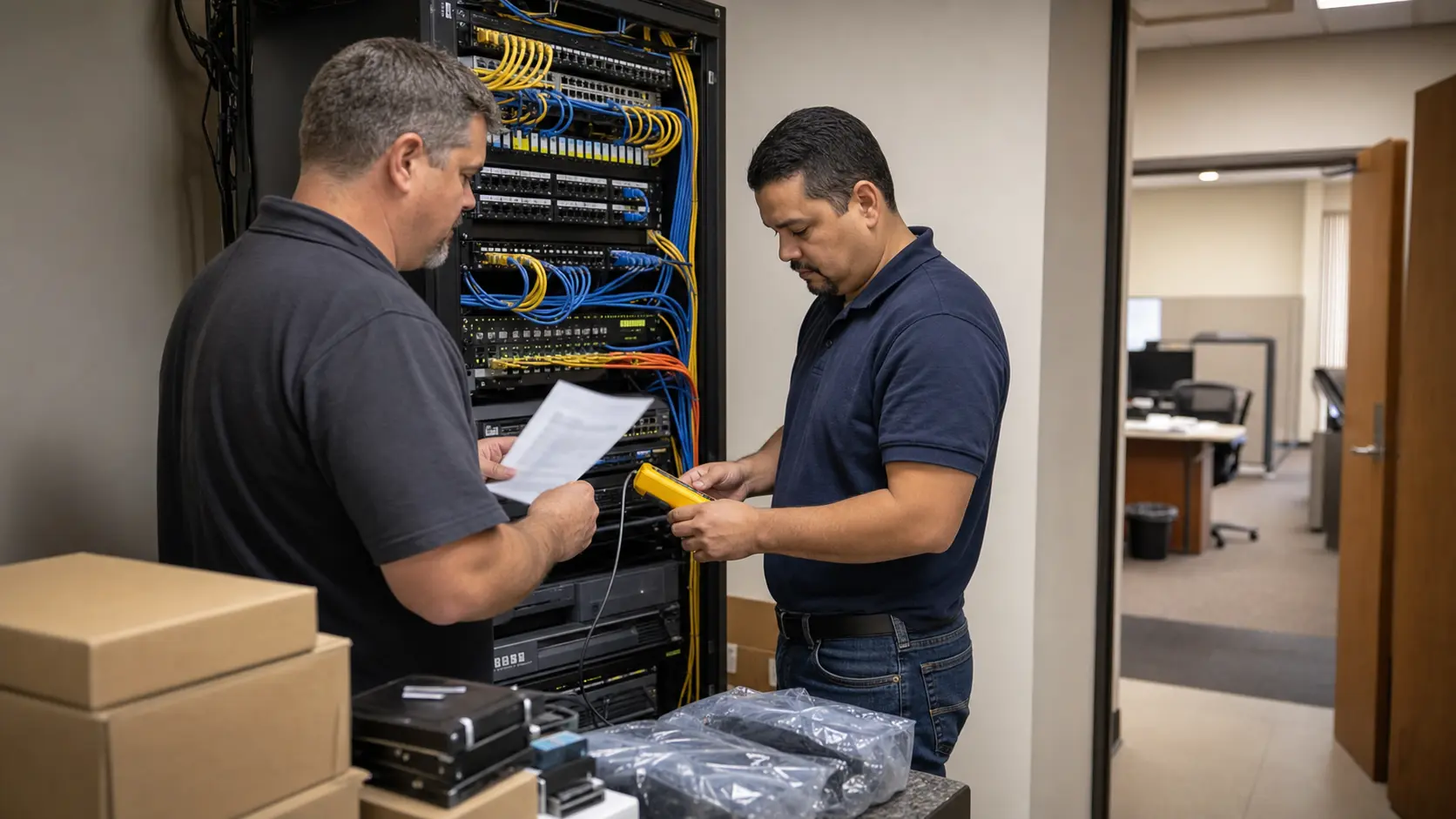
Summary
- Goldsmith Solutions is a Texas managed-IT provider that presents itself around county government and community-bank support, not a generic cloud resale label. Its own site says it serves Austin, Dallas and Abilene, designs and implements solutions for county government and community banks, and offers managed IT, CJIS and election cyber security, helpdesk, hardware and network support and consulting.
- The paid unit is an implementation-support and service-continuity account: the customer buys accumulated knowledge of its courthouse, law-enforcement, bank or local-office environment, plus day-to-day response when devices, networks, software vendors and compliance obligations collide.
- The strongest public evidence is official company copy, project pages and ARIN registration data for AS30210. That evidence supports a continuity thesis but does not prove margin, customer concentration, renewal rates, service-level performance or whether the autonomous-system registration is currently part of a live routed operating footprint.
- The central investment judgement is therefore not whether Goldsmith Solutions has a technology label. It is whether customers with small IT staffs, regulatory exposure and low tolerance for downtime pay a premium to keep local institutional memory near the problem instead of moving to a larger integrator, an in-house technician, a horizontal software platform or a delayed automation project.
- Missing direct operating proof is part of the conclusion, not a side note. Public records do not show customer count, support-ticket volume, response-time history, outage record, gross margin, churn, renewal price increases or current direct routing use, so the business case must be treated as plausible and bounded rather than proven.
The Renewal Problem Starts When Generic Support Runs Out
A rural county or community bank usually does not decide between Goldsmith Solutions and a generic platform when everything is working. The decision appears when an application renewal, a courthouse network move, a device failure, a sheriff's-office cyber incident, a data-destruction request or an after-hours access problem turns into a coordination problem. At that point, the buyer is not only purchasing software or hardware.
It is buying someone who remembers the old cabling route, the county judge's tolerance for disruption, the bank's audit calendar, the courthouse move, the law-enforcement network, the vendor that installed the firewall and the local politics of saying that a cheaper technology project failed.
That is why Goldsmith Solutions is commercially interesting despite a sparse public record. The company does not pitch itself as a hyperscale cloud platform. On its homepage it describes "Managed IT Services | CJIS & Election Cyber Security | Helpdesk | Hardware & Network Support | Consulting" and says it serves the Austin, Dallas and Abilene area as a managed IT provider for county government and community banks (Goldsmith Solutions homepage). Those words make the market narrow. They imply recurring support labour, project recall, regulatory familiarity and local response rather than a product that can be compared only by monthly seat price.
The paid unit is an implementation-support and service-continuity account. The cheaper substitute is a larger integrator, a thin in-house technician, a horizontal SaaS platform, a regional managed-service competitor or simply postponing automation until the next budget cycle. The cost driver is labour with memory: field visits, vendor coordination, compliance interpretation, user support, after-hours triage and the ability to reconnect a new problem to a decision made years earlier. The strongest evidence class is official company evidence backed by registry and routing metadata.
The three missing proof categories are economics, reliability and retention: public evidence does not show account profitability, measured uptime or renewal durability.
That third sentence matters because it disciplines the article. Goldsmith Solutions can be valuable without looking like a large network operator, and it can own an autonomous-system registration without proving that the account economics are attractive. The correct question is whether its self-described support surface is the kind of service that customers keep paying for because the institutional cost of switching is higher than the visible invoice.
In small public-sector and community-bank IT, that is often the real contest: not whether a cheaper tool exists, but whether the buyer can bear the implementation risk of replacing the people who know how the tool was made to work locally.
What the Company Says It Sells
Goldsmith Solutions' public wording is unusually direct about the customer type. The homepage says the company designs, develops and implements solutions for county government and community banks, and adds that knowing a customer's operations, challenges and regulatory environment is critical (Goldsmith Solutions homepage). The solutions page sharpens the same point: it says Goldsmith Solutions provides turn-key information-technology solutions for county government or community banks and then "stand[s] beside" customers after the initial project to support ongoing day-to-day technology needs (Goldsmith Solutions solutions page). That is a managed-service claim, but the economics are not the same as a commodity helpdesk.
The buyer in that sentence is a local institution with small staff, many obligations and low tolerance for silent failure. A county government needs email, user access, records, elections, public-safety systems, sheriff-office connectivity, courthouse devices, remote offices and finance systems to be available enough that public service continues. A community bank needs user support, cyber hygiene, vendor coordination, branch reliability and audit-ready technology controls. Both may buy third-party software and hardware, but the painful part is rarely the SKU.
The painful part is keeping several vendors, public rules, local buildings and non-technical users coordinated over years.
Goldsmith Solutions describes itself around that pain. Its site says it offers "streamlined IT solutions" that are "simple to support" and reliable, and that it builds relationships with partners to ensure competitive pricing and service (Goldsmith Solutions homepage). The word "partner" is not proof of formal supplier status; the company's own solutions page includes a disclaimer that third-party trademarks belong to their owners and that use of "partner" does not imply a legal partnership relationship (Goldsmith Solutions solutions page). That caveat is commercially useful. It keeps the public reader from mistaking vendor-logo proximity for a binding channel agreement.
The stronger signal is the after-sale claim. Goldsmith says it stays beside customers after the initial project. That moves the paid unit from project delivery to continuity. If a county pays for a new network once and then relies on the same provider for daily support, the account becomes less vulnerable to generic platform comparison. The vendor is no longer only the installer. It becomes the memory layer between a historic courthouse, a sheriff's office, a jail, a district clerk, a tax office, an auditor, a bank branch or a remote county office and the technology stack those units rely on.
This is also where the thesis becomes harder to prove. The public site describes the service, but it does not publish standard monthly pricing, gross margin, managed endpoints, number of customers, service tickets, engineer utilization, renewal rates or incident statistics. A reader cannot tell from public evidence whether Goldsmith sells premium contracts, low-margin local support, hardware pass-through, emergency work, recurring managed-service bundles or a mixture of all four. The article therefore prices the account as an economic mechanism, not as a verified financial model.
Implementation Memory Is the Product
The company's projects page is the clearest public support for implementation memory. It now opens with a privacy note, saying Goldsmith no longer publishes projects on the website because of security and organizational privacy but will review its project portfolio with prospective customers (Goldsmith Solutions projects page). That sentence cuts both ways. It is sensible for a provider serving county and law-enforcement environments, because publishing detailed infrastructure diagrams would be risky. But it also means outsiders cannot independently inspect the current project book. The article must therefore treat older public examples as evidence of service type, not as proof of current account volume.
The project examples still reveal the shape of the service. For Callahan County, Goldsmith says it has implemented numerous projects over 20 years, supports more than 50 employees, two remote offices, one tower site and a courthouse complex including courthouse, annex and jail, and that a 2005 voice and data network saved more than $100,000 over a 10-year effective life (Goldsmith Solutions projects page). The county website confirms Callahan County's public operating surface, including county offices, elections, sheriff, auditor, tax, notices and an employee email link using a Goldsmith-related domain (Callahan County). The county page does not verify every Goldsmith savings claim, but it does confirm the kind of public body and multi-office surface Goldsmith says it supports.
For Throckmorton County, Goldsmith says it helped bring the county up to date for eFile Texas, designed a new data network and moved the county to VoIP when it returned to a restored 1890 courthouse (Goldsmith Solutions projects page). That example matters because it is not a generic cloud migration. It is a courthouse operating problem: old building, court mandate, voice, data, local users and physical move. The economic value is not the cheapest VoIP account. The economic value is lowering the risk that voice, court filings and office connectivity fail during a facility transition.
For Stonewall County, the company says it worked on CJIS security compliance, a centralized network, telecom cost reduction, electrical work in an old jail facility and an eventual clean audit by the Texas Department of Public Safety (Goldsmith Solutions projects page). The Stonewall County website confirms a small county government with sheriff, courts, public notices and county offices (Stonewall County). Again, the official county website is not a testimonial for Goldsmith's specific claims. It is a boundary condition: these are not abstract enterprise logos; they are local public bodies where law-enforcement, records, payments, offices and citizens meet.
For Fisher County, Goldsmith says a law-enforcement network ransomware problem led the county to call after two other support paths failed, and that Goldsmith responded within an hour, isolated the issue, notified state entities and later won the county IT-support contract (Goldsmith Solutions projects page). The Fisher County website shows the county's law-enforcement center, public notices, auditor, treasurer, tax, court and contact surfaces (Fisher County). The ransomware narrative is self-reported by Goldsmith, so it should not be treated as an independently established incident record. Its business meaning is nevertheless clear: Goldsmith wants buyers to see response judgement and local escalation knowledge as part of the account.
For Shackelford County, Goldsmith says it built IT infrastructure from the ground up in 2014, used the law-enforcement center as an IT hub and achieved network uptime above 99.999% while working with the county (Goldsmith Solutions projects page). The Shackelford County site confirms a county operating surface with courthouse hours, sheriff, court, elections, online records and state law-enforcement resources (Shackelford County). The uptime claim is important but unverified. There is no public service-status record, monitoring history, incident log or independent audit attached to the claim. That absence should not erase the example; it should cap the confidence placed on it.
Across the project page, the same commercial structure repeats. Goldsmith is not merely selling a ticket queue. It is selling the memory of who depends on what, where the equipment sits, which local office cannot tolerate disruption, which public rule is driving urgency and which prior design choice now constrains a fix. That memory is expensive because it lives in people, not in a portal. It requires senior staff to understand local context, not just answer a script. It is valuable because many small institutions cannot carry that memory internally without hiring more staff than their budget allows.
The Cheaper Substitutes Are Real
The continuity argument only matters if cheaper substitutes are credible. They are. A county can hire an internal technician, although that can create single-person dependence and limited specialization. A bank can buy more directly from a core-banking vendor or a national managed-service provider. A county can ask a regional telecom or cable provider to handle parts of connectivity. A board can delay modernization. A sheriff's office can keep an older network alive for another year. A procurement officer can choose a larger integrator with a deeper bench and a larger cyber practice.
Goldsmith's public value proposition is that those substitutes do not necessarily carry the same local operating memory. A large integrator may have more certifications and buying power, but the team that sells the project may not be the team that answers a rural after-hours outage. An in-house technician may know the courthouse well, but may lack enough time or breadth to handle network design, law-enforcement security, bank compliance, data destruction, vendor negotiation, endpoint support and emergency response.
A SaaS platform may reduce one application problem while leaving cabling, switching, firewalls, backups, user behaviour and physical facilities untouched.
The price that matters is therefore not the nominal monthly cost. It is the cost of the next avoidable interruption. In a county environment, a failed network move can affect court operations, sheriff workflows, public records, tax collection, election preparation or email. In a community bank, a vendor handoff failure can affect staff productivity, audit response, customer service and cyber exposure. If the customer believes Goldsmith can reduce the probability or duration of those failures because it knows the environment, it may rationally pay for continuity even when a larger platform looks cheaper.
But continuity can also become a weak defence if the provider cannot prove performance. If customer boards ask for measurable response times, ticket closure rates, security maturity, backup recovery testing, incident history, customer references or renewal economics, public evidence does not answer. A buyer may still get that evidence privately during procurement. An outside analyst does not. That distinction is essential. The company may have strong private performance data, but the public record does not show it.
The same applies to the project portfolio. Goldsmith says it no longer publishes projects for security and organizational privacy reasons. That can be a prudent policy, especially for county infrastructure. It also removes a public verification route. Without current public project lists, the reader cannot know whether older county examples remain the core of the business, whether community-bank work has become larger, whether the company's strongest accounts are now private, or whether the customer base is concentrated in a few long-running contracts.
That uncertainty is not a generic warning. It is the mechanism by which the business could be either better or worse than it looks. If Goldsmith has many long-retained county and bank accounts with measured response performance, the continuity thesis strengthens. If it depends on a small number of local customers, a few key engineers and self-reported project history, the account risk is higher. The public evidence does not decide between those outcomes.
Cost Base: Skilled People, Local Visits and Vendor Coordination
Goldsmith's team page is useful because it makes the labour base visible. It lists a founder and CTO, finance officer, administrative support, senior support engineer, support engineers, network engineers, infrastructure support technician, customer success manager, senior systems engineer and multiple support technicians (Goldsmith Solutions team page). A small provider with that mix has a different cost structure from a pure software platform. Salaries, travel time, training, vendor certifications, tools, insurance, remote-support software, on-call coverage and management overhead all have to be recovered from the account base.
The homepage reinforces the labour claim by saying the team supports core IT infrastructure from PCs to servers, cabling, switching, routing and firewalls, and that customers are covered 24/7 by 365 (Goldsmith Solutions homepage). The after-hours contact language also appears on the homepage: after-hours support goes through a toll-free number and option path. Public evidence does not show how often after-hours support is used, how fast the company responds, or whether all customers receive the same coverage. But the claim changes the economics. On-call support is not free just because the phone does not ring every night.
The largest cost driver is skilled labour under uncertainty. A remote platform can amortize code over many accounts. A local managed-service provider has to keep enough people available to handle lumpy incidents. The worst calls are not the routine password reset or device order. They are the mixed calls: a law-enforcement network problem with cyber implications, an old courthouse rewiring issue, a vendor access problem near a public meeting, a decommissioned device with sensitive data, a branch office that depends on a link nobody has touched in years, or a bank audit request that requires evidence of past controls.
That kind of work is hard to price cleanly. Fixed monthly contracts protect customers from surprise but expose the provider to labour spikes. Time-and-materials work protects the provider but can make customers delay preventive work. Hardware resale may carry thin margin and create support obligations after the sale. Project work can be profitable but episodic. Recurring support can be sticky but may become underpriced if the customer environment grows more complex. Public evidence does not reveal Goldsmith's mix, so the economics must be inferred from the service type.
The 20-year anniversary page adds another labour signal. Goldsmith says that in May 2025 it reached 20 years serving county government, that its team has more than 150 years in IT and 120 years in government, and that customers rely on it 24 hours a day, seven days a week, 365 days a year (Goldsmith Solutions 20-year page). It also claims Goldsmith has only ever lost one county-government customer, and that the customer later hired the company back. Those are valuable retention claims if true. They are also self-reported and not accompanied by a named customer list or contract data. The correct reading is that retention is central to the company's story, but not publicly quantified.
Labour scale also creates key-person risk. The public team page shows named specialists, but it does not show headcount history, hiring funnel, training investment, turnover or succession depth. A service built on implementation memory is vulnerable if that memory sits in a few people. It is more defensible if the provider has processes that turn field knowledge into shared records, repeatable support routines and cross-trained staff. Public pages show roles and experience language; they do not show the internal operating discipline that would make the memory portable inside the company.
Suppliers and Upstream Dependence
Goldsmith's own site says it partners with industry leaders, but it carefully disclaims that the word "partner" does not imply a legal partnership relationship (Goldsmith Solutions solutions page). That is the right way to read supplier dependence. The company likely coordinates hardware, software, security tools, remote support, network gear, telecommunications and cloud vendors, but public evidence does not prove formal channel economics or preferred status with each supplier.
For a small managed-service provider, supplier dependence matters in three ways. First, the provider's margin may depend on purchase discounts, rebate arrangements, resale markups, managed-service tooling and the amount of labour bundled with third-party services. Second, the customer's reliability may depend on vendors Goldsmith does not control: carriers, software providers, cloud services, firewall updates, backup platforms and endpoint tools. Third, switching cost can be created by integration complexity, but it can also be weakened if the underlying tools are standard and another provider can take over cleanly.
Goldsmith's homepage references PCs, servers, cabling, switching, routing and firewalls (Goldsmith Solutions homepage). The projects page references voice and data networks, VoIP migration, centralized networks, law-enforcement systems, electrical infrastructure and telecom cost reduction (Goldsmith Solutions projects page). Those are multi-supplier environments. The provider's value is partly project management: coordinating enough suppliers and local constraints that the customer does not have to become its own systems integrator.
Supplier dependence also shows up in the support surface. The homepage presents remote support and a client portal (Goldsmith Solutions homepage). A remote-support tool can make a small team more efficient; it can also make the provider dependent on a third-party remote-access platform. The public site does not provide the service architecture, security controls or uptime statistics for those support paths. A customer would reasonably ask privately how remote access is authenticated, logged, limited and recovered if the support platform itself has an incident.
The data-destruction page adds another supplier and compliance layer. Goldsmith says it provides onsite secure data destruction, documents removal, storage and destruction, lets customers witness destruction, provides certificates and photos in archived tickets, and uses equipment it says meets U.S. Department of Defense and Defense Security Services requirements and includes degaussing and physical destruction (Goldsmith Solutions data-destruction page). NIST's media sanitization guidance defines media sanitization as rendering access to target data infeasible for a given level of effort and helps system owners set up a program with appropriate techniques and controls based on information sensitivity (NIST SP 800-88 Rev. 2 page). The public Goldsmith page claims a service aligned with serious compliance pressure, but it does not publish equipment model, audit evidence, certification scope or third-party verification.
That gap is economically relevant. Data destruction can be a high-trust add-on that deepens the customer relationship because it touches sensitive devices and records at the end of life. It can also be a narrower service attached to broader managed IT. Without pricing, volume and audit evidence, the reader cannot treat it as a large revenue line. It is better understood as part of the continuity account: the same provider that installed and supported the environment can help retire assets without forcing the customer to coordinate another vendor.
Network-Resource Evidence Is Bounded
The directory record and public network databases associate Goldsmith Solutions with AS30210. ARIN RDAP lists AS30210 with the name GOLDSMITH-AS1, registrant Goldsmith Solutions, an active status, registration and last-changed events, and registration comments that include Goldsmith's web domain, standard network-operations hours and 24/7 on-call support (ARIN RDAP AS30210). That is meaningful evidence of resource-holder accountability. It shows that Goldsmith Solutions has a registry footprint and named operating contacts in the ARIN system.
But the same evidence must not be overread. IPinfo lists AS30210 as Goldsmith Solutions in the United States and shows the ASN type as ISP, business or hosting, but it also reports no hosted domains, no IPv4 addresses, no IPv6 addresses, no peers, no upstreams and no downstreams for the ASN page observed (IPinfo AS30210). RIPEstat's AS overview for AS30210 describes the holder as GOLDSMITH-AS1 - Goldsmith Solutions and says it is not announced for the observed query date (RIPEstat AS overview for AS30210). RIPEstat's routing-status data for AS30210 shows zero announced IPv4 prefixes, zero announced IPv6 prefixes and no observed neighbours at the query time (RIPEstat routing status for AS30210). PeeringDB's API returns no entity for ASN 30210 (PeeringDB ASN lookup).
That combination is the heart of the network-resource judgement. AS30210 is not evidence that Goldsmith currently runs a large public routed network. It is evidence that a registry object exists and that Goldsmith has claimed or maintained network-resource responsibility. The absence of visible announced space, peers, upstreams, downstreams and PeeringDB presence limits what can be inferred about direct operating footprint. A generic "cloud-service" category can therefore mislead if it implies a live hosting platform.
The better reading is that network-resource evidence supports identity and technical accountability, not revenue scale.
The historical routing status is also instructive. RIPEstat reports a first-seen prefix in 2003 and a last-seen prefix in 2015 for AS30210, while current visibility is zero (RIPEstat routing status for AS30210). That does not prove the company's current business shrank or changed; ASNs can be dormant, repurposed, reserved or maintained without being visible in global routing. It does mean the public network record does not carry the thesis. The thesis must be carried by company-service evidence and customer-continuity logic.
This matters because network databases can tempt analysts into false precision. ASNs, prefixes, routes and registry handles are useful bounded evidence. They help distinguish a real technical footprint from pure marketing. They can show accountability, contactability and sometimes current routing activity. Here, they do not show live public reachability at scale. That makes missing direct operating proof part of the judgement: if Goldsmith's economics are attractive, the proof likely sits in private managed-service contracts, support performance and customer retention, not in global BGP visibility.
Customers and Market Dependence
Goldsmith's site repeatedly names two customer types: county governments and community banks. The county side is more visible because the projects page gives county examples. The bank side is less visible publicly. The homepage and solutions page say community banks are part of the market, but the public pages reviewed do not name bank customers or show bank-specific project examples (Goldsmith Solutions homepage; Goldsmith Solutions solutions page). That asymmetry matters. County work can demonstrate public-service complexity; bank work remains a claim without direct public customer proof.
County dependence can be attractive. Counties have recurring needs, public obligations, aging facilities, small staffs and compliance pressure. They often prefer providers who understand local procurement, political accountability and legacy buildings. Once a provider becomes embedded, switching can be disruptive. A new vendor has to learn the county's offices, network maps, user habits, vendors, backups, licenses, law-enforcement constraints, election timelines and asset history. That is precisely where implementation memory becomes economic value.
County dependence can also be risky. Public-sector budgets can be slow. Procurement rules can force rebids. Political turnover can change priorities. A small set of county accounts can create customer concentration. Emergency work can be praised after a crisis and questioned when budgets tighten. If a county grows dissatisfied, the same public transparency that makes procurement available can put vendor decisions under scrutiny. Goldsmith's public pages do not reveal contract sizes, durations, renewal terms or concentration by customer.
The community-bank market has a different risk profile. Banks tend to have stricter vendor-management expectations, cyber and audit pressure, uptime sensitivity and board oversight. They may value a provider that understands local operations, but they may also demand stronger evidence: documented controls, ticket data, audit responses, security reports, incident response, backups, vendor due diligence and insurance. The public Goldsmith pages do not show bank references, bank-specific certifications, SOC reports or regulatory examination outcomes. That does not mean they do not exist privately. It means the public reader cannot count them.
The company's geographic posture is Texas-centric. It says it serves Austin, Dallas and Abilene, and the 20-year page uses the line "Texans Serving Texans" (Goldsmith Solutions homepage; Goldsmith Solutions 20-year page). That local identity can be a retention asset where clients value cultural proximity and rapid field response. It can also cap expansion if the service depends on physical presence and local trust. A software platform can scale across states; a continuity provider that sells local knowledge may need new people, references and field coverage before it can scale beyond its strongest geography.
Market dependence therefore cuts both ways. Goldsmith's narrow customer thesis makes the account more defensible against generic technology labels, but less diversified than a broad cloud marketplace. The more its revenue depends on long-standing county relationships, the more valuable retention is and the more damaging one lost account can be. The more it expands into community banks or other regulated local institutions, the more it must show controls that are legible to auditors and boards, not just to local officials who know the team.
Regulation and Operational Risk Are Not Decorations
Goldsmith's service language names CJIS and election cyber security on the homepage (Goldsmith Solutions homepage). Those labels should not be treated as mere marketing decoration. County technology support touches records, law enforcement, courts, elections, tax offices, email and public-facing websites. A provider that claims to support those settings has to manage security, access control, physical infrastructure, incident response and documentation expectations that a generic office-IT provider might not face.
The project page's Stonewall County example illustrates why. Goldsmith says it helped with CJIS security standards, network centralization, telecom cost reduction and facilities work tied to a jail, sheriff's office and dispatch operations (Goldsmith Solutions projects page). If accurate, that is a regulated operating problem with physical and cyber pieces. A jail's electrical infrastructure, a sheriff's network, dispatch reliability and compliance are not separable in a crisis. The provider has to understand how one failure can propagate into another.
The data-destruction page adds privacy and records risk. Goldsmith says data destruction is performed onsite, documented from removal through destruction, witnessed if the customer wants, and archived in tickets for at least seven years (Goldsmith Solutions data-destruction page). NIST's guidance explains why media sanitization is a practical risk decision tied to the sensitivity of information (NIST SP 800-88 Rev. 2 page). A county or bank may have old drives, desktops, servers and devices that contain sensitive records. The cost of getting disposal wrong can be far larger than the cost of paying a trusted provider to document destruction.
Election cyber security is also a serious claim, but the public evidence does not show detailed Goldsmith election work. The homepage names the service category; the project page does not publish a full election-security case study. That missing proof matters. Election systems are high-sensitivity public infrastructure. A customer assessing Goldsmith would need private evidence of controls, scope boundaries, incident response and coordination with official election authorities. The article cannot infer those from the service label alone.
The broader operational risk is that a small provider can become a point of concentration. If many counties or banks rely on the same team for remote access, firewalls, backups, credentials or emergency response, the provider's own security and continuity become part of every customer risk assessment. Public evidence shows support channels and 24/7 language; it does not show Goldsmith's internal security posture, access-management controls, recovery tests, insurance, independent audits or incident history. A sophisticated customer should ask for those directly.
Geopolitical risk is modest but not absent. The company is U.S.-based, Texas-focused and serving local public and financial institutions. That lowers some cross-border sovereignty questions compared with offshore support. It also exposes the company to U.S. local-government cyber threats, ransomware pressure, election security concern, bank vendor oversight and public procurement scrutiny. The relevant risk is not sanctions or global data localization; it is whether a small local provider can maintain controls and staffing as threat expectations rise.
Informal Market Signals Are Weak but Useful
The assignment calls for an extra market-signal lane for small IT-service targets. For Goldsmith, the available informal signals are weak and should be treated as colour, not proof. The company maintains a public homepage, project pages, team page, support area, community page, social link and customer-facing contact information. Its site claims long service to county government, a narrow Texas identity, after-hours support and a high-retention story (Goldsmith Solutions 20-year page). Those signals are consistent with a relationship-based managed-service business, but they are not independent performance evidence.
The community page is a local-trust signal. It says Goldsmith is involved in the communities it serves, naming historical preservation, public safety, youth baseball and community building (Goldsmith Solutions community page). For a provider selling to county governments, community presence can matter. Local officials may prefer vendors who show up, understand the place and are known beyond a procurement email. But community involvement does not prove service quality, cyber controls or account profitability.
The projects page's note that Goldsmith no longer publishes project details due to security and privacy is another mixed signal (Goldsmith Solutions projects page). It may reflect mature caution. It may also reduce public market confidence because current customer proof becomes harder to inspect. An outside reader should not penalize a county IT provider for avoiding detailed infrastructure disclosures, but should also avoid treating undisclosed current projects as confirmed evidence.
Public county websites provide a limited signal of operating context. Callahan County's homepage includes an employee email logon link hosted at an email.goldsmith.solutions domain (Callahan County). That is a stronger external clue than a generic link because it shows a Goldsmith-related domain on a county-operated website. It still does not disclose contract scope, email platform, security controls or support quality. It supports reach into a county operating surface, not the economics of the account.
Market chatter that would be useful but is not visible in the reviewed public evidence includes board-meeting minutes mentioning contract renewals, county procurement awards, bank vendor announcements, local complaints, job postings, client reviews, lawsuit records, outage reports, insurance claims, security notices and public budget line items. The absence of those signals in the evidence reviewed does not prove absence in the real world. It means the public judgement must remain anchored in official company pages and bounded registry evidence.
The safest informal conclusion is therefore modest. Goldsmith presents like a local, relationship-driven provider with a public-sector service history. The market signals are consistent with continuity and trust, not with scale. They do not show a large platform, a broad hosting network or a high-growth software company. They point to a specialist service account whose value depends on whether customers believe continuity is worth paying for.
Pricing Logic Without Public Prices
Goldsmith does not publish a standard managed-service price card on the pages reviewed. That absence is normal for customised county and bank support. The price likely depends on users, sites, devices, servers, network complexity, after-hours coverage, compliance scope, project work, vendor tooling, backup and security requirements, travel distance and the amount of historical remediation required. A county with courthouse, annex, jail, remote offices and tower site is not priced like a small office with ten laptops.
The economic unit can be broken into four components. First is baseline support: helpdesk, endpoint support, user access, remote triage and routine maintenance. Second is infrastructure continuity: servers, switching, routing, firewalls, cabling, backups and physical facilities. Third is compliance and trust work: CJIS, election cyber security, data destruction, evidence retention, user controls and audit support. Fourth is project memory: knowing why the current setup exists and how to modify it without breaking local operations.
The fourth component is the most defensible against generic substitutes. A customer can compare endpoint tools or firewall hardware across vendors. It is harder to compare the memory of a 2005 network decision, a courthouse restoration, a jail electrical constraint, a remote office link or a sheriff's ransomware recovery. If Goldsmith can keep that knowledge inside the account, switching cost rises even if the underlying technology is standard.
That does not automatically create attractive margins. Implementation memory is expensive to maintain. It requires documentation, cross-training and enough staff overlap that one person's departure does not strand the customer. If the provider underprices support to win loyalty, continuity becomes a burden. If it prices too aggressively, customers may take the risk of switching to a larger vendor or internal staff. The financial question is not whether customers like the provider; it is whether contract pricing captures enough of the avoided failure cost.
The best public retention claim is the 20-year page's statement that Goldsmith has only lost one county-government customer and later won it back (Goldsmith Solutions 20-year page). If that claim is accurate and representative, it points to strong renewal economics. But because it is not accompanied by customer count, contract list or renewal table, it cannot be used as a hard retention metric. It should be treated as management's public positioning: retention is central to the company story, but public proof is incomplete.
The private facts that would change the pricing judgement are straightforward. A list of active recurring accounts, anonymized revenue by customer type, renewal rates, gross margin by service line, tickets per endpoint, response-time distribution, engineer utilization, after-hours call frequency, contract term length and project-to-recurring conversion would clarify whether continuity produces durable economics. Without those, the public case is qualitative.
Reliability Logic Without Public Service Data
Goldsmith's reliability language appears throughout the site. It promises reliable, simple and secure technology, says customers are covered 24/7 by 365, describes a response story in Fisher County, and claims Shackelford County network uptime exceeded 99.999% while Goldsmith worked with the county (Goldsmith Solutions homepage; Goldsmith Solutions projects page). Those are serious claims in a public-sector support setting. They are also not accompanied by service dashboards or third-party assurance.
Reliability for this business is not only network uptime. It is the ability to prevent small failures from becoming public-service failures. It includes the time to answer the phone, identify whether the problem is local or vendor-side, escalate to the right supplier, visit the site if remote access is insufficient, preserve evidence if the issue is security-related, and explain the problem to non-technical county or bank leadership. A provider can have no visible public routing and still be reliable if its job is customer-site continuity rather than operating a public internet backbone.
The AS30210 evidence makes that distinction necessary. ARIN shows a registry object with network-operations language (ARIN RDAP AS30210). RIPEstat and IPinfo show no current visible public routing activity at the checked points (RIPEstat routing status for AS30210; IPinfo AS30210). That means network-resource evidence does not prove customer reliability. The relevant reliability facts would be support response and customer environment performance, and those are not public.
The reliability risk is labour congestion. A small provider can look excellent until two emergencies occur at once: a courthouse issue, a bank audit response, a remote-office link problem and a cyber incident can all compete for the same senior people. Public evidence does not show staffing ratios or escalation depth. The team page shows roles, but not shifts, coverage model or backup capacity (Goldsmith Solutions team page). The more the company sells after-hours continuity, the more important those private operating details become.
Another reliability risk is documentation debt. Implementation memory creates switching cost only if it is institutionalized enough to survive turnover. If the memory sits in a founder or a senior engineer, the customer is exposed. If it sits in maintained diagrams, asset records, ticket notes, configuration histories, vendor maps and cross-trained staff, the provider can scale trust. Public pages do not reveal which is true. That fact would change the confidence score more than another marketing service label.
The article's reliability judgement is therefore bounded: Goldsmith sells into use cases where reliability has real economic and public-service value, and its examples are plausible for that thesis. Public evidence does not prove measured reliability. A buyer should ask for response-time history, outage history, backup-restore tests, incident postmortems, remote-access controls, ticket reporting and named escalation paths before treating continuity as proven.
Retention Is the Core Asset, but It Is Not Independently Measured
Goldsmith's strongest commercial defence is retention. A provider that stays with small counties for years can become hard to replace. It knows budget cycles, personalities, facilities, local vendors, history and the precise ways a county's technology is non-standard. The company leans into that story on the 20-year page and the projects page (Goldsmith Solutions 20-year page; Goldsmith Solutions projects page). The article's title follows that logic: Goldsmith sells continuity against a generic platform.
The difference between loyalty and lock-in matters. Loyalty is earned through reliable service, fair pricing and useful judgement. Lock-in can arise when the customer lacks documentation, alternatives or internal capacity. A strong continuity provider should be able to show that retention comes from value, not opacity. Public evidence does not answer that. It shows a relationship-based story; it does not show customer satisfaction surveys, rebid outcomes, transition documentation or contract termination history.
If retention is strong, the business can be more attractive than its small scale suggests. Recurring accounts lower sales cost. Long accounts create project pull-through. Emergency response can lead to broader support contracts, as Goldsmith says happened in Fisher County (Goldsmith Solutions projects page). Data destruction, cyber review, hardware refreshes and network upgrades can attach naturally to existing support. The provider can learn once and monetize that knowledge over time.
If retention is weak, the same model becomes fragile. Each lost county or bank removes institutional knowledge that cannot be sold elsewhere. A larger competitor can absorb transition cost. An in-house hire can gradually replace external support. A county's political leadership can decide that a long relationship needs rebidding. A bank's risk committee can demand controls a small provider struggles to document. Without public renewal data, the outside reader cannot know how often this happens.
Customer concentration is the other missing retention fact. The project page lists a handful of county examples, and the team page suggests a small but multi-role staff. If a few large public-sector accounts fund most of the team, retention risk is high. If the company has a broad base of counties, banks and other institutions, risk is lower. Public evidence does not show the distribution. That missing fact is not a generic caveat; it is the commercial hinge.
The company may have private references that resolve the question. Its project page says it will review the project portfolio with prospective customers (Goldsmith Solutions projects page). A serious buyer should take that offer and ask for current references, not only older public examples. The public article cannot replace that diligence. It can only show why those references would matter.
Competition: Better Bench or Better Memory
Goldsmith competes on a tension between bench strength and memory. Larger integrators and national managed-service providers can offer broader coverage, formal processes, cyber teams, procurement leverage, standardized reporting and sometimes lower unit costs. They may be stronger for a customer that wants dashboards, audit packets, mature security operations and a deep bench. They may also feel distant, especially when a rural county's problem is physical, local and historically messy.
Regional competitors may offer a closer substitute. A Texas managed-service provider with county experience could compete on similar terms: local trust, field visits, cyber support and public-sector familiarity. The differentiation then becomes customer references, response, price, documentation, staff continuity and the ability to coordinate law-enforcement, court, bank and public-office needs without treating them as ordinary small-business IT.
An in-house team is another real substitute. A county or bank can hire staff and preserve knowledge internally. That can improve control and availability. It can also expose the institution to hiring difficulty, vacation coverage, narrow expertise and lack of specialized cyber or network depth. Goldsmith's model is attractive where the customer needs more breadth than one employee can offer but cannot justify a large internal IT department.
A horizontal SaaS platform is a partial substitute. It can improve one process, reduce on-premise infrastructure and shift maintenance to the vendor. But local institutions rarely eliminate all local complexity. Users still need devices, identity, network access, security, backups, vendor management and incident response. The more Goldsmith's account depends on local continuity across many systems, the less vulnerable it is to one software substitution. The more it depends on reselling standard tools, the more vulnerable it is.
Delayed automation is the quiet competitor. Counties and small banks can defer projects if budgets are tight, especially when the cost of failure is not immediately visible. Goldsmith's sales argument must therefore make avoided risk legible. The project page's savings and emergency-response stories are attempts to do that (Goldsmith Solutions projects page). The missing evidence is quantified return: the public site does not show systematic cost savings, downtime avoided, insurance impact or audit outcomes across the customer base.
The competitive conclusion is mixed. Goldsmith's narrow customer knowledge can be a defence against generic platforms, but only if customers see that knowledge as current, transferable inside the company and priced fairly. A larger competitor wins if formal proof, cyber scale or procurement comfort matters more. Goldsmith wins if local operating memory and response judgement matter more. Public evidence suggests the company is deliberately positioned for the second contest.
What Public Evidence Can and Cannot Prove
The evidence can prove identity and positioning. Goldsmith Solutions has an active public website, describes itself as a managed IT provider for county government and community banks, names specific service categories, lists a team, publishes county project examples, provides support contact routes and appears in ARIN/IPinfo/RIPEstat records for AS30210 (Goldsmith Solutions homepage; ARIN RDAP AS30210; IPinfo AS30210). It can also show that several county websites named in Goldsmith's project examples are real county operating surfaces (Callahan County; Fisher County; Shackelford County).
The evidence can support a business-mechanism hypothesis. The company's own words and examples point to a support account priced through implementation memory, local public-sector knowledge, after-hours response, compliance-sensitive work and customer retention. That is a coherent market thesis. It explains why a narrow provider can survive against generic tools: the buyer is not only buying technology. It is buying lower implementation and recovery risk.
The evidence cannot prove the financial quality of the account. There is no public revenue, margin, pricing, customer count, contract value, renewal table, churn data, utilization, service-line mix or bank-customer list. It cannot prove the operational quality of the account. There is no public ticket dataset, measured response time, outage history, service-level record, backup-restore evidence or incident-report history. It cannot prove retention beyond self-reported claims. There is no independent customer-retention table.
The network-resource evidence also cannot prove current public network operation. ARIN proves an active registration; IPinfo and RIPEstat show no current visible announced space; PeeringDB shows no entity (ARIN RDAP AS30210; RIPEstat AS overview for AS30210; PeeringDB ASN lookup). That means the AS should be treated as bounded evidence of technical identity and accountability, not as proof of scale.
This distinction protects the article from both overstatement and underestimation. It would be wrong to dismiss Goldsmith because it does not look like a large public network operator; that may not be the business. It would also be wrong to treat a service story and an active ASN as proof of strong economics. The right conclusion is narrower: Goldsmith plausibly sells continuity in a market where continuity can be valuable, but public evidence leaves the decisive economics, reliability and retention facts private.
The Facts That Would Change the Judgement
The first facts that would change the judgement are economic. Active recurring revenue by customer type, gross margin by support and project work, hardware resale contribution, data-destruction volume, average contract size, customer concentration and price increases would show whether implementation memory is monetized or merely subsidized by labour. If long-running county accounts produce stable high-margin support revenue, the business is stronger. If they consume senior labour without adequate pricing, the business is weaker.
The second facts are reliability facts. Response-time distributions, after-hours call volume, incident history, backup recovery tests, endpoint and server coverage, security monitoring, outage reports, remote-access controls and independent audit evidence would show whether the continuity promise is operationally real. Goldsmith's public stories are plausible, but measured reliability would move the conclusion from narrative to proof.
The third facts are retention facts. Active customer count, years retained, renewal rate, reasons for churn, rebid wins, reference calls, contract duration and expansion from project to recurring support would determine whether customers keep paying because Goldsmith is valuable. The 20-year page makes a strong retention claim, but it is self-reported (Goldsmith Solutions 20-year page). Independent renewal evidence would materially improve confidence.
The fourth facts are staff-resilience facts. Turnover, cross-training, documentation quality, escalation depth and succession planning would show whether implementation memory belongs to the company or a few individuals. That matters because the article's thesis depends on memory. If memory is institutional, it is an asset. If it is personal, it is a key-person risk.
The fifth facts are customer-scope facts. Named current county and bank references, where disclosure is safe, would clarify whether the old public examples represent the current business. If Goldsmith has a broad and current base across counties and community banks, the market position is more durable. If the public examples are historical and the current account base is narrow, risk rises.
The sixth facts are network-scope facts. Current use of AS30210, any direct prefixes, private connectivity arrangements, customer network dependencies and reasons for unannounced public routing would clarify the network-resource evidence. The current public record shows bounded registry accountability, not visible public routing. That may be perfectly consistent with a managed-service account. It should simply not be described as direct network scale without proof.
Final Assessment
Goldsmith Solutions matters because it is the kind of company that can be misread by both platform analysts and local-service romantics. A platform analyst may look at AS30210, see no current announced space, no PeeringDB record and no public scale indicators, and conclude there is little there. That misses the point if customers are buying local continuity, not public-network reach. A local-service romantic may read the county stories and 20-year language and conclude the business is clearly entrenched.
That also goes too far, because the public record lacks the direct economics, reliability and retention evidence that would prove the account quality.
The best judgement sits between those errors. Goldsmith Solutions sells a plausible continuity account to institutions where continuity can be worth more than a generic tool: county governments and community banks with regulatory pressure, small teams, local facilities, sensitive records and low tolerance for confused vendor handoffs. Its public pages support that thesis through service language, project examples, after-hours support, team roles, data-destruction claims and long-customer rhetoric. Registry evidence supports identity and technical accountability but does not show current public routing scale.
The business is most valuable if customers pay Goldsmith to remember what a generic platform cannot: why a county network was designed a certain way, which office breaks if a link moves, how a sheriff's system touches the rest of the county, why a bank's audit request cannot wait, and which vendor decision from years ago constrains today's fix. That memory can create switching resistance and renewal value. But because public evidence does not show customer count, margins, measured uptime, response history or churn, the continuity premium remains a disciplined thesis rather than a proven financial conclusion.
For readers assessing the company, the practical question is not whether Goldsmith has a modern technology label. It is whether the next support failure would be cheaper with a generic substitute or with the people who know the environment. Public evidence makes the second answer plausible. It does not make it automatic. The judgement should remain conditional: Goldsmith Solutions is commercially relevant where implementation memory and response continuity matter, and materially uncertain where direct operating proof is missing.