
Summary
- GLS Poland sells more than transport from one address to another. For merchants, the practical unit is a scan-backed parcel handoff that creates customer proof, routing instructions, delivery options, COD settlement evidence and a basis for claims.
- Official evidence supports the economic thesis that the scan is expensive because it sits on labour, depots, partner points, vehicles, fuel and road surcharges, software integrations, data processing and exception handling. Public evidence does not yet prove the exact value of the unit because GLS Poland does not publish first-attempt success, merchant churn, route density, complaint ratios or per-parcel margin for Poland.
- Poland is a demanding market for this unit. The national regulator reported nearly 1.40 billion courier shipments in 2025, while the country had 67,060 automated postal devices at year-end. That means GLS Poland's doorstep scan competes with dense parcel-locker habits as much as with other couriers.
- The evidence supports a cautious business conclusion: GLS Poland can justify a premium where a merchant needs European network reach, predictable tracking, COD support, business integrations and a broad pickup-point footprint. The thesis remains unproven for highly price-sensitive domestic merchants unless GLS can show that its scan reduces failed deliveries, support tickets, claims and customer refunds enough to offset locker-led substitutes.
The merchant is buying a dispute record, not just a van stop
Start with the merchant rather than the van. A small online seller in Poland has packed a parcel, printed a label and handed it into a carrier network. The product has already been paid for or is attached to a cash-on-delivery instruction. The buyer may be at home, at work, travelling, watching a marketplace app, waiting for a locker code or preparing to complain if the delivery window slips. The merchant's cost is visible as a shipping line.
The merchant's risk is less visible: a customer message, a marketplace refund request, a claim over damage, a returned parcel, a second delivery attempt, a support worker searching for status, or a bank reconciliation item if the shipment is COD.
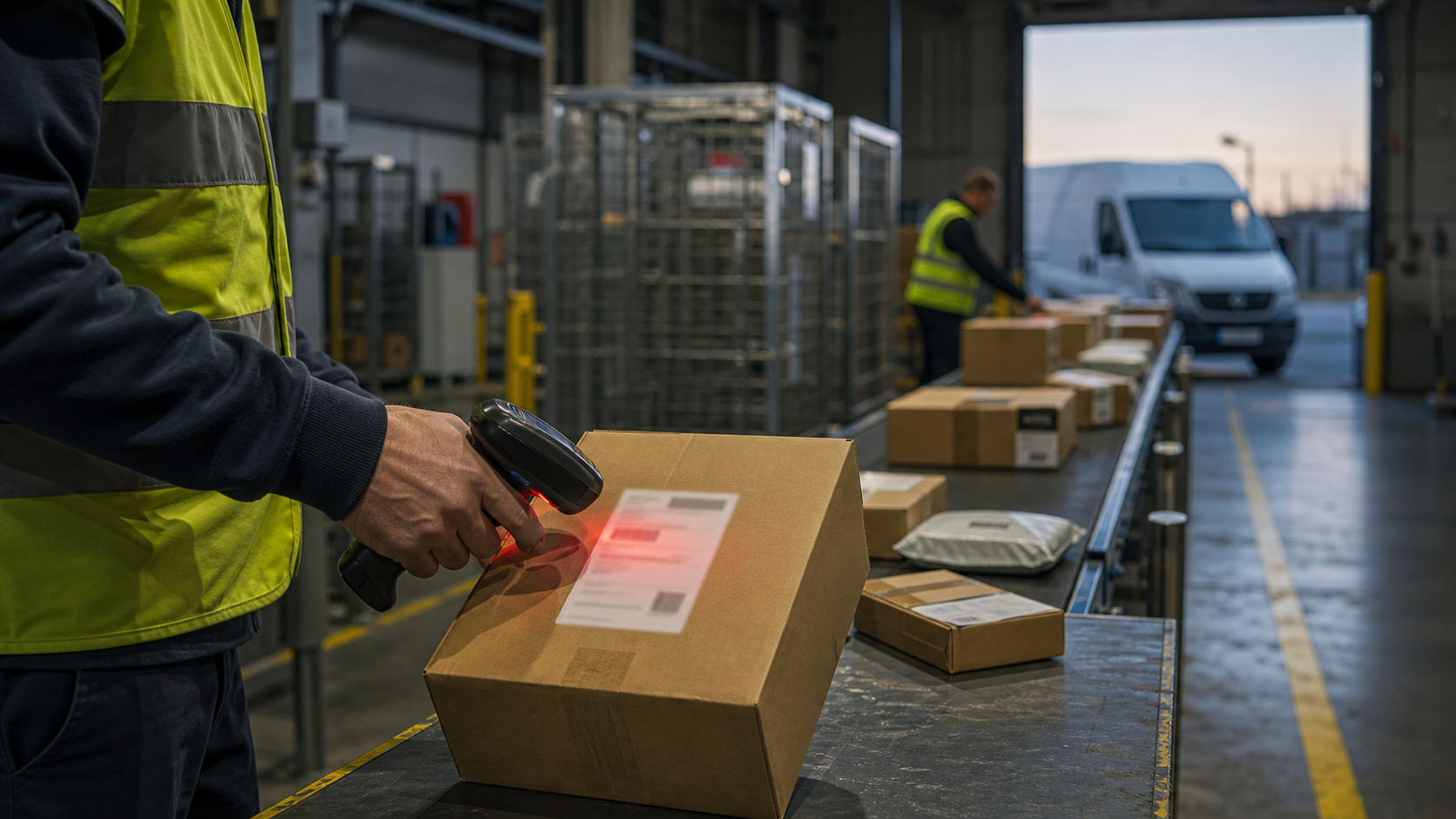
That is why the economic unit in GLS Poland is not best described as "a parcel." A parcel is the object that moves. The paid unit is the scan and delivery handoff: a chain of status events that turns physical movement into evidence. A useful scan says the carrier accepted the item, the parcel met the carrier's size and data rules, the route system knows where it should go, the recipient can be notified, the courier or pickup point can confirm release, and the merchant has a record if the recipient says the order never arrived. The carrier's invoice buys that evidence as much as the road miles.
This unit answers the first question a business customer should ask: what exactly does the customer buy beyond the product name? GLS Poland sells domestic and international parcel services for businesses, e-commerce sellers and occasional shippers, with options for home delivery, GLS Points, Orlen parcel lockers, returns, COD and delivery notifications. The customer buys access to a Polish and European routing system, not an isolated courier. A shipment can be priced by parcel size, country, contract terms, fuel and toll adjustments, special handling and optional services.
But the carrier's real economic product is the conversion of messy household delivery into a documented promise that a merchant can show to a customer.
The second question is why that unit becomes expensive once labour, capital, compliance, risk, time and failure costs are counted. Each scan is cheap as an electronic event, but it is embedded in a costly system. It requires a label that machines and people can read, a parcel that is suitable for sorting, a depot network near senders and recipients, linehaul capacity, local couriers, delivery devices, pickup-point partners, data retention, privacy controls, claims staff, payment handling for COD, fuel exposure and exception procedures.
When a parcel misses the recipient, cannot be sorted automatically, exceeds weight or size limits, contains restricted goods, has a wrong address, is redirected to a point, is returned, is claimed as damaged, or triggers a customer-service exchange, the scan becomes the starting evidence for cost allocation.
The third question is whether public evidence proves that the unit is worth paying for. The evidence supports the idea that GLS Poland has the infrastructure and group backing to sell it. The public record does not prove the value at merchant level. It shows network scale, terms, prices, surcharges, data duties, market growth and pickup-point strategy. It does not show how often a GLS Poland scan avoids a failed delivery, how much support cost it saves a merchant, whether route density is improving, or whether claims are low enough to justify a premium over locker-heavy alternatives. That missing data is central to the judgement.
The legal company sits inside a larger GLS and IDS logistics stack
General Logistics Systems Poland Sp. z o.o. is the Polish operating company behind GLS Poland. The company's corporate page identifies the business name, management-board representation, KRS number 0000005009, Polish tax identification number PL-785-15-61-831, BDO number 000134659, share capital of PLN 16,311,638 and address at ul. Teczowa 10, Gluchowo, 62-052 Komorniki, Poland. Its own tax-strategy publication for the fiscal year from 1 April 2023 to 31 March 2024 gives the same registered-office and tax identity, and describes the company as operating within GLS Group.
GLS Poland's own public material says the company has been active in Poland for more than two decades and had served more than 13,000 customers. Its tax-strategy document said that at 31 March 2024 the company had 50 branches in Poland and employed 1,260 people. A current GLS Poland "About" page describes the Polish network as 51 branch offices, a central sorting plant in Strykow near Lodz, more than 13,000 customers, over 18,000 GLS Points, approximately 8,000 Orlen parcel lockers within the shared Orlen Paczka network, and courier bikes in 11 cities.
Another GLS Poland technology page describes about 51 branches, around 18,000 collection points and roughly 7,000 Orlen parcel machines, with more than 110,000 points and machines across Europe. The precise point and locker counts differ across current company pages, but the direction is consistent: GLS Poland is presenting out-of-home delivery as a central part of the Polish offer, not as a side feature.
The ownership context matters because a Polish merchant is not only buying a local depot. GLS Group began after Royal Mail Group acquired German Parcel and established General Logistics Systems. GLS Group now operates as the international parcel arm within International Distribution Services, the group that includes Royal Mail and GLS. International Distribution Services' 2025-26 results reported group revenue of GBP 13.6 billion, with GLS revenue of GBP 5.2 billion, adjusted GLS operating profit of GBP 237 million and GLS parcel volume of 977 million.
GLS Group's own 2025-26 public fact pages put revenue at EUR 6 billion and parcel volume at 977 million. EP Group's 2026 reporting says its 2025 acquisitions included IDS, represented by Royal Mail and GLS, creating a logistics pillar with exposure to parcel delivery and postal services.
That group context strengthens GLS Poland's claim to cross-border relevance. It also shapes the risk. A merchant using GLS Poland relies on local execution in Poland, but the economic promise includes group systems, brand standards, international linehaul, partner countries, investment discipline and ownership decisions outside Poland. For export-oriented Polish SMEs, that group surface can be a benefit: one carrier relationship can carry a parcel from a Polish warehouse into a European delivery network.
For a merchant that only ships cheap domestic items, group scale matters less than the domestic price, the first-attempt success rate and the ease of claims.
The paid unit is accepted, routed, notified, delivered and defensible
GLS Poland's public terms describe services as acceptance, transport and delivery of parcels in domestic and international trade. That wording matters because acceptance is the first economic conversion. The carrier does not merely promise to move any object. It accepts a parcel that fits conditions. The sender must provide correct recipient and sender data, package the contents so they do not move or become damaged, avoid excluded items, stay within size and weight limits, and submit a parcel suitable for automatic handling during transshipment and sorting.
GLS Poland's terms say the sender guarantees that the parcel's weight does not exceed 31.5 kg for the relevant GLS Point terms, and the broader terms also refer to volumetric-weight charging and charges for parcels unsuitable for automatic handling.
These rules turn the scan into a sorting contract. A parcel that cannot move through a belt conveyor is no longer the same cost unit as a parcel that can. A wrong address, missing data, oversize parcel or restricted item shifts cost and risk from the carrier's planned route into exception handling. GLS Poland's terms reserve the right to refuse or withdraw from service when the parcel does not meet service conditions, and its published price and charge materials include additional fees such as oversize parcel charges and fuel or toll adjustments. This is not legal decoration. It is the pricing architecture behind the scan.
The delivery proof is also explicitly electronic. The GLS Point terms state that the recipient confirms delivery by signing on an electronic device or paper document, or by entering a PIN or BLIK code on an electronic device or parcel-locker screen. The customer agrees to the printed electronic signature or pickup code as proof of delivery and cannot object merely because the confirmation is stored electronically. For a merchant, that is a crucial part of the bought unit. It means the paid carrier event is designed to become evidence in disputes, not only a route activity.
GLS Poland's commercial pages make the same point in more operational language. InfoService informs recipients by e-mail about delivery, provides a three-hour expected window for many shipments, allows alternative forms or dates where available, and sends SMS if delivery cannot happen as planned and the phone number is available. Live Tracking gives the recipient a link on the day of delivery, shows an expected delivery timeframe that updates continuously, and makes the courier's position available when there are 20 stops or fewer to the destination.
A GLS Poland blog page on LinkerCloud describes automated shipment handling from label generation to shipment status tracking, automatic synchronization of status updates after collection, and support for home delivery, parcel lockers and GLS Points in Poland and across more than 20 European countries.
The merchant is therefore buying several records at once: label generation, collection, sorting, expected delivery window, live tracking where available, alternative delivery instructions, delivery confirmation and a possible return or complaint record. Those records are not free to produce. They require customer data, phone or e-mail contact, handheld devices, APIs or plugins, depot scanning, route planning, customer-service systems and rules that decide when the parcel can be left, redirected, returned or claimed.
Pricing exposes how the clean parcel subsidizes the messy one
The public price record is imperfect because regular business customers are quoted individually. GLS Poland says exact transport costs depend on needs and requirements, and that regular senders receive an individual offer based on shipment structure. That is standard for parcel carriers. It means published counter or GLS Point prices do not reveal contract margins for large merchants. They still show what the company believes the occasional parcel costs when it cannot rely on a negotiated volume profile.
GLS Poland's 2025 GLS Point price list, valid from July 2025, shows domestic Polish parcels in size bands. The public table lists low prices for shipments to GLS Points, starting at PLN 12.99 for XS, PLN 13.99 for S, PLN 15.99 for M and PLN 25.99 for L. The same price-list page also shows domestic address-delivery prices starting at PLN 15.99 for XS, PLN 16.99 for S, PLN 18.99 for M, PLN 28.99 for L and PLN 44.99 for XL. The table also lists much higher amounts for international destinations.
Even without interpreting every country column, the direction is clear: domestic Polish out-of-home parcels are priced materially below many address and international parcels.
That difference is the economics of the scan. A locker or pickup-point delivery can concentrate handoffs in a location that many recipients visit anyway. A doorstep delivery fragments the same volume across addresses, stairs, intercoms, parking spaces, recipient absence, office receptions and rural detours. A cross-border parcel adds linehaul, partner network, customs or import-cost risk where relevant, and international service variance. The cheap scan is the one that fits a dense, predictable route.
The expensive scan is the one that turns into a special trip, manual handling, a failed doorstep, a cash collection, an invoice dispute or a claim.
GLS Poland's additional-fee page makes this logic visible. It says increasing transport costs caused by fuel-price dynamics and changed delivery structure in non-urban areas require additional fees. For 1-15 July 2026, the page showed a fuel surcharge of 26.50 percent for both domestic and international transport, based on an average diesel price of PLN 5,779.08 per cubic metre. It also states that from 1 October 2025 an updated road-toll adjustment applies: PLN 1.20 for domestic shipments and PLN 1.78 for international shipments, listed separately on the invoice.
These are small line items when viewed parcel by parcel, but they reveal a broader truth: the carrier prices not only labour and depots, but exposure to energy and road-use policy.
The terms give another clue. GLS Poland can index prices in the price list and must notify customers not later than 30 days before changes take effect. If the customer objects, the agreement terminates when the indexed prices enter force. That clause is commercially important for SMEs because a parcel carrier cannot promise static economics in a market where wages, fuel, tolls, density and failed-delivery patterns move. The merchant wants stable shipping at checkout. The carrier needs the right to reprice the scan when the route no longer pays.
Compared with substitutes, the Polish price setting looks competitive but not dominant on sticker price. InPost's public English price page lists InPost Fast Send parcel-locker prices from PLN 11.49 for XS, PLN 16.49 for size A, PLN 18.49 for size B and PLN 20.49 for size C, with a 0 percent fuel fee. DHL eCommerce Poland's public English price list for individual clients shows some locker-to-locker and locker-to-courier domestic gross prices in a similar low-zloty range. These comparisons are not exact because size definitions, channels, contract terms and service scope differ.
They do show that a GLS Poland merchant paying for the scan is operating in a market where the alternative is not expensive traditional courier delivery only. The alternative is a dense locker and pickup ecosystem that trains consumers to expect low prices, convenient collection and predictable app-based evidence.
Failed delivery is the economic enemy that the scan is meant to control
The assignment's planned thesis is that GLS Poland's delivery promise is priced through the scan: sorting labour, route density, failed deliveries, locker alternatives, claims and tracking trust decide whether the parcel handoff is worth paying for. Public evidence supports that thesis because GLS Poland's own service catalogue is full of failure prevention and failure containment.
InfoService is one example. It tells the recipient before delivery and allows alternative forms or dates where available. The page says it can send an SMS when delivery cannot take place as planned, for example leaving the parcel at the nearest Szybka Paczka or ParcelShop. PreadviceService sends SMS notifications and can be combined with COD so the recipient knows the amount to prepare.
FlexDelivery-style redirection on the tracking page allows a recipient who cannot collect in person to redirect the order free of charge to a nearby Szybka Paczka point or choose leaving the parcel at a designated location without signature, such as with a neighbour, where that option applies.
ThirdAttemptService shows the cost more directly. GLS Poland describes it as a third delivery attempt after two unsuccessful deliveries. The sender can request another delivery before the parcel is sent back. That is the clearest public acknowledgement that two failed attempts are part of the standard risk envelope and a third one is an extra service. The first attempt is a route plan. The second attempt is a recovery cost. The third attempt is a decision: is keeping the sale alive worth more than returning the parcel and refunding or reshipping?
ShopDeliveryService is the structural alternative. GLS Poland delivers parcels directly to GLS Points or Orlen parcel lockers; the recipient selects the point in advance and receives e-mail or SMS when the parcel is waiting. GLS Poland's business page says the service offers a practical alternative for people rarely at home and gives choice from more than 18,000 GLS Points in Poland and more than 8,000 Orlen parcel lockers. In a household-delivery market, this is not merely a convenience feature. It is a way to convert failed-doorstep risk into planned out-of-home collection.
The national market explains why this matters. Poland's Office of Electronic Communications reported that the Polish postal-services market was worth PLN 20.16 billion in 2025, up 7.0 percent from 2024, with total postal-service volume of 2.26 billion items. Courier shipments were the largest service by volume, at nearly 1.40 billion items, up 14.3 percent. By the end of 2025 Poland had 67,060 automated postal-service devices, up 29.7 percent from 2024.
The same regulator's 2024 English report said courier shipments accounted for 73.3 percent of postal-market value and 56.5 percent of total postal-service volume in 2024, mainly due to e-commerce growth.
In such a market, route density can improve and deteriorate at the same time. More parcels create better depot and route utilization. More delivery options fragment the last mile. The merchant's customer may prefer a locker for cheap goods, doorstep delivery for heavy goods, a point near work for returns, or COD for trust-sensitive purchases. A carrier's scan must work across those behaviours. If it cannot, the merchant sees the cost as support, refund, review and lost repeat purchase rather than as a logistics line.
COD turns the delivery scan into a payment-risk product
Cash on delivery is not the whole Polish market, but it clarifies the economics because it attaches payment settlement to delivery proof. GLS Poland's business page describes CashService as a domestic COD service where the recipient pays for the goods at delivery, using cash or cashless payment methods available from GLS, including card and BLIK. GLS accepts the money and transfers it to the sender in less than seven business days from delivery. The page states a maximum COD amount and liability limit of PLN 6,000 per parcel and says payment status is visible in ADE-Plus.
The general terms add risk detail. GLS Poland acts only as an intermediary collecting the receivable for the goods and has no authority to impose obligations on the sender or conclude a sales agreement on the sender's behalf. The sender performs anti-money-laundering obligations required by applicable law. The terms also say GLS Poland is obliged to hand over the CashService amount within seven working days of collecting it from the recipient, and that the customer must reimburse GLS Poland if a cardholder's bank uses a chargeback procedure for the amount collected and paid to the customer under CashService.
This is a compact example of why the paid unit is more than carriage. A COD scan bundles identity of the parcel, timing of delivery, amount collected, payment method, bank settlement, reporting, chargeback risk and a possible customer dispute. The merchant is buying a payment-risk interface as much as a courier. A failed scan in COD is not only a missed delivery. It can become a working-capital delay, a bank reconciliation problem, a support ticket, a customer-trust problem and a carrier-credit exposure.
This also explains why GLS Poland's terms contain customer-solvency language. If payment for services is late, GLS Poland can retain amounts due to the customer, including amounts under CashService, or deduct its claim from amounts due to the customer. It can calculate statutory interest, require financial documents and suspend services or terminate the agreement in cases involving customer solvency concerns. The scan-backed delivery unit therefore carries credit risk in both directions: the merchant trusts the carrier to collect and remit, while the carrier trusts the merchant to pay invoices and reimburse chargebacks.
For SMEs, this can be valuable. A small merchant may not want to build its own COD collection and reconciliation process. But it also means the shipping provider becomes part of cash conversion. If the carrier's evidence is weak, the merchant cannot easily separate delivery failure from payment failure. If the evidence is strong, COD can support customers who do not want to prepay. The public evidence proves GLS Poland offers this service and publishes settlement rules. It does not prove how often COD shipments fail, how many chargebacks occur, or whether COD materially improves merchant conversion enough to justify the operational risk.
Claims show where proof of delivery stops being enough
The claims process is the other end of the scan. GLS Poland's terms say claims about shortages or damage not visible at delivery must be reported within seven days of acceptance, provided the claimant proves the damage occurred between acceptance for shipment and release. The GLS Point terms say complaints should be submitted in writing or electronically within 30 days, or in the case of parcel loss within 45 days from the date GLS Poland accepted the parcel for transport, but not later than 12 months from shipment.
Complaints should be resolved within 30 days from submission, and accepted compensation should be paid within 30 days from acceptance of the complaint.
Those deadlines define the economic life of a disputed scan. If the recipient signs or enters a pickup code and later alleges damage, the merchant needs the damage report, packaging evidence and timing. If the parcel disappears, the terms say a package can be considered lost if it is not delivered to the recipient or an authorized third party within 30 days of acceptance for transport. If damage is found before handover, the delivering courier or GLS Point representative prepares a damage report, which both parties sign. Each of those steps converts a physical event into a legal and accounting record.
The company also defines sender obligations in ways that shift some claim risk back to the merchant. The sender must package the parcel properly, prevent access without visible signs, include internal protection to prevent contents moving, ensure correct data and avoid excluded goods. If a customer ships something poorly protected, the carrier's scan cannot absorb that cost. If the merchant chooses an inappropriate delivery mode or underestimates product fragility, the economics of the handoff break.
From a merchant's perspective, this does not make GLS Poland weak. It makes the purchased unit conditional. The carrier can only sell a dependable scan if the parcel is machine-compatible, correctly addressed, lawful and packaged for the network. The merchant's internal fulfilment quality becomes part of the carrier's external reliability. That is why serious shipping economics should not compare only headline prices. A PLN 1 saving on the label may be meaningless if the cheaper flow produces more manual handling, failed deliveries or claims.
The public data gap is still large. GLS Poland does not publish Poland-level claims ratios, average claim processing time, first-attempt success, return-to-sender rates, damage frequency by product category, or merchant support-ticket reductions from Live Tracking. Without those metrics, the evidence can show the design of the trust product but cannot prove its net value for a particular merchant segment.
Labour and partners make the scan local even when the network is European
The scan may look digital, but the cost base is local. GLS Poland's tax-strategy document reported 1,260 employees in Poland as of 31 March 2024. Its partner page says GLS Point partners can add courier services to a shop, office or service business, gaining more visits and revenue, while GLS Point management includes advising clients, accepting parcels from senders, accepting parcels for recipients absent from home and accepting returns.
The same page says transport companies and their employees are important throughout Europe because they care for the "last mile" for GLS, and that GLS Poland seeks independent transport companies to handle courier routes across Poland.
This matters for two reasons. First, a scan is only as good as the person and place behind it. A GLS Point must be open, staffed, trained, compliant and able to store parcels. A courier must reach the address, obtain proof, handle payment where relevant, use a scanner or app, and manage absence or redirection. A depot worker must sort quickly without damaging parcels. A support worker must handle the complaint. If any one of those labour nodes fails, the digital record can become evidence of failure rather than evidence of service.
Second, local labour changes the economics of route density. A dense urban route lets a courier complete more handoffs per hour, while pickup points and lockers concentrate many deliveries in fewer stops. A dispersed non-urban route has longer drive times and fewer successful handoffs per hour, especially if recipients are absent. GLS Poland's own additional-fee language refers to changes in the structure of supplies in non-urban areas as part of the reason for added fees.
That phrase reveals the carrier's problem: the same scan costs different amounts depending on how many parcels fit a route and how often recipients convert the stop into a successful handoff.
The labour dimension also affects switching costs for merchants. A merchant can switch label providers quickly if all it needs is a commodity domestic shipment. It is harder to switch if the merchant has trained warehouse staff on GLS label flows, uses ADE-Plus reports, integrates a store platform such as LinkerCloud, relies on COD reconciliation, offers GLS Points at checkout, or has customer-support scripts around GLS tracking. Each integration makes the scan more valuable and more sticky. It also makes carrier failure more costly because the merchant's own workflow is built around the carrier's status events.
GLS Poland's public evidence supports the idea of a labour-heavy but technology-enabled network. It does not show courier pay, subcontractor margins, route volumes, partner retention or depot-level productivity. Those missing metrics would decide whether route density is improving enough to protect margins as consumers move toward lockers and cheaper point delivery.
Locker competition changes what "reliable" means in Poland
Poland is not a market where home courier delivery can assume it is the default symbol of convenience. Government trade material based on Polish e-commerce research says the most popular delivery form was delivery to a parcel machine, used by 81 percent of purchasers, and that the possibility of delivering and returning to a parcel locker was a major motivator for online shopping. Ecommerce Europe's 2025 report for Central Europe also presents Poland as a market where the share of people buying online has risen and where e-commerce activity continues to grow.
The national regulator's 67,060 automated postal devices at year-end 2025 quantify the infrastructure behind that habit.
InPost is the central competitive reference. Its public price page shows low parcel-locker prices, and its investor material says it added a record 14,200 automated parcel machines in 2025 and closed the year with 61,196 APM locations across the group. Its Q1 2026 investor material presents very high Polish consumer usage of InPost lockers and a large app audience. Exact comparisons with GLS Poland are difficult because InPost is both a Polish champion and an increasingly European locker platform, while GLS Poland is part of a broader parcel group with home, point, locker and cross-border services.
But the direction is unmistakable: the Polish consumer has been trained to see a locker code as a strong form of convenience and proof.
GLS Poland's response is not to ignore the locker. The group announced in 2024 that GLS Poland and Orlen would partner so GLS customers could pick up parcels from Orlen parcel machines in Poland before peak season, with sending through the Orlen network as a next step. Current GLS Poland pages place Orlen parcel lockers and GLS Points at the centre of its Polish network. The strategic message is clear: GLS Poland wants to defend the scan by making it delivery-mode neutral. If the recipient wants a doorstep, the scan must predict and prove the doorstep.
If the recipient wants a point or locker, the scan must produce the pickup code and the notification.
This changes the value proposition. A carrier that offers only low-cost out-of-home delivery may win cheap domestic parcels. A carrier that offers only doorstep delivery may lose consumer convenience. GLS Poland's stronger case is hybrid: it can offer doorstep delivery where the merchant needs it, out-of-home alternatives where absence risk is high, COD where trust-sensitive consumers still want it, and cross-border GLS network reach where merchants need European expansion. The economic question is whether that hybrid flexibility reduces enough friction to justify the carrier relationship.
The public record suggests it can in some segments. It is consistent with a merchant choosing GLS Poland for a mix of Polish deliveries, returns, COD, customer-service visibility and European shipments. It is less conclusive for a merchant whose domestic business is overwhelmingly small, prepaid, locker-friendly parcels where InPost-like locker economics or marketplace-negotiated options may be cheaper and more familiar to consumers.
Cloud, data and tracking trust are part of the product, but the public record sets limits
The scan-backed unit depends on data. GLS Poland's privacy policy says the company processes personal data to perform agreements, settle services, contact parties, assess solvency, operate compliance or sanction programmes, establish and pursue claims, create summaries and statistics, examine service quality, use GPS monitoring and video surveillance for transport partners and handle direct marketing where applicable.
It says GLS Poland may provide personal data to GLS subsidiaries, subcontractors such as transport partners, processors including IT service providers, senders, recipients, customer-service employees, mapping services, advertising and marketing agencies, social-media recipients and other persons or organisations under applicable law. It also states that only the sender and recipient have the right to shipment information unless law provides otherwise.
For data sovereignty and locality, the article's safest conclusion is modest. GLS Poland is a Polish controller for relevant personal data and operates under GDPR and Polish postal and transport law. Its public policy shows that parcel data can move across subsidiaries, transport partners, processors and mapping or IT services when needed to provide the service. It does not prove where every operational system is hosted, how every scan is replicated, which data stores are in Poland, or whether a particular merchant's data remains in a particular geography.
A serious merchant should treat data locality as a contractual and due-diligence question, not as something proven by a public webpage.
Public DNS records add only limited evidence. As of the research check, gls-poland.com resolved to an IP address and redirected to the GLS group Polish website; MX records pointed to Microsoft mail protection; SPF and TXT records referenced Microsoft 365 mail, GLS mail gateways and several third-party service verifications. gls-group.com also published a broad SPF and verification surface for group services. This public technical surface indicates a modern web, mail and SaaS-dependent customer interface.
It does not prove internal architecture, data residency, cybersecurity posture, service uptime, parcel-system resilience or governance outcomes.
That limitation matters because tracking trust can be destroyed by a system outage just as surely as by a failed courier attempt. The merchant's customer does not distinguish between "the parcel moved but the tracking did not update" and "the parcel did not move." Both trigger anxiety. GLS Poland's Live Tracking and app strategy recognizes this. The service says recipients can see courier route and a dynamic delivery window, and that the courier position becomes visible when the courier has 20 stops or fewer to the destination. The myGLS app page promotes live tracking and management from one place.
App Store metadata for myGLS in Poland lists General Logistics Systems Poland Sp. z o.o. as provider and shows a 4.1 rating from around 1,000 ratings at the time checked.
The public evidence therefore supports a business conclusion about dependency rather than performance. GLS Poland's scan unit relies on digital systems, integrations and personal-data processing. These systems are part of the product because they reduce support uncertainty and create proof. But the public record does not show system-level uptime, latency, incident history, recovery time or location of critical data processing. For merchants whose customer-service promise depends on accurate delivery windows, those missing metrics are material.
Reviews and app signals are pressure signals, not proof of Polish performance
Parcel delivery attracts negative public reviews because people rarely review a routine delivery. The evidence still has to be read because consumer anger is a market cost. Trustpilot's "GLS Europe" page showed a very low TrustScore and more than 22,000 reviews at the time checked, with many complaints about missed attempts, delays, wrong redirections and difficulty contacting support. That page is not a clean measure of GLS Poland. It covers a broader European review target, is unclaimed in the Trustpilot presentation and mixes countries and use cases.
It cannot prove GLS Poland's service quality, claims rate or courier behaviour.
The signal is still relevant to the economics. Complaints cluster around exactly the problems the scan is meant to solve: whether the carrier attempted delivery, whether the tracking status is trusted, whether the recipient can contact someone, whether the parcel was sent to a usable pickup point, and whether the merchant can defend its position. Even if many reviews are unrepresentative, they show the reputational categories that turn a carrier invoice into merchant cost. A bad delivery does not only hurt the carrier. It often hits the merchant first, because the buyer's purchase relationship is with the store.
App-store signals are more balanced. Apple's Polish App Store page for myGLS showed a 4.1 rating from around 1,000 ratings and identified the provider as General Logistics Systems Poland Sp. z o.o. Search snippets from Google Play describe an app for parcel tracking, delivery status, redirection, parcel sharing, naming parcels, live map and notifications. A visible App Store review complained that live tracking can be useful but frustrating when the schedule is not met. That single review is not data, but the issue is commercially important: a tracking window creates trust only if actual route behaviour stays close enough to the window.
The right way to use these signals is as market evidence, not verdict. They show what customers punish and what merchants should ask carriers to prove. The public evidence that would settle the question is first-attempt delivery by route type, delivery-window accuracy, complaint rate per 1,000 parcels, average complaint resolution time, percentage of parcels redirected successfully to points or lockers, and merchant support-ticket volumes before and after live tracking or out-of-home adoption. None of those are public for GLS Poland.
The strongest case for GLS Poland is SME continuity across channels
The controlled topics assigned to this research are SME service continuity, local support labour, cloud service dependency and data sovereignty and locality. GLS Poland touches all four. The SME continuity case is the strongest. A small or mid-sized merchant does not need the cheapest scan in every scenario. It needs enough delivery continuity that a promotion, marketplace listing, seasonal peak or export lane does not collapse under customer messages. GLS Poland's combination of domestic parcels, international parcels, GLS Points, Orlen lockers, COD, returns, Live Tracking, ADE-Plus and integrations is designed for that continuity.
The local labour case is mixed but important. GLS Poland reports a substantial employee base and a partner network that includes GLS Point owners, transport companies and couriers. That gives local reach, but it also means quality depends on many actors. The scan is standardized, while the last mile remains human. A merchant should value the network where local labour and points reduce failure. It should demand evidence where subcontractor or point quality could vary.
The cloud-service dependency case is unavoidable. GLS Poland's public customer proposition includes digital labels, status updates, e-invoices, shipping systems, integrations, app tracking and Live Tracking. Those tools are not optional extras if the merchant uses the scan as proof. They are the control plane of delivery trust. The public DNS and privacy evidence shows third-party service dependence and data sharing with processors and partners, but not enough to judge resilience. A serious buyer should ask for uptime, API support, incident notice, data-processing terms and recovery procedures.
The data sovereignty and locality case is narrower than the topic might imply. The public record shows GDPR-covered processing by a Polish operating company, personal-data sharing with subsidiaries, subcontractors, IT providers and mapping services, and shipment-information restrictions. It does not prove that data is stored only in Poland, nor would a pan-European network necessarily be expected to keep all operational data inside one country. The right question for merchants is whether the processing locations, subprocessors, retention periods and transfer safeguards fit their customer promise and regulatory duties.
For many SMEs, the decisive factor will not be one topic. It will be the combined economics. A merchant selling fragile goods may pay more for better claims documentation. A merchant selling fashion may care about returns and pickup points. A merchant selling to Germany or France may care about cross-border GLS reach. A merchant selling cheap accessories may care mostly about locker cost and consumer familiarity. GLS Poland's scan is worth paying for only where it reduces more cost than it adds.
Public evidence
The following public sources are the strongest anchors for this analysis:
- GLS Poland corporate information: https://gls-group.com/PL/en/corporate-information/ - identifies General Logistics Systems Poland Sp. z o.o., KRS 0000005009, tax number, capital and address.
- GLS Poland tax strategy 2023-24: https://gls-group.com/PL/media/downloads/InformacjaORealizowanejStrategiiPodatkowej_2023.2024.pdf - supports the company's Polish identity, more than 13,000 customers, 50 branches at fiscal year-end, 1,260 employees, CIT and VAT payments, and related-party international shipment transactions.
- GLS Poland About page: https://gls-group.com/PL/en/about-gls/ - supports the Polish network, current branch/depot and point claims, Strykow sorting plant, group context and GLS Group facts.
- GLS Poland shipping page and price list: https://gls-group.com/PL/en/shipping/ and https://gls-group.com/PL/media/downloads/gls_cennik_a4_maj_2025_a4_RGB_online.pdf - support public parcel-size prices, individual business quotes, fuel surcharge and toll adjustments.
- GLS Poland general terms and conditions: https://gls-group.com/PL/en/gtc/ - supports service definition, sender obligations, proof of delivery, delivery windows, liability, complaints, COD settlement and price-indexation mechanics.
- GLS Poland courier-for-business page: https://gls-group.com/PL/en/shipping/courier-for-business/ - supports CashService, InfoService, PreadviceService, ShopDeliveryService, ThirdAttemptService and returns services.
- GLS Poland Live Tracking page: https://gls-group.com/PL/en/live-tracking/ - supports the no-fee live tracking promise, 20-stop visibility threshold and dynamic delivery window.
- GLS Poland privacy policy: https://gls-group.com/PL/en/privacy-policy/ - supports personal-data purposes, sharing with subsidiaries, subcontractors, IT providers and mapping services, and shipment-information restrictions.
- Office of Electronic Communications 2025 postal-market report: https://bip.uke.gov.pl/raporty/raport-o-stanie-rynku-pocztowego-w-2025-r-%2C112.html - supports the 2025 Polish postal-market value, total volume, courier-shipment volume and parcel-machine count.
- Office of Electronic Communications 2024 English report: https://uke.gov.pl/en/newsroom/report-on-the-state-of-the-postal-market-in-2024%2C401.html - supports 2024 market value and courier share of postal-market value and volume.
- International Distribution Services 2025-26 results: https://www.internationaldistributionservices.com/en/press-centre/press-releases/international-distribution-services/international-distribution-services-ltd-results-for-the-year-ended-march-2026/ - supports group revenue, GLS revenue, adjusted operating profit, parcel volume and out-of-home growth.
- GLS Group business and about pages: https://gls-group.eu/GROUP/en/about-us/ and https://gls-group.com/GROUP/en/our-business/ - support group revenue, parcel volume, B2B/B2C split and network framing.
- EP Group 2025 report announcement: https://epgroup.eu/en/press-releases/the-ep-group-reported-exceptional-growth-in-2025 - supports EP Group's acquisition of IDS as a logistics pillar including Royal Mail and GLS.
- InPost prices and investor materials: https://inpost.pl/en/prices and https://inpost.eu/sites/default/files/2026-01/Trading%20update%20for%20Q4%202025%20and%20FY25_1.pdf - support locker-price substitutes and the scale of InPost's out-of-home network.
- Trade.gov.pl e-commerce in Poland: https://www.trade.gov.pl/en/news/e-commerce-in-poland/ - supports parcel-machine popularity and e-commerce delivery preferences.
- Apple App Store myGLS page: https://apps.apple.com/pl/app/mygls/id6742817504 - supports provider identity and public app-rating signal.
- Trustpilot GLS Europe page: https://www.trustpilot.com/review/gls-group.net - supports a broad, non-Poland-specific consumer-review pressure signal around delivery trust.
What would change the judgement
Several facts would materially change the assessment. First, Poland-level first-attempt delivery success would show whether GLS Poland's scan reduces failed-doorstep economics or merely records them. Second, route-density and cost data by urban, suburban and non-urban segments would reveal whether the company can protect margin as out-of-home and home-delivery preferences fragment. Third, complaint and claim ratios by parcel type, delivery mode and merchant segment would show whether proof of delivery translates into lower merchant support cost.
Fourth, customer-retention or marketplace-performance data would show whether merchants receive enough conversion or repeat-purchase value to justify the carrier choice. Fifth, data-processing and uptime metrics would clarify whether Live Tracking and integrations are resilient enough for merchants that use tracking as part of their customer promise.
The competitive judgement would also change if GLS Poland's Orlen locker partnership scaled sending as well as pickup and became an obvious alternative to InPost for both delivery and returns. It would change if InPost, DHL, DPD, Allegro or marketplace logistics made locker selection so dominant that hybrid carriers had to price doorstep delivery as a premium exception rather than a standard option. It would change if fuel or toll surcharges moved sharply, because small merchants often treat shipping as checkout psychology rather than as a transparent pass-through.
Finally, the judgement would change if public consumer signals diverged strongly by channel. If app-based live tracking keeps improving and complaint categories fall, the scan becomes more valuable. If customers continue to complain that tracking windows do not match route reality, the scan risks becoming a source of disappointment. A promised delivery window creates a claim on customer time. That claim is valuable only when it is accurate often enough to change behaviour.
Conclusion: the evidence supports the scan thesis, with missing proof at merchant level
The evidence supports the thesis that GLS Poland's delivery promise is priced through the scan. The company sells a scan-backed parcel handoff that includes acceptance, routeability, recipient notification, delivery proof, out-of-home alternatives, COD where used, returns and complaints. The cost of that unit is visible in public price bands, fuel and toll adjustments, sender obligations, claims deadlines, third-attempt service, out-of-home investment and the scale of Poland's courier market.
The public record suggests GLS Poland is strongest where merchants need a combination of local Polish reach, European network access, customer-service evidence, delivery-mode flexibility and payment or returns services. It is weaker as a purely price-led domestic proposition, because Poland's locker ecosystem gives consumers and merchants low-price substitutes with strong convenience habits.
The available evidence is consistent with GLS Poland being a credible carrier for SMEs that treat delivery as part of customer trust rather than as a commodity label. The thesis remains unproven without Poland-level first-attempt success, claims frequency, route-density economics, delivery-window accuracy, merchant support-ticket impact and per-parcel margin by delivery mode. Until those metrics are public, the safest conclusion is conditional: GLS Poland's scan is worth paying for when it prevents more failure cost than it adds in carrier price. The merchant's real purchase is not the van at the door.
It is the defensible proof that the parcel promise survived the sorting belt, the route, the recipient's schedule and the claim window.