
Topic
Peering and Transit
Within the Topic facet, Peering and Transit topic intelligence connects articles that share a specific subject, signal focus, or monitoring theme. The page gives readers a richer path through related reporting, source evidence, market actors, and infrastructure implications, with enough context to understand why the topic matters across company movements, governance decisions, regional exposure, and operational risk. Readers can compare recurring signals, affected organisations, public evidence, market context, service continuity, procurement, competition, compliance, and strategic planning questions behind the subject instead of stopping at a thin list of matching articles. It explains what the topic covers, which infrastructure actors or policies are involved, what evidence supports the coverage, and why the subject may matter for operators, customers, investors, and policy readers.

Europe and Middle East Regional ISP Trends
Poyrazwifi: the wireless footprint that makes repair capacity the real product
Poyrazwifi: the wireless footprint that makes repair capacity the real product intelligence summary explains the development, the public evidence available to readers, the organisations involved, the regional context, market exposure, and the infrastructure consequences that may…

Story
LACNIC’s 2025 Path Study Does Not Date Its Measurements
A year in a report title tells readers when an edition belongs on the shelf. It does not tell a network operator when the packets behind its charts crossed the wire. LACNIC’s regional path study offers a useful view of routes and latency, but leaves that second clock unstated.
CASE FILE
The Route Reflector Distributed the Link. It Never Witnessed It: RFC 9815's Sparse-Peering Evidence Boundary
A route reflector can hold the newest authenticated account of a data-centre link and still know nothing directly about whether that link carries a packet. RFC 9815 makes this separation operationally useful: BGP can distribute a link-state graph over far fewer sessions than the…

Europe and Middle East Institutional Trends
Power International-Tyres: the corporate ASN behind a physical distribution promise
Power International-Tyres: the corporate ASN behind a physical distribution promise intelligence summary explains the development, the public evidence available to readers, the organisations involved, the regional context, market exposure, and the infrastructure consequences that…

Global Regional ISP Trends
PolBox.TV: three registered relationships, one observed neighbour
PolBox.TV: three registered relationships, one observed neighbour intelligence summary explains the development, the public evidence available to readers, the organisations involved, the regional context, market exposure, and the infrastructure consequences that may follow. The…

Europe and Middle East Regional ISP Trends
Plusine Systems: three public names, separate responsibilities
Plusine Systems appears in public evidence under a legal name, the Axians commercial brand and the registered autonomous-system name PLUSINE-AS. Those identities can be joined, but the join does not answer every operational question. For a buyer, the useful work is to map which…
IETF
Default Reject Turns Missing EBGP Policy from Silent Authority into an Explicit Failure
An external BGP session can be established while its authority to receive or advertise routes remains undefined. RFC 8212 changes the default at that boundary: without import policy, accept no routes; without export policy, announce none. The leadership question is not whether a…

Europe and Middle East Institutional Trends
Piter-IX turns regional peering reach into a resilience question
Piter-IX presents a broad exchange footprint across Russian cities. That reach can shorten interconnection paths and widen choice, but a map is not yet a resilience proof: buyers still need to know which facilities, transport routes and operating processes can fail together.
NPNOG
After the RPKI Panel: Did npNOG’s 2020 Routing-Security Moment Survive the Screen?
The official page does not, by itself, prove that entities created ROAs, deployed validation or changed production routing policy afterwards.
IETF
Enhanced uRPF Lets an Operator Admit Feasible Source Paths Without Trusting Every Route
A valid packet from a multihomed customer can arrive on a link that the receiving router would not choose for the return journey. Strict reverse-path forwarding may discard it; loose checking may accept any routed source. RFC 8704 defines a narrower middle ground: build an…
IETF
BGP Roles Turn a Peering Relationship into a Route-Leak Boundary
Before two networks exchange a single route, each can state what kind of neighbour it believes it has. RFC 9234 turns that bilateral statement into a control: incompatible roles can stop the session, while the Only-to-Customer attribute can stop a marked route from crossing the…

Global Regional ISP Trends
A Second Remote Peering Service Is Not a Second Path
Remote peering can put an exchange within logical reach without putting a second physical route under the buyer’s control. Resilience begins by tracing each service through every handoff, not by counting green entities in a portal.

NPNOG
A decade of meetings, but where is the outcome ledger? Auditing npNOG’s institutional value
npNOG can document that it kept opening the room. Its public chronology runs from the first numbered meeting in 2016 to npNOG-11 in 2025, with a virtual programme in 2020. The archive shows workshops, conferences, fellows, committees and technical subjects. That is not trivial…

NPNOG
Who Opens the Room? npNOG, NPIX and SANOG in the npNOG-10 Ceremony
The first ten minutes of a conference can look like an org chart. At npNOG-10 in Pokhara, the [published programme](https://npnog.org.np/npnog10/programs/conference/) gave the first welcome to Rupesh Shrestha, identified there as NPIX managing director and SANOG chair. The next…

Story
RIPE’s IRR Study Says RPKI Can Replace a Route Object, Not a Customer Cone
A new RIPE Labs study makes a useful distinction that is easy to lose in general talk about replacing the IRR. A prefix–origin record and the policy information used to discover a customer cone are not the same operational entity, so they cannot share one retirement decision.
NPNOG
One Week, Two Institutions—and Two Edition Numbers: Untangling npNOG and SANOG-38
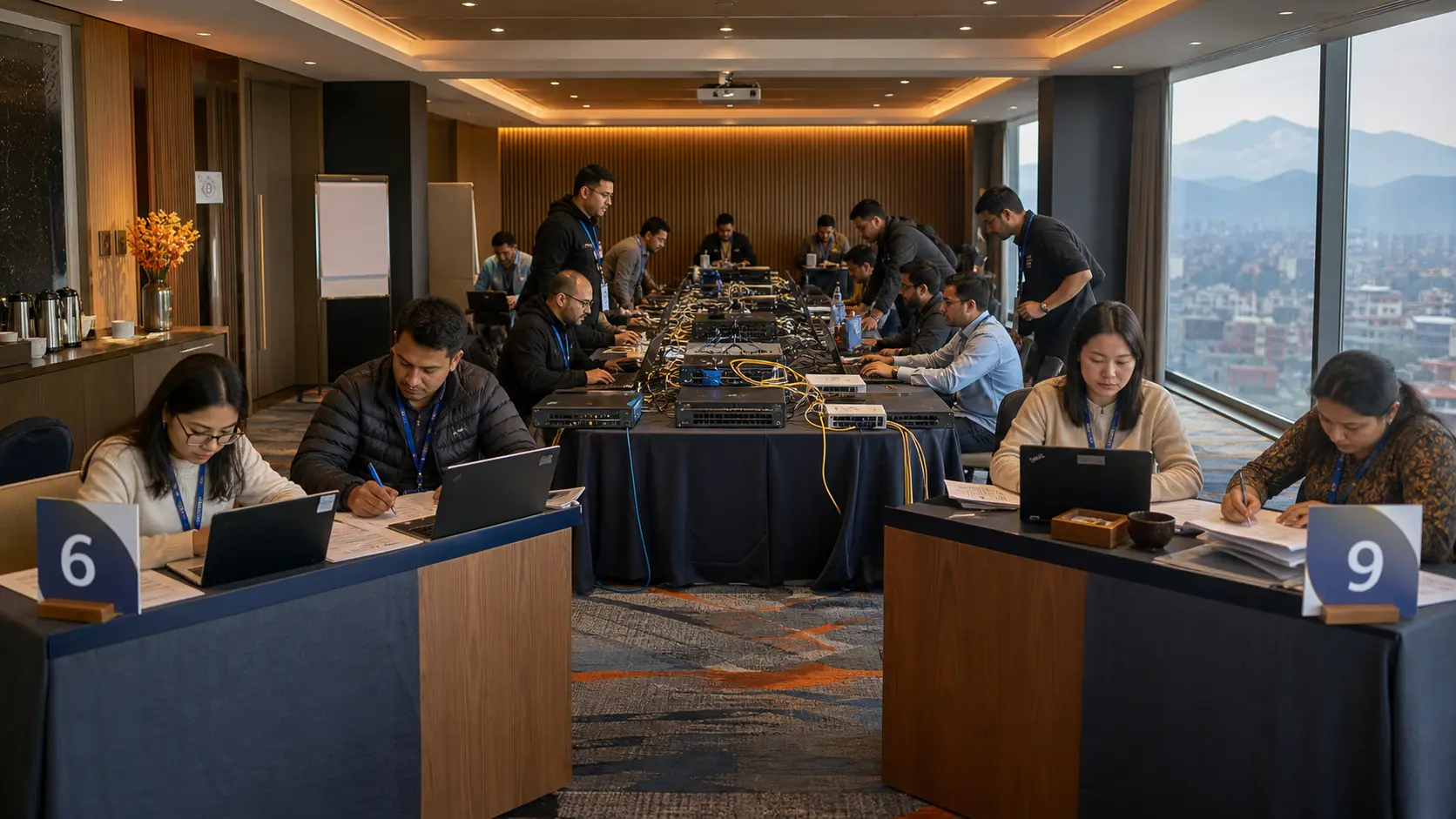
In July 2022, operators arriving at the Kathmandu Marriott encountered one technical week: four workshop days followed by a conference. The surviving institutional record is less unified. npNOG calls the event NPNOG-6 with SANOG-38. SANOG's contemporaneous pages called the same…

Story
AFRINIC Says Douala-IX Strengthens Local Exchange. Its Public Snapshot Does Not Yet Measure It.
AFRINIC’s March community bulletin frames its support for Douala-IX as a way to strengthen local interconnection in Cameroon. The public evidence now available is useful, but it is an inventory of exchange attributes—not a measurement of the claimed operational result.

Story
RIPE NCC’s RIS Is Updating Its Peering Policy. The Archive Needs a Selection Receipt
An archive becomes a public institution long before anyone gives it a constitution. A researcher downloads a route dump; an operator compares an incident against a collector feed; a policymaker treats a graph as a picture of the network. Each act lends the archive a little…

Europe and Middle East Regional ISP Trends
Satellite Ltd's power-backed business tiers need a failure map
Satellite Ltd sells reserve power as a visible feature of selected business tariffs. That turns continuity from a broad promise into a priced distinction—and makes the exact boundary of what stays powered the most important part of the offer.

Europe and Middle East Regional ISP Trends
SC TECHNOLOGICAL's low-price fibre tiers make recovery economics the real product
Technological advertises fibre from €2.90 a month, no annual commitment and a portfolio that extends into voice and television. The compelling question is not whether those prices look attractive. It is what must keep working—and who must pay for recovery—after a customer…