
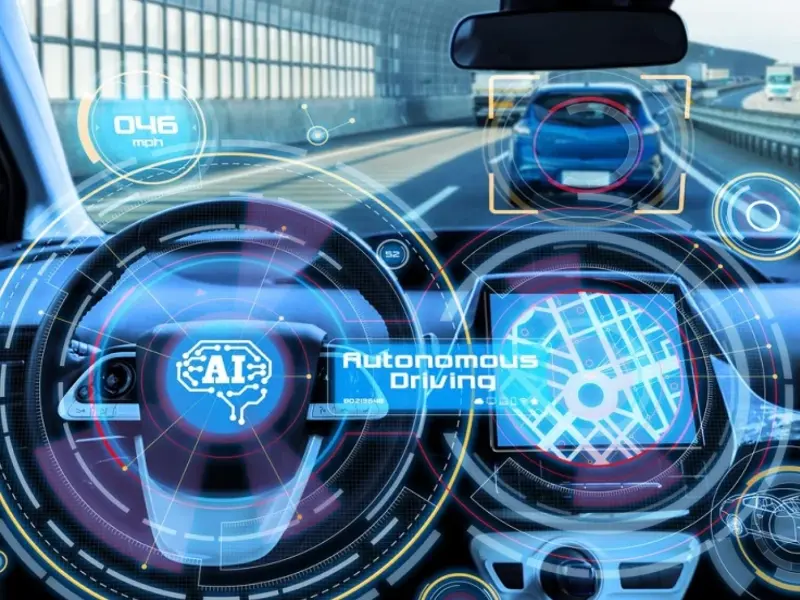
- Computer vision enables autonomous vehicles to identify and classify various entities on the road, such as pedestrians, other vehicles, traffic signs, and obstacles, ensuring safe navigation and decision-making.
- Advanced algorithms help self-driving cars detect lane boundaries and traffic signs, ensuring they stay within their lanes and obey road rules, even in challenging conditions.
- By continuously scanning the road for potential hazards, computer vision systems in autonomous vehicles can make real-time decisions to avoid obstacles, significantly enhancing road safety and efficiency.
Computer vision involves enabling computers to interpret and understand the visual world in the way humans do. But what exactly is computer vision, and how is it applied in real-world scenarios? Let’s dive into an example-based exploration to illuminate this intriguing technology.
What is computer vision?
Computer vision is a field of AI that trains computers to interpret and make decisions based on visual data from the world around them. This involves various processes such as image acquisition, image processing, and image analysis to extract meaningful information from images or videos. The ultimate goal is for machines to gain a high-level understanding from visual inputs and perform tasks that typically require human vision.
Example: Autonomous vehicles
One of the most prominent and transformative examples of computer vision in action is its application in autonomous vehicles, commonly known as self-driving cars. Let’s break down how computer vision contributes to this technology.
1. Entity detection
Autonomous vehicles rely heavily on computer vision to detect and classify entities on the road. Using cameras and sensors, the car’s AI system can identify pedestrians, other vehicles, traffic signs, and obstacles.
For instance, a self-driving car equipped with computer vision can:
Recognise a pedestrian crossing the street and stop to avoid an accident.
Detect a stop sign and halt at the intersection, even without human intervention.
Identify and differentiate between various vehicles (cars, bicycles, motorcycles) to navigate safely.
Also read: Steering towards compliance: Legislation for autonomous vehicles
2. Lane detection
Another critical application is lane detection. Computer vision algorithms analyse the road markings to ensure the vehicle stays within its lane. This involves:
Detecting lane boundaries using edge detection techniques.
Tracking the lanes in real-time, even in challenging conditions like rain or poor lighting.
Making adjustments to the car’s steering to stay centered within the lane.
3. Traffic sign recognition
Traffic sign recognition is essential for obeying road rules and ensuring safety. Computer vision systems can:
Identify traffic signs such as speed limits, yield signs, and no-entry signs.
Interpret the signs and make decisions accordingly (e.g., adjusting speed or changing routes).
Continuously update the vehicle’s knowledge of the road environment.
4. Obstacle avoidance
Autonomous vehicles must avoid unexpected obstacles on the road, such as debris or animals. Computer vision helps by:
Continuously scanning the road ahead for potential hazards.
Analysing the size, shape, and movement of entities to determine if they pose a threat.
Making real-time decisions to maneuver around obstacles or stop if necessary.
Also read: Autonomous vehicles: 3 potential drawbacks
Real-world impact
The implementation of computer vision in autonomous vehicles has the potential to revolutionise transportation. Some of the key benefits include:
Increased safety
Reducing human error, which is a leading cause of accidents.
Enhanced efficiency
Optimising routes and reducing traffic congestion.
Accessibility
Providing mobility solutions for individuals unable to drive.
Computer vision is a powerful tool that is transforming numerous industries, with autonomous vehicles being one of the most significant examples. By enabling machines to see and interpret the world as humans do, computer vision is paving the way for a future where technology and reality seamlessly blend. As advancements continue, we can expect even more innovative applications that will further enhance our daily lives.